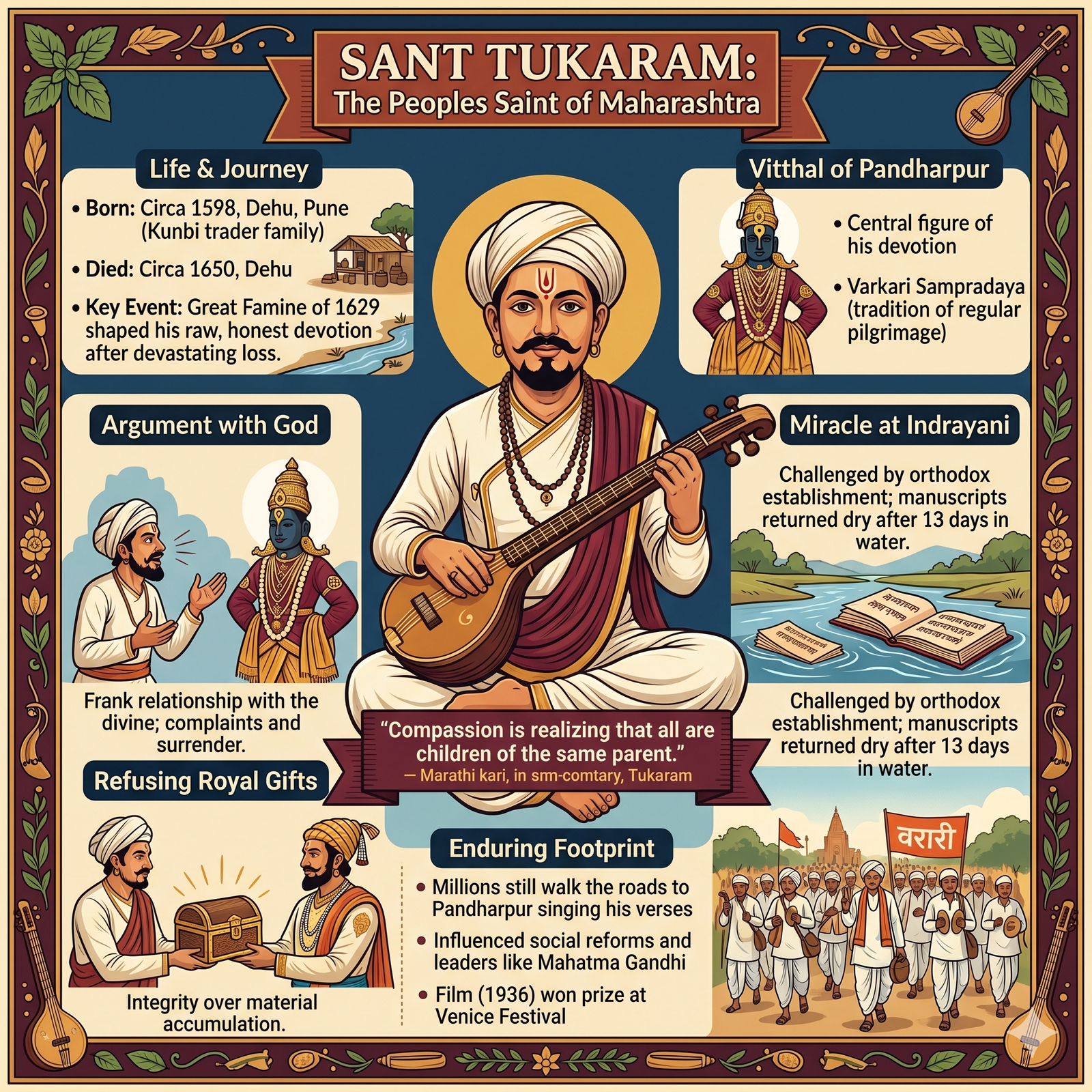
Sant Tukaram was a seventeenth-century Marathi saint-poet whose abhangas, short devotional verses composed in the language of ordinary people, became the most beloved expression of the Varkari tradition in Maharashtra. Born into a family of traders in Dehu near Pune, he endured devastating personal loss before finding in his devotion to Vitthal of Pandharpur both his own healing and the instrument of a social and spiritual transformation that touched an entire region. His teachings were distinguished by their compassion, their complete rejection of caste hierarchy within devotional life, and their insistence on the direct, unmediated experience of the divine as available to every human being regardless of birth or learning.| Detail | Information |
| Full Name | Tukaram Bolhoba Ambile |
| Born | Circa 1598, Dehu, Pune district, Maharashtra |
| Died | Circa 1650, Dehu, Maharashtra |
| Deity of Devotion | Vitthal (Vithoba) of Pandharpur |
| Literary Form | Abhanga (devotional verse) |
| Language | Marathi |
| Spiritual Tradition | Varkari Sampradaya |
| Guru Lineage | Raghava Chaitanya, through Namdev and Dnyaneshwar |
| Key Work | Gatha of Tukaram (collected abhangas) |
| Estimated Abhangas | Over 4,500 attributed compositions |
| Pilgrimage Center | Pandharpur, Solapur district, Maharashtra |
| Contemporary Of | Shivaji Maharaj, Ramdas Swami |
The Saint Who Argued With God
Most saints are remembered for their serenity. Tukaram is remembered for his arguments. He addressed Vitthal, the standing god of Pandharpur with hands resting on his hips, with a frankness that would have shocked the religious establishment of his time and that continues to surprise readers encountering his abhangas for the first time. He told Vitthal that he was negligent, that he failed to show up when needed, that the arrangement between them was not working as advertised. He complained, cajoled, accused, and then, in the same poem or the next one, dissolved into a love so complete that the complaint seemed to belong to a different person entirely.
Why the Poetry of Faiz Ahmad Faiz Still Resonates in Modern Protests
This combination, the argument and the surrender, the accusation and the adoration, is what makes Tukaram unlike any other saint in the Indian tradition. He brought to his relationship with the divine the full emotional register of an ordinary human life, including its frustration, its confusion, its moments of desperate need, and its equally desperate gratitude. In doing so he created a body of poetry that ordinary Maharashtrians recognized as their own experience translated into verse, which is the deepest possible form of recognition a poet can receive.
He did not achieve this from a position of comfort. He achieved it from the wreckage of an ordinary life that had been taken apart by history and personal catastrophe, and then slowly, painfully, put back together through devotion.
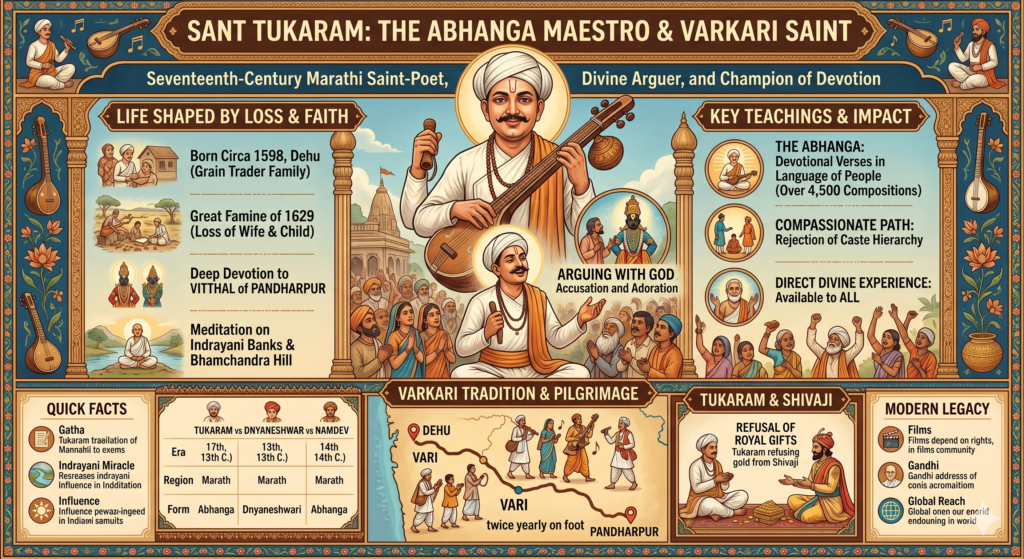
A Life Shaped by Loss
Tukaram was born around 1598 in Dehu, a village on the banks of the Indrayani river in the Pune district of Maharashtra. His family were Kunbi traders, members of the Shudra caste who ran a small business selling grain and other goods. It was not a life of privilege, but it was a life of modest stability, and for the young Tukaram it was enough. He married twice, his first wife Rakhma Bai was sickly and remained so through her short life, and he had children and the ordinary textures of a household to manage.
Then the great famine of 1629 arrived, one of the most devastating famines in the history of the Deccan, caused by consecutive years of failed monsoons across Maharashtra and large parts of South India. The famine lasted several years and its effects on communities like Tukaram’s were catastrophic. His first wife and one of his children died during this period. His family business collapsed under the weight of debt that the famine made impossible to service. He went from being a man with a household and a livelihood to being a man with debts he could not pay, a surviving family he could barely feed, and a grief that had no obvious floor.
Why Ismat Chughtai Faced a Trial for Her Fearless Storytelling
It was in this condition, in the ruins of the life he had expected to live, that Tukaram turned with complete and desperate seriousness toward Vitthal. He did not turn toward god because life was good and he wanted to express gratitude. He turned toward god because life had become unbearable and he had nowhere else to go. That quality of absolute need, the need of a person who has run out of other options, gives his early abhangas an emotional rawness that is unlike anything else in the devotional literature of his era.
The Indrayani river and the hill called Bhamchandra near Dehu became his places of practice. He would sit alone for hours, sometimes days, absorbed in meditation and composition. The abhangas that began to emerge from these solitary sessions were not polished literary productions. They were cries, questions, confessions, and occasional explosions of joy that came and went without warning.
The Varkari Tradition and Its Demands
Tukaram was not composing in a vacuum. He was entering a tradition that had been built over several centuries by a succession of Marathi saints whose names he invoked with reverence in his own writing. The Varkari sampradaya, the tradition of regular pilgrimage to Pandharpur to see Vitthal, had been shaped by Dnyaneshwar in the thirteenth century and by Namdev in the fourteenth. These earlier saints had established the abhanga as the primary literary form of the tradition and had created the theological and devotional framework within which Tukaram would find his own voice.
The Varkari tradition made specific demands on its practitioners. It required regular pilgrimage, twice yearly, to Pandharpur on foot, in community, singing and chanting through the length of Maharashtra. It required the singing of abhangas in group sessions called kirtans. And it required a quality of personal devotion, a bhava, an emotional orientation toward Vitthal, that could not be performed or pretended but had to be genuinely felt.
Tukaram met these demands with a totality that his contemporaries recognized as extraordinary. His kirtans drew crowds from across the region, not because he was a skilled performer in the theatrical sense but because what he communicated in his singing and in his spoken commentary on the abhangas was unmistakably genuine. People could tell the difference between someone who was talking about the divine and someone who had actually been in contact with it, and what they heard in Tukaram fell unmistakably into the second category.
The Abhanga as an Instrument of Truth
The abhanga, the primary literary form of the Varkari tradition, is a short verse form in Marathi with a specific metrical structure that makes it easy to sing and to memorize. The word itself means unbroken or indestructible, a name that carries within it the tradition’s belief that genuine devotion, once established, cannot be dissolved by any external force.
Tukaram composed over four thousand abhangas, and the range of human experience they cover is extraordinary. He wrote about the nature of god and the nature of the self. He wrote about the relationship between the guru and the disciple. He wrote about the hypocrisy of religious performance divorced from genuine feeling. He wrote about caste, about poverty, about the experience of grief, about the strange joy that arrives without warning in the middle of ordinary tasks, about the difficulty of maintaining devotion when life is actively terrible, and about the equally inexplicable ease of it when grace descends without being invited.
What unifies all of this is a quality of voice. Tukaram’s voice in the abhangas is unmistakable, direct, undecorated, occasionally rough around the edges, and completely honest. He did not write in the elevated literary Marathi of the court or the scholarly tradition. He wrote in the spoken Marathi of Dehu and its surrounding villages, the language of farmers and traders and ordinary householders, and in doing so he made the most sophisticated devotional and philosophical content available to an audience that classical literary language would have excluded.
The Sahitya Akademi has recognized the Gatha of Tukaram, the collected body of his abhangas, as one of the foundational works of Marathi literature and one of the most significant contributions to the devotional poetry of medieval India. The Gatha is not simply a collection of religious verses. It is a comprehensive record of one human being’s spiritual life across several decades, with all of its contradictions, its failures, its recoveries, and its moments of absolute grace intact.
How R.K. Narayan Built Malgudi From Real Memories
The Challenge of the Brahmin Establishment
Tukaram’s emergence as a spiritual teacher of regional significance was not welcomed by all quarters. The Brahmin religious establishment of seventeenth-century Maharashtra operated within a framework that assigned the authority to interpret scripture, lead devotional life, and transmit spiritual knowledge exclusively to men of the appropriate caste. A Shudra trader composing abhangas and leading kirtans that drew thousands of followers was, within this framework, not simply unusual but transgressive.
The most dramatic episode in the documented conflict between Tukaram and orthodox authority involves a scholar named Rameshvara Bhatta, who challenged the validity of Tukaram’s compositions on the grounds that a man of his caste had no right to compose devotional verse or teach spiritual knowledge. Rameshvara Bhatta’s challenge was backed by the authority of established religious convention, and the demand he made was extraordinary: that Tukaram throw his written abhangas into the Indrayani river as an admission that they were invalid.
Tukaram, according to the accounts preserved in the Varkari tradition and in the hagiographic text Bhaktavijaya composed by Mahipati, complied. He threw the manuscripts into the river. He then fasted on the riverbank for thirteen days in a state that those around him described as suspended between life and death, neither eating nor sleeping but remaining absorbed in meditation and in his relationship with Vitthal.
On the thirteenth day, the manuscripts are said to have floated back to the surface of the river, dry and undamaged. Whether understood as a literal miracle, a devotional metaphor, or a symbolic story encoding the tradition’s belief in the indestructibility of genuine spiritual expression, the account has survived for nearly four hundred years as one of the defining moments of Tukaram’s story. It communicates something essential: that the kind of truth Tukaram was carrying could not be drowned by institutional authority, however legitimate that authority believed itself to be.
Shivaji and the Saint Who Refused Gifts
Tukaram’s life overlapped with one of the most consequential political developments in Maharashtra’s history. Chhatrapati Shivaji Maharaj, the founder of the Maratha Empire, was a contemporary and is said to have held Tukaram in the highest personal regard. The account of their interaction that has become most celebrated in Maharashtra’s historical memory involves Shivaji sending a gift to Tukaram, a substantial offering of gold and valuables intended as an expression of royal respect and patronage.
Tukaram refused it. His refusal, recorded in an abhanga he composed on the occasion, was not an act of ingratitude but a statement of complete consistency with the life he was living. He had given up the pursuit of material accumulation as part of his spiritual practice, and accepting a royal gift would have contradicted everything he had been teaching and living. He told Shivaji, in the abhanga, that a saint who accepts wealth has lost something that wealth cannot replace.
Shivaji is said to have received this refusal with respect rather than offense, recognizing in it exactly the quality of integrity that had made Tukaram worth approaching in the first place. The episode is remembered in Maharashtra as an example of the relationship between spiritual and political authority at its best, a relationship in which the saint’s independence from worldly power is precisely what gives his moral authority its force.
What Compassion Actually Meant in His Teaching
The word compassion, when applied to Tukaram, requires some careful attention because his version of it was not the soft, reassuring kind that asks nothing difficult of anyone. His compassion was muscular and demanding. It was rooted in his conviction that every human being, regardless of caste, regardless of gender, regardless of the condition of their outer life, was equally capable of devotion and equally worthy of the divine’s attention.
This conviction had practical consequences. He accepted disciples from all castes, including untouchable communities, at a time when this was not simply socially unconventional but actively controversial. He composed abhangas addressed to women, treating their spiritual experience as equally valid and equally significant as that of men. He wrote with specific tenderness about the poor, the hungry, and the socially marginalized, not as objects of charity but as people whose proximity to the divine was, in his understanding, often closer than that of the wealthy and the comfortable precisely because they had less to cling to.
His most famous abhanga on this theme declares that Vitthal is the property of the poor, the hungry, and the afflicted. The rich and the powerful, he suggests in the same poem, have already received their portion from the world and need not look for additional favors from god. This is not sentiment. It is a precise theological statement about the relationship between material comfort, ego investment, and spiritual availability, made in a form that a Maharashtrian farmer could carry home from a kirtan and think about for the rest of his life.
How Baba Farid Wove Spiritual Truths Into Early Punjabi Literature
The Mysterious Departure
Tukaram died around 1650, and the manner of his death is one of the great mysteries and one of the great stories of the Varkari tradition. According to the accounts preserved in hagiographic texts and in the oral memory of the tradition, Tukaram did not die in the ordinary sense. He was taken bodily to Vaikuntha, the divine realm, by a celestial vehicle sent by Vitthal himself, in the presence of witnesses who included disciples and other observers in Dehu.
The historical record, understandably, does not confirm or deny this. What the historical record does confirm is that after approximately 1650 there are no further accounts of Tukaram’s presence in Dehu or anywhere else, and that the tradition’s memory of his departure is one of complete and willing surrender to the divine rather than resistance or regret.
Whether received as literal event or as the tradition’s way of encoding the completeness of his spiritual surrender, the departure story carries a logic consistent with everything known about the man. He had spent decades progressively releasing every attachment that ordinary human life accumulates, wealth, status, security, reputation, the comfort of institutional approval. By the time he left, there was very little left to leave.
The abhangas remained. They remain still.
Quick Comparison Table
| Aspect | Sant Tukaram | Sant Dnyaneshwar | Sant Namdev |
| Era | 17th century | 13th century | 14th century |
| Region | Dehu, Pune district, Maharashtra | Alandi, Pune district, Maharashtra | Narsi Bamni, Maharashtra, later Punjab |
| Primary Form | Abhanga in spoken Marathi | Dnyaneshwari (commentary on Bhagavad Gita), Abhangas | Abhanga in Marathi and Hindi |
| Deity | Vitthal of Pandharpur | Vitthal of Pandharpur | Vitthal of Pandharpur |
| Social Context | Shudra trader, caste challenge from Brahmin establishment | Child saint, excommunicated Brahmin family | Tailor by caste, challenged caste hierarchy |
| Key Contribution | Over 4,500 abhangas, Gatha of Tukaram | First Marathi commentary on Bhagavad Gita | Bridge between Maharashtra and North Indian Bhakti |
| Institutional Challenge | Manuscripts thrown in river by orthodox pressure | Denied sacred thread, family excommunicated | Refused temple entry based on caste |
| Legacy | Spiritual backbone of Varkari tradition | Philosophical foundation of Varkari tradition | Connected Varkari to pan-Indian Bhakti |
Curious Indian: Fast Facts
- Tukaram composed his abhangas in the spoken Marathi of his village rather than in literary Marathi, a choice that made him simultaneously more accessible to ordinary people and more controversial to the scholarly establishment of his time.
- The great famine of 1629 that destroyed Tukaram’s family business and took the lives of his first wife and child is considered by scholars to be the biographical event that most directly shaped the particular quality of raw honesty in his early abhangas.
- His collected abhangas, known as the Gatha of Tukaram, run to over four thousand compositions and constitute one of the largest bodies of devotional verse attributed to a single poet-saint in Indian literary history.
- Tukaram is one of very few saints in the Varkari tradition whose interaction with a political figure, in his case the refusal of Shivaji’s gift, is remembered as a defining moment of both his personal integrity and the broader relationship between spiritual and political authority in Maharashtra.
- The episode of his manuscripts floating undamaged from the Indrayani river after thirteen days is celebrated annually in Dehu and is one of the most widely known miracle accounts in the entire Varkari devotional tradition.
- His abhangas include compositions addressed specifically to women, to members of untouchable communities, and to people suffering from poverty and hunger, which was unusual in the devotional literature of seventeenth-century Maharashtra.
- The Vari, the twice-yearly pilgrimage to Pandharpur on foot that Tukaram participated in and wrote about, continues today as one of the largest religious pilgrimages in Asia, with millions of Warkaris walking the roads of Maharashtra every Ashadhi and Kartiki Ekadashi.
- Tukaram’s abhangas were first brought to the attention of a Western scholarly audience by the Indologist Justin Abbott in the early twentieth century, whose translations introduced his work to readers outside the Marathi-speaking world for the first time.
- The 1936 Marathi film Dharmatma, later remade as Sant Tukaram in 1936 and awarded a prize at the Venice International Film Festival, made Tukaram’s life story accessible to a new generation of Indian audiences and remains one of the most celebrated films in Marathi cinema history.
- Mahatma Gandhi drew directly from Tukaram’s abhangas in his understanding of devotion, service, and the relationship between spiritual practice and social responsibility, citing him as one of the saints whose lives most directly influenced his own thinking.
Conclusion
Tukaram’s life does not fit the conventional shape of a saint’s biography. It does not begin in privilege and move toward renunciation. It does not feature a single dramatic moment of conversion after which everything is clarity and peace. It is instead the story of an ordinary man in genuinely difficult circumstances who found, through persistence and through a relationship with the divine that he refused to keep polite or distant, something that held when everything else had broken.
The Fearless Verses of Kabir That Challenged Orthodox Society
That is what his compassionate teachings were ultimately about. Not a set of doctrines. Not a ladder of spiritual achievement visible only to those with the correct training. But the possibility, available to anyone who brought their actual life to the practice rather than the life they wished they had, of finding that the divine was already present in the grief, in the debt, in the failed harvest, in the argument, in the river and the riverbank and the long walk to Pandharpur.
He addressed Vitthal with the familiarity of someone who had stopped being impressed by distance and had decided that closeness was more honest. He wrote about his own failures with an openness that made his readers feel that their own failures were not disqualifications but simply the material the practice worked with. He refused gifts from kings and manuscripts from rivers came back to him. He accepted disciples the establishment said he had no right to accept and built a tradition that outlasted every argument made against it.
The abhangas he composed in Dehu four centuries ago are still sung on the roads to Pandharpur every year by millions of Warkaris walking in the community, which is perhaps the most complete form of literary survival that exists. Not in libraries. Not in academic citations. In the mouths and the feet of people who are still, after all this time, making the journey he described.
If you think you have remembered everything about this topic take this QUIZ
This quiz no longer existsWho was Sant Tukaram and why is he significant in Maharashtra?
Sant Tukaram was a seventeenth-century Marathi saint-poet born around 1598 in Dehu near Pune who became the most beloved figure of the Varkari tradition in Maharashtra. He is significant for several reasons simultaneously. His more than four thousand abhangas constitute one of the largest and most emotionally rich bodies of devotional verse in Indian literary history. His insistence on composing in the spoken Marathi of ordinary people rather than literary language democratized access to devotional poetry in ways that had lasting consequences for Marathi literature and culture. His complete rejection of caste hierarchy within devotional practice challenged the religious establishment of his time in ways that continued to resonate through subsequent centuries of social reform in Maharashtra. And his particular quality of honest, emotionally unguarded engagement with the divine created a model of devotional relationship that ordinary Maharashtrians found more accessible and more truthful than any formal theological presentation could have offered.
What is an abhanga and why did Tukaram choose this form?
An abhanga is a short devotional verse form in Marathi with a specific metrical structure that makes it naturally musical and easy to memorize. The word means unbroken or indestructible, reflecting the tradition’s understanding of genuine devotion as a quality that cannot be dissolved by external circumstances. Tukaram chose the abhanga because it was the established literary form of the Varkari tradition he was working within, rooted in the compositions of earlier saints including Dnyaneshwar and Namdev. He used the form with extraordinary flexibility, bending its conventions to accommodate the full range of his emotional and philosophical content, from philosophical reflection to direct complaint to pure ecstatic joy. The abhanga’s musical structure also made it perfectly suited to the kirtan context in which Tukaram’s compositions were primarily performed and transmitted, ensuring that they traveled through the community by voice rather than requiring literacy for their preservation.
What was the episode of the manuscripts and the river?
The episode of the manuscripts involves Tukaram’s written abhangas being challenged by a Brahmin scholar named Rameshvara Bhatta, who argued that a man of Tukaram’s caste had no legitimate authority to compose devotional verse or teach spiritual knowledge. Under pressure from this challenge and its institutional backing, Tukaram is said to have thrown his written manuscripts into the Indrayani river. He then fasted on the riverbank for thirteen days in a state of deep meditation and devotional crisis. On the thirteenth day, the manuscripts are said to have floated back to the surface of the river, undamaged and dry. The episode is understood within the Varkari tradition as a demonstration of the divine validation of Tukaram’s compositions and as a statement about the ultimately indestructible nature of genuine spiritual expression. It has been commemorated in Maharashtra for centuries as one of the defining moments of his life and legacy.
How did Tukaram’s teachings address caste and social inequality?
Tukaram addressed caste and social inequality not primarily through theological argument but through the consistent, practical demonstration in his life and teaching that devotion to Vitthal was available to and valid for every human being regardless of birth. He accepted disciples from all social backgrounds including untouchable communities, composed abhangas addressed specifically to marginalized groups, and taught in public kirtans that drew mixed audiences without enforcing caste seating or participation hierarchies. His abhangas contain explicit statements about the spiritual equality of all human beings before the divine, including his famous declaration that Vitthal belongs to the poor and the afflicted. These teachings placed him in direct conflict with the Brahmin religious establishment and were part of a broader pattern within the Varkari tradition of challenging caste hierarchy through the radical inclusivity of devotional practice.
What is the Varkari tradition and how does Tukaram fit within it?
The Varkari sampradaya is a devotional tradition centered on the worship of Vitthal at the temple of Pandharpur in Maharashtra and on the practice of twice-yearly pilgrimage to Pandharpur on foot. The tradition was established in the thirteenth century by Dnyaneshwar, who provided its philosophical foundation through his Marathi commentary on the Bhagavad Gita, and was developed through subsequent generations of saints including Namdev, Eknath, and ultimately Tukaram. Tukaram fits within this tradition as its most prolific and emotionally accessible voice, the saint whose abhangas most completely translated the tradition’s philosophical and devotional content into the lived experience of ordinary Maharashtrian people. He is considered by many scholars and practitioners to be the culminating figure of the classical Varkari tradition, after whom the tradition’s center of gravity shifted from the production of new theological content to the preservation and performance of the body of work the earlier saints had created.