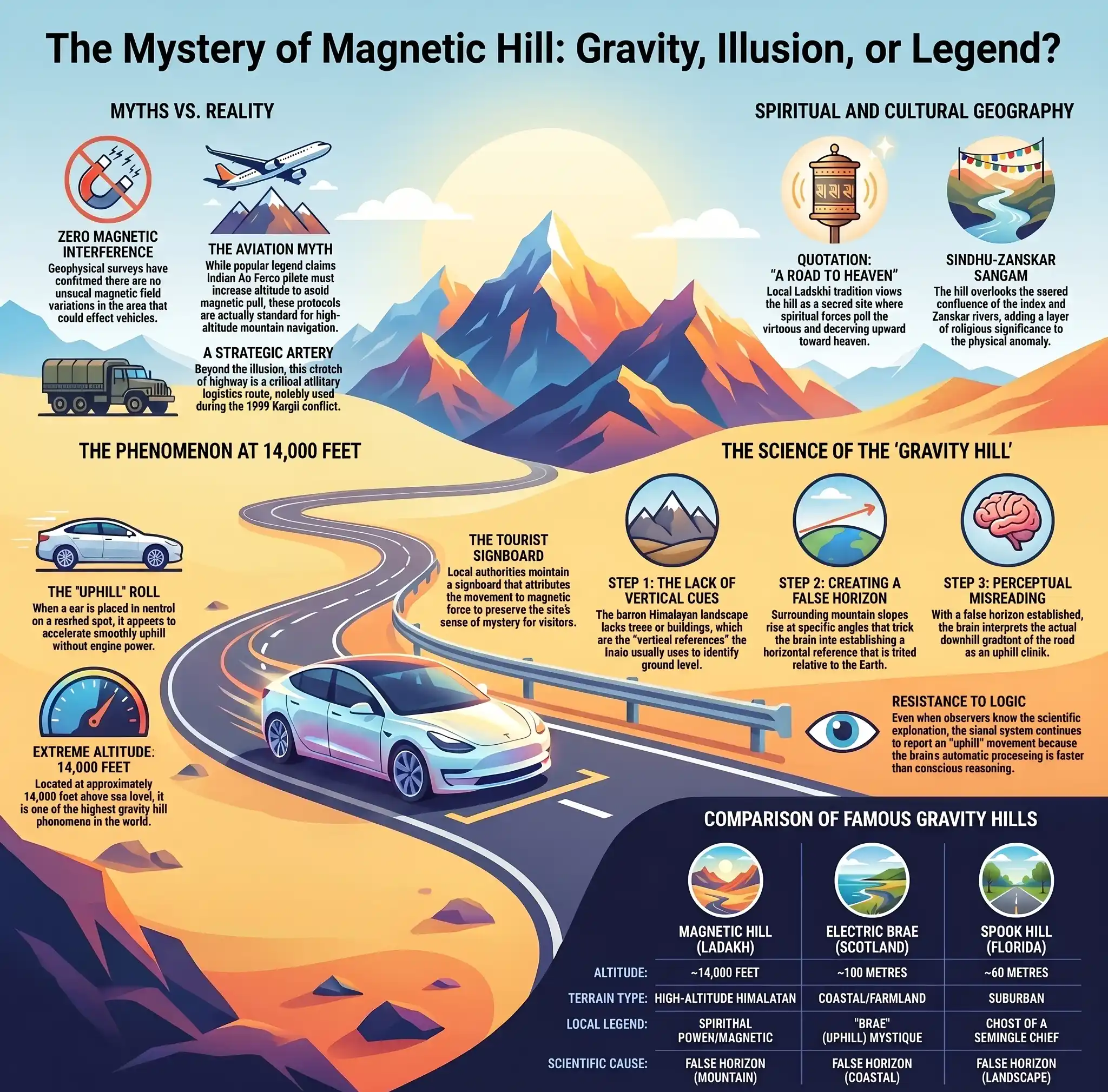
The Magnetic Hill of Ladakh, located on the Leh-Kargil-Srinagar National Highway approximately thirty kilometres from Leh at an altitude of fourteen thousand feet, is one of India's most famous geographical curiosities, a stretch of road where vehicles placed in neutral appear to roll uphill against the pull of gravity. The phenomenon is a gravity hill, a well-documented category of optical illusion in which the specific configuration of the surrounding landscape causes the human visual system to misread a gentle downhill slope as an uphill one, creating the perception of impossible upward movement. The hill has accumulated local spiritual legend, aviation mythology, and an ever-growing tourist economy around an illusion that the science of visual perception explains completely, and that remains, even after explanation, genuinely surprising to experience.| Detail | Information |
|---|---|
| Location | Leh-Kargil-Srinagar National Highway, approximately 30 km from Leh, Ladakh |
| Altitude | Approximately 14,000 feet above sea level |
| Phenomenon | Vehicles appear to roll uphill without engine power |
| Road Gradient | Appears uphill visually but is actually a slight downhill slope |
| Scientific Explanation | Optical illusion created by surrounding landscape |
| Local Name | Magnetic Hill |
| Nearby Landmark | Sindhu-Zanskar Sangam (confluence of Indus and Zanskar rivers) |
| Administrative Status | Union Territory of Ladakh |
| Tourism Status | Established stop on Leh highway tourist circuit |
| Local Belief | Sacred hill with spiritual power that pulls the deserving toward heaven |
| Aviation Claim | Indian Air Force aircraft said to increase altitude when passing over |
| Signboard Present | Yes, placed by local tourism authority |
The Car That Goes Uphill
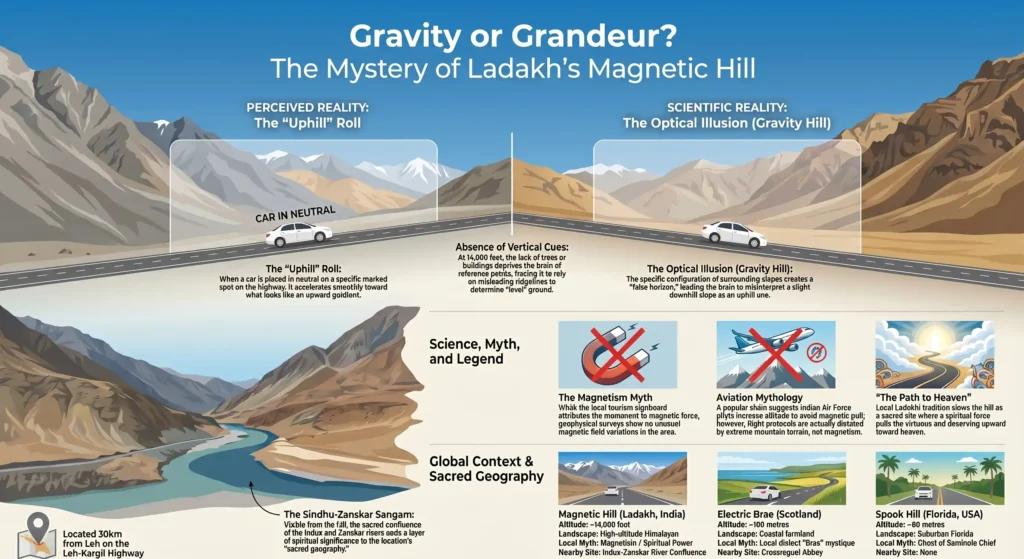
Put a car in neutral on a specific marked spot on the Leh-Kargil highway. Remove your foot from the brake. Watch the car begin to move. It will accelerate, smoothly and without any engine assistance, toward what your eyes are telling you is an uphill gradient, reaching speeds that make the experience feel not like a gentle optical confusion but like a genuine defiance of the physical laws that govern everything you have ever observed about how cars and gravity interact.
This is the experience that travelers have been having at the Magnetic Hill of Ladakh for decades, and it is the experience that has generated the extraordinary range of explanations, from the scientific to the supernatural to the aviation-adjacent, that surround this particular stretch of highway. The experience is real. The car genuinely moves. The question of why it moves in the direction it appears to move toward, and what this reveals about the relationship between human perception and physical reality, is one of the most interesting questions a short drive on a Himalayan highway has ever generated.
The Ladakh landscape that surrounds the Magnetic Hill does not look like a place where ordinary rules have been suspended. It looks, at first, like what it is, a high-altitude Himalayan highway running through some of the most dramatic mountain terrain in the world, with the bare grey and ochre slopes of the Ladakh range rising on either side, the blue thread of the Indus river visible in the valley below, and the particular quality of light that fourteen thousand feet of altitude and clear Himalayan air produce combining to make everything look simultaneously vast and precise.
It is exactly this landscape that is responsible for the illusion. And understanding why requires understanding something about how the human brain processes the visual information that the landscape provides.
The Landscape of Ladakh and Its Particular Properties
Ladakh is one of the most geologically and visually distinctive landscapes in the world. The region sits on the Tibetan Plateau at extreme altitude, with terrain that has been shaped by the collision of the Indian and Asian tectonic plates over millions of years into a configuration of dramatic relief, with peaks exceeding seven thousand metres, deeply incised river valleys, and the particular barren, mineral-coloured landscape that results from high altitude, minimal vegetation, and the specific geology of the collision zone.
The visual properties of this landscape are unusual in ways that are directly relevant to the Magnetic Hill phenomenon. The absence of trees, the relative scarcity of built structures, and the extreme scale of the terrain mean that the visual cues the human brain normally uses to establish the orientation of a surface, the presence of vertical structures like trees and buildings whose known height provides a reference for ground level, are largely absent. The brain must construct its model of ground orientation from the landscape itself, from the angles of slopes, the positions of ridgelines, and the apparent relationship between different parts of the terrain.
In ordinary environments, these landscape-based cues are reliable enough that the brain’s construction of surface orientation is accurate most of the time. In the specific configuration of the Magnetic Hill area, they are systematically misleading, producing a consistent and involuntary misreading of the actual slope of the road.
What Gravity Hills Actually Are
The Magnetic Hill of Ladakh belongs to a category of geographical feature known to geographers and psychologists as a gravity hill or mystery hill. These are locations, documented in many parts of the world, where the specific configuration of the surrounding landscape creates an optical illusion that causes observers to misread the slope of a road or surface, perceiving a downhill slope as uphill and therefore experiencing the apparently impossible sight of objects rolling or vehicles moving in the wrong direction relative to the perceived gradient.
Gravity hills have been documented in the United States, Canada, the United Kingdom, Italy, Brazil, South Korea, and numerous other countries. The Electric Brae in Scotland, Confusion Hill in California, Magnetic Hill in New Brunswick, Canada, and Spook Hill in Florida are among the most well-known examples. All of them operate through the same basic mechanism, the systematic misreading of surface orientation caused by a specific landscape configuration, and all of them produce the same basic experience, the apparently impossible movement of objects against the perceived direction of gravity.
The scientific understanding of gravity hills is well established. They are studied within the fields of visual perception psychology and cognitive science, where they serve as particularly dramatic examples of how the brain constructs its model of the visual world from available cues and how that construction can go systematically wrong when the available cues are unusual or misleading.
The mechanism involves several interacting elements. The brain uses multiple sources of visual information to establish the orientation of a surface, including the apparent horizon, the angles of surrounding slopes, the positions of vertical reference objects, and the relationship between the road surface and the surrounding terrain. When these sources of information are in conflict, or when the primary sources of orientation information are misleading due to the specific configuration of the landscape, the brain resolves the conflict in a way that can be systematically incorrect.
Goddess Kamakhya and Mythology Behind the Ambubachi Mela
At the Magnetic Hill, the specific configuration of the surrounding Himalayan terrain creates a false horizon that the brain interprets as the true horizontal reference for the area. With this false horizon established, the actual slope of the road, which is a gentle downhill gradient in the direction the vehicles roll, appears to be an uphill slope relative to the falsely perceived horizontal. The brain does not simply make this mistake momentarily and then correct it. It maintains the misperception consistently as long as the observer is within the landscape that creates the false reference, which is why the experience is so compelling and so resistant to conscious correction even when the observer knows the scientific explanation.
Research on gravity hills and the specific visual mechanisms that produce them has been published extensively in journals of cognitive science and visual perception psychology, and the phenomenon is a standard case study in courses on visual perception and the psychology of illusion. The Ladakh version is distinguished from many other gravity hills primarily by the dramatic quality of the surrounding landscape, the extreme altitude, and the cultural and spiritual meanings that have been layered onto the physical phenomenon.
The Aviation Story and What to Make of It
One of the most widely repeated claims about the Magnetic Hill of Ladakh is that the Indian Air Force has acknowledged the area’s unusual properties by directing its aircraft to increase altitude when flying over it, in order to avoid being pulled down by the magnetic field that the hill supposedly generates. This claim appears in virtually every popular account of the site and has become one of the fixed elements of the Magnetic Hill mythology.
The claim is almost certainly not accurate in the form in which it is usually stated. The Indian Air Force operates at altitudes far above any terrain feature in the Ladakh region and does not require altitude adjustments to avoid magnetic effects from a stretch of highway. The specific corridors and altitude regulations that govern flight in the Ladakh region are determined by the extreme terrain and the specific operational requirements of high-altitude aviation in a mountainous region, not by the magnetic properties of particular locations.
What may contain a grain of truth in this account is the possibility that the area around the Magnetic Hill, like many locations in the Ladakh region, has specific air traffic management protocols related to the mountain terrain, and that these protocols have been interpreted and elaborated in popular accounts into the more dramatic story of magnetic interference with aircraft operations.
The aviation story is a particularly clear example of a broader pattern in the cultural life of the Magnetic Hill, in which the genuine strangeness of the visual experience generates explanatory stories that grow in dramatic reach as they are transmitted, each retelling adding an element that makes the phenomenon more extraordinary and the explanation more satisfying to a mind that finds the correct optical illusion explanation both accurate and somehow insufficient.
The Spiritual Dimension and Local Belief
The local belief traditions surrounding the Magnetic Hill are older than the tourism infrastructure and older than the scientific documentation of the phenomenon, and they carry a different kind of explanatory logic than either the scientific or the aviation accounts.
The Ladakhi communities who have lived in this region for generations understand the hill not as a magnetic anomaly or an optical illusion but as a sacred place whose power to draw certain travelers toward it is a manifestation of spiritual force rather than physical force. The local tradition describes the road as one that pulls the virtuous and the deserving toward heaven, an upward journey in the spiritual sense that finds its physical expression in the apparent uphill movement of vehicles.
How the Bhotiya Weavers of Uttarakhand Kept a Himalayan Textile Tradition Alive
This spiritual interpretation of the phenomenon is not simply a naive misunderstanding of the physics. It is a culturally coherent account of an experience that is genuinely strange, one that places the strangeness within a framework of meaning that has organized human experience in this landscape for centuries. The idea that certain places have power, that certain roads lead toward or away from something sacred, and that the natural world encodes moral and spiritual information in its physical arrangements, is a framework of interpretation with deep roots in the religious and cosmological traditions of the Ladakhi communities.
The Sindhu-Zanskar Sangam, the confluence of the Indus and Zanskar rivers that is visible from the Magnetic Hill area and that is considered a sacred site in both Hindu and Buddhist traditions, contributes to the spiritual geography within which the Magnetic Hill phenomenon is understood by local communities. The proximity of a recognized sacred confluence to the hill has reinforced the interpretation of the hill itself as spiritually significant rather than simply physically unusual.
The Indira Gandhi National Centre for the Arts has documented the cultural landscape of Ladakh, including the sacred geography within which natural phenomena are understood by local communities, as part of its broader work on the intangible cultural heritage of the Himalayan region.
The Cognitive Science of the Illusion
Understanding exactly what the brain is doing when it misreads the slope at the Magnetic Hill requires some engagement with the specific mechanisms of visual perception that cognitive scientists have identified through research on gravity hills and related optical illusions.
The brain’s model of the visual world is not a simple recording of the light that falls on the retina. It is an active construction, built from the raw visual data using a set of rules about how the world is likely to be organized that have been accumulated through evolutionary history and individual experience. These rules are generally reliable because the physical world is generally organized in ways that make them reliable. But they can be systematically violated by specific configurations of the visual scene, and when they are, the brain’s construction of the world can be systematically wrong.
The specific rule that is violated at gravity hills is the rule about how the apparent horizon relates to the actual horizontal plane of the ground. In ordinary environments, the apparent horizon, the line where the sky meets the terrain in the visual field, is a reliable indicator of the horizontal plane, and the brain uses it as a reference for establishing the orientation of surfaces. When the surrounding terrain creates a false apparent horizon that does not correspond to the actual horizontal plane, the brain establishes an incorrect horizontal reference and then misreads the orientation of the road surface relative to that incorrect reference.
At the Magnetic Hill of Ladakh, the specific configuration of the surrounding Himalayan slopes creates exactly this kind of false horizon. The slopes on one side of the road rise more steeply than the slopes on the other side, and the ridgeline that forms the apparent horizon on the steeper side is significantly higher than the actual horizontal plane of the ground. The brain interprets this higher ridgeline as the true horizontal and then reads the road surface relative to it, producing the consistent impression that the road slopes upward in the direction it actually slopes downward.
The reason the illusion is so compelling even to observers who understand the correct explanation is that the conscious knowledge of the correct explanation does not override the visual system’s automatic processing of the landscape cues. The visual system operates faster than conscious reasoning and its output is what the observer experiences as direct perception. Knowing that the apparent uphill slope is actually a downhill slope does not change the experience of seeing it as uphill, just as knowing that two lines of equal length appear different in the Muller-Lyer illusion does not make them appear equal.
What the Signboard Says
Local tourism authorities have placed a signboard at the Magnetic Hill that invites drivers to park their vehicles on the marked spot and experience the phenomenon for themselves. The signboard describes the hill as a magnetic hill and attributes the vehicle movement to magnetic force, which is the popular explanation for the phenomenon rather than the scientifically accurate one.
The signboard is an interesting document in itself. It represents the local tourism economy’s understanding of what visitors want from the experience, which is a sense of the genuinely mysterious and the physically anomalous rather than an account of a well-understood optical illusion. The magnetic explanation preserves the strangeness of the experience and the sense that something extraordinary is happening, while the optical illusion explanation, however accurate, might be perceived as reducing an extraordinary experience to something merely cognitive.
How Titu Singh’s Past Life Memories Led to a Murder Conviction in Agra
This tension between accurate scientific explanation and the preservation of experiential strangeness is not unique to Magnetic Hill. It appears at most of the world’s gravity hills and mystery spots, and the tourism infrastructure around these sites consistently tends toward the more dramatic explanation regardless of what the scientific evidence shows. The choice of explanation in the tourism context is not simply a matter of accuracy. It is a matter of how the experience is framed for visitors and what kind of meaning the place is being invited to carry.
The Broader World of Gravity Hills
Placing the Magnetic Hill of Ladakh within the global context of gravity hills and mystery spots reveals both what it shares with similar sites elsewhere and what makes it distinctive. The physical mechanism, the specific perceptual conditions that create the optical illusion, is essentially identical across all gravity hills worldwide. What differs is the cultural and environmental context in which the phenomenon is experienced and the meanings that local communities and tourism industries have attached to it.
The Ladakh version is distinguished by the extraordinary quality of the landscape within which it sits. A gravity hill in a flat or suburban landscape has the same perceptual properties but lacks the additional context of high-altitude Himalayan terrain, the proximity of major rivers and their sacred confluences, the traditions of Ladakhi spiritual geography, and the particular emotional quality that extreme altitude and dramatic scenery add to any experience. The illusion at Magnetic Hill is experienced within a setting of such overwhelming natural power that the perceptual anomaly seems more significant than it might appear in a less dramatic environment.
The altitude itself adds an element that most gravity hills do not have. At fourteen thousand feet, the air is thin enough to affect cognition in subtle ways for visitors who have not acclimatized, and the physical sensation of being at extreme altitude, the heightened awareness, the slight breathlessness, the intensified quality of the light, all contribute to the receptivity with which visitors approach the experience and the vividness with which they remember it.
The Indus Below and the Hill Above
One of the most beautiful aspects of the Magnetic Hill’s location is its relationship to the Sindhu-Zanskar Sangam, the confluence of the Indus and Zanskar rivers that is visible from the road in the valley below. The Indus at this point is a wide, fast-moving river of a particular turquoise-grey colour produced by the glacial melt that feeds it, and the Zanskar that joins it from the side carries water of a subtly different shade, producing at the confluence a visible seam between two differently coloured rivers that gradually blends as the waters mix downstream.
The confluence is considered sacred in the Hindu tradition as the meeting of two holy rivers, and Buddhist communities in Ladakh also regard the site as spiritually significant. It is one of those geographical features that the religious traditions of the region have recognized and incorporated into their understanding of the sacred landscape, attributing to the meeting of the waters a significance that goes beyond the merely physical.
The coexistence, in a single stretch of Ladakhi highway, of an optical illusion that produces the experience of a car rolling uphill, a sacred river confluence visible in the valley below, and the dramatic backdrop of the Himalayan range in every direction, creates a layered experience of place that goes beyond what any single element of it, the science, the spirituality, or the geology, can fully account for. It is the combination that makes the Magnetic Hill memorable in the way that genuinely interesting places are memorable, as a location where several different kinds of meaning converge and produce something more complex than any of them individually.
That complexity is worth more attention than the simple question of whether the hill is actually magnetic. It is not. But what it is, a place where the human visual system meets a specific landscape configuration and produces a systematic, compelling, and genuinely surprising misreading of physical reality, is interesting enough on its own terms, and the spiritual and cultural meanings that have been layered on top of that perceptual foundation add dimensions to the experience that the physics alone cannot provide.
Why Paliwal Brahmins Left Kuldhara in a Single Night and Never Returned
Quick Comparison Table
| Aspect | Magnetic Hill, Ladakh | Electric Brae, Scotland | Spook Hill, Florida |
|---|---|---|---|
| Altitude | Approximately 14,000 feet | Approximately 100 metres | Approximately 60 metres |
| Surrounding Terrain | High altitude Himalayan mountain landscape | Scottish Ayrshire coast and farmland | Central Florida suburban landscape |
| Documented Since | Popularized with Leh highway tourism development | Documented in print since 1930s | Documented since early 20th century |
| Local Explanation | Magnetic force, spiritual power drawing the deserving upward | Local dialect term Brae means uphill, added to mystique | Lake created by meteor, ghost of Seminole chief |
| Scientific Mechanism | Optical illusion, false horizon created by mountain slopes | Optical illusion, false horizon created by coastal terrain | Optical illusion, false horizon created by surrounding landscape |
| Tourism Development | Established highway stop, signboard, significant visitor numbers | Established tourist attraction, roadside marker | Established tourist attraction, city park |
| Cultural Significance | Sacred Ladakhi spiritual geography, aviation mythology | Scottish cultural heritage, local identity | Florida folklore, Indigenous legend association |
| Nearby Sacred Site | Sindhu-Zanskar Sangam river confluence | Crossraguel Abbey | None specifically documented |
Curious Indian: Fast Facts
- The Magnetic Hill of Ladakh is located at approximately fourteen thousand feet above sea level, making it one of the highest-altitude gravity hill phenomena documented anywhere in the world, with the thin air and dramatic Himalayan landscape adding dimensions to the experience that lower-altitude equivalents do not have.
- The hill is not magnetic. Detailed geophysical surveys of the area have found no unusual magnetic field variations that would account for the movement of vehicles, confirming that the phenomenon is entirely explained by the optical illusion produced by the surrounding landscape configuration.
- The signboard placed by local tourism authorities at the marked parking spot describes the phenomenon as a magnetic hill and attributes it to magnetic force, a scientifically inaccurate explanation that the tourism economy has preferred over the accurate optical illusion account because it preserves the sense of genuine physical mystery.
- Gravity hills similar to the Magnetic Hill of Ladakh have been documented on every inhabited continent, with particularly well-known examples in Scotland, the United States, Italy, Brazil, and South Korea, all operating through the same basic mechanism of visual horizon misreading.
- The Sindhu-Zanskar Sangam, the confluence of the Indus and Zanskar rivers visible from the Magnetic Hill area, is one of the most photographed natural landmarks in Ladakh and is considered sacred in both Hindu and Buddhist traditions, adding a dimension of spiritual significance to the site that goes beyond the optical illusion itself.
- The aviation claim that the Indian Air Force increases aircraft altitude when flying over the Magnetic Hill to avoid magnetic interference is almost certainly an elaboration of the popular magnetic explanation rather than an accurate account of actual Air Force operational procedures in the region.
- The visual misperception at the Magnetic Hill is so compelling that observers who understand the correct scientific explanation, that the road actually slopes gently downward in the direction the car rolls, continue to experience the hill as uphill while they are within the landscape that creates the false reference frame.
- The phenomenon belongs to a well-studied category of optical illusion that cognitive scientists and visual perception researchers use as a case study in how the brain constructs its model of the visual world from available cues and how that construction can be systematically wrong when the cues are misleading.
- Ladakhi spiritual tradition understands the hill as a road that draws the virtuous toward heaven, an interpretation that places the physical phenomenon within a moral and cosmological framework that gives it a significance extending well beyond its status as an interesting perceptual anomaly.
- The Magnetic Hill is located within the landscape that India’s military has historically regarded as strategically critical, situated on the highway that connects Leh to Kargil and Srinagar, the same highway along which the logistics of the Kargil conflict of 1999 were partly managed, adding a layer of contemporary strategic significance to a location more commonly discussed in terms of tourism and optical illusion.
Conclusion
The Magnetic Hill of Ladakh is most interesting precisely at the point where the complete scientific explanation and the continuing strangeness of the experience meet and fail to cancel each other out. Knowing that the hill is not magnetic, that the road actually slopes gently downward, and that the human visual system is performing a specific and well-understood misreading of the landscape, does not make the experience of watching a car roll uphill less surprising. The surprise survives the explanation, which is itself one of the most interesting things about the phenomenon.
This is what makes the best optical illusions philosophically productive rather than simply entertaining. They demonstrate, with the immediacy and concreteness that abstract argument cannot quite achieve, that what we experience as direct perception of the world is actually the output of a complex constructive process that can go systematically wrong in ways we cannot override even when we know they are happening. The world as we experience it is not the world as it is. It is the world as our visual systems have constructed it from available evidence, and the construction is usually accurate enough to function but not accurate enough to be trusted without question.
The Magnetic Hill makes this abstract point viscerally concrete. You know the car should not be rolling uphill. You know it is not actually going uphill. And you watch it roll uphill anyway, with the untroubled confidence of a physical system that does not know what you know and is simply responding to the gradient that actually exists rather than the gradient that appears to exist.
The spiritual interpretation that the hill draws the virtuous toward heaven, for all that it does not match the physics, captures something real about the experience. There is a quality to it, as the car begins to move without engine power in the thin Himalayan air at fourteen thousand feet with the Indus winking in the valley below and the peaks of the Ladakh range rising on every side, that exceeds what can be fully contained in the vocabulary of optical illusion.
It is not magic. But it is, in the specific and demanding sense of that word, genuinely wonderful. And that is a different kind of thing from simply being explained.
Mythological Origins of the Kumbh Mela and Descent of the Ganga
If you think you have remembered everything about this topic take this QUIZ
Results


#1. The Magnetic Hill of Ladakh is situated on which national highway?
#2. At approximately what altitude above sea level is the Magnetic Hill of Ladakh located?
#3. What is the actual physical gradient of the road stretch where vehicles appear to roll uphill?
#4. Which psychological and geographical category does the Magnetic Hill of Ladakh belong to?
#5. What specific geographical feature is visible in the valley below the Magnetic Hill area?
#6. According to local Ladakhi spiritual belief, what does the hill’s path signify?
#7. Why does the local tourism signboard attribute the vehicle movement to magnetic force rather than an optical illusion?
#8. Why does the visual illusion persist even when a visitor consciously knows the scientific explanation?
Why do vehicles appear to roll uphill at the Magnetic Hill of Ladakh?
The phenomenon is an optical illusion produced by the specific configuration of the surrounding Himalayan landscape. The slopes and ridgelines around the road create a false visual horizon that the brain interprets as the true horizontal reference for the area. With this false reference established, the road’s actual gentle downhill slope in the direction the vehicles roll appears to be an uphill slope relative to the falsely perceived horizontal. Vehicles placed in neutral therefore roll downhill in physical reality while appearing to roll uphill in visual experience.
Is the Magnetic Hill actually magnetic?
The hill is not magnetic. Geophysical surveys of the area have found no unusual magnetic field variations that would account for the vehicle movement. The magnetic explanation is the popular and locally promoted account of the phenomenon but does not reflect the scientific understanding of what is actually happening. The correct explanation is the optical illusion produced by the surrounding landscape configuration, a well-understood phenomenon documented at similar gravity hill sites on every inhabited continent.
How common are gravity hills like the Magnetic Hill globally?
Gravity hills have been documented in many countries including Scotland, the United States, Canada, Italy, Brazil, Australia, and South Korea. They are not rare in the sense of being physically unusual locations. They are specific landscape configurations that consistently create a particular optical illusion. What makes each gravity hill distinctive is not the physical mechanism, which is essentially identical across all of them, but the cultural context, surrounding landscape, and meanings that local communities and tourism have attached to the phenomenon.
What is the spiritual significance of the Magnetic Hill to local Ladakhi communities?
Ladakhi communities understand the hill as a sacred place whose apparent power to draw vehicles upward is a manifestation of spiritual force that pulls the deserving toward heaven. This interpretation places the physical phenomenon within the broader framework of Ladakhi sacred geography, in which natural features carry spiritual significance and the landscape encodes moral and cosmological meaning. The proximity of the Sindhu-Zanskar Sangam, a sacred river confluence visible from the site, reinforces the spiritual interpretation of the hill as part of a sacred landscape rather than simply an interesting optical illusion.
Can the illusion be corrected by knowing the scientific explanation?
Knowing the correct scientific explanation does not override the visual experience of the illusion. The brain’s visual system processes landscape information automatically and produces its output faster than conscious reasoning can intervene. Observers who fully understand that the road slopes gently downward in the direction the car rolls continue to experience the road as appearing to slope uphill while they are within the landscape that creates the false horizon reference. This persistence of illusion despite knowledge of the correct explanation is itself one of the most interesting aspects of gravity hills as psychological phenomena and is a standard illustration in courses on visual perception of the distinction between what we consciously know and what we visually experience.