How Gopal Hari Deshmukh’s Rationalist Awakening Challenged an Entire Social Order
Gopal Hari Deshmukh wrote one hundred letters in Marathi between 1848 and 1850 under the pen name Lokahitawadi, meaning one who works for the welfare of the people, and in those letters he said things about caste, superstition, priestcraft, and the condition of women in Maharashtra that the religious establishment of Pune found deeply threatening and that the ordinary Marathi reader, encountering them for the first time in their own language and with the directness of someone who had thought the arguments through completely, found difficult to dismiss. He was not the first person in India to apply rationalist principles to the critique of social custom. He was the first to do it in Marathi, with the systematic force of someone trained in both Western empiricist thought and the classical Indian textual tradition, and that combination made his rationalist awakening in Maharashtra one of the most consequential intellectual events of the nineteenth century.
Another Maharashtra reform voice that confronted the gendered social order was Tarabai Shinde.
The Judge Who Wrote the Letters
How Syed Ahmad Khan Changed Muslim Education in India
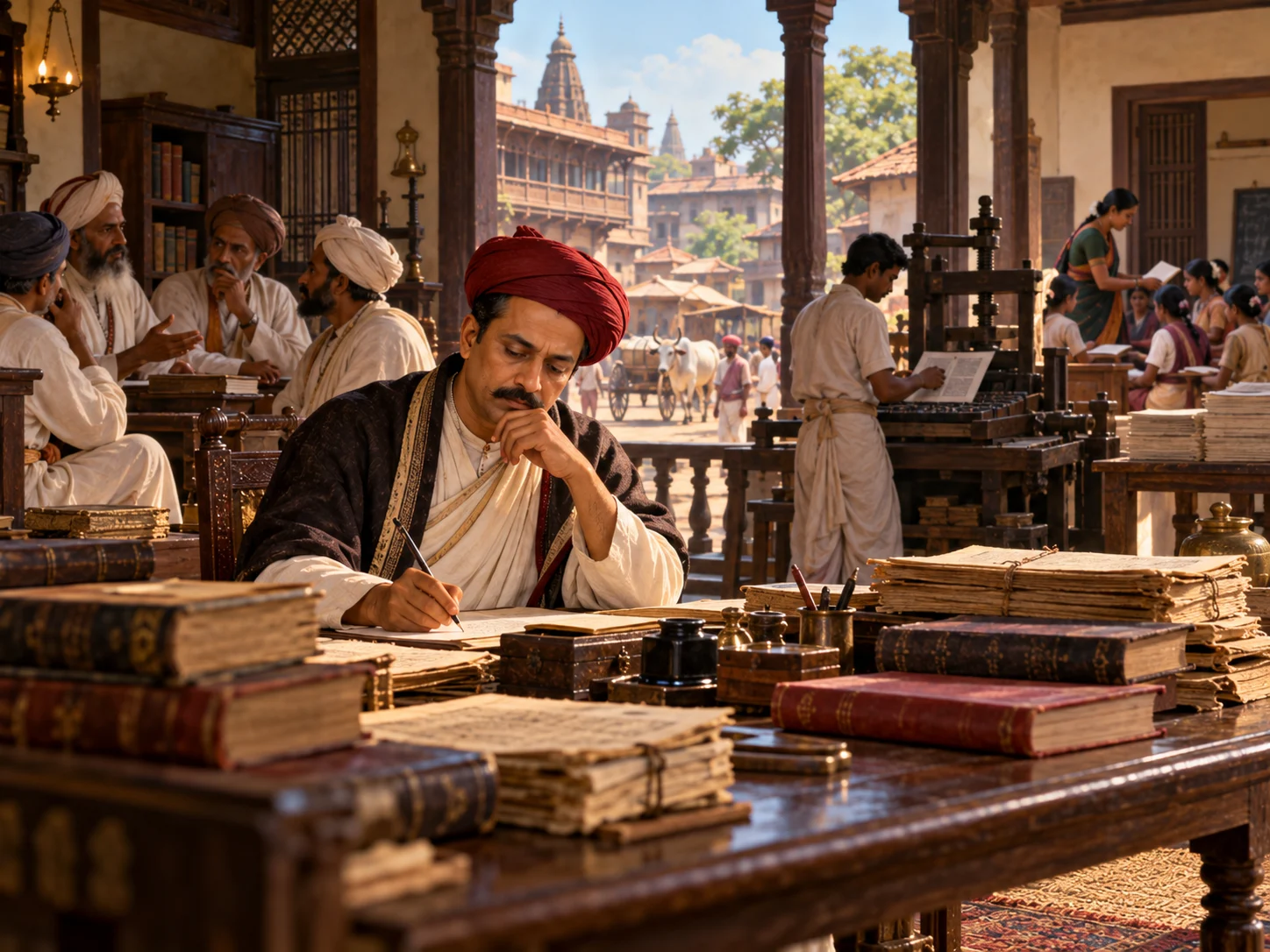
In 1848, a twenty-five-year-old government judge in Pune sat down and began writing letters. Not private correspondence but public letters, addressed to the Marathi reading public through the pages of the Prabhakar newspaper, signed not with his own name but with a pen name that was itself a statement of intent. Lokahitawadi. The one who works for the welfare of the people.
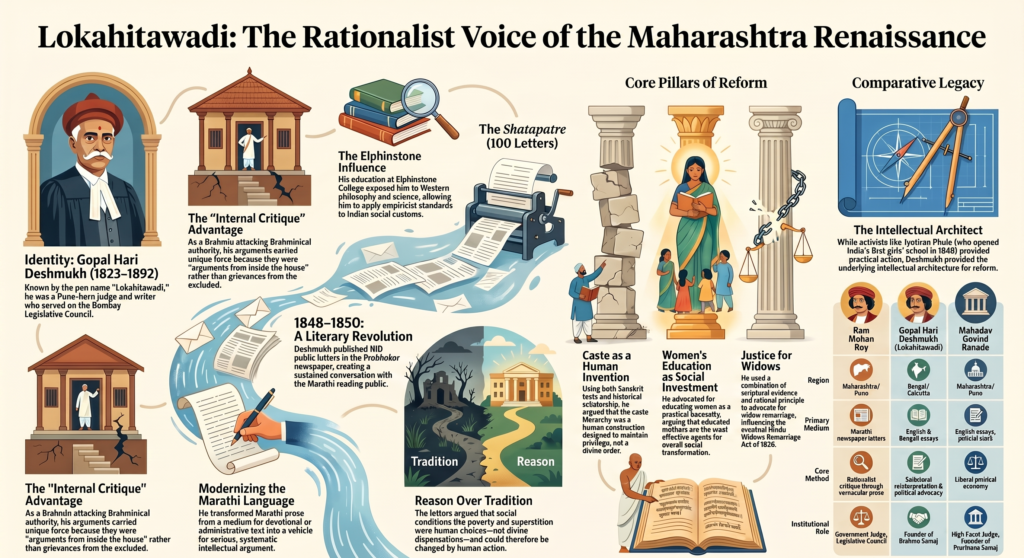
He was Gopal Hari Deshmukh, a Brahmin by birth and a rationalist by conviction, and the one hundred letters he wrote over the following two years constituted the most systematic critique of the social, religious, and intellectual conditions of Maharashtra that anyone had yet attempted in the Marathi language. He wrote about caste as a human invention rather than a divine dispensation. He wrote about the religious rituals and superstitious practices that he believed kept ordinary Maharashtrians in a condition of intellectual dependence on a priestly class whose authority rested on the control of knowledge rather than on any genuine spiritual qualification. He wrote about the education of women as a social necessity rather than a social danger. He wrote about widow remarriage as a matter of simple human justice.
He wrote all of this as a Brahmin. This mattered. The critique of Brahminical authority coming from a Jyotirao Phule, who was a Mali and whose social position gave him every reason to challenge caste hierarchy, could be received by the establishment as the grievance of someone who had been excluded. The same critique coming from a Brahmin who had everything to gain from the system he was attacking carried a different kind of force. It was an argument from inside the house, and arguments from inside the house are harder to dismiss than arguments from the street.
The Formation of a Rationalist Mind
Gopal Hari Deshmukh was born on February 18, 1823, in Pune, into a Brahmin family with the educational and social standing that the upper-caste community of early nineteenth-century Maharashtra associated with respectability and influence. His father, Hari Bhavani Deshmukh, was a government servant, and the family’s position gave the young Gopal access to the Elphinstone College in Bombay, one of the most significant educational institutions established by the British colonial administration in western India.
Elphinstone College in the 1830s and 1840s was an intellectually charged environment. It exposed its students to Western philosophy, history, science, and political thought alongside the classical Indian learning that the Brahmin tradition had always prized. For a young man with Deshmukh’s intellectual temperament, this encounter with two very different ways of organizing knowledge and evaluating claims about the world produced something that neither tradition alone could have generated: a mind that could apply the empiricist standards of Western rationalism to the social customs and religious beliefs of Maharashtra while understanding those customs and beliefs from the inside, with the depth of someone for whom they were not academic objects but living realities.
This combination was what made Deshmukh’s rationalism distinctive. He was not a colonial convert who had simply replaced Indian tradition with Western thought. He was a man who had genuinely inhabited both intellectual worlds and had arrived, through his own thinking, at the conclusion that the social conditions of Maharashtra could not withstand scrutiny by the standards of reason, evidence, and human welfare that either tradition, honestly applied, demanded.
He joined the government judicial service after completing his education, eventually rising to positions of significant judicial authority. The career gave him economic independence and social standing, both of which proved important when the letters he began publishing in 1848 drew the hostility of the conservative establishment.
The Shatapatre: One Hundred Letters and What They Said
How Pandita Ramabai Pioneered a Fearless Crusade for Women’s Education
The Shatapatre, the collective name by which Deshmukh’s one hundred letters became known, was not a systematic philosophical treatise. It was something more immediately effective than that. It was a sustained, ongoing conversation with the Marathi reading public, conducted through the accessible medium of the newspaper, in language that was direct without being crude and learned without being inaccessible.
Each letter addressed a specific aspect of the social, religious, or intellectual conditions of Maharashtra, and together they built an argument that was cumulative in its force. The argument, stated simply, was that the condition of the Marathi people, their poverty, their superstition, their social divisions, their subordination of women, their intellectual dependence on priestly authority, was not the result of divine dispensation, natural order, or historical inevitability. It was the result of specific human choices, maintained by specific human interests, and it could therefore be changed by specific human action guided by reason and informed by knowledge.
This was a radical claim in the Maharashtra of 1848, not because the idea of social reform was new but because no one had yet made it in Marathi, with this degree of systematic force, through this accessible and widely read medium. The Prabhakar newspaper in which the letters appeared had a readership that extended across the literate Marathi-speaking public, and the letters that Lokahitawadi was publishing in it reached people who had never encountered a sustained rationalist critique of their own social conditions in their own language.
The letter on caste argued that the division of society into hierarchical groups based on birth had no rational justification and served no social purpose beyond the maintenance of privilege for those at the top of the hierarchy. He traced the historical development of caste, drawing on his knowledge of both Sanskrit textual tradition and the historical scholarship available to him through his English-language education, to demonstrate that the system was a human construction that had evolved over time rather than a divine order that had existed from the beginning of the world.
The letters on religious superstition addressed the practices of astrology, ritual pollution, and the authority of sacred texts interpreted by Brahmin priests as the sole legitimate intermediaries between the divine and the ordinary person. Deshmukh argued that these practices served primarily the economic and social interests of the priestly class and that their hold on the Marathi public was maintained through the control of education rather than through any genuine spiritual authority.
The letters on women’s education and widow remarriage were among the most practically consequential of the series. He argued for women’s education not on the grounds of abstract equality alone but on the practical grounds that an educated mother was the most effective agent of social transformation available, that the education of women was therefore not a concession to progressive ideology but the most efficient investment in social improvement that Maharashtra could make. On widow remarriage, he argued against the Hindu orthodoxy that condemned widows to lives of enforced celibacy and social marginalization with the same combination of scriptural argument, historical evidence, and rational principle that characterized all of his writing.
The Brahmin Who Challenged Brahminism
Thakkar Bapa’s Tribal Upliftment Work in Remote India
The social position from which Deshmukh launched his critique was not irrelevant to its reception and its consequences. He was a Brahmin attacking Brahminism, a member of the priestly class arguing that the authority of the priestly class rested on the suppression of knowledge rather than its cultivation. This internal critique had a particular quality of force that external critique could not quite replicate.
It also exposed him to a particular quality of hostility. The conservative Brahmin establishment of Pune, which was one of the most intellectually formidable concentrations of orthodox Hindu scholarship in western India, understood precisely what Deshmukh was doing and what it threatened. His position as a government judge gave him a degree of institutional protection that a private individual would not have had, but it did not insulate him entirely from the social pressure, the accusations of apostasy, and the organized attempts to discredit his arguments that the orthodox establishment deployed against him.
He continued writing. The one hundred letters appeared over two years without interruption, each one adding to the cumulative argument that had been building from the first. When the series concluded, Deshmukh had produced a document that was immediately recognized by the reform-minded sections of Marathi intellectual life as something unprecedented and that was simultaneously recognized by the conservative establishment as something genuinely threatening to the social order they were invested in maintaining.
The Partnership with Practical Action
The relationship between Deshmukh’s rationalism and Jyotirao Phule’s activism is one of the most significant intellectual partnerships of the Maharashtra Renaissance. Phule, who opened India’s first girls school in 1848, the same year Deshmukh began publishing the Shatapatre, was working in a different register, the register of direct practical action rather than intellectual argument, but the two projects were complementary and mutually reinforcing. Deshmukh provided the intellectual architecture of the critique. Phule provided the demonstration that the alternative his critique pointed toward was practically achievable.
Deshmukh was not working in isolation. He was part of an emerging intellectual network in Maharashtra that was simultaneously engaging with the reformist currents coming from Bengal, where Ram Mohan Roy had already begun the process of applying rationalist and humanist principles to the critique of Hindu social practice, and with the Western intellectual tradition that colonial education had made newly available to a generation of educated Indians.
The Maharashtra Renaissance, the term used by historians to describe the broad cultural and intellectual transformation of Marathi society during the nineteenth century, had multiple strands and multiple figures. Deshmukh’s rationalism was one strand. Phule’s social activism was another. Vishnu Shastri Pandit’s advocacy for widow remarriage drew directly from arguments that Deshmukh had developed in the Shatapatre. What distinguished Deshmukh’s contribution to this network was his consistent insistence on reason as the primary criterion by which social customs, religious beliefs, and institutional arrangements should be evaluated.
The Judge on the Bench and the Writer at the Desk
How Kamaladevi Chattopadhyay Saved India’s Artisan Heritage
One of the most remarkable dimensions of Deshmukh’s life is the parallel existence he maintained between his career as a government judge and his activities as a radical social critic. The two roles were not simply coexistent but were in genuine tension, and the management of that tension required both personal courage and considerable political intelligence.
As a judge, he was an officer of the colonial administration, expected to maintain a degree of political neutrality and social respectability that his published letters were continuously testing. The colonial administration’s response to his writing was cautious rather than openly hostile, partly because the reforms he was advocating were not directed at British authority and partly because his personal conduct was irreproachable.
His judicial work also gave him an unusually direct view of the social conditions he was writing about. The cases that came before him in his capacity as a judge gave him specific, documented evidence of the way caste hierarchy, the subordination of women, and the exploitation of the ignorant by the educated played out in the actual texture of Maharashtrian legal and social life. This grounding in specific cases and specific conditions gave his critique a concreteness that purely theoretical argument could not have achieved.
He served on the Bombay Legislative Council in a later period of his career, bringing the same combination of careful argument and practical understanding to the legislative process. His presence in the Council was itself a demonstration that the rationalist critique of social custom was not merely a literary exercise but had practical political implications that required engagement with the institutions of governance.
The Language as the Medium of Liberation
One of the most consistently underappreciated dimensions of Deshmukh’s work is his role in the development of Marathi prose as a vehicle for serious intellectual and social argument. Before the Shatapatre, Marathi literary prose was primarily associated with religious and devotional writing, with the administrative language of government documents, and with the oral tradition of the Varkari saints whose abhangas had been the primary literary form of Marathi devotional culture for centuries.
Deshmukh demonstrated that Marathi prose could carry the weight of systematic intellectual argument, that it could translate the concepts of Western rationalist philosophy and the analytical methods of empirical inquiry into a form that Marathi readers could engage with directly, without the mediation of English or Sanskrit. This was a contribution to the language itself as well as to the ideas it was being used to express.
The development of Marathi as a vehicle for social criticism and intellectual argument that Deshmukh initiated was continued by the writers, journalists, and reformers who came after him, building a prose tradition that would eventually produce the literary and intellectual culture of modern Maharashtra. The Sahitya Akademi’s documentation of the development of modern Marathi prose consistently identifies Deshmukh’s Shatapatre as a founding moment of that tradition.
The Legacy in the Long Run
Gopal Hari Deshmukh died on October 9, 1892, in Pune, at the age of sixty-nine, having spent more than forty years in the public life of Maharashtra as a judge, a writer, a legislator, and a reformer. The Maharashtra he left behind was not the Maharashtra he had been born into. The intellectual and social environment had been transformed by the Reform Movement of which he was a foundational figure, and the changes in that environment, however incomplete, were real and traceable in the specific reforms that had been achieved.
Widow remarriage had received legal recognition through the Hindu Widows Remarriage Act of 1856, which drew on arguments that Deshmukh and others had made through the preceding decade. Women’s education had expanded significantly from the near-total absence of institutional provision that had characterized Maharashtra in 1848. The public discourse on caste, while far from having produced the abolition that rationalists like Deshmukh had argued for, had been transformed in ways that made the open defense of caste hierarchy as divine dispensation considerably more intellectually difficult than it had been.
These were not complete victories. The caste system remained deeply entrenched. Women’s education remained limited by standards that later generations would rightly find inadequate. The superstitious practices that Deshmukh had criticized in the Shatapatre survived and in some contexts flourished. But the intellectual ground had shifted, and the shift was in significant part the consequence of the one hundred letters that a twenty-five-year-old judge in Pune had begun publishing in 1848 under a pen name that meant the one who works for the welfare of the people.
That he had done exactly that was the judgment of everyone who came after him and found, in the intellectual tradition he had helped to create, the tools to continue the work.
The Pen and the Principle
Gopal Hari Deshmukh’s rationalist awakening was, at its core, an act of intellectual honesty. He looked at the society he had been born into and educated within and he applied to it the most rigorous standard available to him, the standard of reason, evidence, and demonstrable human welfare, and he reported honestly what that scrutiny revealed.
What it revealed was a society organized around principles that could not survive scrutiny, a caste system whose divine justification evaporated when examined, a religious authority whose claim to special knowledge rested on the suppression of general knowledge, a treatment of women whose practical consequences were visible in every aspect of Maharashtrian social life and whose defense required the abandonment of every principle of human dignity that the tradition itself claimed to uphold.
He said all of this plainly, in Marathi, in a newspaper, in one hundred letters addressed to anyone willing to read them. He did not wait for institutional permission or social consensus. He wrote what he had thought through and he published it and he kept publishing it through opposition, through hostility, through the accumulated pressure of a conservative establishment that understood what was at stake in his argument and was not happy about it.
The Maharashtra that emerged from the nineteenth century, with its reform institutions, its expanding education for women, its legal challenges to caste discrimination, its tradition of rationalist social criticism that would run from Deshmukh through Phule through Ambedkar into the constitutional moment of 1950, was shaped in significant part by those one hundred letters. The intellectual ground that Lokahitawadi prepared is the ground on which the subsequent reformers built, and the building continues.
The pen name he chose was exact. He worked for the welfare of the people. He did it with his pen, with his reasoning, with the courage to say the necessary thing in the necessary language to the necessary audience, and the welfare of the people was genuinely advanced by what he did. That is not a small thing. In the long run, it may be the most important kind of thing.
How Jyotiba Phule’s Satyashodhak Samaj Challenged Caste in Maharashtra
If you think you have remembered everything about this topic take this QUIZ
Results


#1. Under which pen name did Gopal Hari Deshmukh write his famous public letters to the Marathi reading public?
#2. Between which years were the one hundred letters collectively known as the “Shatapatre” published?
#3. In which newspaper were Gopal Hari Deshmukh’s letters originally published?
#4. Which educational institution in Bombay exposed Gopal Hari Deshmukh to Western philosophy, science, and history in the 1830s and 1840s?
#5. What profession did Gopal Hari Deshmukh practice that gave him economic independence and direct evidence of Maharashtrian social conditions?
#6. Which organization has recognized the “Shatapatre” as a foundational text of the Maharashtra Renaissance and rationalist social criticism?
#7. In a later period of his career, Gopal Hari Deshmukh participated directly in legislation as a member of which council?
#8. The arguments for widow remarriage published by Deshmukh in the “Shatapatre” contributed to the intellectual environment that made which 1856 legislative act politically possible?
Who was Gopal Hari Deshmukh and what was his pen name?
Gopal Hari Deshmukh was a nineteenth-century Maharashtrian judge, writer, and social reformer born in Pune in 1823. He wrote under the pen name Lokahitawadi, meaning one who works for the welfare of the people, through which he published his landmark series of one hundred letters in Marathi known as the Shatapatre. He is recognized as a foundational figure of the Maharashtra Renaissance and the pioneer of rationalist social criticism in Marathi literature.
What was the Shatapatre and why was it significant?
The Shatapatre was a series of one hundred letters published by Deshmukh in the Prabhakar newspaper between 1848 and 1850. It was significant because it introduced systematic rationalist critique of caste hierarchy, Brahminical authority, religious superstition, and the subordination of women to the Marathi reading public in their own language for the first time, laying the intellectual foundation for the social reforms of the Maharashtra Renaissance and influencing a generation of reformers including Jyotirao Phule and Vishnu Shastri Pandit.
How did Deshmukh’s position as a Brahmin shape his reform arguments?
His Brahmin background gave his critique of Brahminical authority a particular internal force that external critiques could not replicate. By arguing from inside the caste system he was attacking, he demonstrated that the defense of caste privilege was not a matter of genuine religious conviction but of social interest, making his arguments harder for the orthodox establishment to dismiss as mere grievance from the excluded. It also exposed him to a specific quality of hostility, since his arguments were understood as a betrayal by those who expected him to defend the system that privileged him.
What was Deshmukh’s contribution to the development of Marathi prose?
Deshmukh demonstrated that Marathi prose could carry the weight of systematic intellectual argument, translating concepts from Western rationalist philosophy and empirical inquiry into a form accessible to Marathi readers without requiring knowledge of English or Sanskrit. Before the Shatapatre, Marathi literary prose was primarily devotional and administrative. His letters established a tradition of rationalist social criticism in Marathi that influenced every subsequent generation of Marathi writers and thinkers engaged with questions of social reform.u003cbru003e
How does Deshmukh’s legacy connect to later Maharashtrian reformers?u003cbru003e
Deshmukh prepared the intellectual ground on which later reformers built. Jyotirao Phule’s practical activism operated within an intellectual environment shaped by arguments Deshmukh had already made in the Shatapatre. Vishnu Shastri Pandit’s campaign for widow remarriage drew directly from Deshmukh’s published arguments. The broader tradition of rationalist social criticism in Maharashtra that ran through the nineteenth and twentieth centuries, culminating in Ambedkar’s constitutional thought, traces a direct intellectual lineage to the one hundred letters that Lokahitawadi published in 1848.
Sources & References
Gopal Hari Deshmukh’s life and the Lokahitawadi pen name — Born February 18, 1823 in Pune; died October 9, 1892. A Brahmin judge and writer who published under the pen name Lokahitawadi (one who works for the welfare of the people), he brought systematic rationalist critique to Marathi literature and social discourse in the nineteenth century.
The Shatapatre and its revolutionary significance — One hundred letters published in the Prabhakar newspaper from 1848 to 1850 that introduced systematic rationalist critique of caste, superstition, Brahminical authority, and women’s subordination to the Marathi reading public in their own language, laying the intellectual foundation for the Maharashtra Renaissance.
His Brahmin position and internal critique — As a Brahmin critiquing Brahminism, Deshmukh’s arguments carried particular force and drew hostility from the orthodox establishment. His social position allowed him to argue from inside the system he was attacking, making his critique harder to dismiss as mere grievance from the excluded, while also exposing him to accusations of apostasy and betrayal.
The parallel roles of judge and reformer — His judicial career gave him direct, documented evidence of caste hierarchy and women’s subordination playing out in actual legal disputes. He served on the Bombay Legislative Council, demonstrating that rationalist social criticism had practical political implications requiring engagement with institutions of governance.
The Maharashtra Renaissance and lasting legacy — Deshmukh’s rationalism prepared intellectual ground for Jyotirao Phule’s practical activism (opening India’s first girls school in 1848), Vishnu Shastri Pandit’s widow remarriage advocacy, and the broader reform tradition running through later figures like Ambedkar. The Hindu Widows Remarriage Act of 1856 drew on arguments he had developed, and his role in developing Marathi prose for intellectual argument established the foundation for modern Marathi literary culture.