Savitribai Phule was a nineteenth-century Maharashtrian social reformer, poet, and educator who, alongside her husband Jyotirao Phule and her colleague Fatima Sheikh, opened India's first school for girls in Pune on January 1, 1848. Born into a Mali family in Satara district, she became the first female teacher and school principal in modern Indian history at a time when educating girls, particularly girls from lower-caste backgrounds, was considered by the dominant social order to be both dangerous and immoral. Her life and work constitute one of the most consequential and least adequately recognized contributions to Indian social and educational history, a quiet revolution that changed the meaning of who counted as a citizen deserving of knowledge.| Detail | Information |
|---|---|
| Full Name | Savitribai Phule |
| Born | January 3, 1831, Naigaon, Satara district, Maharashtra |
| Died | March 10, 1897, Pune, Maharashtra |
| Husband | Jyotirao Phule (social reformer) |
| School Founded | Bhidechi Wada, Pune, January 1, 1848 |
| Co-founder | Fatima Sheikh |
| Students at First School | Nine girls at inception |
| Caste Background | Mali (Shudra, OBC community) |
| Literary Works | Kavya Phule (1854), Bavan Kashi Subodh Ratnakar (1892) |
| Organisation | Satyashodhak Samaj (co-founder with Jyotirao Phule) |
| Key Contribution | First female teacher and school principal in modern India |
| Recognition | Postage stamp issued by Government of India (1998) |
The Woman Who Carried a Spare Sari
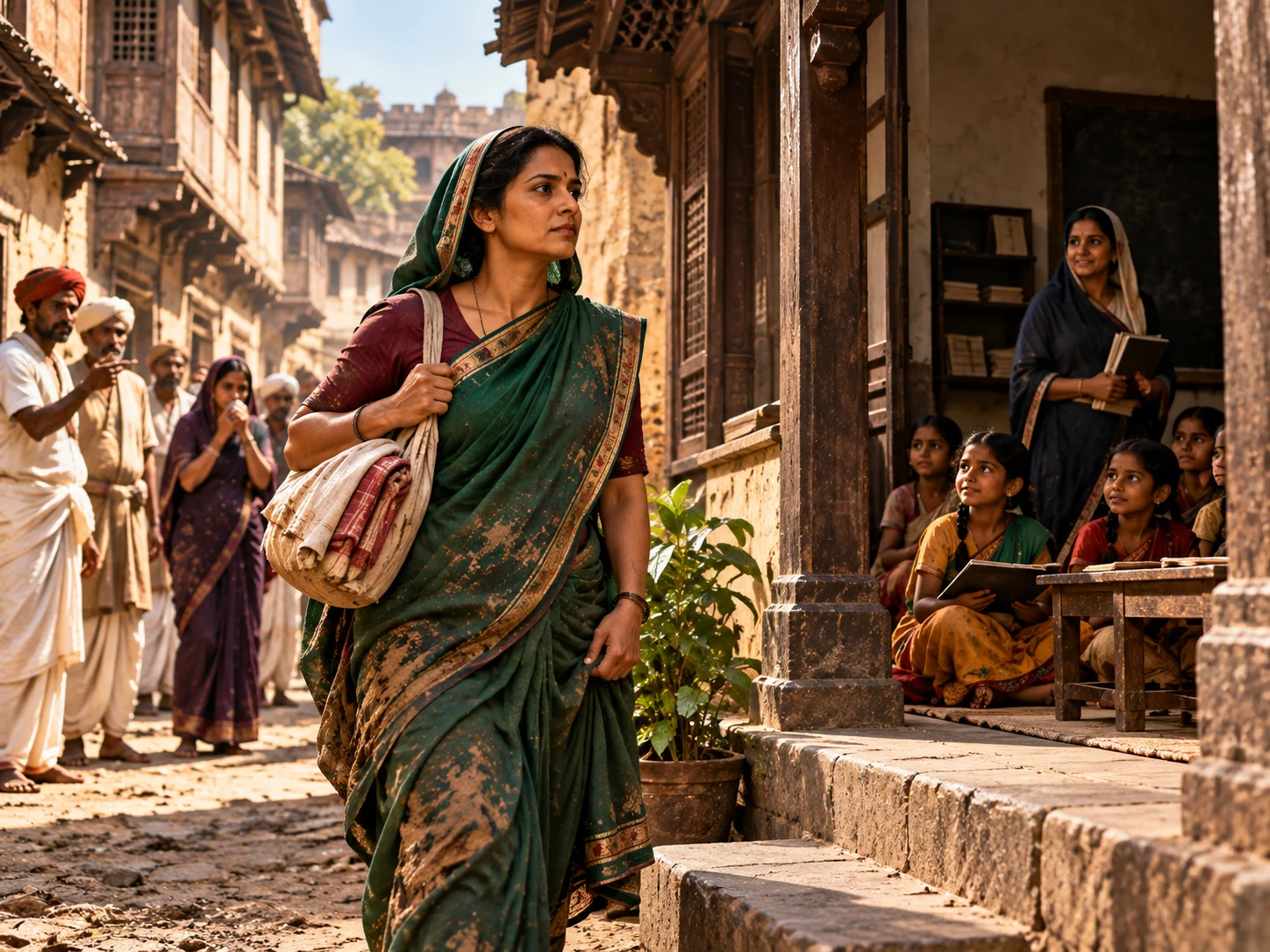
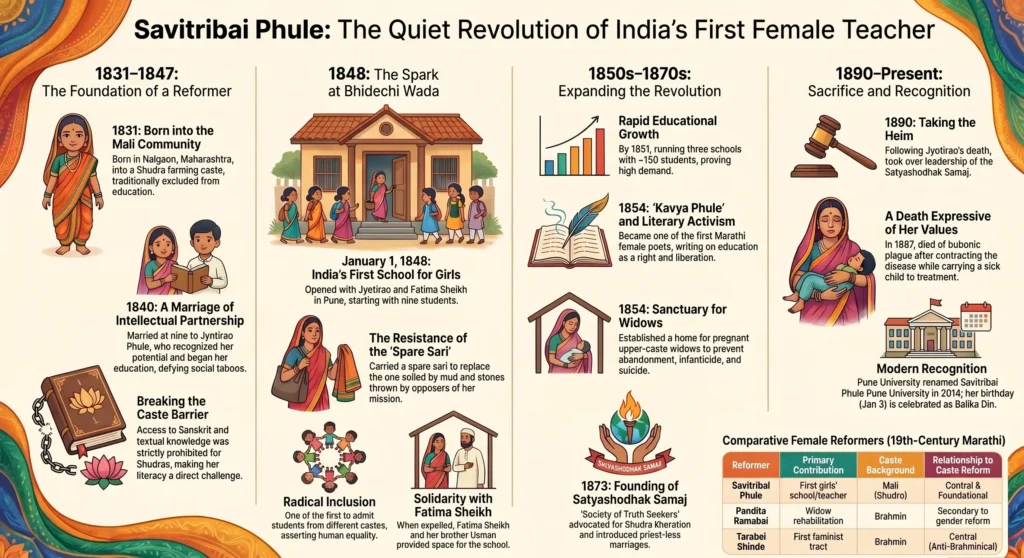
Every morning in Pune in 1848, a seventeen-year-old woman walked through streets where her neighbors, the people she had grown up among, threw mud, dung, and stones at her body because she was going to a school to teach girls. Every morning she carried a clean sari in her bag so she could arrive at the school gate, change out of the soiled one, and walk into the classroom as a teacher rather than as a target.
She did not take a different route. She did not stop going. She changed her sari and she taught.
This is what courage looks like in the actual texture of daily life, not the dramatic, once-off courage of a battlefield moment but the repetitive, unglamorous courage of someone who has decided that a thing needs to be done and continues doing it despite the daily, personal, physical cost of that decision. Savitribai Phule had that kind of courage in quantities that the history of nineteenth-century India did not adequately account for and that the history of modern India has been only slowly learning to recognize.
Savitribai Phule was a nineteenth-century Maharashtrian social reformer, poet, and educator who, alongside her husband Jyotirao Phule and her colleague Fatima Sheikh, opened India’s first school for girls in Pune on January 1, 1848. Born into a Mali family in Satara district, she became the first female teacher and school principal in modern Indian history at a time when educating girls, particularly girls from lower-caste backgrounds, was considered by the dominant social order to be both dangerous and immoral. Her life and work constitute one of the most consequential and least adequately recognized contributions to Indian social and educational history, a quiet revolution that changed the meaning of who counted as a citizen deserving of knowledge.
A closely related nineteenth-century reform voice appears in the story of Tarabai Shinde.
Hidden Networks of Aruna Asaf Ali During Underground Years
The Child Bride Who Became Her Own Teacher
Savitribai was born on January 3, 1831, in Naigaon, a village in the Satara district of Maharashtra. Her family were Mali, a farming caste classified within the Shudra varna, the fourth and lowest tier of the caste hierarchy, above the communities classified as untouchable but excluded from the educational and social privileges available to the upper castes.
In the Maharashtra of 1831, this birth determined almost everything that could and could not happen in a life. A girl born into a Mali family in a village in Satara was expected to be married young, to manage a household, to remain within the boundaries that caste and gender together drew around her existence, and to transmit those boundaries intact to her own children. Education was not part of the picture. The formal religious and social prohibition on Shudra access to Sanskrit learning, to textual knowledge, to the educational institutions controlled by the upper castes, had been in place for centuries and was enforced with the full weight of social sanction.
Savitribai was married at nine years old to Jyotirao Phule, who was twelve. This was not unusual for the time and place. What was unusual was Jyotirao himself, a young man whose own thinking about caste, education, and the position of women in Maharashtrian society was already moving in directions that the established social order would find increasingly difficult to accommodate.
Jyotirao had received some education and had come into contact with ideas, partly through the Scottish Mission School in Pune and partly through his own voracious intellectual engagement with the social and political thought available to him, that were directing him toward a systematic critique of caste hierarchy and Brahminical social dominance. He recognized in his child bride not a domestic appendage but a person of intelligence and potential, and he began to teach her to read.
This decision, made by a twelve-year-old boy in the 1840s in a village in Maharashtra, was the seed from which everything else grew. Savitribai’s own transformation from a child bride with no formal education to India’s first female school principal happened within a decade, one of the most extraordinary educational journeys in Indian history.
Strength of Kushal Konwar and the Assam Martyrs of 1942
The School That Should Not Have Existed
By the time Savitribai and Jyotirao were in their mid-teens, the project of her education had gone well beyond basic literacy. She had learned enough to be able to teach others, and the two of them, together with Fatima Sheikh, a Muslim woman who would become one of the least recognized pioneers of Indian educational history, began to plan what had never been done before in modern India: a school for girls that would be open to all castes.
Fatima Sheikh and her brother Usman Sheikh provided the space for the first school, their home in Bhidechi Wada in Pune, after Jyotirao and Savitribai were expelled from his father’s house under pressure from the community. The story of that expulsion is itself a precise indicator of what the established social order understood to be at stake. Jyotirao’s father, a man of the Mali community who had worked hard to establish himself and his family in the social and economic landscape of Pune, was told by community leaders that his son’s activities were bringing shame and danger on the family, and that if the teaching of girls and lower-caste children continued, the family would face social boycott.
He asked his son and daughter-in-law to stop. They declined. He expelled them from the house. They went to Fatima Sheikh’s home and opened the school.
The school that opened at Bhidechi Wada on January 1, 1848, began with nine students. Every one of them was there in defiance of the social order that said girls of their backgrounds had no right to be there. Their presence was itself an argument, made in bodies rather than in words, about the fundamental equality of human beings regardless of the caste and gender they had been born into.
Within a year, Savitribai and Jyotirao had opened two more schools. By 1851 they were running three schools with approximately one hundred and fifty students. The speed of this expansion, in conditions of active social opposition, is a measure not just of how much demand there was for what they were offering but of how effectively Savitribai had established herself as a teacher whose students and their families trusted her.
The Mythological World Woven Inside a Baluchari Saree
The Opposition That Would Not Stop
The opposition to what Savitribai was doing was not limited to the mud and stones thrown by individuals in the street. It was organized, sustained, and backed by the full weight of the religious and social establishment of Pune.
The Brahmin community leadership of Pune understood with considerable clarity what was at stake in the education of girls and lower-caste children. Knowledge had been one of the primary instruments of caste power for centuries. The restriction of access to education had been enforced not merely as social convention but as religious law, with severe penalties prescribed for those who violated the prohibition on Shudra access to learning. An educated Shudra woman who was teaching other Shudra women and children was dismantling this architecture of power one student at a time, and the people whose position depended on that architecture knew it.
They complained to the British colonial administration, arguing that the schools were a threat to social order. The administration, to its credit in this instance, declined to act on the complaints, having its own reasons for supporting the expansion of primary education in the region. They pressured community members to withdraw their children from the school. They threatened social and economic sanctions against families whose daughters attended. They confronted Jyotirao and Savitribai directly in a series of encounters that the accounts of the period preserve in considerable detail.
None of it worked. The students kept coming. Savitribai kept teaching. The spare sari kept doing its quiet, necessary work.
The Poetry That Carried the Argument
Savitribai Phule was not only a teacher and an organizer. She was a poet, and her poetry was an integral part of her practice of social change rather than a separate creative activity conducted alongside it. Her collection Kavya Phule, published in 1854 when she was twenty-three years old, made her one of the earliest known female poets in the Marathi literary tradition, and what she wrote about in those poems was not the decorative or devotional material that the tradition associated with women’s literary production.
She wrote about education as a right. She wrote about the violence done to women and lower-caste people by a social system that denied them access to knowledge. She wrote about the specific, embodied experience of being a woman who had decided to know things in a world that had organized itself around the principle that she should not. Her poems were calls to action written in the language of the people she was calling.
Her most frequently quoted verse, in which she calls on girls and women to educate themselves, to break the chains of ignorance, to seize the opportunity of learning as a liberation from bondage, reads not like a literary exercise but like a direct instruction from someone who understood from personal experience exactly what was being offered and exactly what refusing it had always cost.
The Sahitya Akademi has recognized Savitribai Phule’s literary contributions as foundational to the tradition of social reform literature in Marathi, placing her work within a lineage that includes the abhangas of the Varkari saints and the reformist prose of the nineteenth-century Maharashtra Renaissance. What distinguishes her poetry within that lineage is its combination of literary skill with a precise, personal, lived knowledge of the conditions it was describing.
The Widow Home and the Satyashodhak Samaj
The school was not the whole of Savitribai Phule’s public life. In 1854, she and Jyotirao established a home for upper-caste Hindu widows who had become pregnant, at a time when the social and religious codes governing widowhood in Maharashtra made such women subject to extreme violence, abandonment, and death, including forced head-shaving, denial of food, and in many cases infanticide of the children they bore. The home provided shelter, safe delivery, and the option of adoption for children born under these circumstances.
This intervention required a quality of courage different from the courage of the spare sari but no less substantial. Upper-caste widowhood was protected by religious sanction of the most serious kind, and the suggestion that widow remarriage was acceptable, that children born of widows deserved to live, and that the women themselves were not responsible for the circumstances of their suffering was a direct challenge to the religious authority of the Brahminical establishment in terms that made the challenge to educational exclusion look relatively mild.
In 1873, Savitribai and Jyotirao co-founded the Satyashodhak Samaj, the Society of Truth Seekers, an organization dedicated to the liberation of Shudra and Atishudra communities from Brahminical social and religious dominance. The Samaj developed a form of marriage ceremony that did not require a Brahmin priest, that was conducted in the language of the people being married rather than in Sanskrit, and that was open to couples across caste lines. This was a fundamental attack on one of the most financially and socially significant sources of Brahminical power, the monopoly on the performance of life-cycle rituals, and it was conducted by an organization that Savitribai was central to building and sustaining.
The Final Act
Jyotirao died in 1890. Savitribai, already fifty-nine years old and by the standards of the time very much in the latter portion of a life, did not retreat. She took over the leadership of the Satyashodhak Samaj. She continued to write. She continued to organize.
In 1897, a bubonic plague epidemic swept through Pune. Savitribai organized and personally participated in the relief effort, moving through plague-affected neighborhoods to bring patients to treatment, carrying the sick to care with her own hands at a time when the fear of contagion had driven most of Pune’s more comfortable residents as far from the affected areas as they could get.
She contracted the plague herself while carrying a plague-affected child to the treatment center. She died on March 10, 1897, at the age of sixty-six, in Pune, from the disease she had contracted in the act of saving someone else. Her death was as directly expressive of her values as any moment of her life.
The History That Tried to Forget Her
The manner in which Savitribai Phule was treated by Indian historical memory in the century following her death is itself a commentary on the social forces she had spent her life confronting. She was not included in the standard nationalist narratives of Indian history that were assembled in the decades following independence. Her husband Jyotirao Phule received somewhat more recognition, but even he remained marginal to the dominant upper-caste nationalist historiography that celebrated figures more compatible with its own social assumptions.
The recovery of Savitribai Phule as a historical figure of the first importance has been the work of Dalit and feminist scholars and activists working from the 1970s onward, who insisted on her place in the history of Indian education, social reform, and literature not as a courtesy or an addition to the main narrative but as a correction of a record that had been systematically distorted by the same forces she had spent her life opposing.
The Government of India issued a commemorative postage stamp in her honor in 1998. Pune University was renamed Savitribai Phule Pune University in 2014, one hundred and seventeen years after her death. January 3, her birth anniversary, is observed in Maharashtra as Balika Din, Girls Day. These recognitions are significant and they are also very late, arriving more than a century after the life they are acknowledging.
Dr. B.R. Ambedkar, whose own transformation of Indian constitutional and social thought was deeply shaped by the tradition of Phule, explicitly acknowledged the Phule legacy as foundational to his understanding of caste, education, and the necessary conditions for genuine democracy in India.
The nine girls who sat in the first classroom at Bhidechi Wada on January 1, 1848, have been waiting a long time for the world to understand what they were part of.
Quick Comparison Table
| Aspect | Savitribai Phule | Pandita Ramabai | Tarabai Shinde |
|---|---|---|---|
| Era | 19th century | 19th to 20th century | 19th century |
| Region | Pune, Maharashtra | Maharashtra, later Kedgaon | Maharashtra |
| Primary Contribution | First girls school, first female teacher in modern India | Women’s education, widow rehabilitation, Christian conversion reform | First feminist tract in Marathi literature |
| Caste Background | Mali, Shudra community | Brahmin family | Brahmin family |
| Key Work | Kavya Phule, Bavan Kashi Subodh Ratnakar | Stri Dharma Neeti, The High-Caste Hindu Woman | Stri Purush Tulna |
| Institutional Legacy | Satyashodhak Samaj, schools across Pune | Mukti Mission, Sharada Sadan | Influenced later feminist writing in Maharashtra |
| Recognition Today | Savitribai Phule Pune University, January 3 as Balika Din | Pandita Ramabai Mukti Mission continues | Largely unrecognized outside academic circles |
| Relationship to Caste Reform | Central, foundational | Secondary to gender reform | Central, specifically anti-Brahminical |
Curious Indian: Fast Facts
- Savitribai Phule began her own education only after her marriage at nine years old, taught by her husband Jyotirao, making her transformation from a child bride with no formal education to India’s first female school principal within a decade one of the most extraordinary educational journeys in Indian history.
- The school at Bhidechi Wada opened with nine students on January 1, 1848, making it not only India’s first girls school but one of the earliest institutions in the subcontinent to explicitly admit students across caste lines.
- Fatima Sheikh, who co-founded the school with Savitribai and provided the physical space at her family home after Savitribai and Jyotirao were expelled from their household, remains one of the most inadequately recognized figures in Indian educational history, her contribution having been largely erased from mainstream accounts for over a century.
- Savitribai Phule’s poetry collection Kavya Phule, published in 1854, makes her one of the earliest known female poets in the Marathi literary tradition and one of the very few women of her era and social background to have published a literary work in any Indian language.
- She and Jyotirao established a home for upper-caste Hindu widows who had become pregnant, offering shelter and safe delivery at a time when such women faced severe social violence including forced isolation, starvation, and in many cases death along with the death of their children.
- The Satyashodhak Samaj that Savitribai co-founded with Jyotirao in 1873 developed marriage ceremonies conducted without Brahmin priests, in the spoken language of the participants rather than in Sanskrit, an act that directly challenged one of the most financially significant monopolies held by the priestly class.
- Savitribai took over leadership of the Satyashodhak Samaj after Jyotirao’s death in 1890, continuing to organize and write until the plague epidemic of 1897 that she entered on behalf of others and from which she did not return.
- She died of bubonic plague on March 10, 1897, having contracted the disease while carrying a plague-affected child to a treatment center, making her death as directly expressive of her values as any moment of her life.
- Savitribai Phule Pune University, one of the largest universities in Maharashtra with over six hundred affiliated colleges, was renamed in her honor in 2014, one hundred and seventeen years after her death.
- Dr. B.R. Ambedkar, whose own transformation of Indian constitutional and social thought was deeply shaped by the tradition of Phule, explicitly acknowledged the Phule legacy as foundational to his understanding of caste, education, and the necessary conditions for genuine democracy in India.
What the School Was Actually Saying
Every morning that Savitribai Phule walked through the streets of Pune with a spare sari in her bag, she was making an argument that could not be made in any other way. She was saying, through the act of continuing, that the right of a girl to learn was not contingent on the approval of the people who stood to lose power if girls learned. She was saying that social permission was not a prerequisite for social justice. She was saying that the way you change a thing that has been wrong for a very long time is to change it, beginning now, beginning with nine students in a borrowed room, beginning with a spare sari and a daily walk through people who do not want you to arrive.
That argument is not finished. It was not finished when she died in 1897 having contracted a fatal disease in the act of caring for a sick child. It is not finished now. But the terms on which it continues to be made were established in Pune in 1848, by a seventeen-year-old woman who changed her sari at the school gate and walked into a classroom to teach.
Savitribai Phule’s revolution was quiet in the sense that it was conducted without armies, without the political machinery of a movement with institutional backing, and without the kind of cultural visibility that the dominant society of her time was prepared to grant to a Mali woman from Satara who had taught herself to read and then decided to teach others.
It was not quiet in any other sense. It happened in the streets of Pune, in full view of the people who were throwing things at her. It happened in classrooms where nine girls, and then more, and then more after that, sat and learned things that the social order had decided they had no right to know. It happened in the homes of widows who had been abandoned to die and instead found someone who thought their lives were worth more than the shame they had been assigned. It happened in the Satyashodhak Samaj’s marriage ceremonies, where couples married across caste lines in their own language without asking a priest’s permission.
The revolution was quiet only in contrast to the noise of the opposition. Against the background of the actual historical record, what Savitribai Phule did makes an enormous sound, the sound of a social order being cracked open from below by someone who had every reason to accept her assigned position and chose instead to change the terms entirely.
She walked to school every morning with a spare sari in her bag. She changed at the gate. She walked in and taught. She did this until there was a school system where before there had been none, until there were teachers where before there had been none, until there were girls who could read where before there had been none.
The nine students in Bhidechi Wada on January 1, 1848, became the beginning of a line that has not ended. That is what a quiet revolution actually looks like when it is allowed to run its full course.
Double Ikat Patola of Patan and Why It Takes a Year to Weave
If you think you have remembered everything about this topic take this QUIZ
Results


#1. On which date did Savitribai Phule, Jyotirao Phule, and Fatima Sheikh open India’s first school for girls in Pune?
#2. Savitribai Phule belonged to which of the following communities?
#3. Who provided the physical space for the first girls school at Bhidechi Wada after Jyotirao and Savitribai were expelled from his father’s house?
#4. How many students were enrolled at the first girls school in Bhidechi Wada at its inception?
#5. What is the title of Savitribai Phule’s poetry collection published in 1854?
#6. In addition to educational institutions, what did Savitribai and Jyotirao Phule establish in the year 1854 to protect vulnerable women?
#7. Savitribai Phule contracted a fatal case of bubonic plague in 1897 while performing which humanitarian act?
#8. Which day is celebrated as Balika Din (Girls Day) in Maharashtra to commemorate Savitribai Phule’s birth anniversary?
Who was Savitribai Phule and why is she called India’s first female teacher?
Savitribai Phule was a nineteenth-century Maharashtrian social reformer, poet, and educator born on January 3, 1831, in Naigaon, Satara district. She is called India’s first female teacher in the modern sense because on January 1, 1848, she opened and began teaching at India’s first school for girls at Bhidechi Wada in Pune, a school explicitly open to girls of all castes at a time when both the education of women and the education of lower-caste people were socially and religiously prohibited.
What role did Fatima Sheikh play in founding India’s first girls school?
Fatima Sheikh was a Muslim woman whose contribution to the founding of India’s first girls school has been systematically underrecognized in mainstream historical accounts for over a century. When Savitribai and Jyotirao Phule were expelled from Jyotirao’s family home under community pressure because of their educational activities, Fatima Sheikh and her brother Usman Sheikh provided their family home at Bhidechi Wada in Pune as the space for the first school. Fatima Sheikh also taught at the school alongside Savitribai, making her the first Muslim woman to teach in a modern Indian school.
How did the established social order respond to Savitribai Phule’s school?
The response of the established social order to Savitribai Phule’s school was immediate, organized, and sustained. At the individual and community level, she faced daily physical opposition including mud, dung, and stones thrown at her by people in the neighborhoods she walked through to reach the school. At the institutional level, the Brahmin community leadership of Pune complained to the British colonial administration, pressured families to withdraw their daughters from the school, and organized social and economic boycotts against families whose children attended. Jyotirao’s father was pressured into expelling both of them from the family home, and the community attempted to use religious authority to declare their activities sinful and their students polluted by association. u003cbru003e
What was Savitribai Phule’s contribution to Marathi literature?
Savitribai Phule’s poetry collection Kavya Phule, published in 1854 when she was twenty-three years old, makes her one of the earliest known female poets in the Marathi literary tradition and one of the very few women of her caste background to have published a literary work in any Indian language in the nineteenth century. Her poems addressed themes of education as liberation, the violence of caste and gender discrimination, and the moral urgency of social reform, making them social documents as well as literary ones. u003cbru003e
Why did it take so long for Savitribai Phule to receive formal historical recognition?
The dominant nationalist historiography of post-independence India was constructed primarily by upper-caste scholars and political figures who built their narratives around figures compatible with their own social assumptions and caste positions. The recovery of her legacy was driven by Dalit and feminist movements that challenged the dominant narrative from the 1970s onward and insisted on her inclusion not as an addition to a story that was otherwise complete but as a correction to a record that had been falsified by omission. The renaming of Pune University in her honor in 2014 and the observance of January 3 as Balika Din in Maharashtra represent the partial institutional acknowledgment of this correction.