Tuesday, May 19, 2026
25 °c
Social Circle
Curious Indian
  • Arts & Culture
  • Festivals of India
  • Indian History
  • Indian Politics
  • Biography
    • Entertainment Personalities
    • Science Personalities
  • Unsolved India
No Result
View All Result
  • Arts & Culture
  • Festivals of India
  • Indian History
  • Indian Politics
  • Biography
    • Entertainment Personalities
    • Science Personalities
  • Unsolved India
No Result
View All Result
Curious Indian
No Result
View All Result
Home Biography

The Final Letters of Khudiram Bose and Soul of Young Bengal

paripurnadatta by paripurnadatta
in Biography, Colonial India, Freedom Fighters, Indian History
Reading Time: 16 mins read
0 0
A A
Khudiram Bose
Share on FacebookShare on Twitter

Table of Contents

Toggle
  • The Final Letters of Khudiram Bose and the Soul of Young Bengal
  • The Boy From Midnapore
  • Bal Gangadhar Tilak and the Political Climate
  • The Muzaffarpur Bombing and What Actually Happened
    •  
  • The Trial and the Final Letters
  • The Morning of 11 August 1908
  • The Revolutionary Tradition He Helped Create
  • Quick Comparison Table
  • Curious Indian: Fast Facts
  • Conclusion
  • If you think you have remembered everything about this topic take this QUIZ
    • Who was Khudiram Bose and why is he significant in Indian history?
    • What was the Muzaffarpur bombing and what were its consequences?
    • What did Khudiram write in his final letters?
    • Why was Khudiram Bose targeting Judge Kingsford?
    • How is Khudiram Bose remembered in Bengal today?

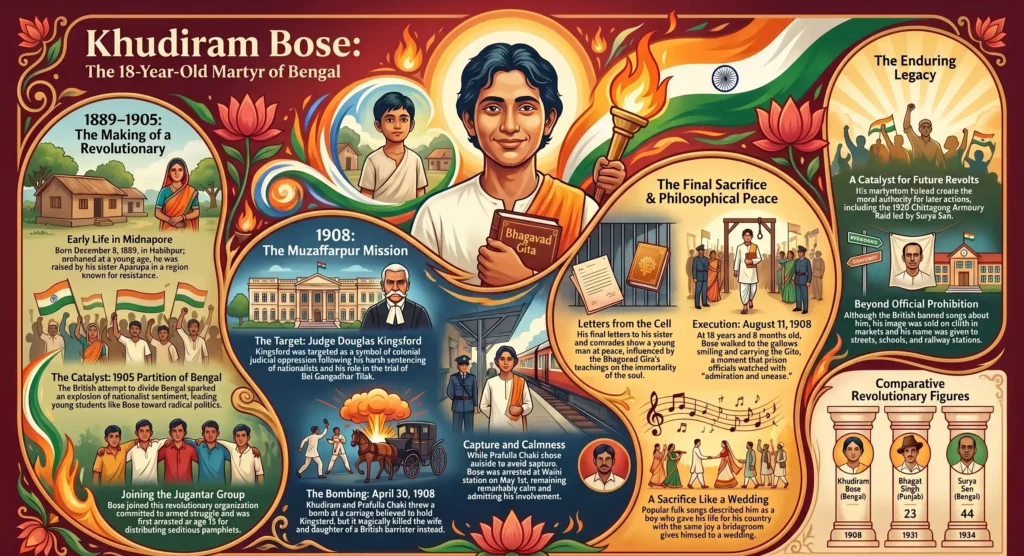
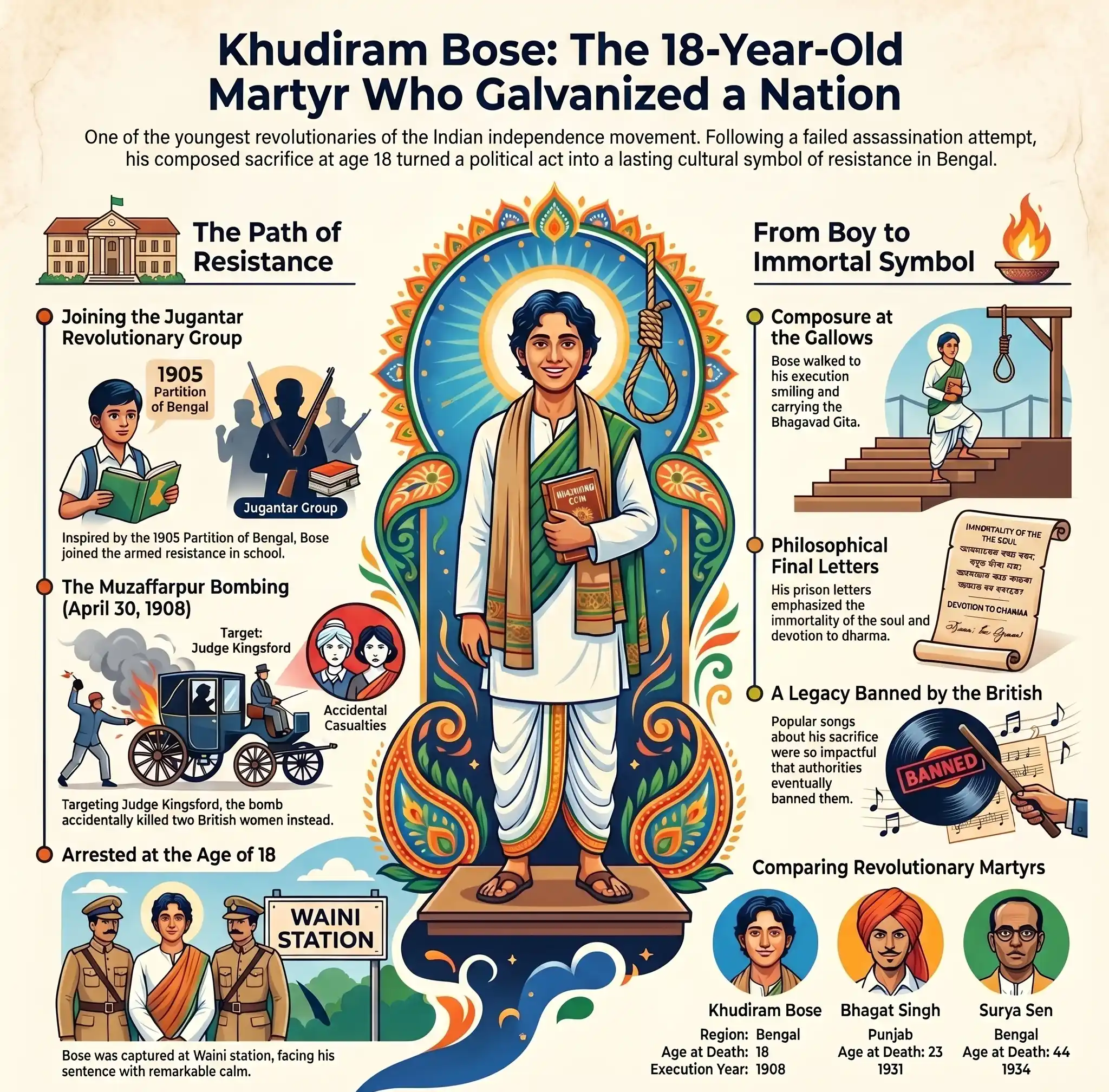
Khudiram Bose was a revolutionary from Midnapore district in Bengal who was executed by the British colonial government in 1908 at the age of eighteen, making him one of the youngest martyrs of the Indian independence movement. His attempt to assassinate the colonial judge Kingsford in Muzaffarpur failed to hit its intended target but set off a chain of events that galvanized revolutionary nationalism across Bengal and beyond. His final letters, his composure at the gallows and the songs that Bengal composed about him in the weeks after his death reveal something essential about what his sacrifice meant to the generation that witnessed it. This piece traces his short life, his act and the long aftermath of his eighteen years.

DetailInformation
SubjectKhudiram Bose
Born3 December 1889, Habibpur, Midnapore, Bengal
Died11 August 1908, Muzaffarpur, Bihar
Cause of DeathExecuted by hanging, British colonial government
Age at Execution18 years
Key ActMuzaffarpur bombing, 30 April 1908
Associated WithJugantar revolutionary group
LegacyYoungest revolutionary martyr of the Indian independence movement
Khudiram Bose

The Final Letters of Khudiram Bose and the Soul of Young Bengal

There is a song that became so popular in Bengal after Khudiram Bose’s execution in 1908 that British authorities eventually banned it from public performance. The song described him as a boy who went to the gallows smiling, who gave his life for the country the way a bridegroom gives himself to a wedding, with joy and without hesitation. It spread through Bengal’s villages, mills and schools in the weeks after his death, sung by people who had never met him and never would. By the time the British colonial government tried to suppress it, the song was already inside the culture. It has stayed there ever since.

This is what it means to become a symbol. Not simply to die for a cause but to die in a way that a people recognizes as the fullest possible expression of something they already felt but had not yet found words for.

The Boy From Midnapore

Khudiram Bose was born on 3 December 1889 in Habibpur village in Midnapore district, the same district that would produce Matangini Hazra three decades later and that had been a center of organized resistance to colonial authority for generations. He was the youngest of four children. Both his parents died before he was in his teens and he was raised by his elder sister Aparupa and her husband.

He was introduced to revolutionary nationalism while still in school in Medinipur town, where the atmosphere of political agitation in Bengal following the 1905 Partition of Bengal had reached even the youngest students. The Partition, which the British colonial government had implemented as an administrative measure but which Indians widely understood as a deliberate attempt to divide Hindu and Muslim communities in Bengal, had produced an explosion of nationalist sentiment. Young men across the province were joining revolutionary organizations, reading radical publications and discussing whether constitutional methods were sufficient to the scale of the injustice being done.

READ MORE:  Hema Malini: From Cinema's Darling to Mathura's MP

Khudiram joined the revolutionary group Jugantar, which operated on the principle that armed resistance was a necessary component of the independence struggle. He began participating in activities including the distribution of seditious pamphlets and was arrested by colonial authorities for the first time at the age of fifteen. He was released because of his age but remained active in the revolutionary network.

Bal Gangadhar Tilak and the Political Climate

The political moment in which Khudiram came of age was shaped significantly by the radical nationalist Bal Gangadhar Tilak, whose newspaper Kesari had been arguing for years that moderate constitutional approaches to independence were insufficient. Tilak’s philosophy of swaraj, or self-rule, and his insistence that Indians had a right to resist colonial authority by more forceful means if necessary, provided an ideological framework within which the actions of revolutionary groups like Jugantar felt not only justified but necessary.

When the colonial government put Tilak on trial for sedition in 1908, the proceedings were presided over by a judge named Douglas Kingsford who delivered a verdict widely regarded in nationalist circles as a travesty of justice. Kingsford became a symbol of colonial judicial oppression. The decision by Khudiram and his fellow revolutionary Prafulla Chaki to target Kingsford in Muzaffarpur, where he had been transferred after the trial, was rooted in this political context.

The Muzaffarpur Bombing and What Actually Happened

On the evening of 30 April 1908, Khudiram and Prafulla Chaki waited outside the European Club in Muzaffarpur for the carriage they believed carried Kingsford. When a carriage emerged, they threw their bomb at it. The explosion was powerful. But the carriage did not carry Kingsford. It carried the wife and daughter of a British barrister named Pringle Kennedy. Both women were killed.

The deaths of two women who had no connection to the colonial judicial system that Khudiram and Prafulla were targeting was a consequence that the revolutionary movement could not easily absorb morally. The British colonial press used the incident to delegitimize revolutionary nationalism. The moderate Congress was horrified. Even within the revolutionary circles, the accidental deaths produced grief and complicated debate.

Prafulla Chaki was cornered by police the following day and shot himself rather than be captured. Khudiram ran but was caught at Waini railway station on 1 May 1908. He was calm when arrested, made no attempt to deny his involvement and showed from the first moments of his detention the composure that would characterize everything that followed.


1 of 3
– +
Khudiram Bose
Khudiram Bose
Khudiram Bose

The Trial and the Final Letters

Khudiram’s trial moved quickly. The evidence was clear and he did not contest the essential facts. He was found guilty of murder and sentenced to death. He was eighteen years old.

In the period between his sentencing and his execution, Khudiram wrote several letters. The letters that survive, preserved through archives maintained by the West Bengal State Archives and referenced extensively in historical accounts of the period, reveal a young man who had thought carefully about what he was doing and what it meant. He wrote to his sister Aparupa. He wrote to fellow revolutionaries. The letters do not read as the writings of someone in despair or regret. They read as the writings of someone who has made a decision he understands completely and is at peace with.

He wrote about his belief in the rightness of the cause. He wrote about the Bhagavad Gita, which he had been reading in his cell, and about the Gita’s teaching that the soul is not destroyed by the death of the body, that action taken in the service of dharma carries its own justification regardless of consequence. He wrote to his sister with affection and with the specific kind of tenderness that a person who knows they will not see someone again puts into a final letter.

READ MORE:  Daulat Singh Kothari: Physicist Who Built India's Scientific Future

These letters are among the most remarkable documents of the Indian independence movement. They were written by a boy who had not yet turned nineteen, who had caused the deaths of two innocent people through a miscalculation, who was about to be hanged by a colonial government, and who was nonetheless able to write with philosophical clarity and personal warmth about what he believed and why.

The Morning of 11 August 1908

Khudiram Bose was executed at Muzaffarpur jail on 11 August 1908. He walked to the gallows carrying the Bhagavad Gita. The prison officials who were present at the execution reportedly noted his composure with a mixture of admiration and unease. He was, by all accounts, not afraid.

The news of his execution spread through Bengal with the speed of something that people had been waiting for without knowing they were waiting. Not waiting for his death specifically, but waiting for a proof that the revolutionary generation was serious, that the young men who talked about giving their lives for India were not simply talking. Khudiram Bose provided that proof at eighteen years old, and Bengal responded with the grief and the songs and the anger that his death deserved.

Songs were composed. His image was printed on cloth and sold in markets. His name was given to streets, schools and institutions. The British colonial government, recognizing that his execution had produced the opposite of its intended deterrent effect, attempted to restrict public mourning and the distribution of his image. These restrictions had little practical effect. Khudiram was already inside the culture of Bengal in a way that official prohibition could not reach.

The Revolutionary Tradition He Helped Create

Khudiram Bose did not live to see the movement he had contributed to develop into its later and more organized forms. But the tradition of revolutionary nationalism in Bengal that produced the Chittagong Armoury Raid led by Surya Sen in 1930 and the broader network of armed resistance that persisted through the 1930s drew directly on the example he had set. Young revolutionaries across Bengal grew up knowing his name and his story. His death was part of the education of a generation.

The political philosopher and historian Bipin Chandra Pal, whose writings on the revolutionary period are preserved through the records of the Indian Council of Historical Research, wrote extensively about how martyrdom functions in nationalist movements, arguing that the willingness of individuals to sacrifice everything for the cause creates a moral authority that political argument alone cannot generate. Khudiram’s execution was exactly this kind of event. It turned an argument about freedom into a lived reality that people could feel personally.

Quick Comparison Table

FeatureKhudiram BoseBhagat SinghSurya SenMasterda Surya Sen
RegionBengalPunjabBengalBengal
Age at Death18234444
MethodBombing attemptShooting, bomb throwingArmed revoltArmed revolt
Associated GroupJugantarHindustan Socialist Republican AssociationIndian Republican ArmyIndian Republican Army
Execution Year1908193119341934
LegacyYoungest martyr, Bengal iconNational icon, Inquilab ZindabadChittagong Armoury RaidChittagong Armoury Raid

Curious Indian: Fast Facts

  • Khudiram Bose was executed at the age of eighteen years and eight months, making him one of the youngest people executed by the British colonial government in India
  • He carried the Bhagavad Gita to the gallows on the morning of his execution at Muzaffarpur jail on 11 August 1908
  • The bomb thrown at Muzaffarpur on 30 April 1908 missed its intended target, colonial judge Kingsford, and killed the wife and daughter of a British barrister instead
  • His fellow revolutionary Prafulla Chaki shot himself rather than be captured by police the day after the bombing
  • Songs composed about Khudiram after his execution became so popular that British colonial authorities banned them from public performance
  • His final letters to his sister and fellow revolutionaries, written from his prison cell, remain among the most remarkable documents of the Indian independence movement
  • He was first arrested by colonial authorities at the age of fifteen for distributing seditious pamphlets
  • His name has been given to streets, schools, railway stations and institutions across West Bengal
READ MORE:  Ancient Secrets of Indian Rock-Cut Architecture: Journey Through Stone

Conclusion

Khudiram Bose was eighteen years old and he knew exactly what he was doing. He had read the Gita. He had thought about death and decided that the death of the body was not the end of what a person was. He had decided that the cause of Indian freedom was worth the full cost of his participation in it, including the final cost.

He also knew that the bomb he threw had not hit the person it was aimed at. That knowledge was part of what he carried to the gallows, alongside the Gita and alongside whatever a boy of eighteen carries inside him when he has run out of tomorrows. He did not pretend the outcome had been what he intended. He accepted the full weight of what had happened and faced the consequences with a composure that people twice his age rarely find.

What Bengal made of his death was larger than what he could have intended. The songs, the images, the stories told about him in villages and mills and schools created a version of Khudiram Bose that was already becoming mythological while his body was still being mourned. That version carried the independence movement forward in a way that is impossible to measure but impossible to ignore.

He was a boy. He became a symbol. Both things are true, and both things matter.

If you think you have remembered everything about this topic take this QUIZ

Who was Khudiram Bose and why is he significant in Indian history?

Khudiram Bose was a revolutionary from Midnapore district in Bengal who was executed by the British colonial government in 1908 at the age of eighteen. He is significant as one of the youngest martyrs of the Indian independence movement and as a defining figure of the revolutionary nationalist tradition in Bengal. His composure at the gallows and his final letters made him a powerful symbol of the willingness of young India to sacrifice everything for freedom.

What was the Muzaffarpur bombing and what were its consequences?

The Muzaffarpur bombing took place on 30 April 1908, when Khudiram and his fellow revolutionary Prafulla Chaki threw a bomb at a carriage they believed carried the colonial judge Kingsford. The bomb hit the wrong carriage and killed the wife and daughter of a British barrister. Prafulla Chaki shot himself the following day to avoid capture. Khudiram was arrested, tried and executed. The incident galvanized revolutionary nationalism in Bengal while also prompting serious debate within the movement about methods and targets.

What did Khudiram write in his final letters?

Khudiram’s final letters, written from his prison cell between his sentencing and his execution, addressed his sister Aparupa and fellow revolutionaries. They expressed his belief in the rightness of the independence cause, his engagement with the Bhagavad Gita’s teaching about the soul’s continuity beyond bodily death and his personal affection for those he was leaving behind. The letters reveal a philosophical clarity and emotional warmth that is remarkable given the circumstances in which they were written.

Why was Khudiram Bose targeting Judge Kingsford?

Douglas Kingsford was a colonial judge who had presided over the sedition trial of Bal Gangadhar Tilak and had delivered a verdict widely regarded in nationalist circles as unjust. He had also been responsible for harsh sentences against young Bengali nationalists in earlier cases. Revolutionary groups including Jugantar identified him as a symbol of colonial judicial oppression and decided to target him as an act of political resistance.

How is Khudiram Bose remembered in Bengal today?

Khudiram Bose is remembered across West Bengal through streets, schools, railway stations and institutions bearing his name. His image continues to be associated with the tradition of revolutionary sacrifice in Bengali nationalist culture. His execution date, 11 August, is observed in West Bengal. His story is taught in schools and his final letters and the songs composed about him after his death remain part of the living cultural memory of Bengal’s independence movement.

ShareTweetPin
paripurnadatta

paripurnadatta

Related Posts

Bhikaiji Cama
Biography

How Madam Bhikaiji Cama Unfurled India’s Flag in Germany

May 19, 2026
Matangini Hazra
Biography

Matangini Hazra: The Widow Who Walked Into Gunfire

May 19, 2026
Gommateshwara statue
Ancient Civilizations & The Vedic Age

Gommateshwara Statue and the Philosophy of Inner Peace

May 19, 2026
No Result
View All Result

Stay Updated

  • Trending
  • Latest
Life of Mahavira: From Prince Vardhamana to Great Conqueror

Life of Mahavira: From Prince Vardhamana to Great Conqueror

April 11, 2026
Life of Buddha: The Journey to Enlightenment

Life of Buddha: The Journey to Enlightenment

April 11, 2026
Christmas in India

Christmas in India: A Festive Blend of Faith, Flavors, and Tradition

April 11, 2026
From Shimla to Stardom: The Complete Biography of Anupam Kher

From Shimla to Stardom: The Complete Biography of Anupam Kher

April 11, 2026
Khudiram Bose

The Final Letters of Khudiram Bose and Soul of Young Bengal

May 19, 2026
Bhikaiji Cama

How Madam Bhikaiji Cama Unfurled India’s Flag in Germany

May 19, 2026
Matangini Hazra

Matangini Hazra: The Widow Who Walked Into Gunfire

May 19, 2026
Gommateshwara statue

Gommateshwara Statue and the Philosophy of Inner Peace

May 19, 2026

Widget Title

Facebook Twitter Youtube RSS
Curious Indian Logo

Explore the soul of Bharat with Curious Indian. A definitive guide to Indian history, arts, culture, biographies, and the events that defined our future.

Follow us on social media:

Recent News

  • The Final Letters of Khudiram Bose and Soul of Young Bengal
  • How Madam Bhikaiji Cama Unfurled India’s Flag in Germany
  • Matangini Hazra: The Widow Who Walked Into Gunfire

Category

  • Ancient Civilizations & The Vedic Age
  • Architecture
  • Artists & Cultural Icons
  • Arts & Culture
  • Battles of India
  • Biography
  • Business & Industrialists
  • Colonial India
  • Cultural Insights
  • Dance & Music
  • Entertainment Personalities
  • Festivals of India
  • Freedom Fighters
  • Freedom Movement
  • Historical Events & Turning Points
  • Indian History
  • Indian Politics
  • Major Festivals
  • Medieval India
  • North East India
  • Paintings & Visual Arts
  • Political Leaders
  • Post-Independence India
  • Regional Culture
  • Religious & Spiritual Figures
  • Science Personalities
  • Scientific Discoveries
  • Sculpture
  • Social Issues
  • SOCIETY & MYSTERIES
  • Strange & Unknown Stories
  • Textiles & Handicrafts
  • Uncategorized
  • Unsolved India
  • Unsung Heroes

© 2026 Curious Indian- Everything about India

Welcome Back!

Login to your account below

Forgotten Password?

Retrieve your password

Please enter your username or email address to reset your password.

Log In

Add New Playlist

No Result
View All Result
  • Arts & Culture
  • Festivals of India
  • Indian History
  • Indian Politics
  • Biography
    • Entertainment Personalities
    • Science Personalities

© 2026 Curious Indian- Everything about India

This website uses cookies. By continuing to use this website you are giving consent to cookies being used. Visit our Privacy and Cookie Policy.
Are you sure want to unlock this post?
Unlock left : 0
Are you sure want to cancel subscription?
×