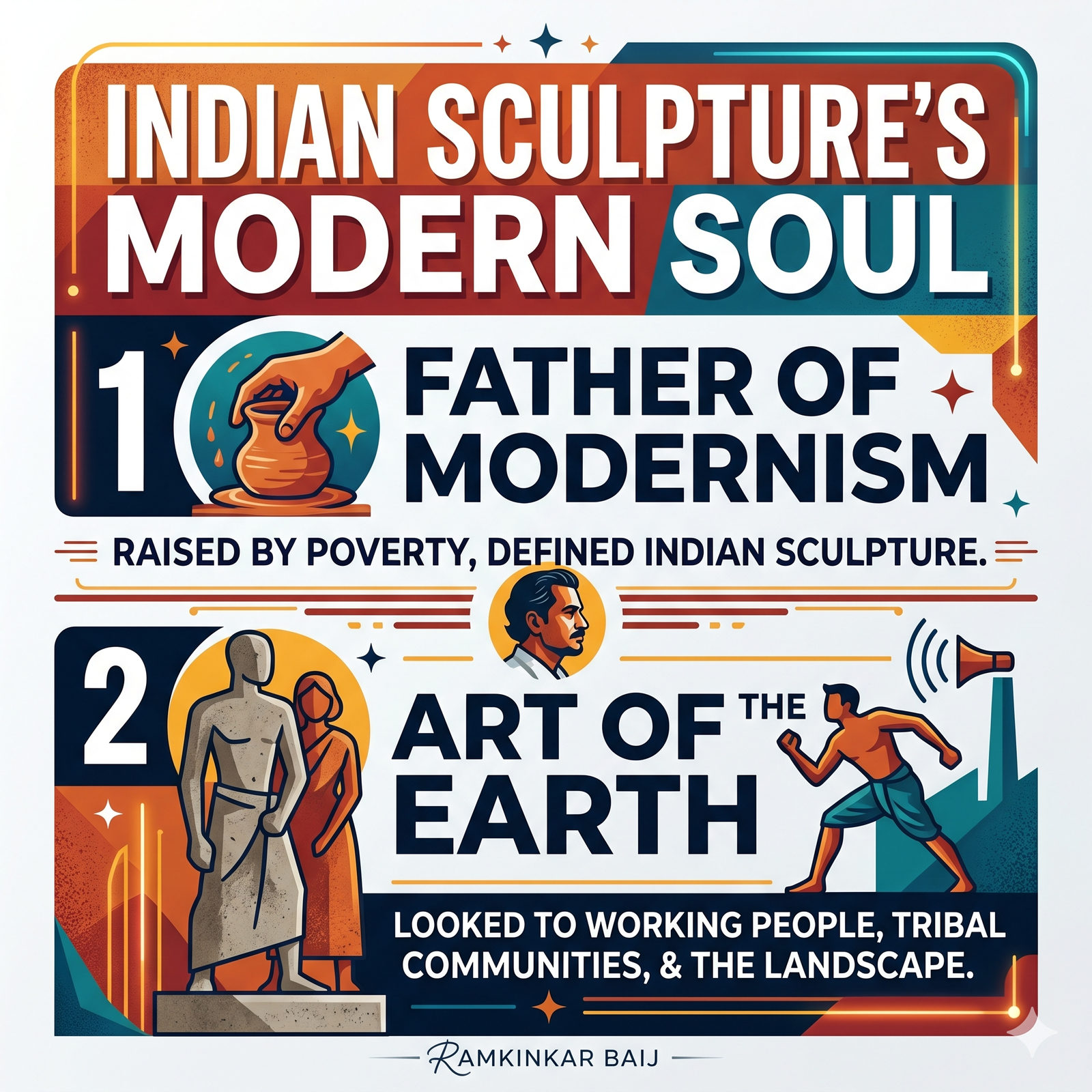
Ramkinkar Baij was born into poverty in Bankura, West Bengal in 1906 and died as one of the most important artists India has ever produced. Working primarily at Santiniketan, he broke away from both the academic realism of colonial Indian art and the classical conventions of ancient temple sculpture. He looked instead at the workers, the Santali tribal communities, and the landscape around him and turned those observations into monumental cement and stone works that shocked and moved people in equal measure. This piece traces his journey from a small-town boy with clay in his hands to a sculptor whose work still defines what modern Indian art can be.| Detail | Information |
| Subject | Ramkinkar Baij |
| Born | 1906, Bankura, West Bengal, India |
| Died | 1980, New Delhi, India |
| Profession | Sculptor, Painter, Printmaker |
| Art Movement | Indian Modernism |
| Associated Institution | Kala Bhavana, Visva Bharati University, Santiniketan |
| Mentor | Nandalal Bose |
| Notable Works | Sujata, Yaksha Yakshi, Mill Call, Santali Family |
| Medium | Cement, Stone, Wood, Metal, Terracotta |
| Awards | Padma Bhushan (1970) |
| Legacy | Pioneer of modern Indian sculpture |

Ramkinkar Baij and the Modern Soul of Indian Sculpture
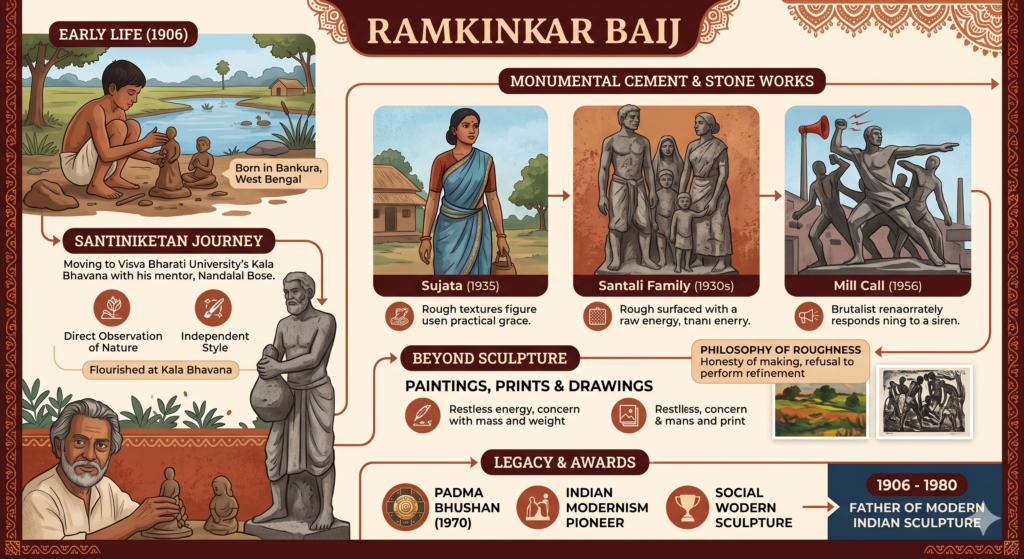
There is a large cement sculpture at Santiniketan that most visitors walk past without fully stopping. It shows a group of Santali tribal workers, rendered in rough, unpolished surfaces, their bodies caught mid-stride as if they are actually moving through the campus grounds. The work is called Santali Family and it was made by Ramkinkar Baij sometime in the 1930s. It looks nothing like the smooth bronze figures you might see in a government museum. It looks like the earth itself decided to take human form.
That quality, raw, immediate and deeply rooted in the Indian soil, is what separates Ramkinkar Baij from every sculptor who came before him in this country.
A Barber’s Son Who Saw Art in Everything
Ramkinkar was born in 1906 in Jugipara, a small locality in Bankura district, West Bengal. His father was a barber. His family had no connection to the arts in any formal sense. But the boy had a habit that his neighbors found peculiar. He would sit for hours molding figures from clay he collected near the village pond. He drew on walls. He studied the terracotta temple decorations of Bankura with the intensity of a scholar, though no one had told him those were worth studying.
When he was a teenager, his talent caught the attention of a local collector who helped him get access to better materials and eventually some recognition. But the real turning point came when he was brought to Santiniketan and introduced to Rabindranath Tagore’s Visva Bharati University, specifically its art school, the Kala Bhavana.
Santiniketan and the Freedom to Experiment
Kala Bhavana under Nandalal Bose was not a conventional art school. Students were encouraged to observe nature directly, to study Indian classical traditions without being enslaved by them, and to find their own visual language rather than imitating European academic conventions. For a young man from Bankura who had already developed his instincts independently, this environment was exactly right.
Ramkinkar flourished here. He eventually became a teacher at Kala Bhavana and spent most of his working life at Santiniketan, rarely leaving, deeply embedded in the rhythms of its landscape and its communities. He lived simply, often in financial difficulty, and poured everything he had into his work.
Scholars associated with Visva Bharati University have noted that Ramkinkar’s relationship with Santiniketan was not merely institutional. It was ecological. He absorbed the red laterite soil, the Santali villages, the seasonal workers, the sal forests and the open skies of Birbhum district into his artistic vision. His sculptures feel like they grew out of that ground rather than being placed on it.
The Works That Changed Everything
Ramkinkar’s most celebrated works are outdoor cement sculptures that remain on the Santiniketan campus to this day. Sujata, completed in 1935, shows a woman offering food to the meditating Buddha. The figure is not idealized in the classical sense. She leans forward with a kind of determined, practical grace that feels entirely human rather than divine.
Mill Call, created in 1956, is a monumental cement work depicting factory workers responding to a mill siren. The figures are dynamic, almost brutalist in their energy, with bodies stretched and twisted as if the siren’s sound is physically pulling them. This was not the gentle ruralism of the Bengal School. This was something harder, more urgent and more honest about the lives of working people.
Yaksha Yakshi, installed at the Reserve Bank of India building in New Delhi, brought his vision to a national audience. These large figures draw from the ancient Indian tradition of yaksha and yakshi imagery found in early Buddhist and Hindu sculpture, but Ramkinkar reinterpreted them through a modernist lens, giving them a weight and earthiness that felt neither purely ancient nor purely Western.
The India’s most respected art historians, many of whose analyses are catalogued through the National Gallery of Modern Art in New Delhi, consistently place these works among the foundational pieces of Indian modernism, arguing that Ramkinkar achieved what very few artists manage, a genuinely original synthesis that belongs entirely to its own time and place.
Why He Refused to Polish His Surfaces
One of the most distinctive features of Ramkinkar’s cement sculptures is their deliberately rough texture. He did not smooth his surfaces. He left marks, grooves and the evidence of process visible in the final work. This was not carelessness. It was a philosophical position.
In the European academic tradition that dominated Indian art schools during the colonial period, finish and refinement were signs of mastery. A polished surface showed that the artist had conquered the material. Ramkinkar turned that logic around. He believed the marks of making were part of the truth of the object. To smooth them away was to lie about how the work came into being.
This attitude connects him not only to Western expressionist sculptors like Rodin, whose influence is sometimes noted by critics, but also to the ancient terracotta traditions of Bengal, where the hand’s impression in clay was never considered something to hide. Ramkinkar brought those two impulses together in a way that felt completely natural to the Indian context.
The academic discourse around his technique has been thoroughly explored through publications by the Lalit Kala Akademi, India’s national academy of art, which recognized his contribution through retrospectives and monographs that documented his working methods in detail.
A Man Out of Step With the Art Market
Ramkinkar was famously indifferent to commercial success. He did not cultivate collectors. He did not move to cities where the art market was centered. He lived at Santiniketan, earned a modest teacher’s salary, and sometimes could not afford basic materials. There are accounts of him mixing his own cement and working with whatever pigments he could find. He once reportedly used coal tar to achieve a particular dark tone he needed.
This indifference to the market meant that during his lifetime, his fame was largely confined to those who knew Santiniketan or followed Indian modernism closely. It was only after his death, and as Indian modern art began to attract serious international attention in the late 20th century, that the full scale of his achievement became widely recognized.
The organization responsible for preserving and promoting his legacy, documented extensively through the Kala Bhavana archives at Visva Bharati University, holds some of the most detailed records of his working methods, his correspondence and his teaching philosophy.
His Paintings and the Other Side of His Vision
Sculpture was Ramkinkar’s primary language but not his only one. He painted prolifically, creating landscapes, figure studies and abstractions that show the same restless energy as his three-dimensional work. His paintings are looser, more improvisational, sometimes almost wild in their handling of color and form. They feel like a sculptor’s paintings, concerned with mass and weight even when rendered in flat brushstrokes.
He also made prints and drawings that were often quick observations of the world around him, workers, women carrying water, trees bent by wind, the particular quality of light in the Bengal countryside. These works on paper reveal an artist who was constantly watching, constantly recording, never satisfied with what he had already figured out.
What His Legacy Actually Means
Ramkinkar Baij received the Padma Bhushan in 1970, one of India’s highest civilian honors. He died in 1980. In the decades since, his reputation has only grown. Young Indian sculptors continue to engage with his example, not always to imitate his style but to understand his attitude, his insistence on looking at the world immediately around him rather than at European or ancient Indian models, his willingness to work with humble materials, and his absolute seriousness about what sculpture could say about human life.
The broader context of his contribution is best understood through the lens of what Indian art was doing when he began. The Bengal School, led by figures like Abanindranath Tagore, was attempting to build a nationalist art by reviving Mughal and Ajanta traditions. The colonial academic schools were producing technically accomplished but culturally mimetic work. Ramkinkar stepped outside both camps and looked at the Santali woman carrying firewood, the factory worker answering a siren, the village pond and the laterite soil, and decided that was where Indian modern art needed to begin.
He was right. And the sculptures still standing on the Santiniketan campus, weathered now and streaked with time, are the proof.
Quick Comparison Table
| Feature | Ramkinkar Baij | Rodin | Brancusi | Devi Prasad Roy Chowdhury |
| Nationality | Indian | French | Romanian | Indian |
| Period | Early to mid 20th century | Late 19th to early 20th century | Early to mid 20th century | Early to mid 20th century |
| Style | Indian Modernism, Expressionism | Realism, Impressionism | Abstract Modernism | Academic Realism |
| Primary Medium | Cement, Stone, Wood | Bronze, Marble | Bronze, Wood, Stone | Bronze, Marble |
| Cultural Context | Rural India, tribal life, Santiniketan | European classical tradition | European avant garde | Colonial Indian academic tradition |
| Institutional Role | Faculty, Kala Bhavana, Santiniketan | Independent artist, Paris | Independent artist, Paris | Principal, Madras School of Arts |
| Legacy | Father of modern Indian sculpture | Founder of modern Western sculpture | Pioneer of abstract form | Academic tradition in Indian sculpture |
Curious Indian: Fast Facts
- Ramkinkar Baij was born in 1906 in Bankura, West Bengal, the son of a village barber with no formal connection to the arts.
- He spent almost his entire working life at Santiniketan, rarely leaving the campus even as his fame grew.
- His outdoor cement sculptures at Santiniketan are among the first truly modernist public sculptures in India.
- He was awarded the Padma Bhushan in 1970, one of India’s highest civilian honors.
- Ramkinkar deliberately left his cement surfaces rough and unpolished as a philosophical statement about the honesty of making.
- His work Yaksha Yakshi stands at the Reserve Bank of India building in New Delhi, one of the most publicly visible sculptures in the country.
- He painted, drew and made prints alongside his sculpture, leaving behind a vast body of work across multiple mediums.
- Despite his enormous influence, he lived most of his life in financial difficulty, indifferent to the commercial art market.
- He died in 1980 in New Delhi and is now widely regarded as the father of modern Indian sculpture.
Conclusion
Ramkinkar Baij never tried to be a revolutionary. He simply refused to look away from what was in front of him. The Santali women, the factory workers, the trees and the red soil of Birbhum district were his subjects not because they were fashionable but because they were real. In a period when Indian art was still negotiating between colonial academic traditions and nationalist revivalism, he quietly built a third path out of cement and instinct.
What makes his achievement remarkable is not just the quality of individual works but the consistency of his vision across decades. He never chased trends. He never relocated to a city with a richer market. He stayed at Santiniketan, taught generations of students, and kept making sculptures that looked and felt like nowhere else in the world.
The rough surfaces of his cement figures are a kind of honesty. They say this is how the work was made, these are the hands that made it, this is the material we used and we are not going to pretend otherwise. In that honesty there is something deeply modern, and something deeply Indian, about refusing to perform refinement when the truth is more interesting.
Walking past his Santali Family on the Santiniketan campus today, you still get the feeling that those figures are about to move. That is not a small thing. That is everything.
If you think you have remembered everything about this topic take this QUIZ
Results
#1. In which district of West Bengal was Ramkinkar Baij born in 1906?
#2. Who served as the mentor to Ramkinkar Baij at Kala Bhavana, Santiniketan?
#3. Which of Ramkinkar Baij’s sculptures depicts a woman offering food to the meditating Buddha?
#4. Why did Ramkinkar Baij deliberately leave the surfaces of his cement sculptures rough and unpolished?
#5. Which notable monumental work by Baij is located at the Reserve Bank of India building in New Delhi?
#6. What unconventional material did Ramkinkar Baij reportedly use to achieve a specific dark tone in his work?
#7. In which year was Ramkinkar Baij awarded the Padma Bhushan, one of India’s highest civilian honors?
#8. Which 1956 sculpture depicts factory workers reacting dynamically to a siren? A) Santali Family
Who was Ramkinkar Baij and why is he important to Indian art?
Ramkinkar Baij was a sculptor, painter and printmaker born in Bankura, West Bengal in 1906. He is widely regarded as the father of modern Indian sculpture because he was among the first artists in India to develop a genuinely modernist sculptural language that drew from Indian life and landscape rather than European academic conventions or ancient classical traditions.
Where can you see Ramkinkar Baij’s sculptures today?
Several of his most important outdoor cement sculptures remain on the campus of Visva Bharati University in Santiniketan, West Bengal, including Santali Family, Sujata and Mill Call. His work Yaksha Yakshi is installed at the Reserve Bank of India building in New Delhi. The National Gallery of Modern Art also holds works from his career.
What materials did Ramkinkar Baij prefer to work with?
He worked across a range of materials including cement, stone, wood, metal and terracotta. He is particularly known for his large outdoor cement sculptures, which he often finished with deliberately rough, unpolished surfaces. He sometimes mixed his own materials when resources were limited.
What was the relationship between Ramkinkar Baij and Santiniketan?
Santiniketan was the center of his entire working life. He came to Kala Bhavana as a young student, was mentored there by Nandalal Bose, and eventually became a teacher at the institution himself. He lived on the campus for most of his adult life and drew his subjects directly from the landscape and communities surrounding it.
Did Ramkinkar Baij receive recognition during his lifetime?
He received the Padma Bhushan in 1970, which was a significant national recognition. However, his commercial success was limited because he lived away from major art market centers and showed little interest in cultivating collectors. His full critical and popular recognition grew substantially after his death in 1980.