A Prime Minister died abroad, his body came home, and no autopsy was carried out anywhere
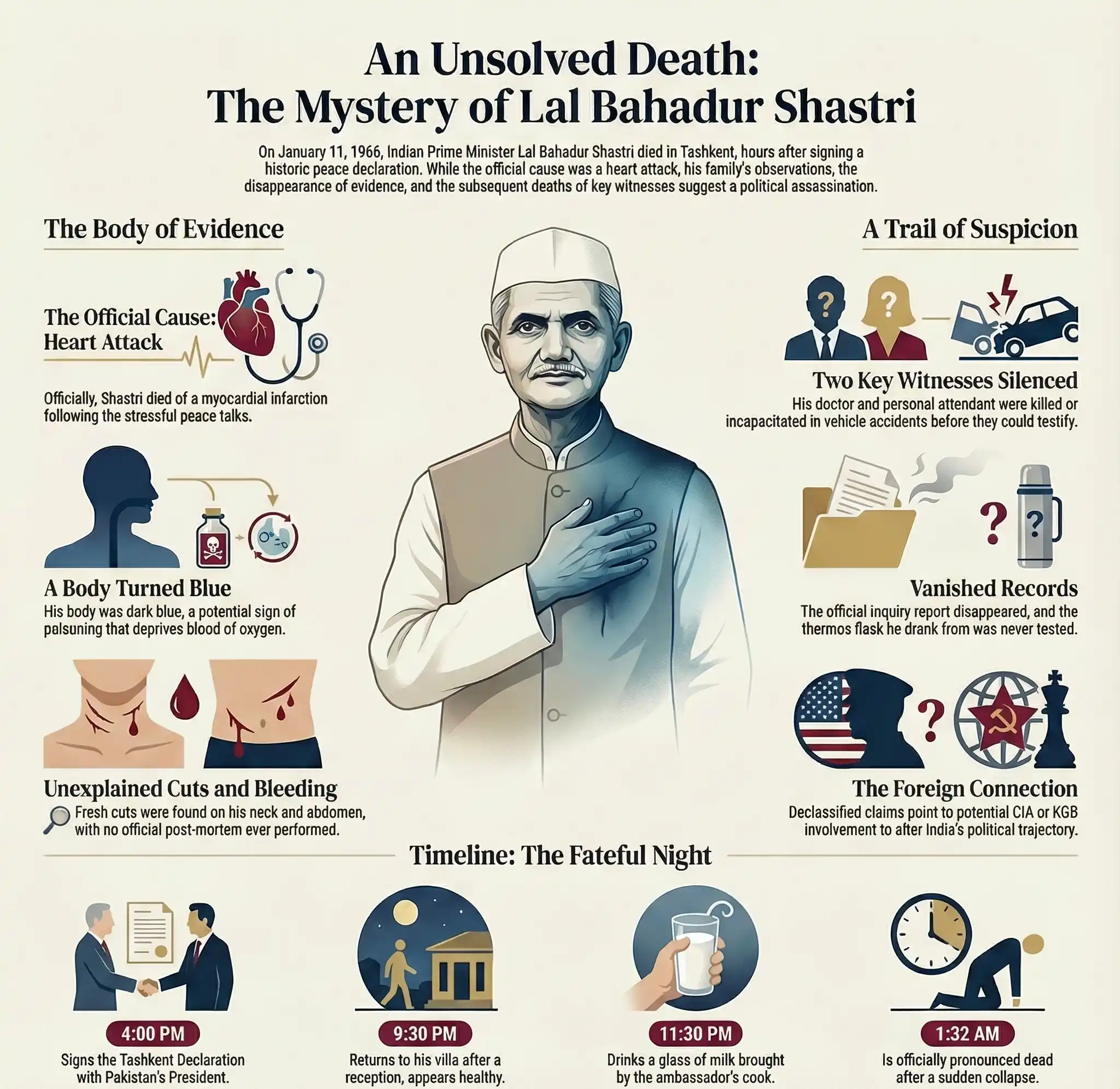
Lal Bahadur Shastri signed the Tashkent Declaration on the afternoon of 10 January 1966 and was dead before the next day was properly begun.
He had given up Haji Pir and Tithwal, taken in the war six months earlier, and the telephone calls reaching him at the Soviet villa that evening told him how that was going down in Delhi. He spoke to his family at home. Some time after midnight he woke with pain in the chest, and by about two in the morning he was gone.
He was sixty-one, he had already had two heart attacks, and he had just finished the hardest day of his political life. A third heart attack is the least surprising thing in this story.
The thing that was not done
No post-mortem was conducted in Tashkent. No post-mortem was conducted when the body reached Delhi either. The family asked for one and did not get it.
Whatever anybody believes about what happened in that room, this is the fact the whole business rests on. A head of government died suddenly in a foreign country in the middle of the Cold War, and the one procedure that exists to establish a cause of death was skipped twice.
Everything argued about since is an argument about an absence. There is no autopsy report to disagree with.
The Syama Prasad Mookerjee Death Mystery: 5 Hidden Facts
The Roopkund Skeleton Lake Mystery: Why Were Greeks Dying in the Indian Himalayas?
What the family said
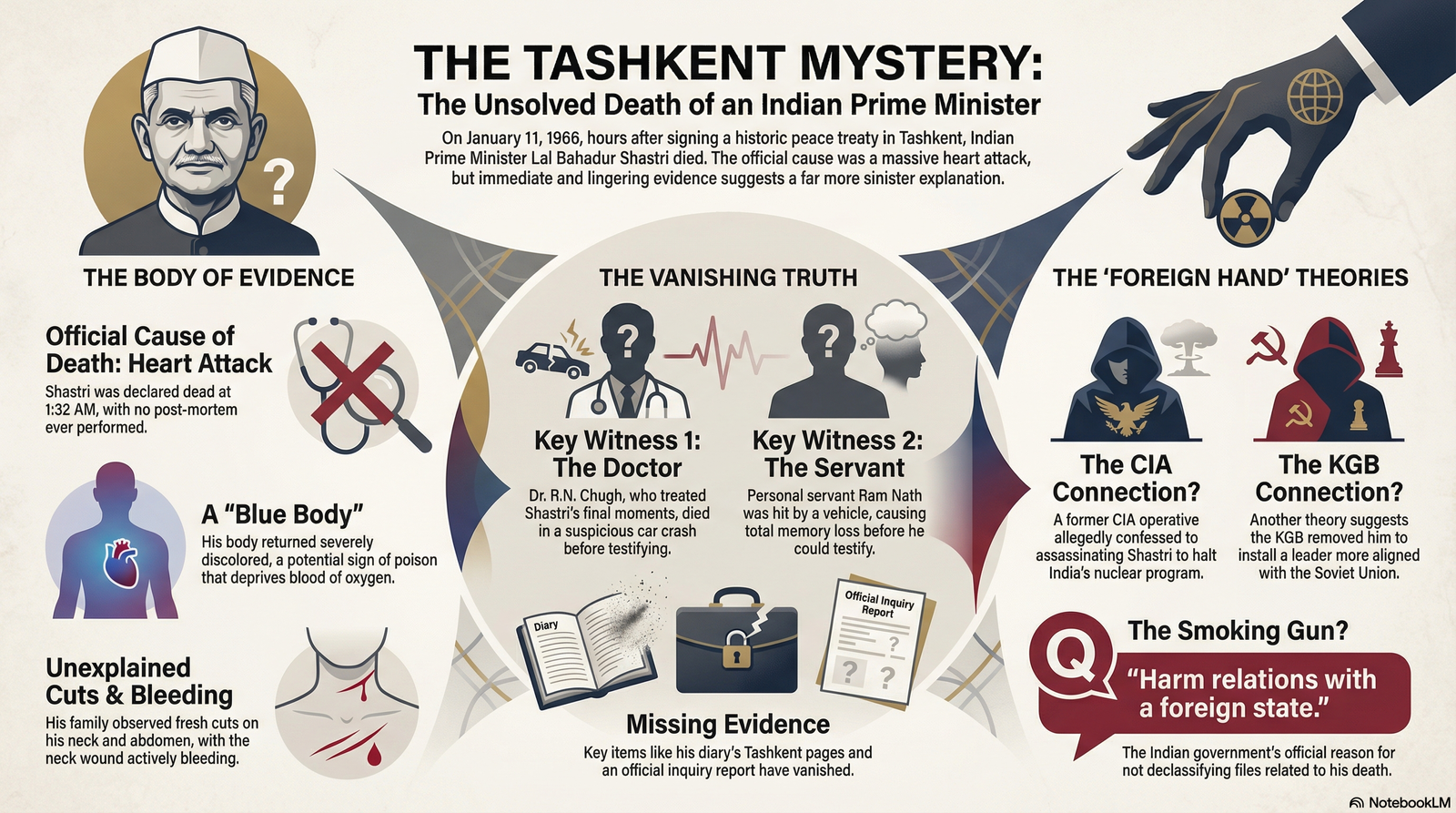
His widow, Lalita Shastri, did not accept the account from the first day. She spoke about the condition of the body when it was brought back, about discolouration and marks that she did not think belonged, and about belongings that did not come home with him.
The question reached Parliament in February 1966, within weeks. In 1970 his childhood friend Tribhuvan Narain Singh demanded a proper inquiry, and his stated reason was the simple one: there had been no autopsy.
1977
The Janata Party government set up an inquiry committee under Raj Narain. Two people who had been in Tashkent with Shastri were to give evidence: his personal physician, Dr R.N. Chugh, and his personal attendant, Ram Nath.
Dr Chugh was killed in a road accident along with members of his family. Ram Nath was hit by a vehicle and lost his legs. Both incidents happened as they were travelling to depose.
The committee then produced nothing of substance. And the records of it are gone. When the Central Information Commission went looking in 2018, the files could not be traced at the Prime Minister’s Office, the ministries, or in the library of Parliament.
A parliamentary inquiry into the death of a Prime Minister has left no trace anywhere in the records of the Indian state.
7 Secrets of Padmanabhaswamy Temple Treasure
One classified document
In 2009 an RTI application asked the Prime Minister’s Office what it held on the death. The reply was that there is a single classified document, and that it cannot be released because doing so could damage relations with a foreign country.
In May 2018 the Central Information Commission directed the PMO and the home and external affairs ministries to make the Raj Narain records public and to publish a list of the categories of documents they hold on the death. The Commission also noted eleven pages held by the Cabinet Secretariat for which the government had claimed exemption.
Little has come out since.
What is actually being asked for
It is worth being precise about the claim, because the film versions of this story are not.
The Shastri family have said repeatedly that they are prepared to accept that he died of a heart attack. What they have asked for is the paperwork: the correspondence between the Ministry of External Affairs and the Indian embassy in Moscow in January 1966, and whatever the Raj Narain committee collected.
Anil Shastri’s argument has been a straightforward one. If the files on Subhas Chandra Bose could be declassified, there is no reason these cannot be.
Against that, the ordinary explanation remains the likely one. Sixty-one, two previous coronaries, no cardiologist in the room, a foreign winter and a day of extraordinary strain. Most of what gets offered as evidence of foul play is the memory of a grieving family and the behaviour of a secretive state, and only the second of those is documented.
What he left
He had bought a Fiat a couple of years earlier, the only car he ever owned, on a loan from a bank because he did not have the money for it. When he died the instalments were still outstanding, and his widow paid them off out of her pension. His sons have told the story many times.
He left an estate of almost nothing and a car loan. Sixty years on, the state he ran will not open the one file it admits to holding on his death.
The Purulia Arms Drop Mystery 1995: When the Sky Rained Guns
If you think you have rememberd everything about this topic take this QUIZ
Results

#1. What was the official cause of Lal Bahadur Shastri’s death, and what specific physical sign on his body aroused his family’s suspicions? ? Hint
Consider the contrast between the government’s explanation and what his family observed upon the return of his body.
#2. The story of Shastri’s Fiat DLE 6, for which he took out a bank loan, is used in the text to primarily illustrate what aspect of his character? ? Hint
Think about why the Prime Minister of a country would not have enough savings to buy a common family car.
#3. What was the nature of the distressing final phone call Lal Bahadur Shastri had with his daughter, Kusum? ? Hint
The conversation revolved around the political agreement he had just signed.
#4. According to the medical insight in the text, why was Dr. Chugh’s decision to administer Mepthentin Sulphate significant? ? Hint
Focus on what the specific medication treats and how that symptom relates to the different theories about his death.
#5. What suspicious fates befell the two key witnesses, Dr. R.N. Chugh and Ram Nath, before they could formally testify? ? Hint
The text highlights the statistically improbable nature of what happened to both men just before they were scheduled to speak.
#6. The source material connects the alleged CIA involvement in Shastri’s death with the death of which other prominent Indian? ? Hint
The motive for this theory was to stop India’s strategic ambitions in a particular scientific field.
#7. Besides the missing Raj Narain Inquiry report and torn diary pages, which crucial piece of physical evidence was never secured for investigation? ? Hint
This object is directly linked to the theory that he ingested a fatal substance.
#8. What is the primary reason the Indian government’s refusal to declassify a file on Shastri’s death is considered a “smoking gun” by theorists? ? Hint
Consider why the truth about a natural death would affect international relations decades later.
This article is part of our exclusive series Unsolved India. Stay tuned for more chapters where we will explore more unsolved mysteries of India.
- Read the previous chapter: The Netaji Subhas Chandra Bose Disappearance.


Was a post-mortem conducted on Lal Bahadur Shastri?
No. Despite the strange color of the body and the bleeding wounds, no post-mortem was conducted in Russia or India. The government claimed it was to avoid “international embarrassment”.
Who was Jan Mohammad?
Jan Mohammad was the cook for the Indian Ambassador to Moscow, T.N. Kaul. He prepared Shastri’s meals in Tashkent instead of Shastri’s personal cook, Ram Nath. He was later employed at the Rashtrapati Bhavan, which some critics view as a reward.
What happened to Dr. R.N. Chugh?
Dr. Chugh, Shastri’s personal physician, died in a mysterious road accident in 1977 along with his family, while he was on his way to testify before the committee investigating Shastri’s death.
Did the CIA kill Lal Bahadur Shastri?
It is a leading theory. Former CIA officer Robert Crowley allegedly confessed that the CIA eliminated Shastri and Homi Bhabha to stop India from becoming a nuclear power.
Why does the government refuse to declassify the Shastri files?
The PMO has stated under the RTI Act that declassifying the document would “harm relations with a foreign state,” implying that a foreign power (USA or USSR) was involved in the death.
Sources & References
Central Information Commission, order of May 2018 directing the Prime Minister’s Office, the Ministry of Home Affairs and the Ministry of External Affairs — the missing Raj Narain Committee records and the documents held on the death.
Reply of the Prime Minister’s Office to an RTI application (2009) — the single classified document and the grounds for withholding it.
Lok Sabha Debates, February 1966 — the first questions raised in Parliament about the circumstances of the death.
Public statements of the Shastri family, including Anil Shastri and Sunil Shastri — the request for declassification of the 1966 correspondence and the committee’s records.
Author


Exploring the Soul of Bharat through History, Science, Culture, and its Diversity
Our Mission
Curious Indian is a definitive knowledge portal dedicated to chronicling the events, personalities, and cultural shifts that defined the Indian subcontinent. From the ancient Vedic Period to the complexities of 21st-century politics, our goal is to provide deep-dive analysis that inspires.
Editorial Standards & E-E-A-T
Every article published under our brand undergoes a rigorous fact-checking process. We prioritize primary historical records, academic citations, and credible archives to ensure our readers receive accurate, high-authority information.
Historical Integrity Directly sourcing from ASI archives and academic journals.Topical Authority Comprehensive clustering of Indian Science, Biographies, and Wars.Managed by Paripurna Datta and TEAM | Dedicated to the Knowledge of India.