Nearly three months after the fighting stopped, a search party climbed to Rezang La
The snow had closed the pass and nobody had been able to get up there since November. On 10 February 1963 a search party reached the position at last.
The men of Charlie Company were where they had been left. Frozen in their trenches, in firing positions, weapons still in their hands. Most of the wounds were in the chest, which tells you which way they had been facing. Magazines were empty.
Major Shaitan Singh was found against the boulder where his own men had put him down, because he had ordered them to leave him and go.
Three months of Ladakh winter had preserved the last few minutes exactly as they happened.
Why they were there
Rezang La is a pass at about sixteen thousand feet on the approach to the Chushul valley. Chushul had an airstrip, and in a Ladakh winter an airstrip is the difference between holding ground and losing it. Whoever came through the pass could take the valley, and whoever took the valley could take a great deal more.
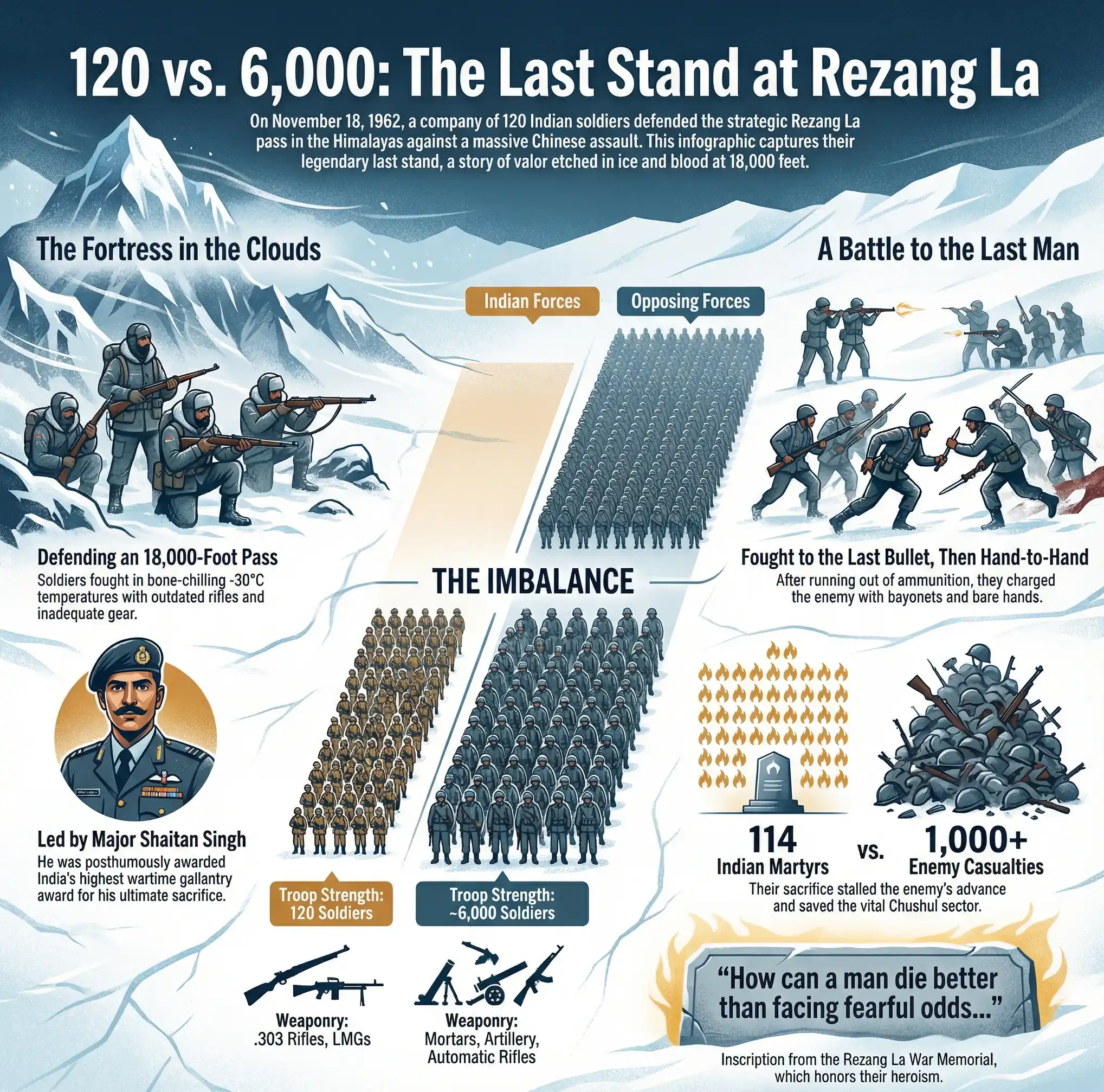
Charlie Company of 13 Kumaon held it with a hundred and twenty men and a section of three-inch mortars.
Beyond the Stars: How Mahaviracharya Defined Modern Math

The 10th Century Legacy: Halayudha Life Story Unfolded
The ridge
There was a problem with the ground that everybody in the sector understood. A ridge stood between Rezang La and the Indian guns at Chushul, and it masked the position completely. Artillery could not reach over it.
That is a dry sentence with a hard meaning. Whatever came at those men, no gun was going to answer it. They had what was in their trenches: rifles, a few light machine guns, the mortars, grenades and the ammunition they had carried up.
18 November
It was minus twenty-four degrees that morning. The Chinese came before first light, under artillery and mortar fire that could not be returned, and attacked in successive waves against five platoon positions.
The positions were fought through one at a time. Men who had run out of ammunition were found afterwards to have gone on using whatever was to hand. Shaitan Singh moved between the platoons across open ground under fire to keep them supplied and in contact, was hit, and told the men carrying him to leave him and get out.
A hundred and fourteen of the hundred and twenty died. Five or six came off the hill, some of them taken prisoner.
The Kamarupa Ascendancy: Assam’s First Great Kingdom Explained
The arithmetic nobody can settle
Indian accounts put Chinese losses in the battle at a thousand and more. Chinese records acknowledge a small fraction of that, and no independent count has ever existed.
What is not in dispute is the outcome. The pass held long enough. Chushul was not taken, the airstrip stayed Indian, and on 21 November the Chinese declared a unilateral ceasefire with the valley still in Indian hands.
Where the telegrams went
This is the part that gets left out of the retellings, and it is the part that changes the size of the thing.
Charlie Company was an Ahir company. Almost every man in it came from one small cluster of villages in the Rewari and Mahendragarh districts of what is now Haryana, within a few miles of each other.
So the casualties did not spread out across a country. They landed on a handful of villages at once, in the same week, delivered by the same postmen along the same roads. There are households there that lost their men in a single morning on a mountain none of them had ever seen.
A nation lost a hundred and fourteen soldiers. A few villages in Haryana lost almost every young man they had sent.
Netaji Subhas Chandra Bose: Did He Really Die in 1945?
Afterwards
Charlie Company came out of it with one Param Vir Chakra, eight Vir Chakras, four Sena Medals and a mention in dispatches, which makes it one of the most decorated companies in the history of the Indian Army. Shaitan Singh’s body was taken to Jodhpur and cremated with military honours.
The battalion put up a memorial at the pass carrying a line from Macaulay about how a man can die well, chosen by the commanding officer. There is another at Rewari, among the villages that paid for it. Chetan Anand’s film Haqeeqat, made in 1964, was built on the battle.
In the summer of 2020, during the standoff in eastern Ladakh, Indian troops moved back onto the heights of the Kailash range and held Rezang La again.
They were left without artillery on a ridge in the cold, and they stayed. The search party in February found them exactly where they had been told to be.


5 Dark Secrets of Homi Bhabha Death Mystery
If you think you have remembered everything about this topic take this QUIZ
Results


#1. What was the strategic significance of the Rezang La pass that Major Shaitan Singh and his men were tasked to defend?
#2. Despite the sub-zero temperatures and high altitude, what was the primary weapon used by most Indian soldiers during the battle?
#3. How did Major Shaitan Singh continue to lead his men after being seriously wounded by machine-gun fire?
#4. What was discovered about the Indian soldiers when the battlefield was found the following spring?
#5. Which specific region in India did almost all the 120 soldiers of Charlie Company hail from?
#6. What was the result of the hand-to-hand combat that occurred once the Indian soldiers ran out of ammunition?
#7. According to the casualty comparison, approximately how many enemy troops were estimated to have been killed or wounded by the 120 Indian soldiers?
#8. Which prestigious gallantry award was posthumously given to Major Shaitan Singh for his actions at Rezang La?
Who led the Indian troops at the Battle of Rezang La?
Major Shaitan Singh led the Charlie Company of 13 Kumaon during the battle. He was posthumously awarded the Param Vir Chakra.
Where is Rezang La located?
Rezang La is a mountain pass on the south-eastern approach to the Chushul Valley in Ladakh, at an altitude of approximately 18,000 feet.
How many Indian soldiers survived the battle?
Out of the 120 soldiers, 114 were martyred. Only 6 soldiers survived, most of whom were sent back to deliver the news of the battle or were taken prisoner and later escaped.
Why was the battle so significant?
The battle prevented the enemy from capturing the Chushul airfield and advancing further into Ladakh. It also inflicted heavy psychological and physical damage on a much larger attacking force.
Is there a memorial for the Battle of Rezang La?
Yes, there is a famous war memorial at Rezang La (and a revamped one in Rewari) that honors the sacrifice of the 13 Kumaon soldiers.
Sources & References
Param Vir Chakra citation for Major Shaitan Singh, Ministry of Defence, Government of India — the isolation of the position, the successive waves and his conduct during the action.
History of the Conflict with China, 1962 (History Division, Ministry of Defence) — the defence of the Chushul sector and the place of Rezang La in it.
Kulpreet Yadav, The Battle of Rezang La (2021) — the composition of Charlie Company and the findings of the search party on 10 February 1963.
ThePrint — the Ahir villages of Rewari and Mahendragarh and the memorial that stands there.
Author


Exploring the Soul of Bharat through History, Science, Culture, and its Diversity
Our Mission
Curious Indian is a definitive knowledge portal dedicated to chronicling the events, personalities, and cultural shifts that defined the Indian subcontinent. From the ancient Vedic Period to the complexities of 21st-century politics, our goal is to provide deep-dive analysis that inspires.
Editorial Standards & E-E-A-T
Every article published under our brand undergoes a rigorous fact-checking process. We prioritize primary historical records, academic citations, and credible archives to ensure our readers receive accurate, high-authority information.
Historical Integrity Directly sourcing from ASI archives and academic journals.Topical Authority Comprehensive clustering of Indian Science, Biographies, and Wars.Managed by Paripurna Datta and TEAM | Dedicated to the Knowledge of India.