The word means life, and for a quarter of a century Indian parents would not give it to a son
Pran means life, or breath. It was an ordinary name for a boy and then, for roughly a quarter of a century, it was not, because of what one man was doing with it on screen.
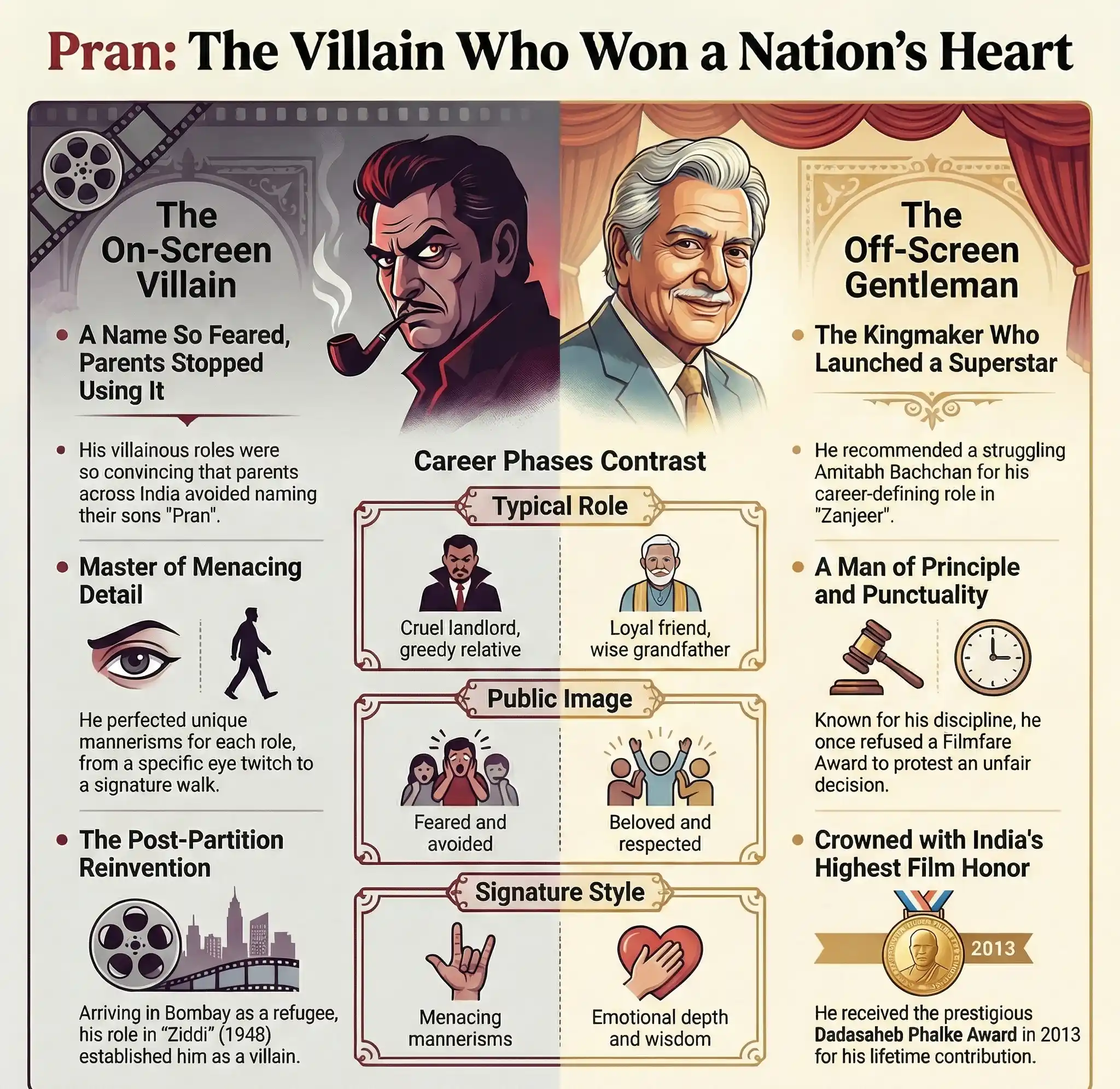
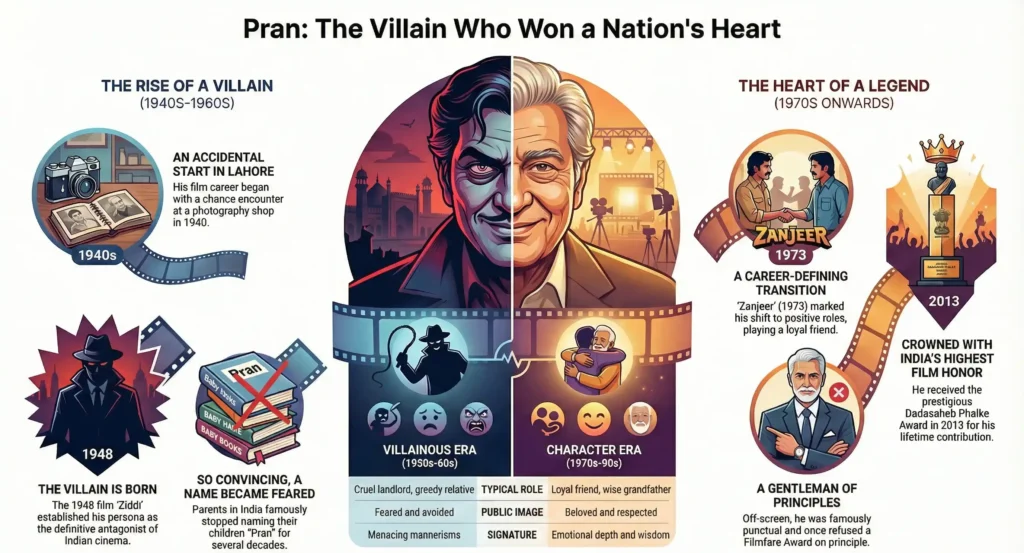
This is the usual way his career gets summarised, and for once the anecdote is the right measure. He played the villain in Hindi cinema for thirty years, opposite Dilip Kumar, Dev Anand, Raj Kapoor, Rajesh Khanna and Amitabh Bachchan, and by the late 1960s his name on the poster sold tickets and he was paid more than some of the heroes.
It is the only career in Indian cinema you can measure in the names people stopped using.
A paan shop in Lahore
He was born in February 1920 into a wealthy Punjabi family, the son of a civil engineer and contractor, and grew up partly in Ballimaran in Old Delhi. He was good at mathematics, trained as a photographer and was sent to Lahore for the work. Acting had not occurred to him.
At nineteen he was at a paan shop when a stranger watched him eat one and told him he should test for a film. The stranger was the writer Wali Mohammad Wali. Pran assumed he was drunk and did not turn up, so Wali found him at a cinema the following Saturday, swore at him in Punjabi and took him to the producer himself.
Yamla Jat came out in 1940. He was the villain in his first film, at twenty.
The Ancient Roots of the Nokrek Biosphere Reserve
Twenty-two films and a border
He worked steadily in Lahore for seven years, more than twenty films, including Khandaan in 1942 as a romantic hero opposite Noor Jehan. He would have stayed.
In August 1947 he was in Indore for his son’s first birthday while Lahore burned. He left the city for good on the tenth and reached Bombay on the fourteenth, the day before independence, with a wife and a baby and no work.
What followed was eight months of nothing. The family moved from the Taj down through cheaper and cheaper hotels to a guest house, and he pawned his wife’s gold bangles. Saadat Hasan Manto, a friend from Lahore, put his name forward and he got a part in Ziddi in 1948.
He arrived as a leading man from a country that no longer existed, and took what was going, which was villains.
How to be hated properly
The thing that made him frightening was that he did not shout. Ugra Narayan in Madhumati sits back in the chair, blows smoke rings, keeps his voice level and has other men do the work, and the effect is worse than any amount of snarling.
He built each one out of specifics, a wig, a walk, a way of holding a cigarette, and he did not repeat himself across three hundred and sixty films. Off screen he was mild, famously punctual, fond of Urdu poetry, and ran a football club.
Gulzar : The Mechanic Who Became India’s Poet Laureate
Upkar
In 1967 Manoj Kumar cast him in Upkar as Malang Chacha, a one-legged war veteran who is the moral centre of the film and who gets the song. The audience, which had spent twenty years hating him, accepted it at once. It won him his first Filmfare Award.
From there the second half of the career opens: character parts, elder brothers, uncles, the occasional lead, another two decades of work at the age most villains are retired.
Zanjeer
In 1973 he played Sher Khan in Zanjeer, and he is the reason the film exists in the form it does. Several stars had turned down the lead. He put forward the name of Amitabh Bachchan, who had nothing much behind him at that point, and Prakash Mehra has said on the record that had Pran not signed, the film would not have been made.
He also turned down Manoj Kumar’s Shor because the part was a Pathan and he was already playing one, which is a level of care about repetition that the industry did not require of anybody.
The year before, he had refused a Filmfare Award outright, on the grounds that the music prize should have gone to Ghulam Mohammed for Pakeezah rather than to the film he himself was in.
2013
The Padma Bhushan came in 2001. The Dadasaheb Phalke Award came in 2013 and had to be brought to his house, because he was too ill to go and collect it. He died on 12 July that year, at ninety-three.
He spent thirty years making a word that means life sound like a threat, and thirty more giving it back.
Understanding Donyi Polo Religion Today
Madhuri Dixit : The Dancing Queen of Indian Cinema
Ekta Kapoor : Breaking Norms and Building Empires
If you think you have remembered everything about this topic take this QUIZ
Results


#1. What unusual social phenomenon occurred in India due to the sheer effectiveness of Pran’s villainous roles on screen?
#2. In which city did Pran accidentally start his career after a chance meeting in a photography shop?
#3. Which iconic character role marked Pran’s transition from a feared villain to a beloved ‘loyal friend’?
#4. What act of professional integrity is Pran famously remembered for regarding the Filmfare Awards?
#5. According to the ‘Quick Comparison’ table, what was a ‘Signature’ of his villainous era (1950s-60s)?
#6. Which legendary Bollywood superstar did Pran personally recommend for the career-defining role in ‘Zanjeer’?
#7. Off-camera, Pran was a dedicated lover of sports and even founded his own team for which sport?
#8. What is the highest honor in Indian cinema that Pran received in 2013, shortly before his passing?
What was Pran’s first film in Bombay?
After moving from Lahore, his first significant break in Bombay was the film Ziddi (1948), which also starred Dev Anand
Did Pran ever play a hero?
Yes, in the early part of his career in Lahore and briefly in Bombay (e.g., Khandaan), he played the romantic lead before transitioning into his more famous negative roles.
Which is considered his most famous “positive” role?
His role as ‘Malang Chacha’ in the film Upkar (1967) is widely considered his most iconic transition from a villain to a beloved character actor.
Why did people stop naming their children Pran?
Pran played his villainous roles with such terrifying realism that the name became associated with “evil” in the minds of the Indian public during the 1950s and 60s.
Sources & References
Eastern Eye — the meeting with Wali Mohammad Wali, his Lahore films, the dates of his departure in August 1947 and Manto’s recommendation for Ziddi.
Cinemaazi, via Google Arts & Culture (“103 Years of Pran”) — his refusal of the Filmfare Award over Pakeezah and the avoidance of his name by parents.
Padma Awards portal, Government of India — the Padma Bhushan of 2001.
Directorate of Film Festivals, Government of India — the Dadasaheb Phalke Award.
Author


Exploring the Soul of Bharat through History, Science, Culture, and its Diversity
Our Mission
Curious Indian is a definitive knowledge portal dedicated to chronicling the events, personalities, and cultural shifts that defined the Indian subcontinent. From the ancient Vedic Period to the complexities of 21st-century politics, our goal is to provide deep-dive analysis that inspires.
Editorial Standards & E-E-A-T
Every article published under our brand undergoes a rigorous fact-checking process. We prioritize primary historical records, academic citations, and credible archives to ensure our readers receive accurate, high-authority information.
Historical Integrity Directly sourcing from ASI archives and academic journals.Topical Authority Comprehensive clustering of Indian Science, Biographies, and Wars.Managed by Paripurna Datta and TEAM | Dedicated to the Knowledge of India.