A seventeen year old with no connections set written conditions on her first Hindi contract, and then spent sixty years keeping them
The director of her first Hindi film told her the name would have to go.
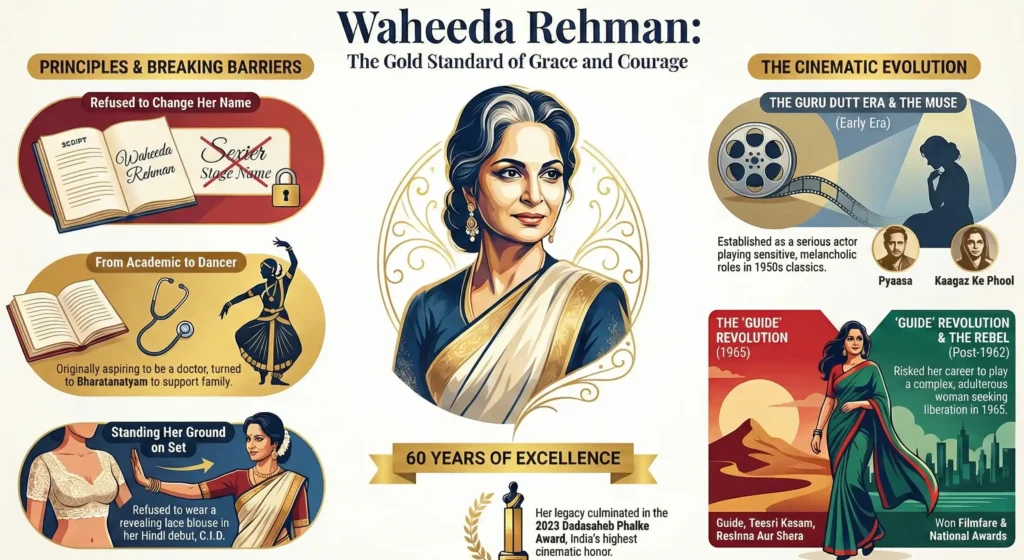
It was too long, he said, and what was wanted was something with more appeal. This was ordinary practice rather than an insult. Yusuf Khan was working as Dilip Kumar, Mahjabeen Bano was working as Meena Kumari, Mumtaz Jehan Dehlavi was working as Madhubala. Changing a Muslim name for a Hindu one was simply how the industry arranged itself.
Waheeda Rehman was seventeen, had no connections and no standing, and said no.
She was born in 1938 in Chengalpattu, into a Deccani Muslim family with no connection to films at all, and what she had actually wanted to do was study medicine. Two Telugu films in 1955 had gone well enough that Guru Dutt, scouting in Hyderabad, offered her a small part in C.I.D. She travelled to Bombay with her mother to meet Raj Khosla, who was directing it.
The reason given for the name change, by her own account, was that it ought to be something sexier. A newcomer in that position takes what she is given. Khosla was reportedly startled. Guru Dutt agreed to her terms, and that is how the career started.
The second condition was the one she had put in writing.
She has described it plainly enough since: “if I don’t like the costume I will not wear it”, written into the contract for her first Hindi film. She was not making a moral argument about anybody else. She said she needed to be comfortable in order to perform.
Guru Dutt put her in the lead of Pyaasa the following year, playing a prostitute, and the film is now on lists of the greatest films ever made. It is a small thing and it was not small at all. A teenage actress had reserved, on paper, the right to refuse instructions about her own body, in 1956, in an industry that had never been asked for that.
Guide
In 1965 she took the part that everybody expected to finish her.
Rosie, in Vijay Anand’s film of the R.K. Narayan novel, is a married woman who leaves her husband to dance and lives with another man. Actors had turned the project down because of it. She has said she was fairly sure she would never be offered work again.
The film was a success and Rosie became one of the few parts in Hindi cinema of that period that treats a woman’s decision to leave as a decision rather than a fall. She won the Filmfare Award for Best Actress. For the English language version she took diction lessons from Pearl S. Buck, who was involved in producing it. She also refused to shoot the intimate scenes the director wanted, and did not shoot them.
Satyajit Ray cast her in Abhijan in 1962. She won the National Film Award for Best Actress for Reshma Aur Shera in 1971. She worked with Dilip Kumar, Raj Kapoor and Dev Anand, appeared in something like ninety films, and was among the best paid actresses in the country through the 1950s and 1960s.
Her range is the part that gets flattened by the word muse. Gulabo in Pyaasa, Jameela in Chaudhvin Ka Chand and Rosie in Guide are three completely different women, and none of them is decorative. She has also been consistently unimpressed by the fuss about her looks, and has said in as many words that she never thought she was beautiful.
Sixty-six years later
She married the actor Kamaljeet in 1974, moved to a farm outside Bangalore and largely stopped, then came back in the 1980s for character parts and has worked on and off ever since.
The Padma Shri came in 1972 and the Padma Bhushan in 2011. In 2021 she was given the Dadasaheb Phalke Award, which is the highest thing India has to give anybody in film.
A director once told her that her name was the wrong shape for the business. The country’s highest cinema honour now sits against that name, spelled the way her parents spelled it.
She married actor Shashi Rekhi (screen name Kamaljeet) in 1974. They worked together in the film Shagoon (1964). He passed away in 2000.
Which movie won Waheeda Rehman the National Award?
She won the National Film Award for Best Actress for her performance in the 1971 film Reshma Aur Shera, where she played a Rajasthani woman caught in a feudal feud.
Was Waheeda Rehman a trained dancer?
Yes, she and her sister were trained in Bharatanatyam in Chennai. Her dancing skills were a major reason for her entry into films.
Is Waheeda Rehman related to A.R. Rahman?
No, Waheeda Rehman is not related to the music composer A.R. Rahman. They share a surname but are from different families.
Sources & References
Nasreen Munni Kabir, Conversations with Waheeda Rehman (2014) — her own account of the C.I.D. contract and her working life.
Encyclopaedia Britannica (“Waheeda Rehman”) — her career and her principal films.
Directorate of Film Festivals, Government of India — the National Film Award for Reshma Aur Shera and the Dadasaheb Phalke Award for 2021.
Cinemaazi — her early years in Telugu cinema and the terms agreed before C.I.D.
Exploring the Soul of Bharat through History, Science, Culture, and its Diversity
Our Mission
Curious Indian is a definitive knowledge portal dedicated to chronicling the events, personalities, and cultural shifts that defined the Indian subcontinent. From the ancient Vedic Period to the complexities of 21st-century politics, our goal is to provide deep-dive analysis that inspires.
Editorial Standards & E-E-A-T
Every article published under our brand undergoes a rigorous fact-checking process. We prioritize primary historical records, academic citations, and credible archives to ensure our readers receive accurate, high-authority information.
Historical IntegrityDirectly sourcing from ASI archives and academic journals.
Topical AuthorityComprehensive clustering of Indian Science, Biographies, and Wars.
Managed by Paripurna Datta and TEAM | Dedicated to the Knowledge of India.