How the storming of the Golden Temple broke a bond that gold cannot rebuild
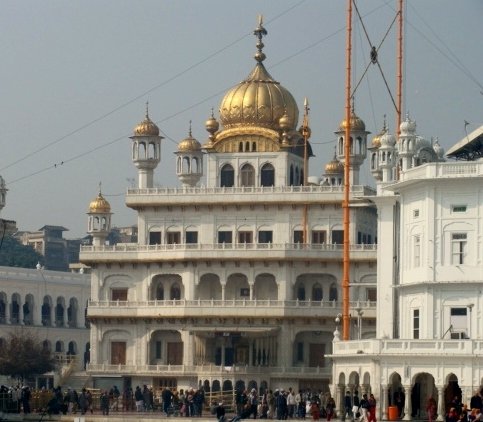
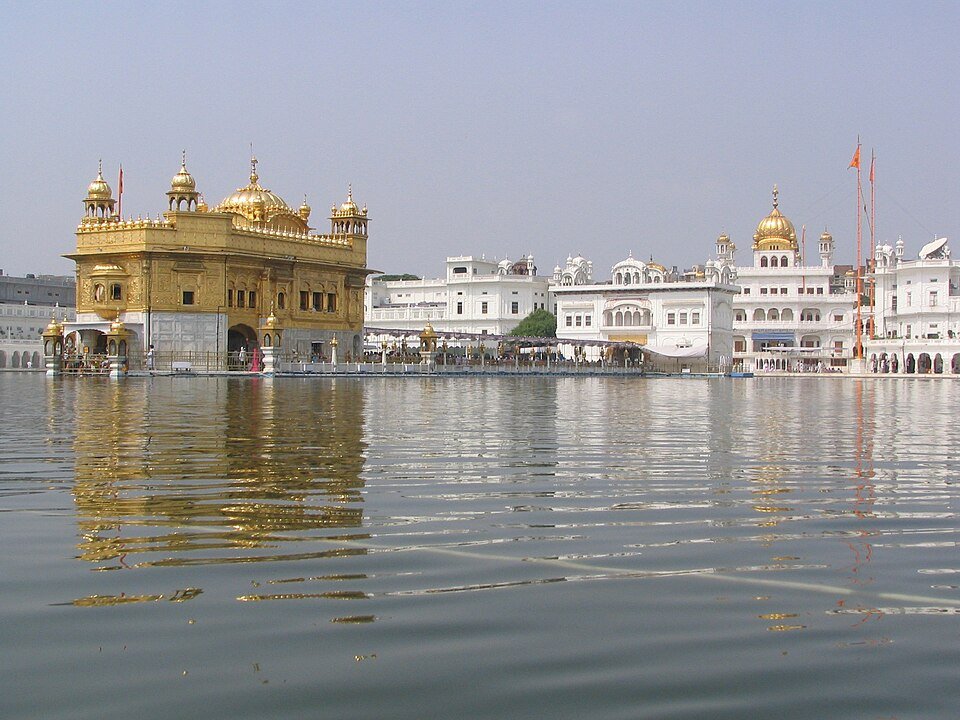
At the heart of the city of Amritsar stands the Harmandir Sahib, the Golden Temple, the holiest place in the Sikh faith.
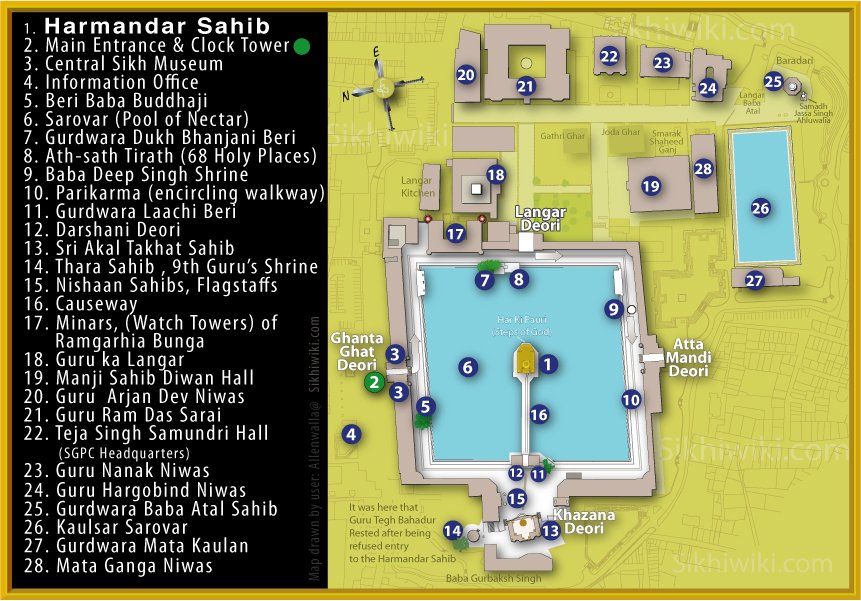
It is a shrine of gold and marble set in the middle of a great pool of still water, and for centuries pilgrims of every background have come to walk its cool walkways, to listen to the endless singing of the scriptures, and to feel, in that shining and peaceful place, a little closer to God. It was built to be a house open to all directions and all people, a place of refuge and of peace.
In June 1984, the Indian Army fought its way into it, with commandos, with artillery, and finally with tanks.
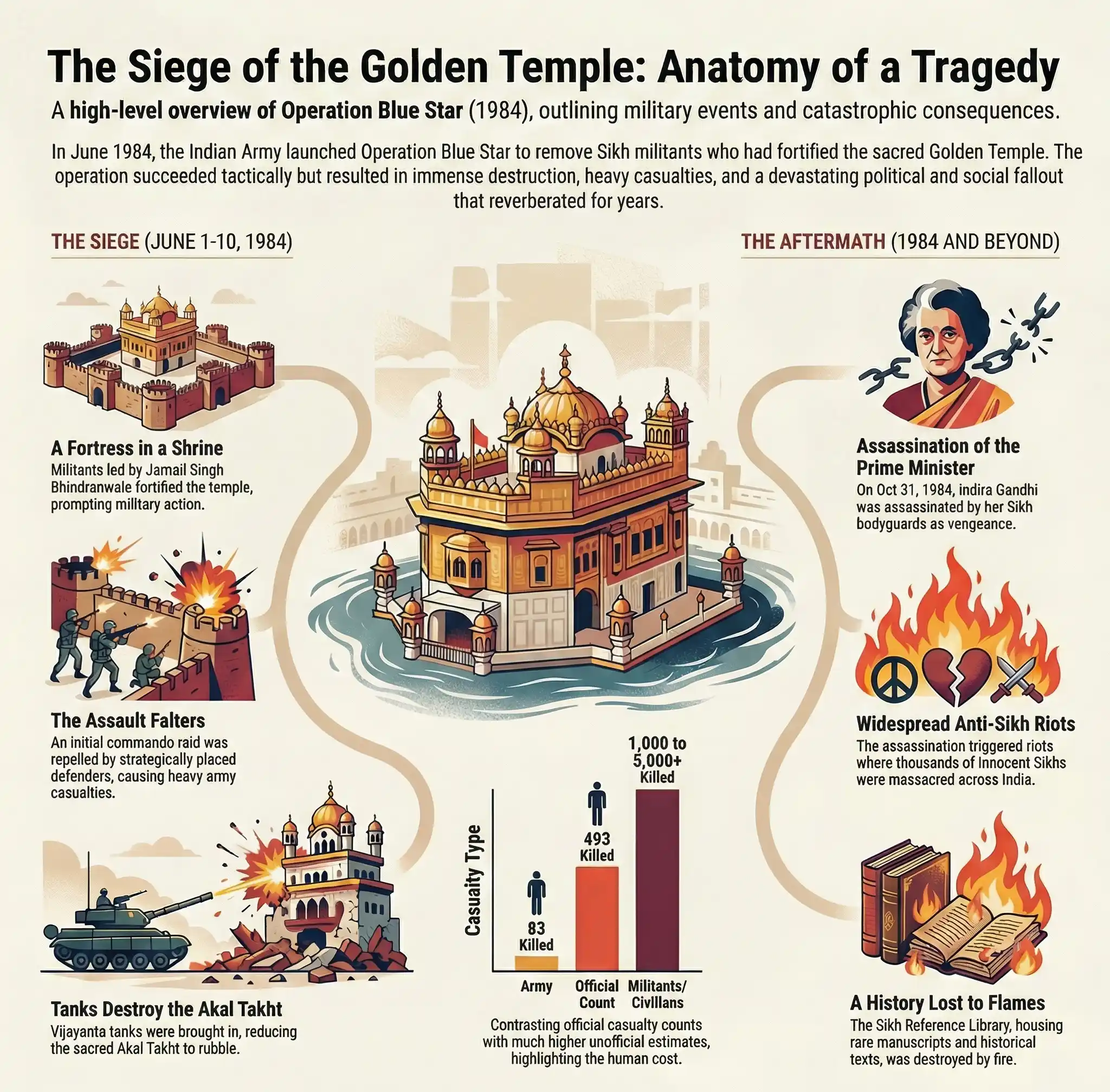
When the guns fell silent, the Akal Takht lay in ruins, hundreds and by some accounts thousands of people were dead, and something far harder to rebuild than any building had been broken. This is the story of Operation Blue Star, an operation that achieved its narrow military aim and became one of the deepest tragedies in the history of modern India. It is a story with no clean choices and no easy villains, and it holds a hard truth about what happens when violence enters a holy place.
How a temple became a fortress
To understand the tragedy, you first have to understand how it became possible for soldiers to be ordered into a temple at all.
By the early 1980s, the state of Punjab was sliding into a violent insurgency. Some within the movement demanded Khalistan, a separate sovereign country for the Sikhs. At the storm’s centre stood a fiery young preacher named Jarnail Singh Bhindranwale, who told the Sikh youth that they were treated as second-class citizens in their own land, and whose followers turned more and more to the gun.
Bhindranwale and his armed men had made the Golden Temple complex their headquarters. Directed by a former general of the Indian Army who had turned against the state, they had quietly turned the sacred site into a fortress, with sandbagged gun positions looking out over the holy walkway. For a government responsible for law and order, this was an intolerable situation: armed men, deep in a violent rebellion, using the most sacred shrine in the land as a stronghold from which they could not easily be touched.
That much is not seriously in dispute. What is also true, and must be said, is that Punjab had reached this point after years of political games and mishandling by that same government, which had once found Bhindranwale a useful figure to encourage. The road to June 1984 was paved with many people’s mistakes.
10 Days of Darkness: The True Story of Operation Blue Star
The choice
The government decided that it would clear the temple by force, and it made fateful choices about when and how.
In the first days of June, it sealed Punjab off from the world. It cut the telephone lines, imposed a total curfew, and expelled the foreign press, so that what happened next would happen in the dark. And it chose a terrible moment. The assault fell around the first week of June, on and near the martyrdom anniversary of Guru Arjan Dev, the fifth Sikh Guru, one of the holiest days in the Sikh calendar, when the shrine was crowded with thousands of ordinary pilgrims who had travelled there simply to pray.
The attack came around the martyrdom day of Guru Arjan Dev, when the temple was thick with ordinary pilgrims who had come only to bow their heads, and who now found themselves trapped inside a battle that was not theirs.
Those pilgrims, caught between the soldiers outside and the gunmen within, would pay a price that had nothing to do with the fight.
Ten days in June
The army expected the operation to be quick. Its planners believed that a show of overwhelming force would make the militants surrender within hours. They were badly wrong.
The defences inside had been prepared by a professional soldier, and they were deadly. When commandos moved in after dark to storm the complex, they were met by disciplined fire from hidden positions and were cut down in the narrow marble passages. The assault stalled. The most heavily defended point was the Akal Takht, the Throne of the Timeless, the highest seat of temporal authority in the Sikh faith and, after the Harmandir Sahib itself, the most sacred structure in the complex. It would not fall to the infantry.
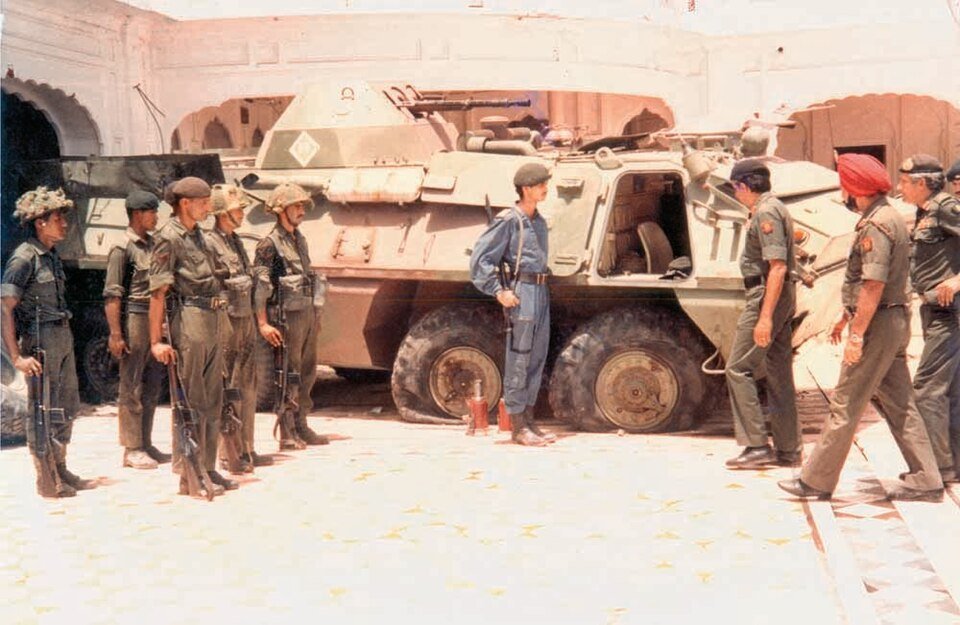
And so the commanders made the decision that would wound the Sikh spirit for generations. They brought in tanks, and turned their heavy guns on the Akal Takht.
When the tanks fired their main guns into the Akal Takht, the highest seat of authority in the Sikh faith, they broke something that no military victory could ever put right.
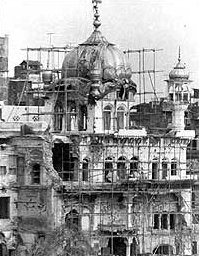
By the time the shell-fire stopped, the Akal Takht was a smoking ruin. Beneath its rubble, the bodies of Bhindranwale and the former general were found. The temple had been taken.
Pokhran-II Nuclear Tests 1998: How Operation Shakti Changed History
What was lost
The counting of the cost began at once, and it has never really finished.
The dead came first. The government put the toll at some four hundred and ninety civilians and militants, along with eighty-three soldiers. Sikh organisations and independent observers have always said the true number of civilian dead was far higher, running into the thousands. What is not in doubt is that among the dead were many ordinary pilgrims. Afterwards, thousands of pairs of shoes were found abandoned across the complex, slipped off at the threshold in the old way, by people who never came back to collect them.
Among the ruins lay thousands of pairs of pilgrims’ shoes, left where they had been set down at the threshold, each one a person who had come to that place only to pray.
There was another loss, quieter but very deep. The Sikh Reference Library, which held priceless old manuscripts and orders written in the hands of the Gurus themselves, was destroyed by fire. To this day the community believes it was burned deliberately, the government blamed the fighting, and the truth remains bitterly contested. But for Sikhs, the meaning of the whole event was never really about buildings, or even about numbers. It was that the holiest and most sovereign space of their faith had been stormed by the army of their own country, and that was a violation that struck at the very heart of who they were.
The spiral
The operation was, in the narrow sense the generals had been given, a success. The temple was cleared. But it set loose a cycle of violence that no one could contain, and this is the darkest lesson of Blue Star.
The pain ran first through the army itself. Sikh soldiers, among the most loyal and decorated in India’s history, were torn in two between their duty and their faith, and in several places they mutinied. It should be remembered, too, that the general who led the operation was himself a Sikh. This was never the simple story of one community against another that it is sometimes made out to be, but a tragedy that cut straight through the middle of a people.
Then, on 31 October 1984, Prime Minister Indira Gandhi was shot dead in her own garden by two of her own Sikh bodyguards, who saw it as vengeance for the desecration of their shrine.
And then came the worst horror of all, and it must be named for exactly what it was. In the days after the assassination, organised mobs moved through Delhi and other cities hunting down Sikhs and murdering them, thousands of innocent people whose only crime was their faith, while the machinery of the state too often stood aside. It was not a riot between two sides. It was a massacre of a community, and justice for it has been agonisingly, shamefully slow to come.
Violence, once it enters a holy place, does not stay there. It ripples outward, from the temple to the garden to the streets, each act of vengeance calling forth the next.
From the militancy to Blue Star, from Blue Star to the assassination, from the assassination to the pogrom, and on into a decade of insurgency and counter-insurgency that would kill tens of thousands more, each horror gave birth to the one that followed.
6 Hours That Shook the Nation: The Demolition of Babri Masjid 1992
The wound that gold cannot heal
Today, the Golden Temple stands whole again, and more beautiful than ever. The Akal Takht was raised once more from its rubble. The gold blazes in the sun, the water lies still, and pilgrims come again in their millions. In stone and marble and gold, the damage has been undone.
But some things a nation breaks cannot be mended with gold.
What Operation Blue Star wounded most deeply was not a building. It was a bond of trust with a community that had given India some of its bravest soldiers, its most productive farmers, and many of its greatest freedom fighters, and that was made, in one terrible week, to feel like a stranger and an enemy in the country it had helped to build and to defend. That wound did not close when the temple was rebuilt. It is carried still, in families and in memory, and in the bullet marks that the community has deliberately kept, unrepaired, on the temple walls, so that no one will forget.
There are, in honesty, no clean hands in this story. A government faced armed men who had turned the holiest of shrines into a fort, and it had a real duty to restore the rule of law. And in the way it chose to discharge that duty, it inflicted a sacred and human catastrophe whose full price is still being paid. Both of those things are true, and holding them together, without flinching from either, is the only honest way to look at Blue Star.
If the story teaches anything, it is the oldest and saddest lesson about violence, and especially violence against the sacred: that it never ends where it begins. It spreads, from the temple to the garden to the street, generation feeding generation, until an entire decade is lost to it. A temple can be rebuilt in a few years. The trust between people, once broken this deeply, takes far longer, if it can be repaired at all.
The gold of the Harmandir Sahib shines today as brightly as it ever has. But those who look closely, and remember, can still see the wound beneath the shine.


Operation Vijay: How India Won the High-Altitude War of 1999
If you think you have remembered everything about this topic take this QUIZ
Results


#1. What was the primary military objective of Operation Blue Star as ordered by Prime Minister Indira Gandhi?
#2. Who was the former Indian Army general who organized the sophisticated defenses for the militants inside the temple complex?
#3. Which heavy military asset was eventually used to dislodge militants from the Akal Takht after infantry and commando attacks failed?
#4. What tragic cultural loss occurred within the complex that remains a point of bitter contention today?
#5. What was the immediate and tragic consequence of the operation for Prime Minister Indira Gandhi on October 31, 1984?
#6. According to the ‘Official’ army casualties provided, how many soldiers were killed in the operation?
#7. Which elite counter-terrorist force was established by India largely in response to the tactical difficulties faced during Operation Blue Star?
#8. What is the ‘Sikh / Critic View’ of Jarnail Singh Bhindranwale’s role in the operation?
Why was Operation Blue Star launched?
It was launched to remove Jarnail Singh Bhindranwale and his armed followers who had occupied and fortified the Golden Temple complex, which the government viewed as a threat to national security.
Who was the Prime Minister during Operation Blue Star?
Indira Gandhi was the Prime Minister. She ordered the military action, a decision that eventually led to her assassination four months later.
How many people died in Operation Blue Star?
Official government figures state 493 civilians/militants and 83 army personnel were killed. However, independent estimates and Sikh organizations claim the civilian toll was much higher, ranging from 1,000 to over 5,000.
Did the army use tanks inside the Golden Temple?
Yes. When infantry attacks failed to clear the heavily fortified Akal Takht, the army deployed Vijayanta tanks to neutralize the militant positions.
What is the connection between Operation Blue Star and the 1984 Riots?
The operation led to the assassination of PM Indira Gandhi by her Sikh bodyguards in retaliation. Her death triggered the 1984 anti-Sikh riots, where thousands of Sikhs were killed by mobs.
Sources & References
- Encyclopaedia Britannica (“Operation Blue Star” and “Sant Jarnail Singh Bhindranwale”) — the 1984 operation, its leaders, and its course.
- Shiromani Gurdwara Parbandhak Committee (Harmandir Sahib and the Akal Takht) — the sacred significance of the Golden Temple and the Akal Takht.
- Encyclopaedia Britannica (“Indira Gandhi”) — her assassination in the months after the operation.
- Ministry of Home Affairs, Government of India (Nanavati Commission report) — the official inquiry into the anti-Sikh violence of November 1984.
Author


Exploring the Soul of Bharat through History, Science, Culture, and its Diversity
Our Mission
Curious Indian is a definitive knowledge portal dedicated to chronicling the events, personalities, and cultural shifts that defined the Indian subcontinent. From the ancient Vedic Period to the complexities of 21st-century politics, our goal is to provide deep-dive analysis that inspires.
Editorial Standards & E-E-A-T
Every article published under our brand undergoes a rigorous fact-checking process. We prioritize primary historical records, academic citations, and credible archives to ensure our readers receive accurate, high-authority information.
Historical Integrity Directly sourcing from ASI archives and academic journals.Topical Authority Comprehensive clustering of Indian Science, Biographies, and Wars.Managed by Paripurna Datta and TEAM | Dedicated to the Knowledge of India.