The story of the Amur Falcons in Pangti is a beautiful tale of change and friendship between humans and nature. Every year, millions of these small raptors fly from Siberia to South Africa, making a massive stopover in Nagaland, India. While they were once hunted, the local community underwent a heart-moving transformation to become their primary guardians. Today, this migration is not just a scientific wonder but a symbol of how a village can save a species and welcome the world to witness a sky filled with wings.
Fact Card
| Category | Details |
| Species Name | Amur Falcon (Falco amurensis) |
| Migration Distance | Approximately 22,000 Kilometers |
| Primary Stopover | Pangti Village, Wokha District, Nagaland |
| Migration Route | Siberia/China to Southern Africa |
| Protection Status | Protected under the Wildlife Protection Act |
The sun was beginning to dip behind the emerald hills of Wokha when the first dark specks appeared on the horizon. At first, it looked like a bit of smoke drifting in the wind. But as the minutes passed, the smoke turned into a swirling cloud of thousands, then tens of thousands, of tiny birds. These are the Amur Falcons of Pangti, and their arrival in Nagaland is nothing short of a miracle. These birds are small, roughly the size of a pigeon, but they carry the heart of a lion. They fly across oceans and mountains without stopping, proving that even the smallest creatures can do the most impossible things.
The long road from the cold north
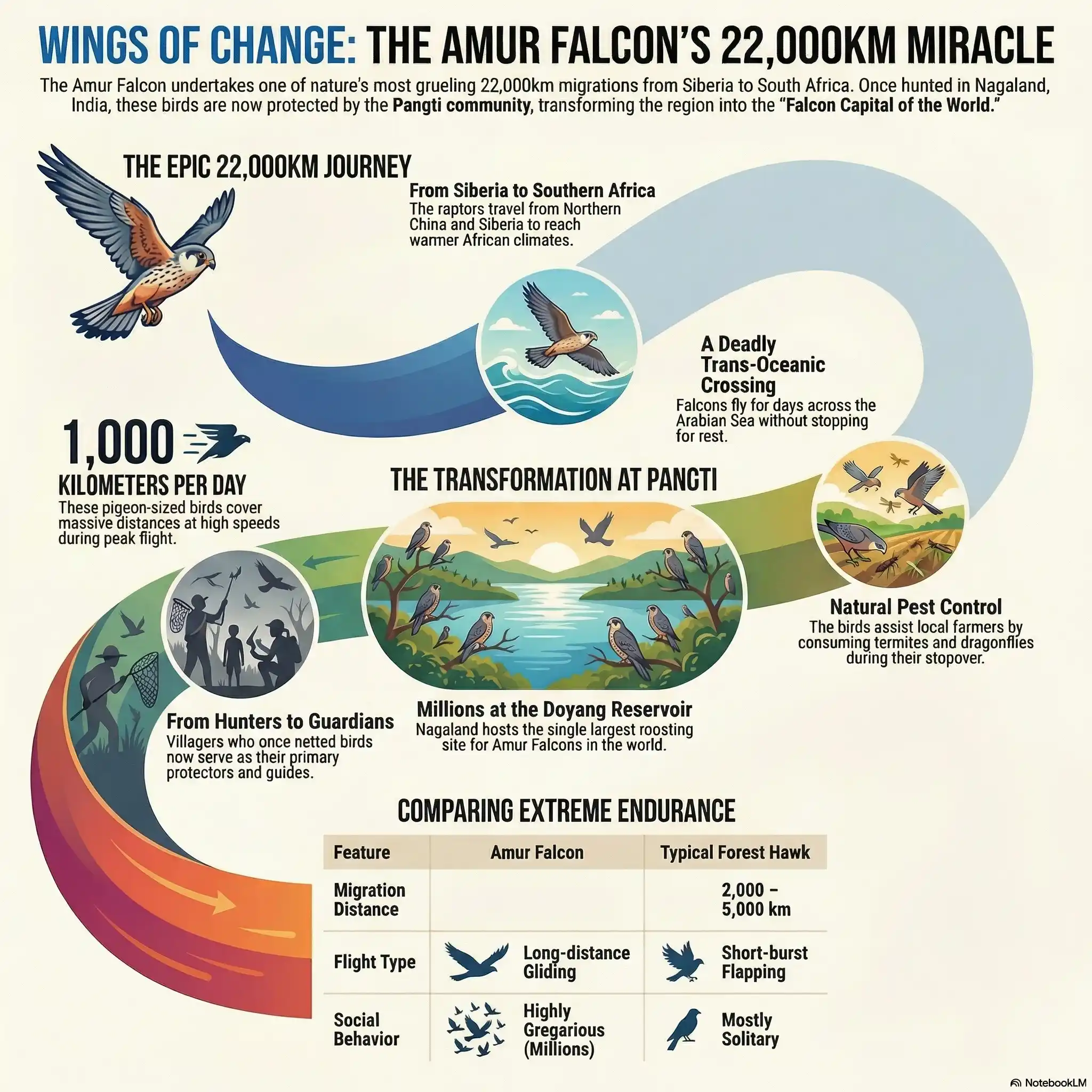
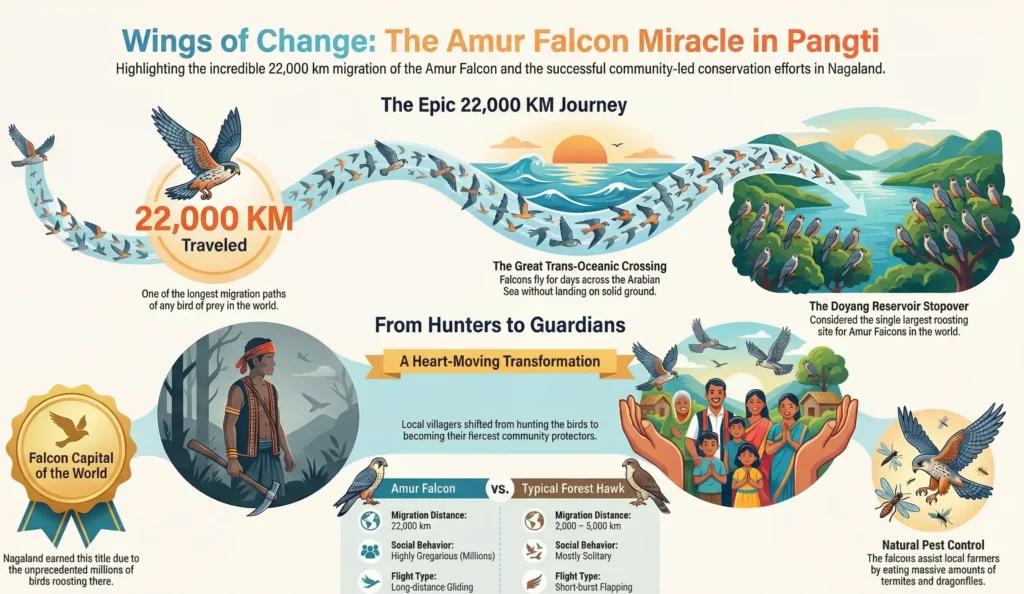
The journey begins far away in the chilly plains of southeastern Siberia and Northern China. As the winter starts to bite, the Amur Falcons know it is time to leave. They don’t just fly to the next forest; they plan a trip that spans continents. This journey is one of the longest migration paths of any bird of prey in the world. They head south, crossing the vast lands of Asia to reach the warm air of Africa.
Along this path, the hills of Nagaland serve as a vital resting station. Imagine running a marathon and finding a perfect garden with plenty of food and water right in the middle of your race. That is what Pangti is for these falcons. They land by the Doyang Reservoir in millions. The sight of the sky covered in birds is so dense that it can sometimes block out the sunlight. It is a moment where time seems to stand still, and the only sound is the whistling of thousands of wings cutting through the air.
A change of heart in the hills
Not long ago, the story of the Amur Falcons of Pangti was very different. When the birds first started arriving in huge numbers after a new dam was built, the local villagers saw them as a source of food. Thousands of birds were caught in nets every day. It was a sad time for the migration, and it seemed like the falcons might stop coming altogether. But then, something wonderful happened. Conservationists and the government spoke to the people of Pangti. They shared how special these birds were and how the whole world was watching them.
The transformation was fast and deep. The very people who used to set nets became the fiercest protectors of the birds. The village elders and the youth formed groups to guard the roosting sites. They realized that these birds were guests in their home, and in Naga culture, guests are treated with the highest honor. This shift is now studied by people all over the world as one of the most successful examples of community-led conservation. It shows that when we understand the value of life, we can change our path and create a better world.
Flying over the great blue ocean
After fattening up on insects in Nagaland, the falcons prepare for the scariest part of their trip. They have to fly over the Arabian Sea. Most small birds stay near the coast because flying over open water is dangerous. If they get tired, there is nowhere to land. But the Amur Falcons are brave. They wait for the perfect winds and then strike out across the ocean toward Africa.
They fly for days and nights without resting on solid ground. Scientists have tracked them using tiny satellite tags and found that they are master navigators. They use the stars and the Earth’s magnetic field to find their way. Many people believe they follow the migration of dragonflies across the sea, snacking on them while they fly to keep their energy up. It is a feat of endurance that leaves even the smartest experts shaking their heads in wonder.
The falcon capital of the world
Because of the incredible numbers that gather here, Nagaland has earned the title of the Falcon Capital of the World. Pangti is the heart of this title. During the peak of the migration in October and November, the village feels alive with a special energy. Tourists and birdwatchers from across the globe travel over bumpy roads and through thick forests just to get a glimpse of the roosting birds.
The local children can now identify the falcons by the way they hover in the air. They tell stories of the birds as if they are old friends returning for a yearly visit. The presence of the falcons has brought a new sense of pride to the community. They aren’t just a village in the hills anymore; they are the guardians of a global treasure. The birds bring a message of peace and a reminder that we are all connected, no matter how far apart we live.
A lesson in survival and unity
The Amur Falcons of Pangti remind us that survival is not just about being strong; it is about being resilient. These birds face storms, predators, and thousands of miles of empty space, yet they return to the same trees in Nagaland year after year. Their story is a reminder that nature is fragile but also incredibly tough if we give it a chance.
When you stand on the banks of the Doyang Reservoir and watch the falcons settle into the trees for the night, you feel a sense of peace. You realize that the world is much bigger than our daily worries. There is a rhythm to life that has been going on for thousands of years. The people of Pangti have chosen to be a part of that rhythm, ensuring that the song of the Amur Falcon continues to be heard for generations to come. It is a story of a second chance, a story of a village that chose love over hunger, and a story of a bird that never gives up.
Quick Comparison Table
| Feature | Amur Falcon | Typical Forest Hawk |
| Migration Distance | 22,000 km | 2,000 – 5,000 km |
| Primary Food | Insects (Aerial) | Small Mammals/Birds |
| Social Behavior | Highly Gregarious (Millions) | Mostly Solitary |
| Flight Type | Long-distance Gliding | Short-burst Flapping |
Curious Indian: Fast Facts
Amur Falcons are known to cover over 1,000 kilometers in a single day during their peak flight.
- The birds primarily eat insects like termites and dragonflies, helping farmers by acting as natural pest control.
- They are the only birds of prey that perform such a long trans-oceanic crossing.
- The Doyang Reservoir in Nagaland is considered the single largest roosting site for these birds in the world.
- Female Amur Falcons have different plumage than males, featuring spots and streaks that help them blend into the trees.
Conclusion
The journey of the Amur Falcons of Pangti is a testament to the power of transformation. From the cold reaches of Siberia to the warm hills of Nagaland and finally to the plains of Africa, these birds link the world together. The story of the people of Pangti who saved them is just as inspiring as the migration itself. It proves that human beings have the power to fix what is broken and protect the wonders of the natural world. Next time you look at the sky, remember the little falcon that is perhaps flying over an ocean right now, driven by an ancient instinct to survive and a village waiting to welcome it home.
How long do the Amur Falcons stay in Nagaland?
The falcons usually arrive in early October and stay for about a month to six weeks before heading towards Africa in mid-November.
Why do they choose Pangti specifically?
The construction of the Doyang Dam created a large water body and a humid environment that attracts billions of insects, providing the perfect feast for the birds before their long ocean crossing.
Is it safe for tourists to visit Pangti to see the birds?
Yes, the local community has developed eco-tourism facilities and the area is very welcoming to visitors who want to witness the migration responsibly.
How many Amur Falcons visit Nagaland each year?
Estimates suggest that between 1 to 2 million falcons roost in the area during the peak of the migration season.
What can I do to help the conservation efforts?
Supporting local eco-tourism in Pangti and spreading awareness about the migration helps ensure the community continues to see the value in protecting these birds.