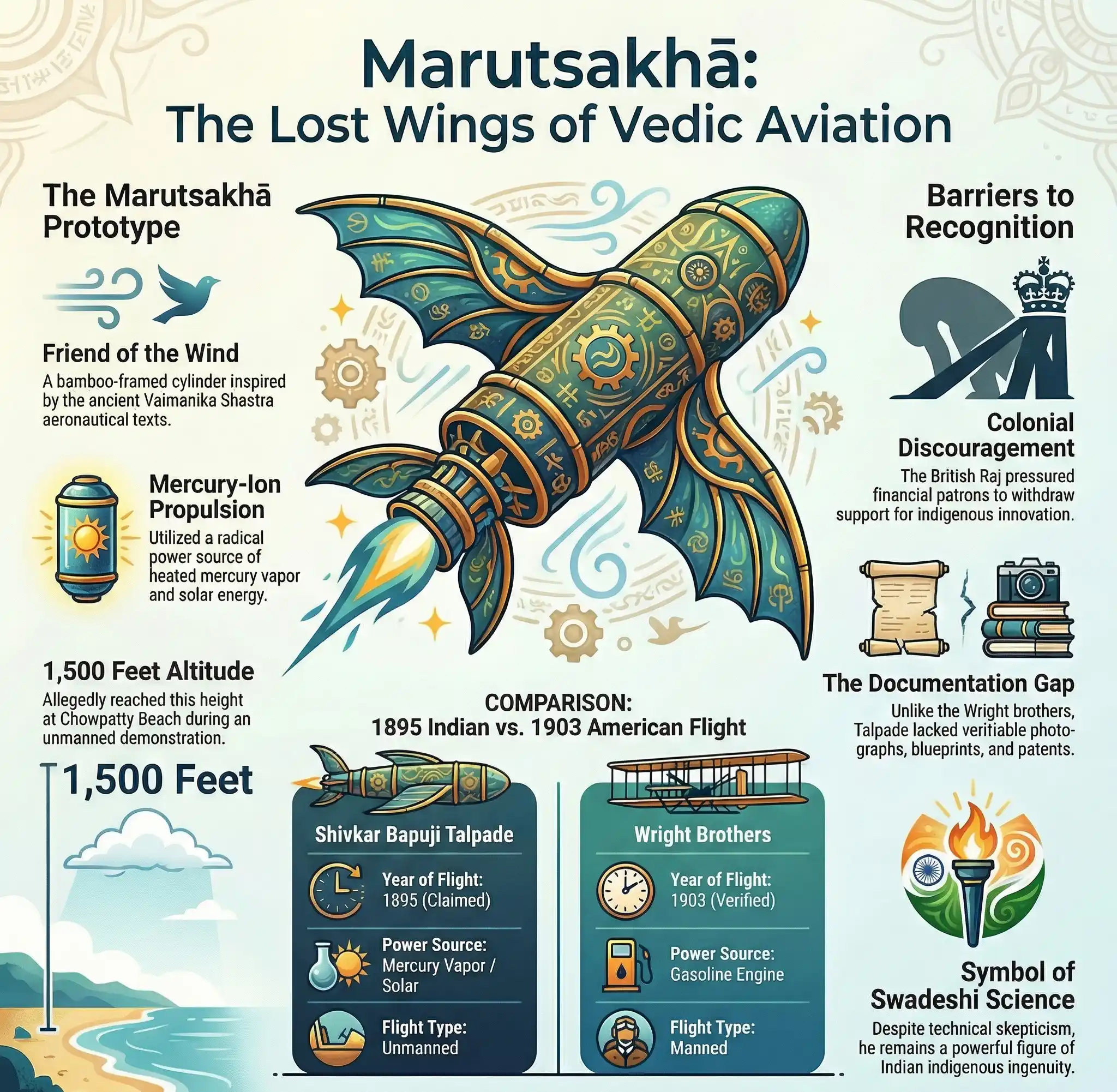
Shivkar Bapuji Talpade (1864–1916) was an Indian scholar and technical instructor from Mumbai who is famously claimed to have constructed and flown an unmanned airplane named Marutsakhā ("Friend of the Wind") in 1895. Drawing profound inspiration from ancient Hindu scriptures, particularly the Vaimanika Shastra attributed to Maharshi Bharadwaja, Talpade attempted to bridge Vedic aeronautical concepts with modern engineering. According to popular accounts, his mercury-ion powered aircraft achieved an altitude of 1,500 feet over Chowpatty Beach before crashing. Despite the presence of high-profile witnesses like the Maharaja of Baroda, Talpade's work was lost to history due to a lack of documented evidence, financial ruin, and active discouragement by the British colonial administration. Today, he remains a powerful symbol of Swadeshi Science and indigenous innovation.| Feature | Details |
| Name | Shivkar Bapuji Talpade |
| Lifespan | 1864 – 1916 |
| Birthplace | Chira Bazaar, Mumbai, India |
| Profession | Sanskrit Scholar, Technical Instructor |
| Claim to Fame | Allegedly flew an unmanned aircraft in 1895 |
| Aircraft Name | Marutsakhā (Friend of the Wind) |
| Key Inspiration | Vaimanika Shastra (Vedic text on aeronautics) |
| Power Source Concept | Heated mercury vapor and solar energy |
| Key Witnesses | Justice M.G. Ranade, Maharaja Sayajirao Gaekwad III |
The Sanskrit Scholar-Technician
Born in 1864 into the Pathare Prabhu community—one of the earliest native communities to settle in Bombay (Mumbai)—Shivkar Bapuji Talpade was a man of two worlds. He received his formal education at the prestigious Sir J.J. School of Art, where he developed a deep understanding of materials, model-making, and technical drafting. Eventually, he became a technical instructor in the school’s Arts and Crafts department.
However, unlike many of his contemporaries who were entirely swept up by Western scientific education, Talpade was a profound Sanskrit scholar. His intellectual fire was stoked by the teachings of Swami Dayanand Saraswati, the founder of the Arya Samaj, who heavily promoted the scientific validity of the Vedas.
Har Gobind Khorana: (1922- 2011)
Decoding Ancient Blueprints: The Vimana
Talpade’s ultimate obsession was the concept of the Vimana—the legendary flying chariots described in ancient Hindu epics like the Ramayana and the Mahabharata.
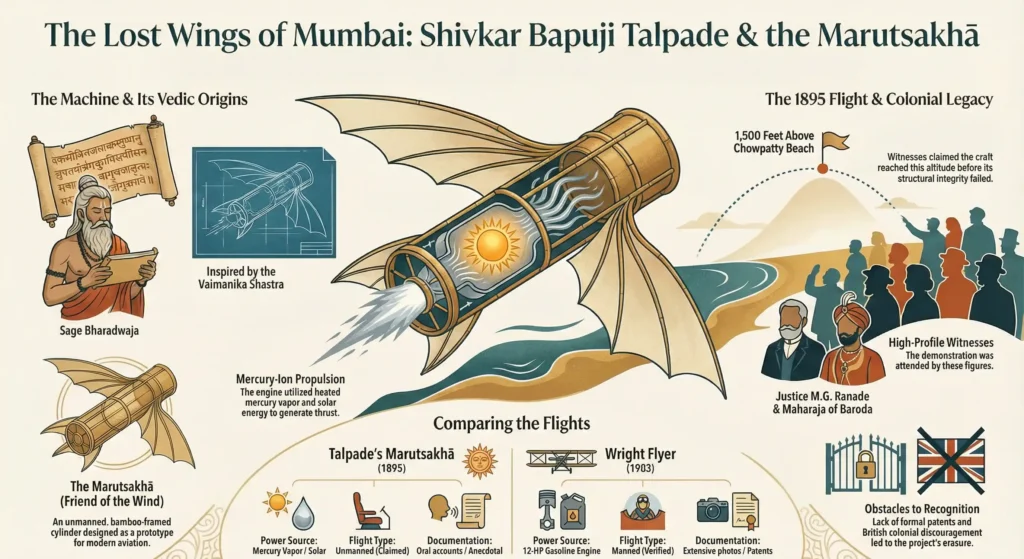
He dedicated his life to studying the Vaimanika Shastra (Science of Aeronautics), a text attributed to the ancient sage Maharshi Bharadwaja. While modern historians debate the dating of this text, Talpade viewed its poetic Sanskrit verses as literal, actionable blueprints for modern aviation. Utilizing the workshops at the School of Art, he spent years trying to decipher the structural and propulsion secrets hidden within the ancient shlokas.
Venkatraman Ramakrishnan: (1952- Present)
The Flight of the Marutsakhā (1895)
After years of relentless experimentation, Talpade constructed a prototype named Marutsakhā, which translates to “Friend of the Wind” (Marut meaning wind/air, and Sakha meaning friend).
- The Engine: The aircraft was reportedly an unmanned, bamboo-framed cylinder. The most radical element of the Marutsakhā was its power source. Based on his interpretation of Vedic texts, Talpade designed a mechanism that utilized heated mercury vapor and solar energy. Some modern theorists speculate this was an early conceptualization of an ion engine or a mercury vortex engine, which created thrust through ionized mercury.
- The Chowpatty Demonstration: In 1895, eight years before the Wright brothers’ historic flight at Kitty Hawk, Talpade allegedly demonstrated his machine at Chowpatty Beach in Mumbai.
According to accounts from his student P.D. Satawlekar, the unmanned craft successfully lifted off the ground, reached a remarkable altitude of 1,500 feet, and remained airborne for several minutes before its structural integrity failed and it crashed. The event was reportedly witnessed by the Indian intellectual elite, including Justice Mahadev Govinda Ranade and Sayajirao Gaekwad III, the Maharaja of Baroda.
Lost to History: The Colonial Erasure
If the Marutsakhā flew in 1895, why isn’t Talpade globally recognized as the father of aviation? The answer lies in the harsh realities of colonial India.
- Lack of Documentation: Unlike the Wright brothers, who meticulously documented, photographed, and patented their work, there is a striking absence of verifiable, contemporary photographs or blueprints of Talpade’s machine.
- Colonial Discouragement: The British Raj was deeply threatened by the concept of indigenous Indian technological supremacy (Swadeshi Science). It is widely believed that the colonial administration pressured the Maharaja of Baroda to withdraw his financial patronage from Talpade’s dangerous “experiments.”
- The Tragic End: Bankrupt and broken, Talpade could not afford to rebuild his machine. The skeleton of the Marutsakhā lay neglected in his house. After his death in 1916, it is claimed that his relatives, desperate to clear his debts, sold the remains of the craft to a British company, erasing the physical proof forever.
Manjul Bhargava: (1974- Present)
Quick Comparison Table: Talpade vs. Wright Brothers
| Feature | Shivkar Bapuji Talpade | Wright Brothers (Wilbur & Orville) |
| Year of Flight | 1895 (Claimed) | 1903 (Verified) |
| Aircraft Name | Marutsakhā | Wright Flyer |
| Type of Flight | Unmanned | Manned |
| Power Source | Mercury Vapor / Solar (Claimed) | 12-horsepower Gasoline Engine |
| Documentation | Oral accounts, anecdotal | Extensive photographs, logs, patents |
| Legacy Status | Folk Hero / Symbol of Swadeshi Science | Global Pioneers of Powered Flight |
Curious Indian: Fast Facts
- The IISc Debunking: In 1974, researchers from the Indian Institute of Science (IISc) in Bangalore conducted a thorough aerodynamic study of the Vaimanika Shastra. They concluded that the aircraft described in the text were aerodynamically unfeasible and could not have flown. However, this does not rule out that Talpade built a functioning prototype using his own physical engineering skills.
- Bollywood Tribute: In 2015, Bollywood released the film Hawaizaada, starring Ayushmann Khurrana as Shivkar Bapuji Talpade, bringing his obscure story back into the national spotlight.
- The Pathare Prabhus: Talpade’s community, the Pathare Prabhus, were known for their progressive views and intellectualism in 19th-century Bombay. They were instrumental in the early civic development of the city.
Conclusion
The story of Shivkar Bapuji Talpade occupies a poignant space between history, mythology, and national pride. While mainstream historians require empirical evidence that Talpade cannot provide from the grave, the spirit of his endeavor is undeniable. During the darkest days of the British Raj, he dared to look at ancient Indian heritage not as a relic of the past, but as a technological roadmap for the future. He remains an enduring icon of Swadeshi Science, representing the unconquered ambition of the Indian mind.
Daulat Singh Kothari : (1906–1993)
If you think you have remembered everything about this topic take this QUIZ
Results


#1. Who is famously claimed to have constructed and flown an unmanned airplane named Marutsakhā in 1895?
#2. Which ancient Hindu scripture profoundly inspired Talpade’s aeronautical concepts?
#3. According to the article, what was the conceptual power source for Talpade’s aircraft?
#4. What altitude did the Marutsakhā allegedly reach during its demonstration at Chowpatty Beach?
#5. Which high-profile individual was reportedly a witness to Talpade’s flight demonstration?
#6. What does the name of the aircraft, “Marutsakhā,” translate to?
#7. Where did Talpade receive his formal education and later work as a technical instructor?
#8. What reportedly happened to the remains of the Marutsakhā after Talpade’s death in 1916?
Did Shivkar Bapuji Talpade fly before the Wright Brothers?
According to Indian anecdotal history, he flew an unmanned aircraft in 1895, eight years before the Wright brothers’ 1903 manned flight. However, there is no contemporary, verifiable documentation to prove this globally.
What was the name of Talpade’s flying machine?
It was named Marutsakhā, which translates from Sanskrit as “Friend of the Wind.”
Where did Talpade get his aircraft design?
He was deeply inspired by the ancient Vedic text Vaimanika Shastra, which describes the construction and operation of legendary Vimanas (flying chariots).
How was the Marutsakhā powered?
Accounts suggest it was powered by a unique engine that utilized heated mercury vapor and solar energy to create thrust.
Why did Talpade stop his experiments?
He faced severe financial ruin after his primary patron, the Maharaja of Baroda, allegedly withdrew funding under pressure from the British colonial administration.
Read More: https://curiousindian.in/venkatraman-ramakrishnan-1952-present/