The life of Satyendra Nath Bose is a saga of intellectual defiance and profound discovery. From being a record-breaking student in Calcutta to becoming a global collaborator with Albert Einstein, Bose transformed our understanding of the subatomic world. By treating particles as indistinguishable entities, he laid the groundwork for the Bose-Einstein Statistics and the discovery of bosons. Despite never winning a Nobel Prize, his legacy is etched into the very name of the fundamental particles that make up our universe, proving that Indian scientific prowess is second to none.| Attribute | Details |
| Full Name | Satyendra Nath Bose |
| Born | January 1, 1894 (Calcutta, British India) |
| Died | February 4, 1974 (Calcutta, India) |
| Known For | Bose-Einstein Statistics, Bosons, Bose-Einstein Condensate |
| Education | Presidency College, University of Calcutta |
| Awards | Padma Vibhushan (1954), Fellow of the Royal Society |
| Famous Quote | “If a man is not a bit of a poet, he will never be a great scientist.” |
Satyendra Nath Bose was a man whose mind moved at a different frequency than the rest of the world. In any comprehensive Satyendra Nath Bose biography, the narrative usually begins in the bustling streets of late 19th-century Calcutta, where a young boy sat on his veranda solving complex arithmetic problems sketched in chalk by his father. This wasn’t just a child doing homework; this was the early blooming of a quantum mechanics pioneer who would eventually redefine how we perceive the very fabric of reality. His journey is a testament to the fact that brilliance doesn’t require a laboratory in the West to change the world; it only requires an inquisitive spirit and the courage to question “settled” truths.
Dr. A.P.J. Abdul Kalam: (1931-2015)
The Boy Who Scored 110 Out of 100
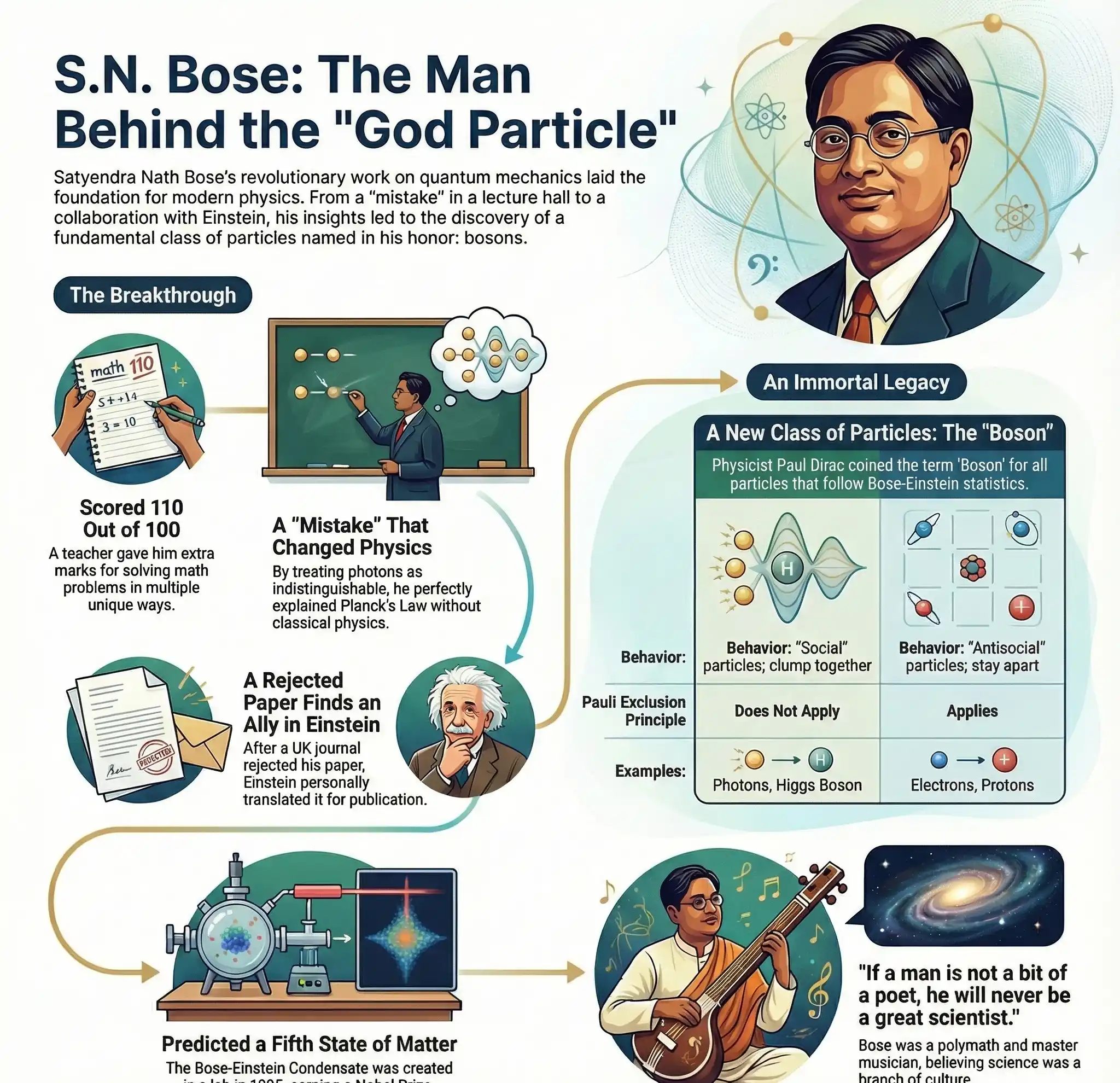
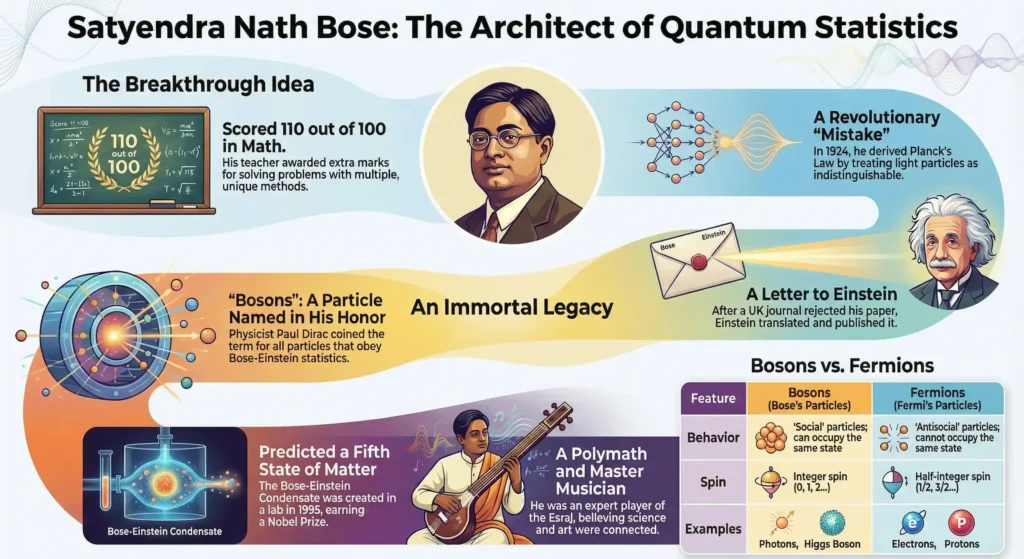
Every legend has a beginning, and for Bose, it was a mathematics exam at the prestigious Hindu School. His teacher, Upendranath Bakshi, was so impressed by Satyendra’s ability to solve problems through multiple unique methods—including some the teacher hadn’t even considered—that he awarded the boy 110 marks out of 100. This wasn’t a clerical error. It was a recognition that Satyendra’s logic transcended the limits of the curriculum.
Growing up in a home where education was the highest currency, he moved to Presidency College, rubbing shoulders with other future giants like Meghnad Saha and Prafulla Chandra Ray. His academic record was so formidable that his marks at the University of Calcutta set a record that remained unbroken for decades. This period of his life was less about textbooks and more about the cultural renaissance of India, where science was seen as a tool for national identity and pride.
The Bold “Mistake” at Dacca University
By 1921, Bose had moved to the newly established Dacca University. It was here, while teaching a class on Planck’s Law of black-body radiation, that the magic happened. Most professors would have followed the standard textbook derivation, which inconsistently mixed classical physics with quantum ideas. Bose, however, felt something was wrong.
During a lecture, he made what seemed like a mathematical “error” in his calculations. However, when he looked at the result of that “error,” he realized it predicted the behavior of light particles perfectly without needing classical physics at all. He had treated photons as “indistinguishable” particles. This was a radical departure from the physics of the time. This moment marked the true boson particle history, as he had just discovered the statistical rules for half the particles in the known universe.
A Letter to Albert Einstein
When Bose wrote down his findings in a paper titled “Planck’s Law and the Hypothesis of Light Quanta,” he sent it to a leading British journal. They rejected it, likely because the ideas were too far ahead of their time or perhaps because the author was an unknown Indian lecturer. Undeterred, Bose did something incredibly brave. He mailed the manuscript directly to Albert Einstein in Berlin.
In his letter, he wrote, “I have ventured to send you the accompanying article for your perusal and opinion.” Einstein, who was already the most famous scientist on Earth, immediately saw the genius in Bose’s work. He translated the paper into German himself and had it published with his own glowing recommendation. This collaboration between an Indian physicist Satyendra Nath Bose and the German giant led to the “Bose-Einstein Statistics,” a cornerstone of modern physics.
8 Defining Chapters in the Vikram Sarabhai Biography
Living Among the Titans in Europe
The recognition from Einstein opened doors that were previously bolted shut. Bose traveled to Europe, where he worked in the laboratories of Marie Curie and discussed the mysteries of the universe with Louis de Broglie and Max Planck. Imagine the scene: a humble man from Calcutta, often seen in a simple dhoti or a plain suit, sitting in the heart of Europe’s scientific elite, debating the nature of light and matter.
Despite the fame, Bose remained remarkably grounded. He wasn’t interested in the politics of science; he was interested in the truth. He spent two years in Europe, absorbing the latest advancements, but his heart remained tied to the soil of India. He returned home to continue building the scientific infrastructure of a nation that was still under colonial rule but was intellectually free.
The Polymath: More Than Just Equations
To view Bose only through the lens of physics would be a mistake. He was a true polymath. He was a master of the Esraj, a traditional Indian musical instrument, and would often play for his friends and students late into the night. He was also deeply interested in chemistry, biology, mineralogy, and even fine arts.
Friends often recalled how he could switch from discussing the nuances of quantum states to debating the merits of French literature or the complexities of soil science. He believed that science was a branch of culture, not a separate silo. This holistic approach made him a beloved teacher. He didn’t just teach physics; he taught his students how to think and how to appreciate the beauty of the world around them.
The Legacy of the “God Particle”
While Bose never received a Nobel Prize—an omission that remains a point of debate in scientific circles—his name is immortalized in a way few others are. In 1945, the great physicist Paul Dirac coined the term “Boson” for particles that follow Bose-Einstein statistics.
Decades later, when scientists at CERN discovered the Higgs Boson (often called the “God Particle”), they were confirming a lineage of thought that started in a classroom in Dacca. The Bose-Einstein Condensate, a fifth state of matter predicted by the duo, was eventually created in a lab in 1995, leading to a Nobel Prize for the researchers involved. Bose’s shadow is cast over every modern particle accelerator and quantum computer today.
Scientific Comparison: Bosons vs. Fermions
| Feature | Bosons (Bose’s Particles) | Fermions (Fermi’s Particles) |
| Statistics Followed | Bose-Einstein Statistics | Fermi-Dirac Statistics |
| Spin | Integer (0, 1, 2…) | Half-integer (1/2, 3/2…) |
| Pauli Exclusion Principle | Does Not Apply (Can stay together) | Applies (Cannot stay together) |
| Examples | Photons, Gluons, Higgs Boson | Electrons, Protons, Neutrons |
| Behavior | “Social” particles; clump together | “Antisocial” particles; stay apart |

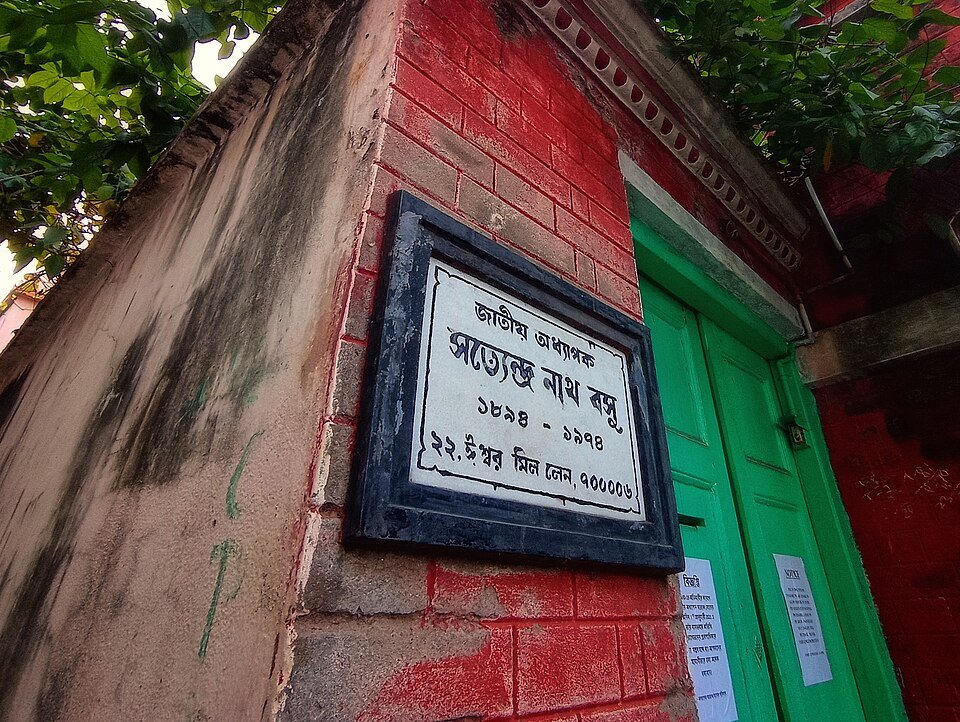

The National Professor and the Simple Life
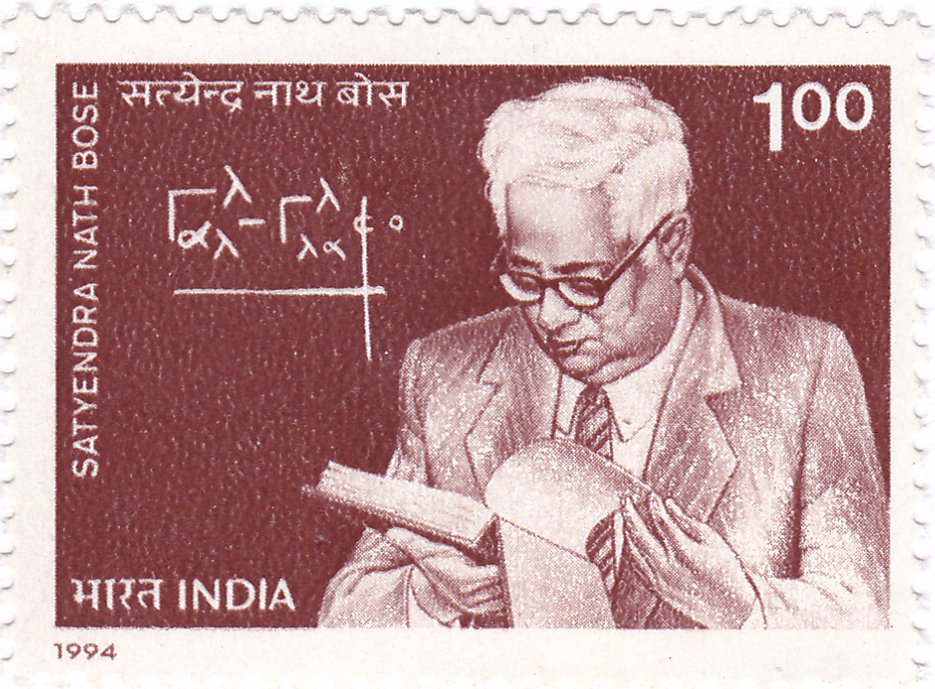
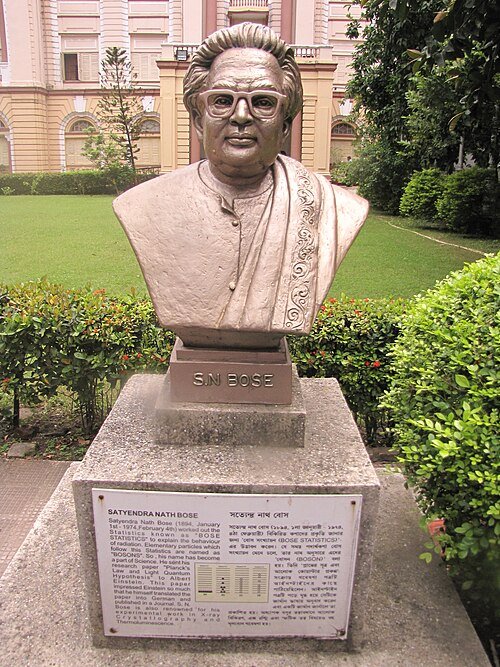
In his later years, Bose served as a National Professor of India and was awarded the Padma Vibhushan. Yet, he lived a life of extreme simplicity. He was often found in his study, surrounded by a mountain of books, papers, and his musical instruments. He remained a fierce advocate for teaching science in mother tongues, believing that true understanding comes when you learn in the language of your heart.
When he passed away in 1974, he left behind a world that understood itself much better because of his “mistake” in a Dacca classroom. He proved that the most complex mysteries of the universe could be unlocked by a curious Indian mind with nothing more than a pen, paper, and the courage to dream.
The Roopkund Skeleton Lake Mystery: Why Were Greeks Dying in the Indian Himalayas?
Curious Indian: Fast Facts
- The 110/100 Legend: Bose’s math teacher gave him extra marks because he solved questions in more ways than the exam required.
- Einstein’s Translator: Albert Einstein was so impressed by Bose’s paper that he personally translated it from English to German.
- Naming the Particle: The term ‘Boson’ was coined by Paul Dirac to honor Bose’s contribution to quantum mechanics.
- The Fifth State: He co-predicted the “Bose-Einstein Condensate,” a state of matter where atoms behave as a single entity at near absolute zero.
- A Master Musician: Bose was an expert player of the Esraj, showing that science and art are two sides of the same coin.
Conclusion
The Satyendra Nath Bose biography is more than just a timeline of a physicist’s life; it is an inspirational roadmap for every “Curious Indian.” It teaches us that resources are secondary to resolve and that a single, well-placed question can bring the world’s greatest minds to your doorstep. Bose remains a towering figure whose work continues to guide the frontiers of modern science, reminding us that the universe belongs to those who dare to look at it differently.
1971 Nagarwala Case: India’s Great Bank Heist Mystery
If you think you have remembered everything about this topic take this QUIZ
Results


#1. Why did Satyendra Nath Bose’s teacher award him 110 marks out of 100 on a mathematics exam?
#2. What was the radical departure from traditional physics that Bose used to derive Planck’s Law at Dacca University?
#3. How did Albert Einstein respond to the manuscript Bose sent him in 1924?
#4. According to the scientific comparison, what is a key behavioral difference between ‘Bosons’ and ‘Fermions’?
#5. Who coined the term ‘Boson’ to honor Satyendra Nath Bose’s contribution to science?
#6. What is the ‘Bose-Einstein Condensate’ (BEC) mentioned in the text?
#7. Besides physics, Bose was a master of which traditional Indian musical instrument?
#8. What was Bose’s stance on the language used for teaching science?
Why is Satyendra Nath Bose famous?
He is famous for his work on quantum mechanics in the 1920s, which led to the Bose-Einstein statistics and the prediction of the Bose-Einstein Condensate. His work provided the foundation for the classification of “boson” particles.
Did Satyendra Nath Bose win a Nobel Prize?
No, Satyendra Nath Bose did not win a Nobel Prize, although he was nominated several times. However, several Nobel Prizes have been awarded to others for work related to the concepts he pioneered, such as the discovery of the Bose-Einstein Condensate.
What is a Boson?
A boson is a type of subatomic particle that follows Bose-Einstein statistics. Examples include photons (light particles) and the Higgs boson. They are known as “force-carrier” particles.
How did Bose and Einstein collaborate?
Bose sent a research paper to Einstein after it was rejected by a British journal. Einstein recognized its importance, translated it, and helped get it published, eventually expanding Bose’s ideas into what we now call Bose-Einstein Statistics.
Where did Satyendra Nath Bose study?
Bose studied at Presidency College and the University of Calcutta, where he set academic records that stood for many years.