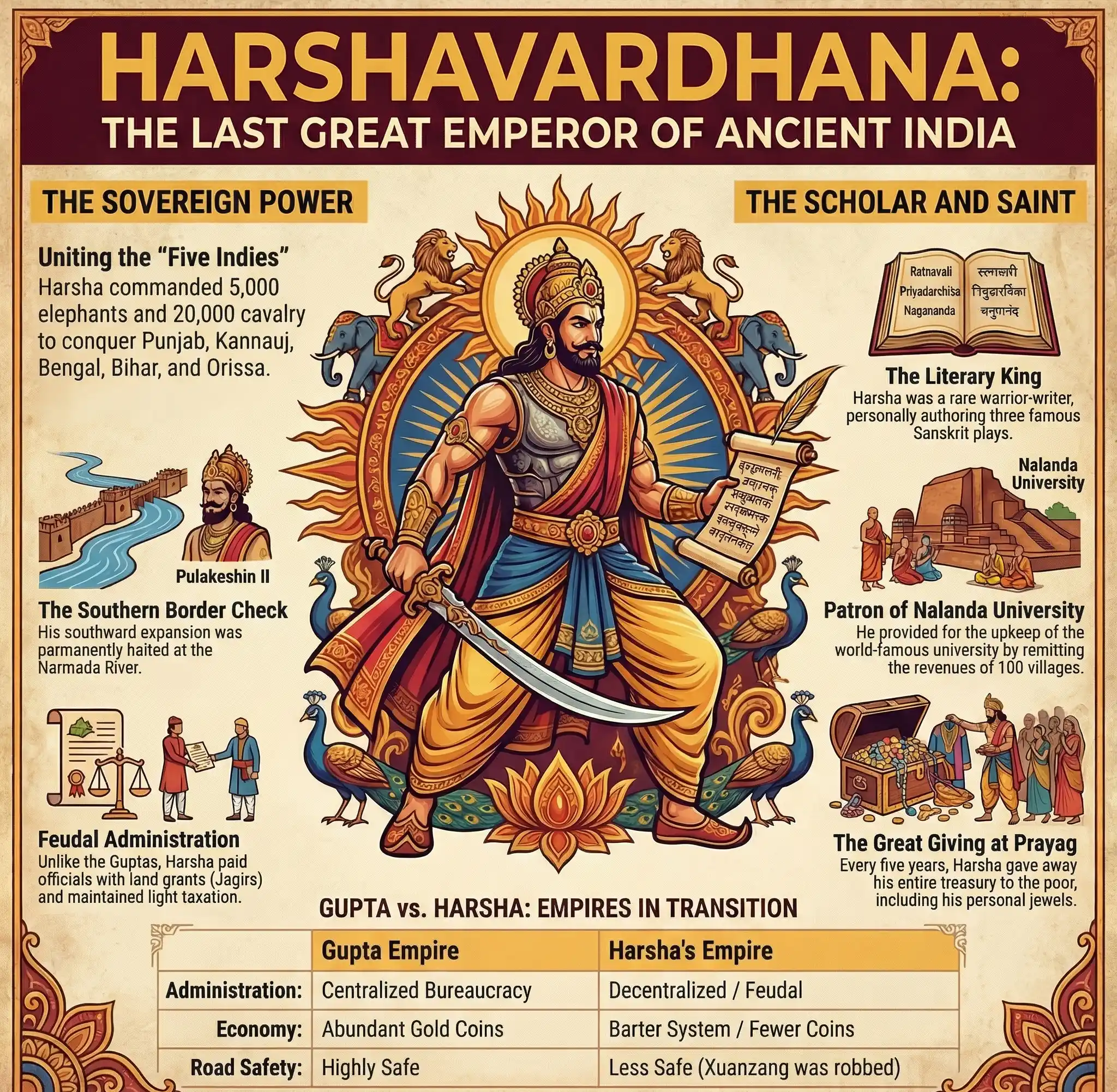
Harshavardhana (also known as Harsha) ruled North India from 606 to 647 CE. Belonging to the Pushyabhuti Dynasty of Thanesar, he ascended the throne under tragic circumstances following the death of his father and the murder of his elder brother, Rajyavardhana. Harsha united the kingdoms of Thanesar and Kannauj, moving his capital to Kannauj, which became the political center of North India. His empire covered Punjab, Haryana, Rajasthan, and the entire Gangetic plain up to Bengal. He is famous for his patronage of Nalanda University, his benevolence at the Prayag Assemblies, and his literary works. His southward expansion was checked by the Chalukya king Pulakeshin II at the Battle of Narmada. His reign is vividly documented by his court poet Banabhatta (in Harshacharita) and the Chinese traveler Xuanzang (Hiuen Tsang).| Feature | Details |
| Reign Dates | 606 – 647 CE |
| Dynasty | Pushyabhuti (Vardhana) Dynasty |
| Capital | Thanesar (Original), Kannauj (Later) |
| Titles | Siladitya, Sakalottarapathanatha (Lord of the North) |
| Key Rival | Pulakeshin II (Chalukya Dynasty) |
| Defeated Enemy | Shashanka (Ruler of Gauda/Bengal) |
| Literary Works | Ratnavali, Priyadarshika, Nagananda |
| Court Poet | Banabhatta |
| Famous Visitor | Xuanzang (Hiuen Tsang) |
The Tragic Accession
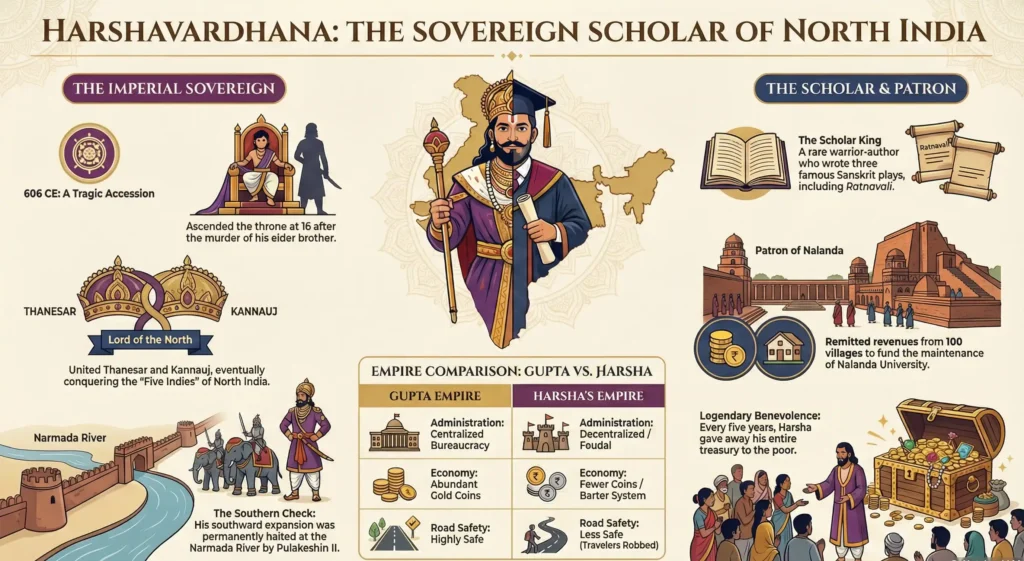
Harsha’s rise reads like a thriller. In 606 CE, the Hunas were attacking the borders. Harsha’s father, Prabhakaravardhana, died of illness. His elder brother, Rajyavardhana, marched to Malwa to avenge the murder of their brother-in-law, the Maukhari king of Kannauj. Although victorious, Rajyavardhana was treacherously killed by Shashanka, the ruler of Gauda (Bengal).
Reign of Raja Raja Chola I: The Golden Age of the Cholas
At 16, Harsha was crowned king. His first mission was not conquest, but rescue. His sister, Rajyashri, had escaped from prison and fled into the Vindhya forests to commit Sati. Harsha, with the help of a tribal chief and a Buddhist monk, found her just in time and saved her. He then vowed to clear the earth of the “wicked kings” who had destroyed his family.
The Lord of the North
Harsha united the thrones of Thanesar and Kannauj. He formed an alliance with Bhaskaravarman, the king of Kamarupa (Assam), to sandwich Shashanka of Bengal from both sides. Over the next six years, his army of 5,000 elephants and 20,000 cavalry conquered the “Five Indies” (Punjab, Kannauj, Bengal, Bihar, and Orissa).
Chola Naval Expedition to Southeast Asia: When India Ruled the High Seas
The Southern Check: Battle of Narmada
Harsha’s ambition to conquer the South was halted at the banks of the River Narmada. The Chalukya king Pulakeshin II (ruler of Vatapi) defeated Harsha’s forces around 618-619 CE.
- The Result: The Narmada became the border between the Northern Empire of Harsha and the Southern Empire of the Chalukyas.
- The Record: This defeat is the only major blot on Harsha’s military career, mentioned in the Aihole Inscription of Pulakeshin II.
Administration and Society
Harsha’s administration was feudal and decentralized compared to the Guptas.
- Feudalism: Officials were paid in land grants (Jagirs) rather than cash. This strengthened the feudal lords (Samantas), who would later weaken the empire.
- Taxation: Taxes were light—typically one-sixth of the produce.
- Crime: Xuanzang noted that while the government was generous, the roads were not as safe as in the Gupta period; he himself was robbed multiple times.
Cultural Patronage: The Scholar King
Harsha was a unique blend of a warrior and a writer.
- Literature: He authored three famous Sanskrit plays: Ratnavali, Priyadarshika, and Nagananda.
- Banabhatta: His court poet wrote Harshacharita (The Deeds of Harsha), the first historical biography in Sanskrit literature, and Kadambari, a famous novel.
- Nalanda University: Harsha was the chief patron of Nalanda. He built a massive monastery there and remitted the revenues of 100 villages for its upkeep.
The Great Assemblies
Harsha was known for his grand religious assemblies.
- Kannauj Assembly (643 CE): Organized to honor Xuanzang and Mahayana Buddhism. It was attended by 20 kings, 3,000 monks, and 1,000 scholars.
- Prayag Assembly (Moksha Parishad): Held every five years at the confluence of the Ganga and Yamuna (modern Prayagraj). Here, Harsha would give away his entire treasury to the poor, monks, and Brahmins, keeping only his personal clothing. He would then ask his sister Rajyashri for a second-hand garment to wear. This tradition is often linked to the origins of the Kumbh Mela.
Foundation of the Vijayanagara Empire: The Rise of Hampi
Quick Comparison Table: Harsha vs. The Guptas
| Feature | Gupta Empire (320–550 CE) | Harsha’s Empire (606–647 CE) |
| Administration | Centralized Bureaucracy | Decentralized / Feudal |
| Religion | Vaishnavism (Hindu Revival) | Shaivism -> Mahayana Buddhism |
| Economy | Gold Coins (Abundant) | Fewer Coins / Barter System |
| Road Safety | Highly Safe (Faxian’s account) | Less Safe (Xuanzang’s account) |
| Literature | Kalidasa (Classical) | Banabhatta (Ornate Style) |
Curious Indian: Fast Facts
- The Sati Incident: Harsha saved his sister Rajyashri from burning herself on a pyre, an early recorded instance of royal intervention against Sati.
- Xuanzang’s Description: The Chinese traveler described Harsha as a tireless worker who divided his day into three parts: one for administration and two for religious works. He noted that Indians were “quick-tempered but honest.”
- No Heir: Despite his greatness, Harsha died without an heir (his children were reportedly killed or died young). His empire disintegrated immediately after his death, plunging North India into anarchy until the rise of the Pratiharas.
- Diplomacy with China: Harsha sent a Brahmin envoy to the court of the Tang Emperor Tai Tsung in China in 641 CE.
Conclusion
The Reign of Harshavardhana was the sunset of the classical age. He kept the lamp of civilization burning in North India after the Gupta collapse. His legacy is not just in the lands he conquered, but in the books he wrote and the university he funded. He proved that a king is remembered not by what he gathers, but by what he gives away.
Reign of Akbar 1556-1605: The Golden Age of the Mughal Empire
If you think you have remembered everything about this topic take this QUIZ
Results


#1. After uniting the kingdoms of Thanesar and Kannauj, to which city did Harshavardhana move his political capital?
#2. Which Chalukya king defeated Harshavardhana at the Battle of Narmada, successfully halting his southward expansion?
#3. Harshavardhana was a unique blend of a warrior and a writer. Which of the following Sanskrit plays was authored by him?
#4. Which famous Chinese traveler visited India during Harsha’s reign and noted that the roads were less safe compared to the Gupta period?
#5. Harsha was a chief patron of which ancient educational institution, remitting the revenues of 100 villages for its upkeep?
#6. At the Prayag Assembly (Moksha Parishad) held every five years, what extraordinary act of generosity was Harsha known for?
#7. According to the comparison table, how did Harsha’s administration primarily differ from that of the Gupta Empire?
#8. Harsha’s first mission upon being crowned king at age 16 was to rescue his sister from committing Sati in the Vindhya forests. What was her name?
Who was the court poet of Harsha?
Banabhatta was his court poet, who wrote Harshacharita and Kadambari.
Which Chinese traveler visited Harsha’s court?
Xuanzang (Hiuen Tsang) visited his court and stayed in India for 15 years.
Who defeated Harshavardhana?
The Chalukya king Pulakeshin II defeated him on the banks of the Narmada River.
What plays did Harsha write?
He wrote Ratnavali, Priyadarshika, and Nagananda.
Where did Harsha shift his capital?
He shifted his capital from Thanesar to Kannauj.