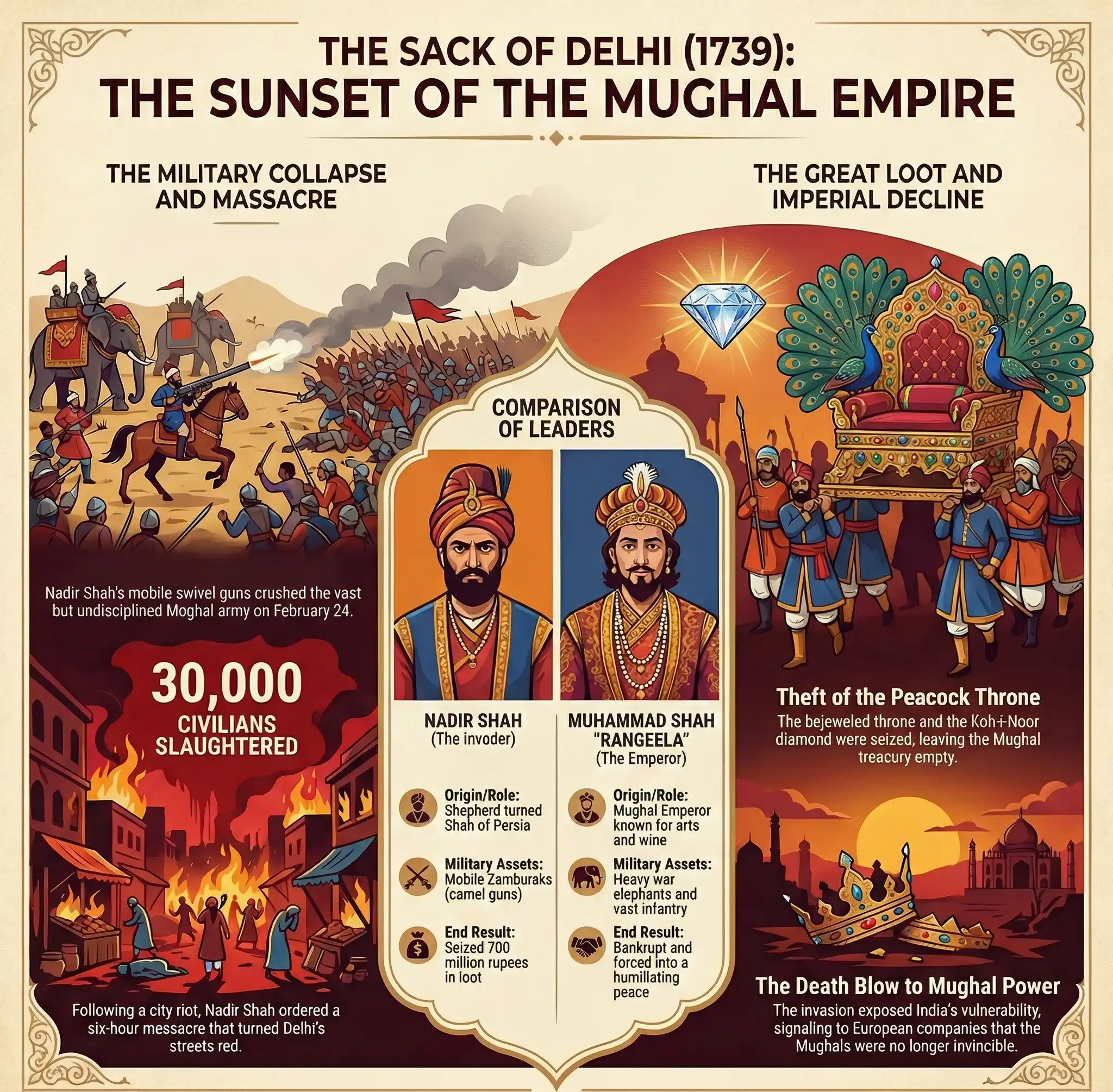
Nadir Shah's Invasion of Delhi in 1739 was a cataclysmic event that shattered the prestige of the Mughal Empire. Nadir Shah, the Shah of Persia and founder of the Afsharid dynasty, invaded India to replenish his treasury. He defeated the Mughal Emperor Muhammad Shah "Rangeela" in less than three hours at the Battle of Karnal on February 24, 1739. Following the victory, he marched into Delhi. A riot by the citizens against Persian soldiers triggered Nadir Shah's fury, leading to the infamous Katal-e-aam (general massacre) on March 22, 1739. The invasion ended with Nadir Shah looting the legendary Peacock Throne and the Koh-i-Noor diamond, leaving the Mughal Empire bankrupt and vulnerable to future colonial conquest.| Feature | Details |
| Invasion Year | 1739 |
| Invader | Nadir Shah (Shah of Persia) |
| Mughal Emperor | Muhammad Shah “Rangeela” |
| Decisive Battle | Battle of Karnal (Feb 24, 1739) |
| Massacre Date | March 22, 1739 |
| Massacre Location | Chandni Chowk / Old Delhi |
| Key Loot | Peacock Throne, Koh-i-Noor, Darya-i-Noor |
| Estimated Dead | 20,000 – 30,000 civilians |
| Outcome | End of Mughal Power; Rise of Marathas/British |
The Crumbling Empire

By 1739, the Mughal Empire was a shadow of its former self. The Emperor, Muhammad Shah, known as “Rangeela” (The Colorful) for his love of arts and wine, paid little attention to the defense of his borders. The empire was rot with court intrigues between nobles like Nizam-ul-Mulk and Saadat Khan.
Nadir Shah, a military genius who had risen from a shepherd to become the Shah of Persia, saw this weakness. Bankrupt after his wars with the Ottomans, he looked toward the fabled wealth of India to pay his army. When the Mughals failed to close their borders to Afghan rebels, Nadir used it as a pretext to invade.
Third Battle of Panipat 1761: The Day the Maratha Dream Died
The Battle of Karnal: Defeat in Three Hours
The Mughal army met Nadir Shah at Karnal (about 110 km from Delhi). It was a mismatch of epic proportions. The Mughal army was vast but indisciplined, relying on heavy war elephants. Nadir Shah’s army was smaller but highly mobile, using Zamburaks (swivel guns mounted on camels) and refined musketry.
On February 24, 1739, the battle began. In just three hours, 20,000 Mughal soldiers lay dead. Muhammad Shah surrendered and was forced to invite Nadir Shah into Delhi as his “guest.”
The Banquet of Blood
Nadir Shah entered Delhi on March 20, 1739, and took residence in the Red Fort. Initially, things were peaceful. But on the night of March 21, a rumor spread through the city that Nadir Shah had been assassinated by a female guard in the Red Fort.
The citizens of Delhi, emboldened by the rumor, rose up and killed about 900 Persian soldiers who were patrolling the streets.
Battle of Buxar 1764: The Victory That Made British Rule Inevitable
March 22: The Darkest Morning
The next morning, a furious Nadir Shah rode to the Sunehri Masjid (Golden Mosque) in Chandni Chowk. Seeing the bodies of his soldiers, he unsheathed his sword—a signal to his army that no mercy was to be shown.
From 9:00 AM to 3:00 PM, the Persian army went on a rampage. It was a systematic slaughter known as Katal-e-aam. Men were decapitated, women were enslaved, and houses were burned. The streets of Chandni Chowk were literally red with blood. An estimated 30,000 people were massacred in six hours.
The horror only stopped when Muhammad Shah, with tears in his eyes, begged Nadir Shah: “For the sake of God, sheath your sword, for no one is left to kill.” Nadir Shah sheathed his sword, and the killing stopped instantly.
The Great Loot: Emptying India
If the massacre was horrific, the looting was comprehensive. Nadir Shah took everything.
- The Peacock Throne: The bejeweled throne of Shah Jahan, worth millions, was dismantled and taken to Persia.
- The Diamonds: The Koh-i-Noor (Mountain of Light) and Darya-i-Noor (Sea of Light) were seized. Legend has it that Nadir Shah obtained the Koh-i-Noor by tricking Muhammad Shah into exchanging turbans as a gesture of friendship, knowing the Emperor hid the diamond in his turban.
- The Treasury: He took 700 million rupees worth of gold, silver, and jewels. He took so much wealth that he cancelled all taxes in Persia for three years.
Battle of Plassey 1757: The Betrayal That Changed India’s Destiny
Quick Comparison Table: Nadir Shah vs. Ahmad Shah Abdali
| Feature | Nadir Shah (1739) | Ahmad Shah Abdali (1761) |
| Target | The Mughal Emperor & Delhi’s Wealth | The Maratha Confederacy |
| Key Battle | Battle of Karnal | Third Battle of Panipat |
| Objective | Plunder and Loot | Political dominance/Religious war |
| Relationship | Master/General | Nadir’s General (Later King) |
| Impact | Broke Mughal Economy | Broke Maratha Military |
Curious Indian: Fast Facts
- The Sword Signal: Nadir Shah’s discipline was so terrifying that his soldiers would not stop killing until he physically put his sword back in the scabbard.
- The Elephant Caravan: When Nadir Shah left Delhi in May 1739, his caravan of loot included 1,000 elephants, 7,000 horses, and 10,000 camels loaded with treasure.
- The Daughter: As part of the humiliating peace treaty, Muhammad Shah was forced to marry his daughter to Nadir Shah’s son, Nasrullah Mirza.
- The End of Nadir: The wealth of India did not bring him peace. Nadir Shah became paranoid and cruel, eventually being assassinated by his own officers in 1747.
Conclusion
Nadir Shah’s Invasion of Delhi was the death blow to the Mughal Empire. While the dynasty limped on for another century, it was hollow. The invasion exposed India’s weakness to the world, signaling to the French and British East India Companies that the great Mughal was no longer invincible. The road to colonial rule was paved with the rubble of Delhi.
Death of Tipu Sultan: The Fall of the Tiger of Mysore
If you think you have remembered everything about this topic take this QUIZ
Who was the Mughal Emperor during Nadir Shah’s invasion?
Muhammad Shah “Rangeela” was the emperor.
What was the Battle of Karnal?
It was the decisive battle fought on February 24, 1739, where Nadir Shah defeated the Mughal army in just three hours.
Which famous diamond did Nadir Shah take from India?
He took the Koh-i-Noor diamond, along with the Darya-i-Noor.
Where did Nadir Shah order the massacre from?
He sat at the Sunehri Masjid (Golden Mosque) in Chandni Chowk while overseeing the massacre.
What was the result of the invasion?
It bankrupted the Mughal Empire, decentralized power to regional governors, and paved the way for European colonization.