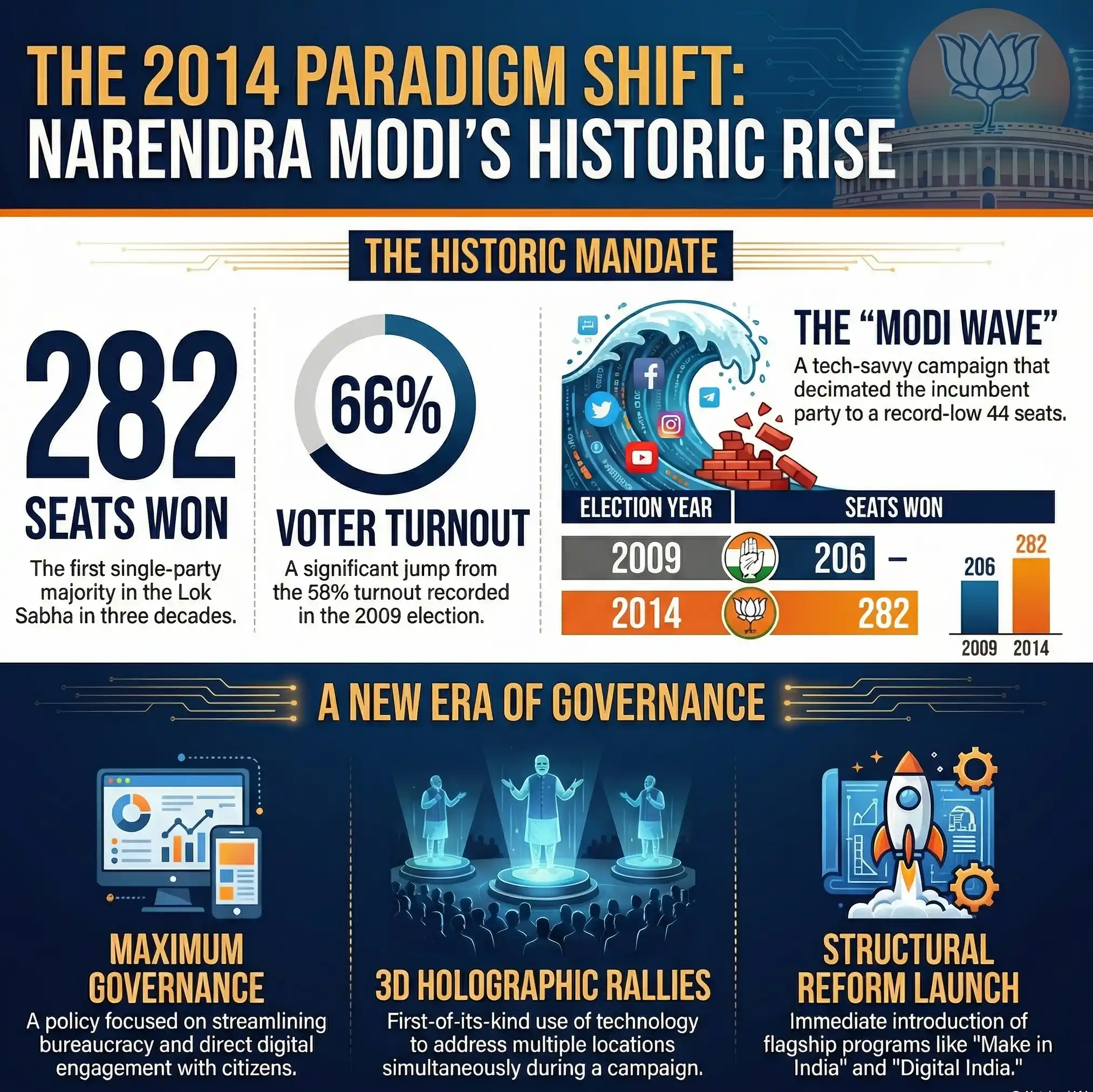
In May 2014, Narendra Modi was sworn in as the 14th Prime Minister of India, marking a seismic shift in the country's political landscape. Leading the Bharatiya Janata Party (BJP) to a landslide victory, he secured 282 seats—the first single-party majority in the Lok Sabha since 1984. His campaign, centered on the promise of "Achhe Din" (Good Days) and the Gujarat model of development, decimated the incumbent Congress party. His first term introduced transformative policies like Make in India, Swachh Bharat Abhiyan, and Jan Dhan Yojana, signaling a move towards decisiveness and digitalization.| Attribute | Details |
| Swearing-in Date | May 26, 2014 |
| Election | 16th Lok Sabha Elections (2014) |
| Party | Bharatiya Janata Party (BJP) |
| Alliance | National Democratic Alliance (NDA) |
| Seat Count | BJP: 282/543 (Single-party majority) |
| Predecessor | Manmohan Singh |
| Constituency | Varanasi, Uttar Pradesh |
| Key Slogan | “Ab Ki Baar, Modi Sarkar” |
The Background: A Mandate for Change
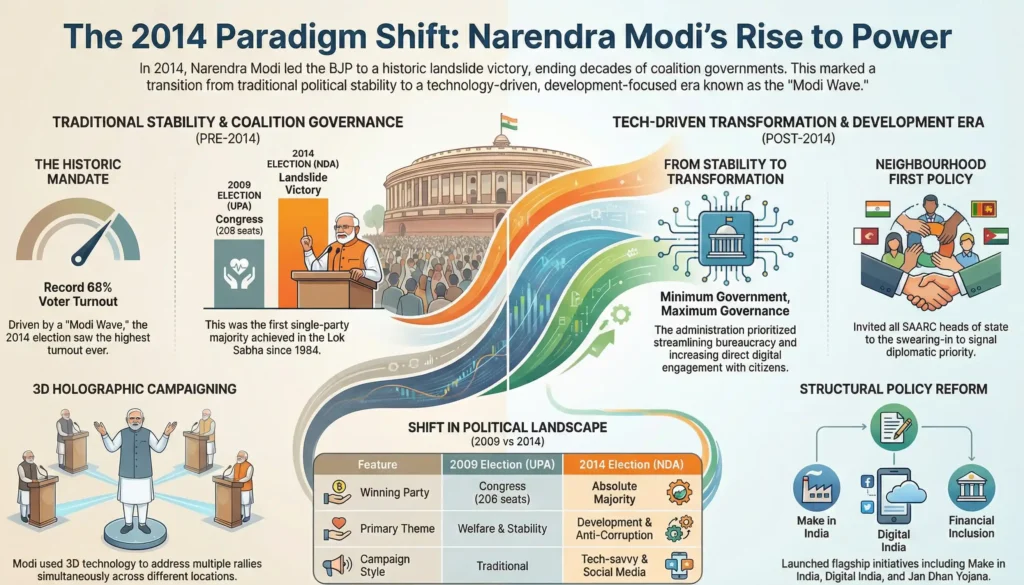
The 2014 general election was fought against the backdrop of corruption scandals, policy paralysis, and inflation that plagued the incumbent UPA government. Narendra Modi, then the Chief Minister of Gujarat, emerged as the BJP’s prime ministerial candidate. He projected an image of a decisive leader capable of replicating the “Gujarat Model” of economic growth on a national scale. His campaign, driven by technology and mass rallies, resonated with a young and aspirational India.
The Roopkund Skeleton Lake Mystery: Why Were Greeks Dying in the Indian Himalayas?
The “Modi Wave” and Historic Victory
The election results were nothing short of a tsunami. The “Modi Wave” swept across the Hindi heartland and western India.
- The Numbers: The BJP won 282 seats, crossing the 272-mark required for a simple majority on its own. The NDA coalition secured a massive 336 seats.
- Congress Decimated: The Indian National Congress was reduced to its lowest-ever tally of 44 seats, failing to even secure the Leader of the Opposition post.
- Varanasi Victory: Modi contested from two seats—Vadodara and Varanasi—winning both by huge margins, but chose to retain Varanasi to symbolize his connection with the cultural heart of India.
Governance: Minimum Government, Maximum Governance
Modi’s swearing-in ceremony on May 26, 2014, was a statement of intent. For the first time, heads of state from all SAARC nations were invited, signaling a “Neighbourhood First” policy. His administration focused on streamlining bureaucracy, digitization, and direct engagement with citizens through platforms like Mann Ki Baat.
1971 Nagarwala Case: India’s Great Bank Heist Mystery
Key Initiatives of the First Term
His first term saw the launch of several flagship programs aimed at structural reform:
- Swachh Bharat Abhiyan (2014): A nationwide cleanliness drive aiming to make India open-defecation free.
- Jan Dhan Yojana (2014): A financial inclusion mission that opened millions of bank accounts for the unbanked poor.
- Make in India (2014): An initiative to transform India into a global design and manufacturing hub.
- Digital India (2015): A campaign to ensure government services are made available to citizens electronically by improved online infrastructure.
8 Defining Chapters in the Vikram Sarabhai Biography
Quick Comparison: 2009 vs. 2014 Elections
| Feature | 2009 Election (UPA Win) | 2014 Election (NDA Win) |
| Prime Minister | Manmohan Singh | Narendra Modi |
| Winning Party | Congress (206 seats) | BJP (282 seats) |
| Primary Theme | Welfare & Stability | Development & Anti-Corruption |
| Voter Turnout | ~58% | ~66% (Record High) |
| Campaign Style | Traditional | Tech-savvy, Social Media driven |
Curious Indian Fast Facts
- First from the “Born Free” Generation: Narendra Modi is the first Prime Minister of India born after the country’s independence in 1947.
- Holographic Campaign: During the 2014 campaign, Modi used 3D holographic technology to address multiple rallies simultaneously across different locations, a first in Indian politics.
- Chai Pe Charcha: To counter a rival’s jibe about his background as a tea seller, the BJP launched “Chai Pe Charcha” (Conversations over Tea), interacting with voters at tea stalls via video conferencing.
- Social Media Pioneer: He was one of the first Indian politicians to effectively utilize Twitter and Facebook for direct communication, bypassing traditional media gatekeepers.
- Madison Square Garden: His visit to the US in 2014 included a rockstar-like reception at Madison Square Garden, New York, attended by over 18,000 Indian-Americans.
Conclusion
Narendra Modi’s ascent to power in 2014 was not just a change of government; it was a paradigm shift in Indian politics. It ended the era of coalition instability and brought a new focus on assertive leadership and development-oriented governance. From the dusty lanes of Vadnagar to the corridors of power in New Delhi, his journey symbolizes the possibility that in a democracy, even a common man can rise to lead the nation.
The Purulia Arms Drop Mystery 1995: When the Sky Rained Guns
If you think you have remembered everything about this topic take this QUIZ
Results


#1. Narendra Modi led the BJP to a single-party majority in the 2014 elections by winning how many seats?
#2. Which famous slogan was the centerpiece of the BJP’s 2014 election campaign?
#3. Narendra Modi is the first Prime Minister of India to be:
#4. Which technology did Narendra Modi use to address multiple rallies simultaneously during the 2014 campaign?
#5. Which constituency did Narendra Modi choose to retain after winning both seats he contested in 2014?
#6. Which flagship scheme was launched in 2014 with the aim of making India open-defecation free?
#7. The 2014 election campaign initiative “Chai Pe Charcha” was launched to counter opposition remarks about Modi’s background as a:
#8. Narendra Modi’s swearing-in ceremony in 2014 was unique because it was attended by the heads of state of which group?
When did Narendra Modi become Prime Minister?
He was sworn in on May 26, 2014.
Which constituency did Narendra Modi represent in 2014?
He contested and won from both Vadodara (Gujarat) and Varanasi (Uttar Pradesh), eventually retaining the Varanasi seat.
What was the BJP’s seat count in the 2014 election?
The BJP won 282 seats, securing a majority on its own.
Who was the Prime Minister before Narendra Modi?
Dr. Manmohan Singh of the Congress party was the Prime Minister from 2004 to 2014.
What was the “Modi Wave”?
It refers to the massive surge in popularity and voter support for Narendra Modi across India during the 2014 elections, driven by his charisma and development promises.