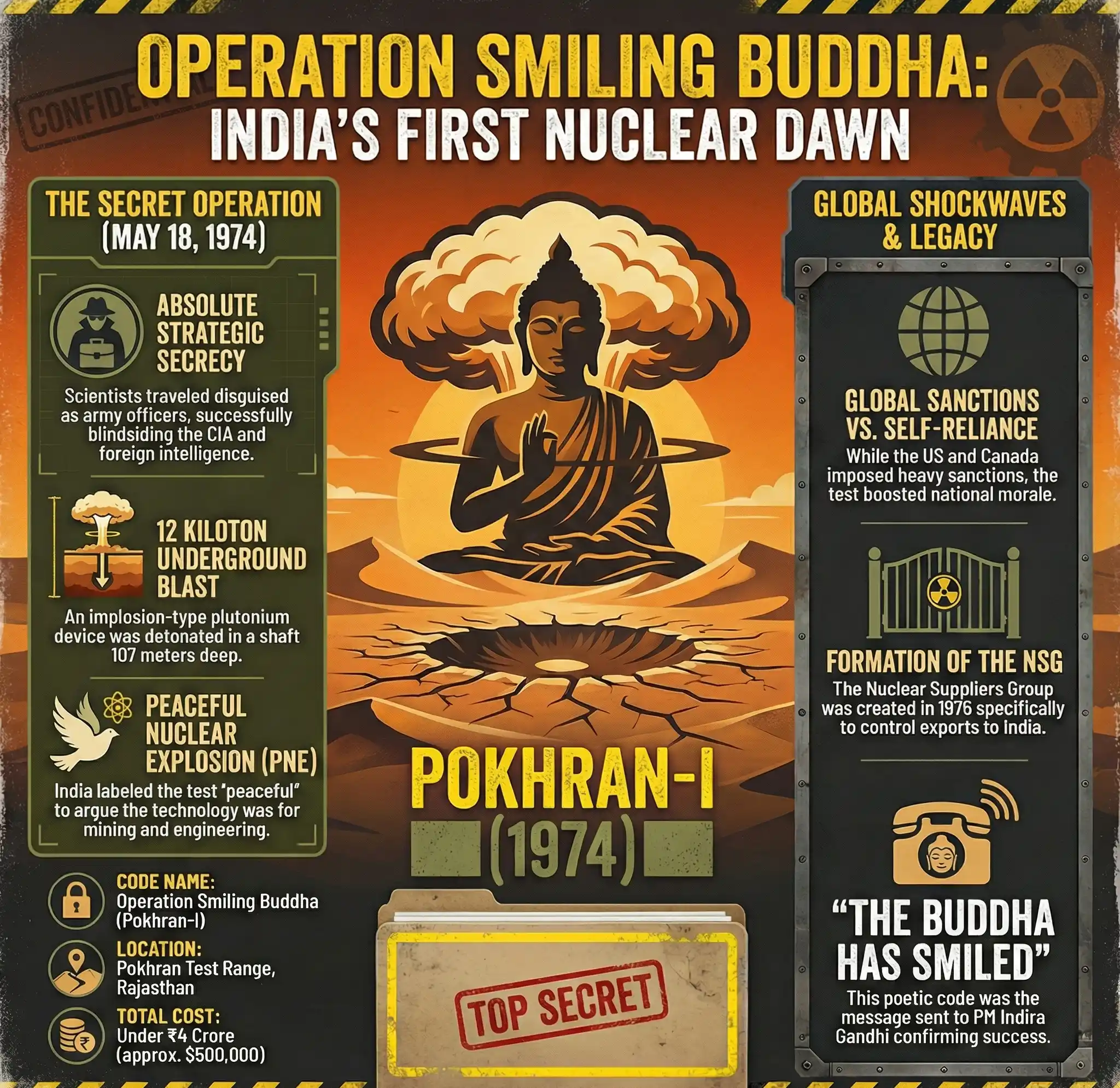
India's First Nuclear Test, code-named Operation Smiling Buddha (Pokhran-I), was conducted on May 18, 1974. In the desolate sands of the Pokhran Test Range in Rajasthan, India successfully detonated a nuclear device, becoming the sixth nation in the world—and the first outside the UN Security Council—to join the nuclear club. Orchestrated by Prime Minister Indira Gandhi and top scientists like Dr. Raja Ramanna and Dr. Homi Sethna, the test was officially described as a "Peaceful Nuclear Explosion" (PNE). It was a direct response to the security threats of the time, particularly from China and Pakistan, and it fundamentally altered the global non-proliferation landscape, leading to the formation of the Nuclear Suppliers Group (NSG).| Feature | Details |
| Date | May 18, 1974 (Buddha Purnima) |
| Location | Pokhran Test Range, Rajasthan |
| Code Name | Operation Smiling Buddha (Pokhran-I) |
| Device Type | Implosion-type Fission Device (Plutonium) |
| Estimated Yield | 8 to 12 Kilotons (Official: 12kt) |
| Key Scientists | Raja Ramanna, Homi Sethna, P.K. Iyengar, R. Chidambaram |
| Prime Minister | Indira Gandhi |
| Impact | India became a Nuclear Power; Sanctions imposed by US/Canada |
The Secret in the Sand
The year was 1974. The Cold War was at its peak, and India was navigating a dangerous neighborhood. Fresh from the 1971 war with Pakistan and wary of China’s nuclear arsenal (tested in 1964), New Delhi decided it could no longer remain vulnerable.
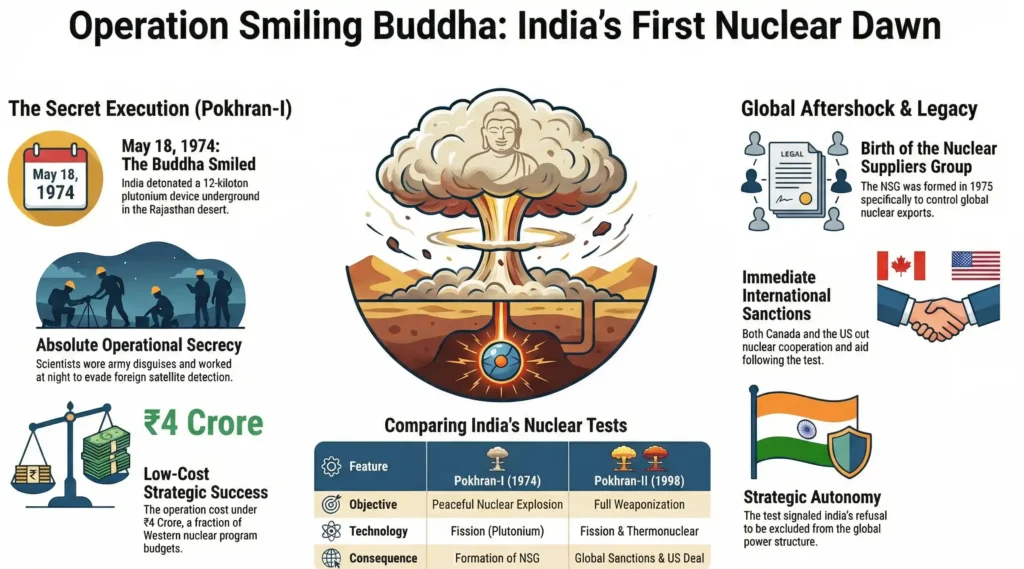
Under the cloak of absolute secrecy, a team of India’s brightest minds from the Bhabha Atomic Research Centre (BARC) began moving towards the desert. The operation was so covert that even the Defense Minister, Jagjivan Ram, was reportedly informed only days before the test. The scientists, including the legendary Raja Ramanna and Homi Sethna, often traveled to Pokhran disguised as army officers to avoid raising suspicion among foreign intelligence agencies.
The Emergency: When India’s Democracy Was Put in Chains
Why “Smiling Buddha”?
The date chosen for the test—May 18, 1974—coincided with Buddha Purnima, the birth anniversary of Lord Buddha. In a land known for non-violence (Ahimsa), the irony of testing a nuclear device on this day was stark. However, the code name “Smiling Buddha” was chosen to symbolize peace. The message sent to Prime Minister Indira Gandhi after the successful detonation was poetic yet powerful: “The Buddha has smiled.”
The Physics of the “Peaceful” Bomb
The device tested was an implosion-type fission weapon, similar in design to the “Fat Man” bomb used on Nagasaki, but significantly smaller. It used plutonium produced at the CIRUS reactor (which was supplied by Canada). The scientists placed the device in a shaft dug 107 meters deep into the earth.
At 8:05 AM, the button was pressed by Pranab Rebatiranjan Dastidar. The ground rose, creating a massive crater, but there was no mushroom cloud in the sky—the explosion was completely contained underground. This containment allowed India to label it a “Peaceful Nuclear Explosion” (PNE), arguing that the technology would be used for mining and earth-moving, not war.
10 Days of Darkness: The True Story of Operation Blue Star
The World in Shock
The explosion didn’t just shake the desert; it shook the geopolitical foundations of the world. The United States and its intelligence network were completely blindsided. The CIA had no idea the test was coming.
The reaction was swift and furious.
- Canada accused India of violating agreements regarding the CIRUS reactor and immediately cut off nuclear cooperation.
- The United States imposed sanctions, blocking aid and technology transfers.
- Pakistan, feeling existentially threatened, accelerated its own nuclear program under A.Q. Khan, vowing to “eat grass” if necessary to build a bomb.
The Formation of the Nuclear Cartel
One of the most lasting impacts of India’s First Nuclear Test was the creation of the Nuclear Suppliers Group (NSG) in 1975. The major powers realized that the existing Non-Proliferation Treaty (NPT) had loopholes that allowed nations to develop nuclear technology for “peaceful” purposes and then divert it. The NSG was formed specifically to control the export of nuclear materials—essentially, a global club created to keep India out.
A Legacy of Self-Reliance
Despite the sanctions and isolation, the 1974 test was a massive morale booster for India. It proved that Indian scientists, working with limited resources and under immense pressure, could master the most complex technology on Earth. It laid the groundwork for the missile programs that would follow and eventually led to the weaponization of India’s nuclear capability in 1998.
In retrospect, Operation Smiling Buddha was the moment India stopped asking for a seat at the table and simply pulled up a chair. It was a declaration of strategic autonomy that continues to define Indian foreign policy today.
Operation Vijay: How India Won the High-Altitude War of 1999
Quick Comparison Table: Pokhran-I vs. Pokhran-II
| Feature | Pokhran-I (1974) | Pokhran-II (1998) |
| Objective | Peaceful Nuclear Explosion (PNE) | Weaponization (Nuclear State Declaration) |
| Prime Minister | Indira Gandhi | Atal Bihari Vajpayee |
| Number of Tests | 1 Device | 5 Devices |
| Secrecy Success | Complete Surprise (CIA missed it) | Complete Surprise (CIA missed it again) |
| Technology | Fission (Plutonium) | Fission & Thermonuclear (Fusion) |
| Global Consequence | Formation of NSG | Global Sanctions & eventual US-India Deal |
Curious Indian: Fast Facts
- The Crater’s Name: The explosion created a crater that the scientists informally named the “Phoenix Crater,” symbolizing a rise from the ashes.
- The Cost: The entire operation is estimated to have cost less than ₹4 Crore (approx. $500,000 at the time)—a fraction of what Western nations spent on similar tests.
- No Radioactivity: The test was so well contained underground that scientists, including Raja Ramanna, drove to the site shortly after the blast to inspect it without protective suits.
- The Army’s Role: The 61st Engineering Regiment of the Indian Army was responsible for digging the shafts. They worked at night to avoid satellite detection, a tactic perfected later in 1998.
Conclusion
India’s First Nuclear Test in 1974 was more than a scientific experiment; it was a geopolitical earthquake. It shattered the monopoly of the P5 nations and signaled India’s refusal to be bullied. While it brought sanctions and hardships, it also forged a steel-like resolve in the Indian scientific community—a resolve that would eventually blossom into the full-fledged nuclear deterrent we see today. The Buddha smiled in 1974 so that India could stand tall in the decades to follow.
Pokhran-II Nuclear Tests 1998: How Operation Shakti Changed History
If you think you have remembered everything about this topic take this QUIZ
Results


#1. What was the official code name for India’s first nuclear test conducted in 1974?
#2. Who was the Prime Minister of India when the first nuclear test was conducted?
#3. The successful detonation led to the formation of which international group to control nuclear exports?
#4. On which significant day was the test conducted, leading to the message “The Buddha has smiled”?
#5. Which country immediately cut off nuclear cooperation with India, accusing it of violating agreements regarding the CIRUS reactor?
#6. The nuclear device was detonated in which location?
#7. How did the Indian government officially describe the 1974 test?
#8. Which legendary scientist was one of the key figures orchestrating the test alongside Homi Sethna?
What was the code name for India’s first nuclear test?
The code name was Operation Smiling Buddha (Pokhran-I).
When did India conduct its first nuclear test?
It was conducted on May 18, 1974.
Who was the Prime Minister of India during the 1974 nuclear test?
Indira Gandhi was the Prime Minister who authorized the test.
Why was it called a “Peaceful Nuclear Explosion” (PNE)?
India maintained that the test was for peaceful purposes, such as mining and earth excavation, rather than for building offensive weapons, to avoid violating international norms.
Which scientists were involved in the 1974 test?
Key scientists included Dr. Raja Ramanna, Dr. Homi Sethna, P.K. Iyengar, and Dr. R. Chidambaram.