Dr. A.P.J. Abdul Kalam (1931–2015) rose from humble beginnings in Rameswaram to become one of India’s most respected scientists and the 11th President of the nation. Instrumental in the development of India's nuclear and missile programs, he earned the title "Missile Man of India." Beyond his technical achievements, Kalam is remembered as the "People's President" and a visionary teacher who encouraged the youth to dream big. This article details his early life, scientific career, presidency, and lasting legacy.
| Achievement | Details |
| ISRO Legacy | Project Director for SLV-III, India’s first Satellite Launch Vehicle. |
| Missile Man | Architect of the Agni and Prithvi missiles under the IGMDP. |
| Nuclear Tests | Chief Project Coordinator for Pokhran-II (1998), making India a nuclear state. |
| Healthcare | Co-invented the low-cost “Kalam-Raju Stent” for heart patients. |
| Vision 2020 | Authored the roadmap to transform India into a developed nation by 2020. |
The People’s President
Have you ever wondered what it takes for a boy from a modest fishing town to become the Missile Man of India and one of the world’s most beloved scientists? This is the story of Dr. A.P.J. Abdul Kalam—a story not just of scientific achievement, but of profound humanity, unwavering dedication, and a relentless commitment to national progress. His life journey is a powerful testament to the idea that dreams, backed by hard work and passion, can indeed change the world.
A Visionary Who Shaped Modern India
Dr. Avul Pakir Jainulabdeen Abdul Kalam was more than just the 11th President of India; he was a national icon, a celebrated Indian scientist, an inspiring educator, and a true visionary. His contributions to the nation’s space and defence programs were nothing short of revolutionary, earning him the title of the ‘Missile Man’.
Kalam’s influence extends far beyond the launchpads and laboratories. He taught us that scientific achievements are the bedrock of a strong nation. His humility, coupled with his towering intellect, made him a unique leader. He was a scientist who spent his life developing powerful technology, yet he was known for his gentle demeanor and his deep connection with India’s youth. His passion for igniting minds and his “Vision 2020” for India’s development continue to serve as a beacon of inspiration for students across the globe. This captivating biography will draw you into the life of a man who believed that the power of dreams could transform a country.
Early Life and Education: Sparking the Flame of Science
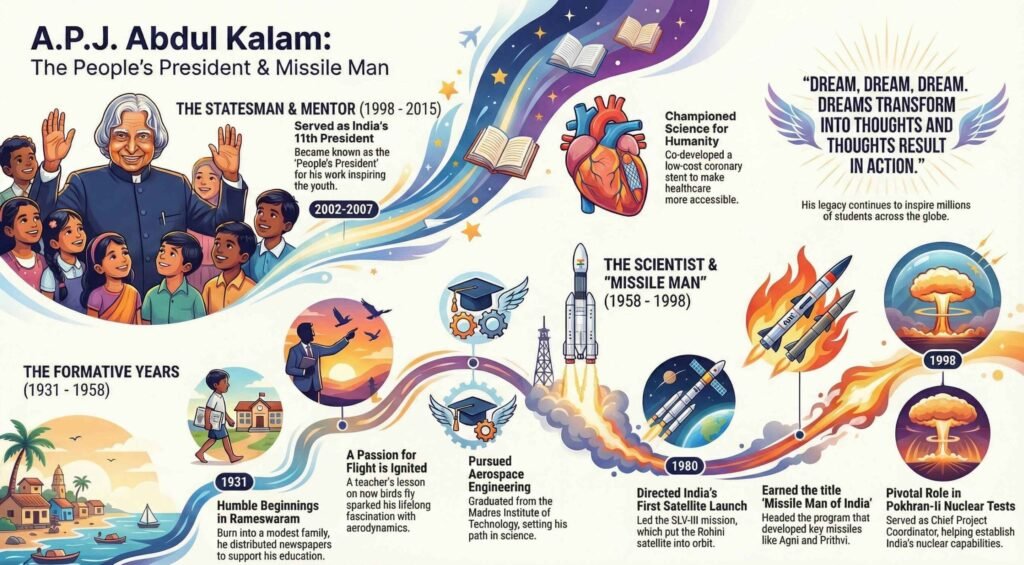
The story begins not in a sophisticated city, but in Rameswaram, a small temple town in Tamil Nadu, where Kalam was born on October 15, 1931. His family was financially modest. His father, Jainulabdeen, owned a boat and was the imam of a local mosque, and his mother, Ashiamma, was a devoted homemaker.
Young Abdul Kalam’s childhood was characterized by diligence and resourcefulness. To support his family, he used to distribute newspapers after school. This early exposure to hard work instilled in him a strong sense of responsibility. His home environment, though simple, was filled with kindness and strong moral values, which deeply influenced his character.
The spark that ignited his interest in science and aviation came from two key places. First, the simple yet profound lessons from his spiritual father, his father, who taught him the importance of prayer, kindness, and respecting all faiths. Second, a pivotal moment in his school life: an unforgettable lesson from his teacher, Sivasubramania Iyer, who explained the flight of a bird by showing them the seagulls soaring over the seashore. This practical demonstration of aerodynamics was a revelation for Kalam, confirming his fascination with how things fly.
He pursued his secondary education at Schwartz Higher Secondary School in Ramanathapuram, and later graduated in Physics from Saint Joseph’s College, Tiruchirappalli. Driven by his newfound passion, he moved on to study Aerospace Engineering at the Madras Institute of Technology (MIT). This move marked a defining step, setting him on the path to becoming one of the greatest Indian scientists.



Journey into Science: The Birth of the ‘Missile Man’
Kalam’s entry into the field of scientific research was not immediate or easy. While at MIT, he faced a critical moment when his project was nearly canceled due to his slow progress. His Dean gave him a stern ultimatum—finish the design within three days or lose his scholarship. Kalam worked tirelessly, barely sleeping, and met the deadline, a powerful early lesson in resilience and commitment.
After graduating, his professional journey began in 1958 at the Aeronautical Development Establishment of the Defence Research and Development Organisation (DRDO). Initially, he designed a small hovercraft, but his ambition was aimed higher. In 1969, he was transferred to the Indian Space Research Organisation (ISRO), which proved to be a major turning point.
At ISRO, he served as the Project Director of the mission to develop India’s first Satellite Launch Vehicle (SLV-III). The success of SLV-III, which successfully injected the Rohini satellite into orbit in 1980, was a monumental national achievement. This mission established India as a self-reliant nation in space technology. Kalam often spoke of this as a moment of great pride, but also remembered the failure of the first attempt in 1979—a setback he and his team learned from to ensure ultimate success.
This success propelled him to lead the Integrated Guided Missile Development Program (IGMDP) for the DRDO. It was during this period, developing a family of indigenous missiles like Agni and Prithvi, that the name Missile Man of India was officially cemented.
Major Achievements and Contributions: Securing India’s Future
Dr. Kalam’s work was the backbone of India’s strategic autonomy. His scientific achievements have provided a shield of security for the nation.
* Pioneering the SLV-III (1980): As mentioned, this was India’s first indigenous satellite launch vehicle, making the country the sixth member of the exclusive space club. This achievement was critical for future space missions.
* The Integrated Guided Missile Development Program (IGMDP): Under his leadership, India successfully developed ballistic missiles like Prithvi (short-range) and Agni (intermediate-range), alongside other systems like Akash and Nag. These indigenous defense systems reduced India’s dependence on foreign powers and significantly bolstered national security.
The Pokhran-II Nuclear Tests (1998): Kalam played a pivotal role as the Chief Project Coordinator for the Pokhran-II nuclear tests, which demonstrated India’s nuclear capabilities. He famously helped keep the project details a secret, even from his colleagues, until the very end.
* A Unique Medical Innovation: Demonstrating his belief that science must serve society, Dr. Kalam collaborated with cardiologist Dr. Soma Raju to develop the ‘Kalam-Raju Stent’—a low-cost coronary stent, and the ‘Kalam-Raju Tablet’—a rugged, low-cost computer for use in rural areas. This showed his commitment to using technology for humanitarian causes.
His unparalleled contributions earned him India’s highest civilian honor, the Bharat Ratna, in 1997.
| Feature | Phase 1: The Scientist | Phase 2: The President |
| Primary Role | Aerospace Scientist & Engineer | 11th President of India |
| Key Organizations | ISRO (Space) & DRDO (Defense) | Government of India |
| Major Focus | Ballistic Missiles, Satellite Launch Vehicles, Nuclear Tech | Youth Empowerment, Education, National Development |
| Key Achievement | Developed Agni & Prithvi Missiles; Pokhran-II Tests | Proposed “URA” (Urban Amenities to Rural Areas); Vision 2020 |
| Popular Title | The Missile Man of India | The People’s President |
| Time Period | 1960 – 1999 | 2002 – 2007 |
Challenges and Turning Points: Learning from Setbacks
Every great life is defined by its struggles. For Dr. Kalam, the challenges were not just technical failures, but moments of intense personal and professional reckoning.
One of the most defining moments was the aforementioned failure of the SLV-III launch in 1979. Kalam, as the Project Director, was prepared to take full responsibility. However, the then-Chairman of ISRO, Satish Dhawan, stepped in, faced the media, and declared that they would succeed the next year. Dhawan’s leadership in shielding his team from the failure and giving them the space to succeed left a lasting impression on Kalam, teaching him the true meaning of leadership. The following year, they succeeded. Kalam often recalled this anecdote to emphasize that a good leader takes the blame for failure but gives the credit for success to their team.
Another emotional turning point was his realization of the power of technology to uplift the common man. After the success of the missiles, he felt a deeper calling—to use his knowledge to improve lives. This led to his collaboration on low-cost medical devices, turning a military scientist into a social innovator.
His presidency (2002-2007) was also a challenge—transitioning from the controlled environment of a laboratory to the unpredictable world of politics. Yet, he embraced it wholeheartedly, using the office as a platform to inspire millions, earning him the title of the People’s President.
Legacy and Inspiration: Igniting the Minds of India
Dr. A.P.J. Abdul Kalam’s legacy is immense, but it rests primarily on his role as a mentor and an educator. He passed away on July 27, 2015, while delivering a lecture to students at the Indian Institute of Management Shillong, an incredibly fitting end for a man who lived to teach.
His impact on science and young learners in India today is immeasurable. He wrote numerous inspirational books, including his autobiography Wings of Fire, which has become a staple for every aspiring Indian scientist and student. His famous quote, “Dream, dream, dream. Dreams transform into thoughts and thoughts result in action,” encapsulates his philosophy and continues to serve as an inspiration for students everywhere.
* Education Reform: He traveled tirelessly, interacting with millions of schoolchildren, encouraging them to pursue science and innovation. He believed that the youth were the greatest resource for India’s future.
* Vision 2020: His blueprint for transforming India into a developed nation by 2020, focusing on economic growth, healthcare, and education, remains a key reference point for policymakers.
* A Symbol of Integrity: His life of honesty, simplicity, and dedication to duty stands as a powerful moral lesson for public servants and citizens alike.
The life of Dr. A.P.J. Abdul Kalam teaches us that true success is not measured by wealth or power, but by the impact we have on the lives of others and the progress we contribute to our nation. He demonstrated that faith, hard work, and a vision for the greater good are the most powerful ingredients for an inspirational life.
Curious Indian Fast Facts: Dr. Kalam
| Curious Detail | The Amazing Reality |
| Minimalist Wealth | He owned no property, no fridge, and no TV. His only major possessions were 2,500+ books, a Veena, a laptop, and a few suits. |
| World Record Holder | He was awarded 48 Honorary Doctorates from universities across the globe. |
| Swiss Honor | Switzerland celebrates May 26th as Science Day to commemorate his visit to the country in 2005. |
| The “Missed” Goal | He wanted to be a Fighter Pilot but ranked 9th in the qualifiers (only 8 slots were available). He became a scientist instead. |
| Last Act | True to his love for teaching, he passed away while delivering a lecture to students at IIM Shillong. |
| No Will | He died without a will; his few personal belongings were left to his elder brother. |
If you think you have rememberd everything about this topic take this QUIZ
Results


#1. What key lesson in leadership did Dr Kalam learn from Satish Dhawan following the initial failure of the SLV-III launch in 1979?
#2. Dr Kalam earned the title ‘Missile Man of India’ primarily for his leadership of which crucial defence programme?
#3. What specific event during his school years is cited as solidifying Dr Kalam’s fascination with flight?
#4. According to the text, what was the primary national significance of the successful SLV-III mission in 1980?
#5. Which of Dr Kalam’s innovations demonstrated his commitment to using technology for humanitarian causes?
#6. In which field did Dr Kalam pursue his higher education at the Madras Institute of Technology (MIT)?
#7. What was the central goal of Dr Kalam’s ‘Vision 2020’ blueprint for India?
#8. Which detail from the text best illustrates Dr Kalam’s childhood diligence and sense of responsibility?
What are the most famous books written by Dr. Kalam?
Dr. Kalam was a prolific writer who authored over 25 books. His most influential works include:
Wings of Fire (Autobiography)
Ignited Minds (Dedicated to the youth)
India 2020 (A vision for the new millennium)
Turning Points (A sequel to his autobiography)
When and where did Dr. A.P.J. Abdul Kalam pass away?
Dr. Kalam passed away on July 27, 2015, in Shillong, Meghalaya. He suffered a sudden cardiac arrest while doing what he loved most—delivering a lecture to students at the Indian Institute of Management (IIM) Shillong.
What awards and honors did Dr. Kalam receive?
He received numerous accolades for his contribution to science and public service, including:
Bharat Ratna (1997): India’s highest civilian honor.
Padma Vibhushan (1990)
Padma Bhushan (1981)
Von Braun Award (2013) from the National Space Society.
What was Dr. Kalam’s role in the Pokhran-II nuclear tests?
Dr. Kalam served as the Chief Project Coordinator for the Pokhran-II nuclear tests (Operation Shakti) in May 1998. Along with R. Chidambaram, he played a pivotal role in the political and technological success of the mission, which declared India a nuclear-armed state.
Read More: https://curiousindian.in/vikram-sarabhai-august-1919-december-1971/