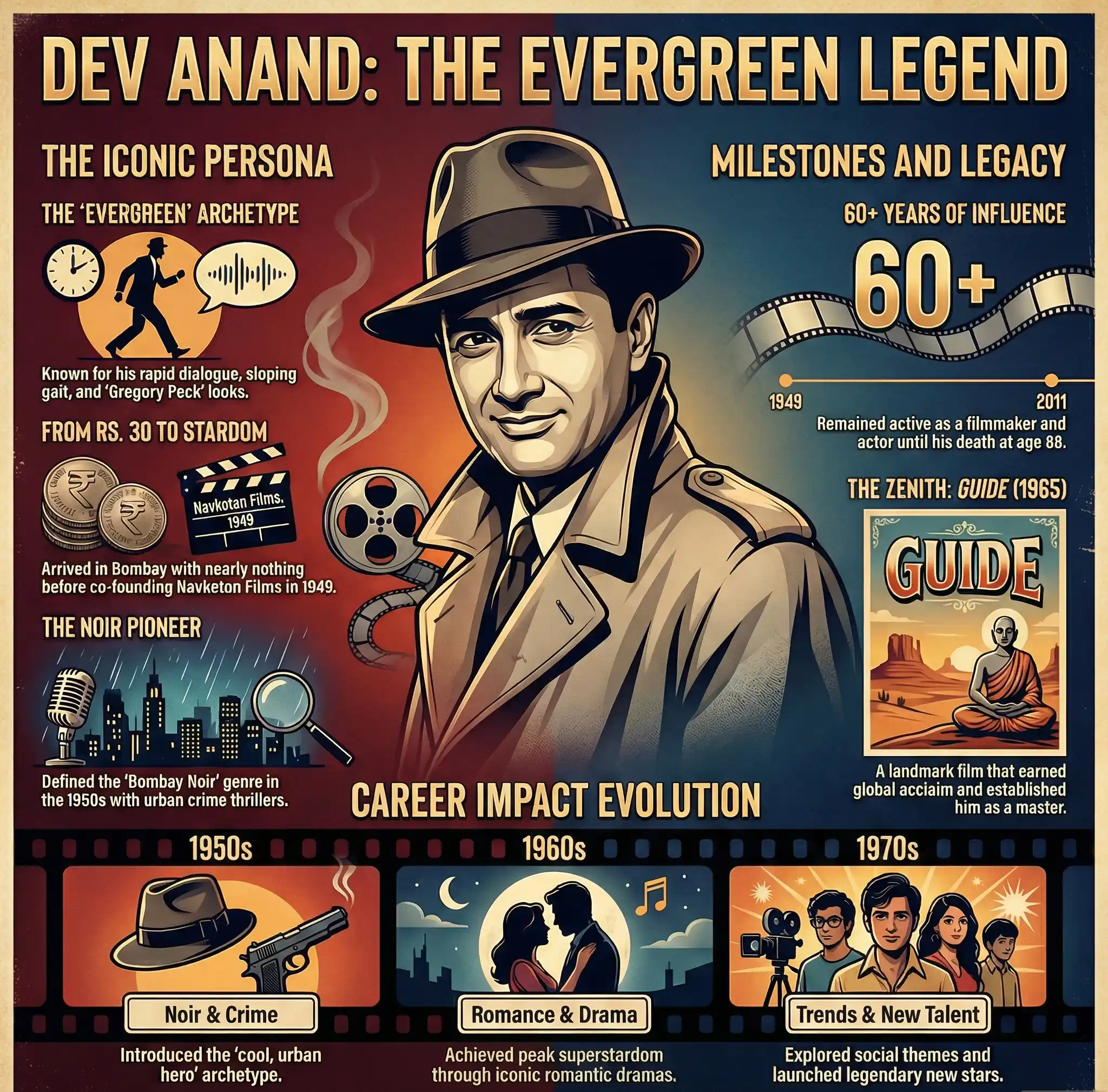
Dev Anand, born Dharamdev Pishorimal Anand in 1923, was a titan of Indian cinema known for his charismatic screen presence and unique acting style. A graduate in English Literature from Lahore, he moved to Bombay with Rs. 30 in his pocket. He co-founded Navketan Films in 1949 and produced cinematic gems like Baazi and Guide. Famous for his rapid dialogue delivery, nodding head, and sloping gait, he was dubbed the "Evergreen Star" for his youthful energy that defied age. A recipient of the Padma Bhushan and Dadasaheb Phalke Award, his career spanned over six decades as an actor, director, and producer.| Attribute | Details |
| Full Name | Dharamdev Pishorimal Anand |
| Screen Name | Dev Anand |
| Date of Birth | September 26, 1923 |
| Birthplace | Shakargarh, Punjab (British India) |
| Date of Death | December 3, 2011 (Age 88) |
| Profession | Actor, Director, Producer, Writer |
| Debut Film | Hum Ek Hain (1946) |
| Key Awards | Dadasaheb Phalke Award (2002), Padma Bhushan (2001), 2 Filmfare Best Actor Awards |
| Spouse | Kalpana Kartik (Married 1954–2011) |
| Children | Suneil Anand, Devina Anand |
| Notable Works | Guide, Jewel Thief, Hare Rama Hare Krishna, C.I.D., Johny Mera Naam |
Dreams from Lahore to Bombay
Born in the Gurdaspur district of Punjab (now in Pakistan), Dev Anand was the third of four sons of a well-to-do advocate. After graduating with a degree in English Literature from Government College, Lahore, he left his hometown for Bombay in the early 1940s to pursue his dreams. His early days were a struggle; he worked as a clerk in the Military Censor’s Office for a meager salary of Rs. 165 to survive. His love for acting led him to join the Indian People’s Theatre Association (IPTA), where his journey truly began.
8 Defining Chapters in the Vikram Sarabhai Biography
Rise to Stardom: The Gregory Peck of India
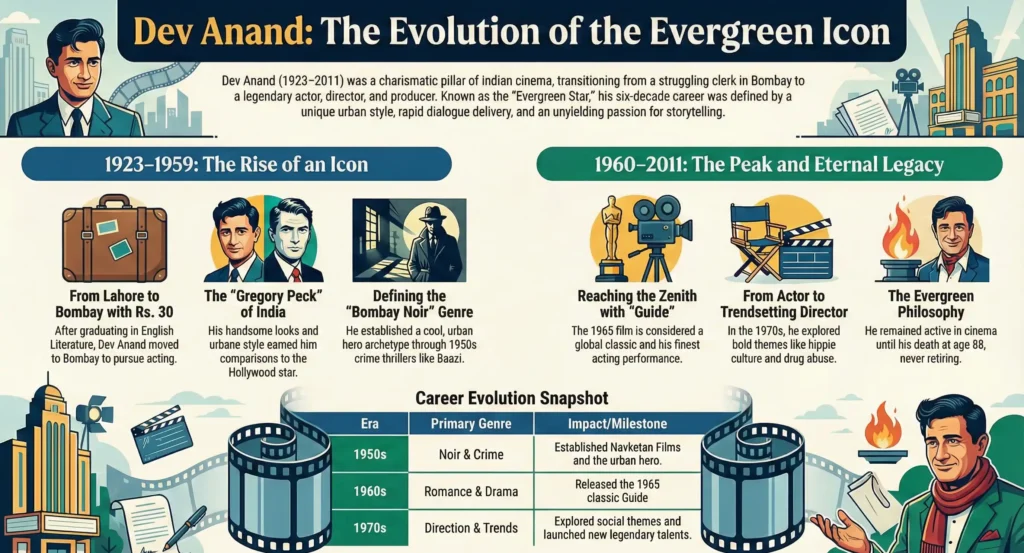
Dev Anand’s big break came with Ziddi (1948), which made him a star. He was often compared to Hollywood actor Gregory Peck due to his handsome looks and urbane style. In 1949, he turned producer and launched Navketan Films, a banner that would become synonymous with quality cinema.
- The Noir Era: In the 50s, he defined the “Bombay Noir” genre with crime thrillers like Baazi, C.I.D., and Kala Bazar, often playing the morally ambiguous urban hero.
- The Romantic Hero: Films like Tere Ghar Ke Samne and Jab Pyar Kisi Se Hota Hai cemented his image as the ultimate romantic lead, charming audiences with his signature puff of hair and scarf.
The Masterpiece: Guide
His career reached its zenith with Guide (1965), based on R.K. Narayan’s novel. Produced by Dev Anand and directed by his brother Vijay Anand, the film was a landmark in Indian cinema. His portrayal of Raju Guide earned him accolades and is considered one of the finest performances in Bollywood history. He continued to experiment with direction, tackling the hippie culture in Hare Rama Hare Krishna (1971), which introduced Zeenat Aman to the world.
Dr. A.P.J. Abdul Kalam: (1931-2015)
Personal Life & Legacy
Dev Anand’s personal life was marked by a passionate but unfulfilled romance with singer-actress Suraiya. Their love story ended due to religious differences and family opposition, leaving a lasting impact on him. He later found love with his co-star Kalpana Kartik, whom he married in a quiet ceremony during the shoot of Taxi Driver in 1954. He remained active in films until his death in 2011, passing away in London at the age of 88, living up to his title of “Evergreen” by never retiring.
7 Secrets of Padmanabhaswamy Temple Treasure
Quick Comparison: The Decades of Dev
| Era | Style/Genre | Key Films | Impact |
| 1950s | Noir & Crime Thrillers | Baazi, C.I.D., Taxi Driver | Introduced a cool, urban hero archetype; established Navketan Films. |
| 1960s | Romance & Drama | Guide, Jewel Thief, Hum Dono | The peak of his stardom; Guide became a global classic. |
| 1970s | Director-Actor & Trends | Hare Rama Hare Krishna, Des Pardes | Explored new themes like drug abuse and illegal immigration; launched new faces. |
Curious Indian Fast Facts
- The Black Suit Ban: Rumor has it that he was asked not to wear black suits in public because women would swoon and jump from buildings just to see him, though Dev Anand himself later clarified this as an exaggerated myth.
- Hollywood Connection: He co-produced the English version of Guide and was friends with international celebrities like Shirley MacLaine.
- Political Stint: He actively opposed the Emergency in India (1975–77) and even formed a political party called the National Party of India, though it was short-lived.
- Discovery of Talent: He gave breaks to legendary talents like Guru Dutt, Sahir Ludhianvi, Zeenat Aman, and Tina Munim.
- Always on the Move: He famously never looked back at his past work or failures, always planning his next film script even in his 80s.
Conclusion
Dev Anand was more than an actor; he was a philosophy of life. He embodied optimism, style, and an undying passion for cinema. Whether it was the philosophical depth of Guide or the stylish swagger of Jewel Thief, he brought a unique energy to every role. His legacy is not just in the films he left behind but in the spirit of “Main Zindagi Ka Saath Nibhata Chala Gaya”—living life to the fullest till the very end.
10 Remarkable Facts About Meghnad Saha Life and Achievements
If you think you have remembered everything about this topic take this QUIZ
Results


#1. What was Dev Anand’s real birth name before he became a star?
#2. Dev Anand co-founded which famous production house in 1949?
#3. Which 1965 film, based on R.K. Narayan’s novel, is considered one of Dev Anand’s finest performances and a landmark in Indian cinema?
#4. Dev Anand was famously compared to which Hollywood actor due to his looks and style?
#5. Which film directed by Dev Anand tackled the theme of hippie culture and introduced Zeenat Aman?
#6. Before becoming an actor, what job did Dev Anand hold in Bombay for a salary of Rs. 165?
#7. Dev Anand had a passionate but unfulfilled romance with which famous singer-actress?
#8. Dev Anand actively opposed the Emergency (1975–77) and formed a short-lived political party called:
Why was Dev Anand called the Evergreen Star?
He was called “Evergreen” because of his youthful energy, zest for life, and his refusal to retire or play “old” roles even as he aged.
Who was Dev Anand’s first love?
His first love was the famous actress-singer Suraiya. Their relationship is one of Bollywood’s most tragic love stories.
Did Dev Anand win the Dadasaheb Phalke Award?
Yes, he was honored with the Dadasaheb Phalke Award, India’s highest award for cinema, in 2002.
Which was Dev Anand’s most acclaimed film?
Guide (1965) is widely considered his masterpiece, winning him the Filmfare Best Actor award and international acclaim.
Who are Dev Anand’s brothers?
His brothers were Chetan Anand (a renowned director) and Vijay Anand (also a celebrated filmmaker who directed Guide and Jewel Thief).
Read more: https://curiousindian.in/raj-kapoor-the-greatest-showman-of-indian-cinema-december-1924-june-1988/