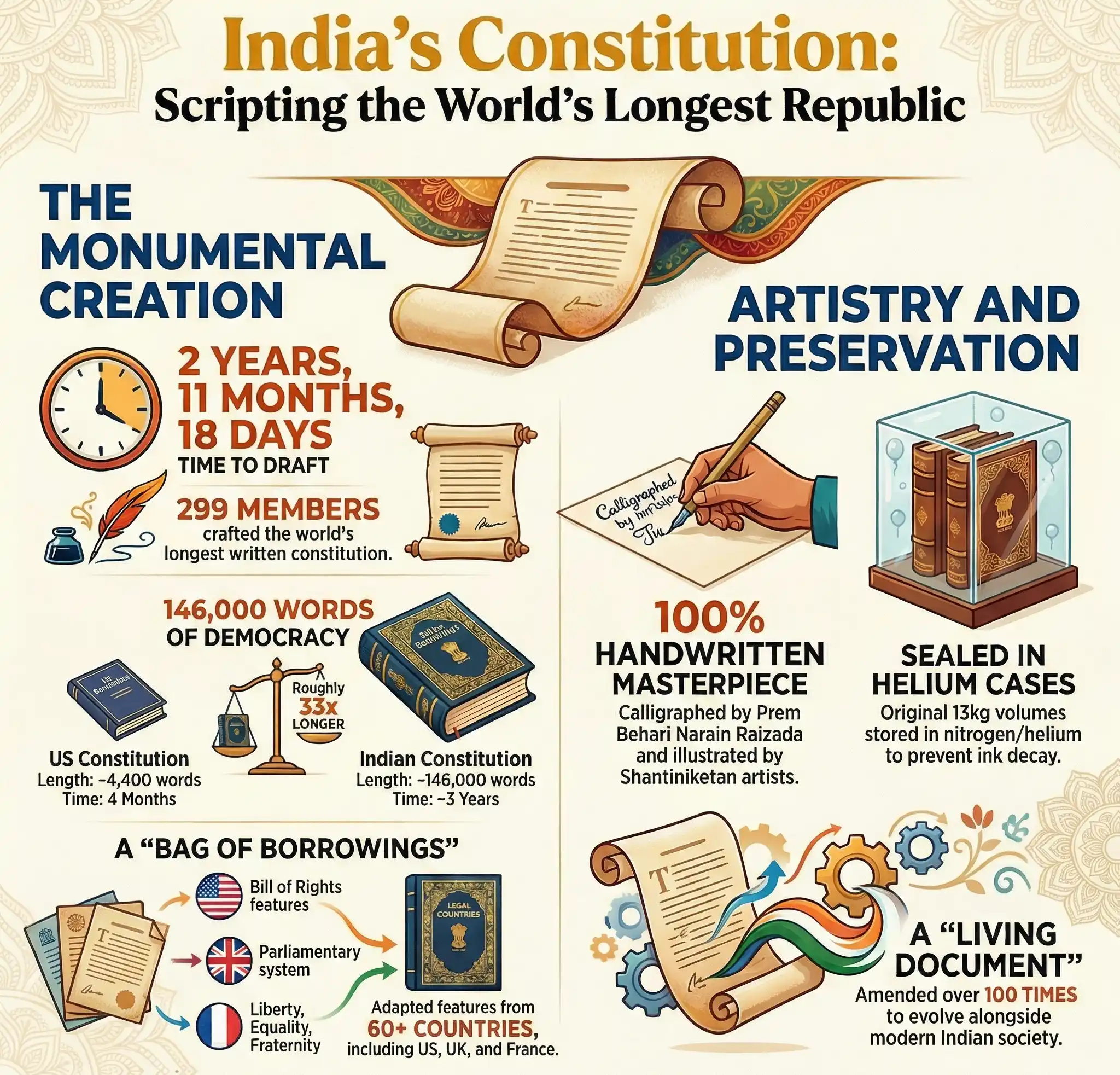
The Constitution of India is the supreme law of the land, adopted on November 26, 1949, and legally enforced on January 26, 1950. It was the product of the Constituent Assembly, a group of 299 members who worked for 2 years, 11 months, and 18 days to draft it. Steering this massive ship was Dr. B.R. Ambedkar, the Chairman of the Drafting Committee. The document they created is unique: it is handwritten (not printed), illustrated by artists from Shantiniketan, and serves as a delicate balance between a strong center and federal states. It transformed the Dominion of India into the Sovereign Democratic Republic of India.| Feature | Details |
| Adoption Date | November 26, 1949 (Constitution Day) |
| Effective Date | January 26, 1950 (Republic Day) |
| Chairman (Drafting) | Dr. B.R. Ambedkar |
| Time Taken | 2 Years, 11 Months, 18 Days |
| Original Scribe | Prem Behari Narain Raizada (Calligrapher) |
| Key Feature | Longest written constitution in the world |
| Articles (Original) | 395 Articles in 22 Parts (with 8 Schedules) |
The Task: Building a Nation from Scratch
In 1946, as British rule neared its end, India faced a crisis of identity. It was a land of 565 princely states, hundreds of languages, and deep religious divides. The challenge was impossible: create a single book of rules that would satisfy a Maharaja in Rajasthan, a tribal leader in Nagaland, and a fisherman in Kerala.
The Constituent Assembly met for the first time on December 9, 1946. It wasn’t just a parliament; it was a crucible. For the next three years, these men and women debated every single word. They argued over the national language, the rights of minorities, and the structure of the government.
The Emergency: When India’s Democracy Was Put in Chains
The Architect: Dr. Ambedkar’s Genius
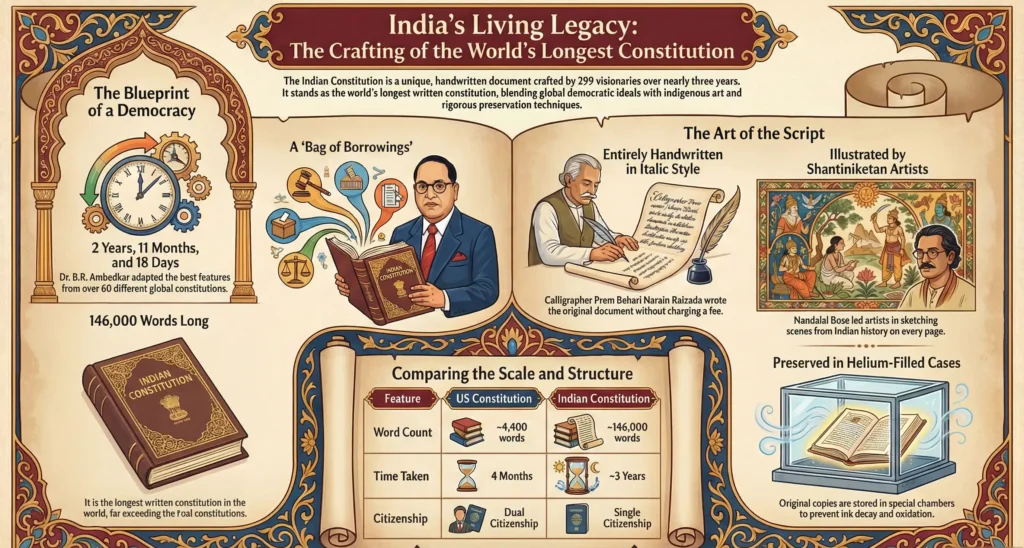
While many great minds contributed, the heavy lifting fell to Dr. B.R. Ambedkar. As the Chairman of the Drafting Committee, he was the bridge between conflicting ideologies. He studied the constitutions of over 60 countries, borrowing the best features—Liberty from France, Fundamental Rights from the US, and Parliamentary Democracy from the UK—and adapting them to the Indian context. This is why the Constitution is often called a “Bag of Borrowings,” but Ambedkar defended it, saying, “Nobody holds any patent rights in the fundamental ideas of a Constitution.”
The Ink and the Art
One of the most “Curious Indian” facts about the Constitution is that the original copies were not typeset or printed. They were entirely handwritten.
- The Calligrapher: Prem Behari Narain Raizada, a master calligrapher, wrote the entire English version in a flowing italic style. When asked what fee he wanted, he famously replied, “Not a single penny. I just want my name on every page and my grandfather’s name on the last page.” His wish was granted.
- The Artists: The blank spaces left by Raizada were filled by artists from Shantiniketan, led by the legendary Nandalal Bose. They drew sketches from Indian history—from the seals of Mohenjo-Daro to the court of Akbar and the march of Gandhi—visually narrating India’s journey.
The 1969 Bank Nationalization: How Indira Gandhi Seized the Vaults
Why Two Dates? (Nov 26 vs. Jan 26)
Many Indians are confused about why we have two dates.
- November 26, 1949: The drafting was finished, and the Constitution was formally adopted. This day is now celebrated as Constitution Day (Samvidhan Divas).
- January 26, 1950: The leaders waited two months to enforce the Constitution. Why? To honor the Purna Swaraj (Total Independence) declaration made by the Congress on January 26, 1930. They wanted the birth of the Republic to align with the dream of freedom.
The Helium Case
Preserving paper for centuries is difficult in Delhi’s climate. The original handwritten copies (one in Hindi and one in English) are kept in the Library of the Parliament House. They are stored in special helium-filled cases to prevent oxidation and decay. The chamber maintains a constant humidity and temperature, monitored 24/7, ensuring the ink never fades.
A Living Document
The Indian Constitution is not a static relic; it is a living document. It has been amended over 100 times to keep pace with society—abolishing untouchability, adding the word “Secular” (during the Emergency), and recognizing the Right to Privacy. It allows for change, but its “Basic Structure” remains untouchable, a safeguard established by the Supreme Court in the famous Kesavananda Bharati case.
India’s First Nuclear Test: The Story of Smiling Buddha
Quick Comparison Table: US vs. Indian Constitution
| Feature | US Constitution | Indian Constitution |
| Length | Shortest written (4,400 words) | Longest written (~146,000 words) |
| Time Taken | 4 Months | ~3 Years |
| Citizenship | Dual Citizenship allowed | Single Citizenship only |
| Amendment | Very Rigid (Hard to change) | Flexible (Mix of rigid and flexible) |
| form of Govt | Presidential | Parliamentary |
Curious Indian: Fast Facts
- The Signature Count: 284 members of the Assembly signed the final document on January 24, 1950. The first to sign was Dr. Rajendra Prasad, and the last was Feroze Gandhi.
- Rain on the Signing Day: On the day the Constitution was signed, it was drizzling outside Parliament. The members considered this a good omen for the future of the republic.
- The “Secular” Addition: The words “Socialist” and “Secular” were not in the original Preamble. They were added in 1976 by the 42nd Amendment during the Emergency.
- Weight: The original bound book weighs a massive 13 kilograms.
Conclusion
The Constitution of India is more than a rulebook; it is the heartbeat of the nation. It guarantees that the voice of the poorest citizen is equal to that of the most powerful leader. As we look at the original copy resting in its helium case, we are reminded that democracy is fragile and requires constant care—a duty that falls not just on judges and politicians, but on every Curious Indian.
The Indo-Pakistani War of 1971: A Victory of Humanity and Strategy
If you think you have remembered everything about this topic take this QUIZ
Results


#1. The Constitution of India was legally enforced on January 26, 1950. On which date was it formally adopted?
#2. Who served as the Chairman of the Drafting Committee of the Indian Constitution?
#3. Who was the master calligrapher who handwritten the entire original English version of the Constitution?
#4. Why was January 26 chosen as the date to enforce the Constitution?
#5. The original handwritten copies of the Constitution are preserved in Parliament House in cases filled with which gas?
#6. How long did the Constituent Assembly take to draft the final Constitution?
#7. Which legendary artist from Shantiniketan led the team that illustrated the blank spaces of the Constitution?
#8. Who was the first member of the Constituent Assembly to sign the final document on January 24, 1950?
Who is the Father of the Indian Constitution?
Dr. B.R. Ambedkar is recognized as the Father of the Indian Constitution for his pivotal role as the Chairman of the Drafting Committee.
Where is the original copy of the Constitution kept?
The original handwritten copies are preserved in helium-filled cases in the Library of the Parliament House in New Delhi.
Who wrote the Constitution by hand?
Prem Behari Narain Raizada was the calligrapher who handwritten the English version of the Constitution.
Why is January 26 chosen as Republic Day?
It was chosen to commemorate the Purna Swaraj declaration of 1930, marking the first time Indians officially demanded complete independence from British rule.