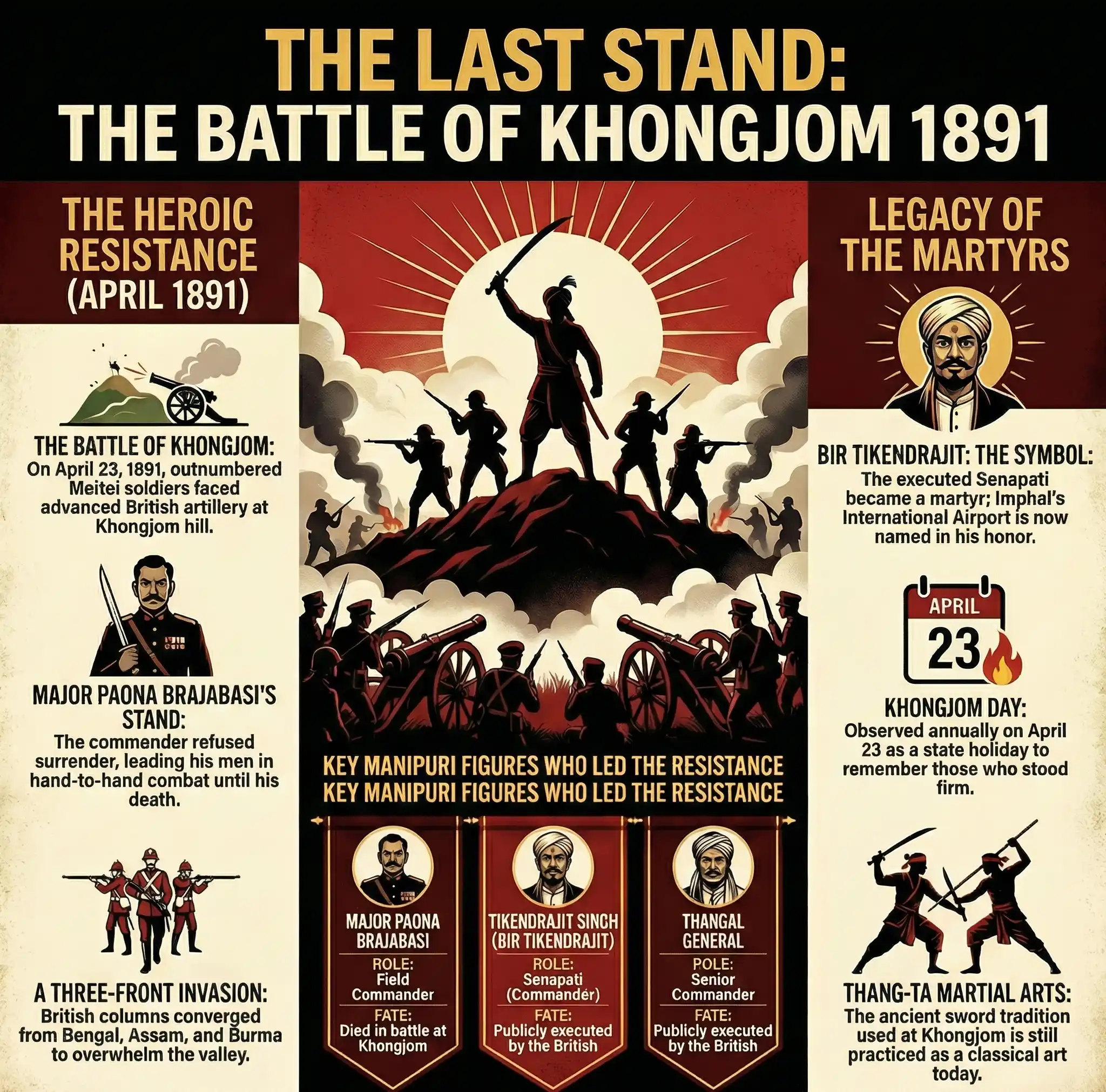
In 1891 CE, the princely kingdom of Manipur in Northeast India was drawn into a war with the British Empire that it had not sought and could not win. What began as an internal succession dispute within the Manipuri royal family became an opportunity for the British to assert direct control over a kingdom that had, until then, maintained a careful and proud independence. When British forces marched on Manipur from multiple directions, the soldiers of the kingdom met them at every turn. The most celebrated of all these encounters was the Battle of Khongjom, fought on 23 April 1891 CE, where a Meitei commander called Major Paona Brajabasi led his outnumbered force against a heavily armed British column and fought until there was no one left to fight. Paona Brajabasi died on that hill. Manipur lost the war. The British installed their own administration and the ancient Manipuri kingdom lost the independence it had held for centuries. But the hill at Khongjom became sacred ground. Every year on 23 April, the people of Manipur gather there to remember the men who stood and did not run. The day is called Khongjom Day and it belongs to all of Manipur.| Detail | Information |
|---|---|
| War | Anglo-Manipuri War |
| Year | 1891 CE |
| Location | Manipur, Northeast India |
| Key Battle | Battle of Khongjom, 23 April 1891 CE |
| Manipuri Hero | Major Paona Brajabasi |
| British Forces | Three columns from Bengal, Assam, and Burma |
| British Commander | General Henry Collett (overall), various column commanders |
| Manipuri King | Kulachandra Singh (during the war) |
| Cause | Succession dispute, British interference in Manipuri sovereignty |
| Outcome | British military victory, Manipur annexed as a princely state under British paramountcy |
| Executed Leaders | Tikendrajit Singh and Thangal General |
| Legacy | Khongjom Day, 23 April, celebrated annually in Manipur |
The Anglo-Manipuri War 1891 CE: The Last Stand at Khongjom
The Kingdom of Manipur: Ancient, Proud, and Carefully Independent
To understand why Khongjom matters so much, you need to understand what Manipur was before 1891 CE. The kingdom of Manipur sits in a small valley surrounded on all sides by forested hills. The Imphal Valley, as it is now called, is one of the most fertile and beautiful places in all of Northeast India. It is ringed by hills that rise steeply on every side, giving the valley a natural fortress quality that shaped the entire history of the people who lived there.
The Meitei people, who formed the heart of Manipuri civilisation, had been building their kingdom in this valley for over a thousand years. Their kings, called Meitei Rajas, traced royal lineages of extraordinary depth. Their martial tradition was equally ancient. The Meitei were famous fighters whose skills in sword combat and the martial art called Thang-ta made them formidable opponents even for much larger armies. Their cavalry, their archers, and their disciplined infantry had defended the valley against invasions from Burma, from Assam, and from other directions across many centuries.
Manipur had a complex relationship with the British that went back to the early 19th century. In 1762 CE, the Manipuri king had signed a treaty of friendship with the British East India Company. In 1824 CE, during the First Anglo-Burmese War, Manipur had actually cooperated with the British against the Burmese who had occupied the valley. The British and the Meitei had, at that point, a relationship of mutual interest rather than direct colonial control.
But the relationship between a small kingdom and a vast empire is never truly equal. For decades after the Burmese War, Manipur maintained its independence while carefully managing its relationship with the British Residency that had been established in Imphal. The Resident, a British official who lived in the capital and represented the interests of the colonial government, was a constant reminder of the shadow that the empire cast over the valley. For as long as the Manipuri royal family presented a united front and avoided giving the British a reason to intervene directly, the kingdom retained its sovereignty in practice if not always in theory.
That united front began to fracture in the late 1880s and the fracture is where the story of the Anglo-Manipuri War really begins.
The Succession Crisis That Changed Everything
In 1886 CE, the Manipuri king Chandrakirti Singh died after a long reign. The question of who should succeed him became the trigger for a crisis that would eventually bring down the kingdom’s independence entirely.
Chandrakirti Singh had many sons. The eldest surviving son, Surchandra Singh, became king. But Surchandra was not a popular ruler and within a few years of taking the throne he faced a serious challenge from his brothers, particularly from Tikendrajit Singh, who was the commander of the Manipuri army and a figure of enormous respect and influence in the kingdom.
In 1890 CE, the situation came to a head. Surchandra Singh was effectively overthrown by his brothers in a palace coup. He fled to British territory and appealed to the British for help in regaining his throne. A new king, Kulachandra Singh, was placed on the throne, with Tikendrajit Singh, now given the title Senapati meaning commander, as the real power behind the new government.
The British Resident in Manipur, Frank St Clair Grimwood, and his superiors in Calcutta watched this situation with growing determination to act. The British position was that the succession in Manipur required their approval, and that the removal of Surchandra without their consent was an affront to British authority in the region. Whether the Manipuri royal family agreed with this interpretation of their kingdom’s sovereignty was, in British eyes, beside the point.
The Chief Commissioner of Assam, James Wallace Quinton, decided to travel to Imphal personally to resolve the crisis on British terms. His plan was to arrest Tikendrajit Singh, remove him from Manipur, and restore a situation that the British could control. It was a plan that reflected the colonial confidence of a man who believed that the full weight of the British Empire behind him made his personal authority in a small valley kingdom effectively unlimited.
He was wrong.
The Events of 24 March 1891: The Night That Made War Inevitable
Quinton arrived in Imphal with a small escort of British soldiers. He summoned Tikendrajit Singh to the Residency and demanded his arrest. Tikendrajit refused to cooperate. The situation deteriorated rapidly.
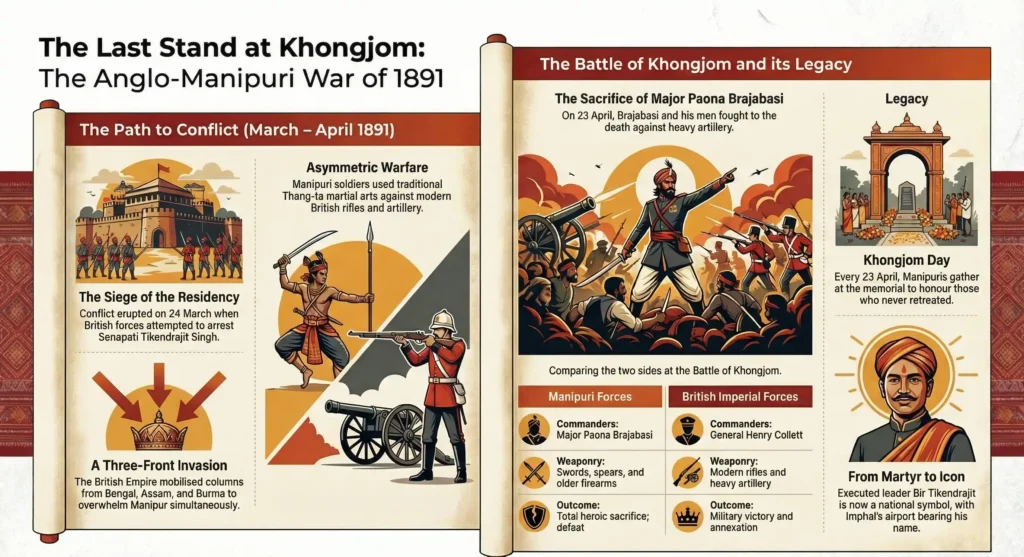
On the night of 24 March 1891 CE, an attempt by British soldiers to arrest Tikendrajit at his home turned into a full confrontation. Manipuri soldiers and British soldiers exchanged fire near the palace. Quinton himself, along with several British officers, entered the palace to negotiate. They did not come out.
The precise details of what happened inside the palace that night have been debated by historians ever since. What is not debated is the outcome. Quinton and the British officers with him were killed. The British Residency in Imphal was burned. The British Resident Grimwood’s wife, Ethel Grimwood, escaped and made her way to British territory, her account of events becoming one of the primary British sources for what happened that night.
U Tirot Sing: The Khasi Chief Who Fought an Empire for Four Years
From that moment, war was inevitable. The British Empire was not in the habit of accepting the deaths of senior officials without a response and the response came swiftly. The colonial government in India mobilised three separate military columns to converge on Manipur from three different directions: one from Bengal to the west, one from Assam to the north, and one from Burma to the east. The intent was to overwhelm the Manipuri defences from multiple directions simultaneously, preventing any possibility of a coordinated response.
The Manipuri kingdom, whatever its internal divisions may have been before the crisis, now faced a war on three fronts against one of the most powerful military organisations in the world.
The Defence of Manipur: Fighting on Every Front
The Manipuri response to the three-column British advance was one of genuine military courage even in the face of impossible odds. Manipuri soldiers were sent to meet each of the advancing columns at the passes and approaches to the Imphal Valley, fighting to buy time and to demonstrate that the kingdom would not simply open its gates because the British had decided to march in.
At the western approach, the Manipuri forces engaged the British column coming from Bengal at the Thoubal river area. At the northern approach, they contested the advance of the Assam column through the hills. At the eastern approach, they faced the Burma column through the mountain passes leading in from the Burmese side.
Each of these engagements was fought by Manipuri soldiers who knew they were massively outgunned. British forces in 1891 CE had modern rifles, artillery, and the organisational support of a full imperial military logistics system. The Manipuri army was equipped with a mixture of older firearms and traditional weapons, had no artillery to match the British guns, and was receiving no resupply or reinforcement from anywhere. They were fighting to defend their valley and they fought with everything they had.
But it was at Khongjom that the most extraordinary stand took place.
Major Paona Brajabasi: The Commander at Khongjom
Major Paona Brajabasi was a senior commander in the Manipuri royal army. He was assigned to defend the approach to Imphal from the west, at a place called Khongjom near the Thoubal river. This was the direction from which the British Bengal column was advancing and it was considered one of the most critical fronts in the defence of the valley.
Paona Brajabasi was not a young man making his first stand. He was an experienced military officer who had served the Manipuri kingdom through a period of enormous political turbulence. He understood warfare. He understood his enemy. And he understood, with the clarity of a professional soldier looking honestly at his situation, exactly how great the odds against him were.
What we know of his character comes primarily from the oral tradition that the Meitei people have maintained around his memory for over a century. He was described as a man of calm authority, someone who inspired confidence not through loudness or bluster but through the quiet steadiness of someone who has already decided what he is going to do and has made his peace with it. When the British column came into view at Khongjom, Paona Brajabasi and his men were ready.
The Battle of Khongjom: 23 April 1891 CE
The Battle of Khongjom was fought on 23 April 1891 CE. The British Bengal column, advancing toward Imphal under its commander, arrived at the Khongjom position to find Paona Brajabasi and his force dug into the terrain, prepared to fight.
The battlefield at Khongjom was a low hill with the Thoubal river and surrounding terrain providing some natural cover. Paona Brajabasi had positioned his men as effectively as the ground allowed, using the slope of the hill and the vegetation for cover and fields of fire. He knew the ground. He had prepared it. And when the British advance came, his men met it with every weapon they had.
The British column had artillery. The artillery changed everything. No matter how bravely the Manipuri soldiers held their positions on the hill, they could not shelter from cannon fire in a way that the terrain allowed. The British guns systematically reduced the cover that Paona Brajabasi’s fighters were using, forcing them into increasingly exposed positions.
But they did not run.
Pa Togan Nengminza: The Garo Resistance Against British Annexation
This is the detail that Khongjom Day celebrates every year and it is a detail that even the British military accounts of the battle acknowledged with a kind of reluctant respect. The Manipuri soldiers at Khongjom, under sustained artillery fire from a vastly better-equipped enemy, held their position. They fought back with the firearms they had. When the firearms became useless or ran out of ammunition, they fought with swords and spears. When the British infantry advanced up the hill after the artillery had done its work, Paona Brajabasi’s men were still there, still fighting.
Paona Brajabasi died on that hill on 23 April 1891 CE. He did not retreat. He did not surrender. He died where he had chosen to stand, on the ground he had been given to defend.
The British took the hill. They took Imphal a few days later. The war was over.
The Public Executions and the Meaning of British Victory
British military victory over Manipur was swift and total. The three columns converged on Imphal, the Manipuri royal family was captured or scattered, and the colonial administration moved immediately to impose its authority on the valley.
The British response to what they called the Manipur Affair was designed to send an unmistakable message to every kingdom in Northeast India that was watching. Two of the most prominent Manipuri leaders were put on public trial. Tikendrajit Singh, the Senapati whose refusal to be arrested had triggered the war, was charged with the murder of the British officers who had died on the night of 24 March. Thangal General, another senior Manipuri commander, faced the same charges.
Both were found guilty. Both were publicly hanged in Imphal on 13 August 1891 CE.
The public nature of the executions was deliberate. The British wanted every person in Manipur and in the surrounding kingdoms to see what happened to those who resisted imperial authority. The hangings were meant to be a demonstration of power, a full stop at the end of the colonial sentence that began: there is no sovereignty here that we do not permit.
The Burmese Invasions and the Treaty That Ended the Ahom Kingdom
But the demonstration had an effect that the British did not intend. Tikendrajit Singh, who had been a controversial figure in Manipur during the succession crisis, was transformed by his public execution into a martyr. His composed bearing at his hanging, his refusal to show fear or regret, and the injustice of a trial in which the coloniser was also the judge turned him in the memory of the Meitei people into something the British could not control: a symbol.
He is called Bir Tikendrajit today. Bir means brave or hero. The airport at Imphal, the capital of Manipur, is named after him. His face is one of the most recognised in the state. The British execution that was meant to erase his significance did the opposite.
What Manipur Lost and What It Kept
The immediate consequences of the Anglo-Manipuri War were severe. Kulachandra Singh, who had been on the Manipuri throne during the war, was deposed and exiled. A young child of the royal family was installed as a nominal king under close British supervision. Real power in Manipur passed to a Political Agent, a British official whose authority superseded that of the Manipuri king in everything that actually mattered.
The kingdom was not directly annexed into British India the way Assam had been annexed after the Treaty of Yandabo. It retained the formal structure of a princely state under British paramountcy, meaning that the Manipuri royal family continued to exist and the symbols of the kingdom were preserved. But sovereignty as a practical reality was gone. The ancient kingdom of the Meitei people, which had governed the Imphal Valley for over a thousand years, now governed it only with British permission and within British limits.
The Integration of Princely States: The Making of a United India
The martial traditions of Manipur, however, proved harder to take away. The Meitei people continued to practise Thang-ta, their ancient martial art. They continued their traditions of polo, which had been played in the Imphal Valley long before it became a British imperial sport. They continued their religious traditions, their classical dance form Manipuri which would later be recognised as one of India’s eight classical dance styles, and their deep connection to the cultural identity that centuries of independent statehood had built.
The people of Manipur, in other words, did what peoples who lose a war but do not lose themselves always do. They kept going. They carried what mattered most through the darkness of colonial rule and came out the other side with it still intact.
Khongjom Day: A Living Memorial
Every year on 23 April, the people of Manipur gather at the Khongjom War Memorial, which stands on or near the site where Paona Brajabasi made his last stand. The day is called Khongjom Day and it is a state holiday in Manipur.
The memorial itself is a place of quiet power. It marks the ground where ordinary Manipuri soldiers stood against one of the most powerful armies in the world and chose not to run. Songs are sung at the memorial in the Meitei language, many of them composed in the generations since the battle, that tell the story of what happened there and keep the names of those who died from being forgotten.
10 Lessons from the Battle of Walong 1962 Mystery
The Pena songs of Manipur, a form of traditional music played on a single-stringed instrument, carry stories of Khongjom with a directness and emotional force that formal historical writing rarely achieves. These songs are among the most important ways that the memory of 1891 CE has been kept alive in Manipuri communities across generations. A child in rural Manipur who might not have read a history book about Khongjom will very likely have heard a Pena song about it.
This is how communities that experience colonial defeat survive culturally: not through official records alone but through the living transmission of memory in music, in story, in the names parents give their children, and in the annual gathering at a hillside that refuses to be forgotten.
Quick Comparison Table: Anglo-Manipuri War vs. Anglo-Khasi War
| Feature | Anglo-Manipuri War 1891 | Anglo-Khasi War 1829 to 1833 |
|---|---|---|
| People | Meitei, Manipur | Khasi, Meghalaya |
| Key Leader | Major Paona Brajabasi | U Tirot Sing Syiem |
| Enemy | British Imperial forces, three columns | British East India Company |
| Duration | Weeks, culminating in April 1891 | Four years |
| Key Tactic | Conventional defence with traditional weapons | Sustained guerrilla warfare |
| Trigger | Royal succession dispute and British interference | British road construction through sovereign territory |
| Outcome | Military defeat, executions, princely state status | Military defeat, U Tirot Sing exiled |
| Annual Memorial | Khongjom Day, 23 April | U Tirot Sing Day, Meghalaya |
| Legacy Figure Named After | Bir Tikendrajit International Airport, Imphal | Meghalaya Legislative Assembly |
Curious Indian: Fast Facts
The Bir Tikendrajit International Airport at Imphal, the main gateway to Manipur, is named after the Manipuri Senapati who was publicly hanged by the British in 1891 CE. Every flight that lands there carries the name of a man the British meant to make an example of.
Khongjom Day on 23 April is a state holiday in Manipur. It is one of the few annual commemorations in India dedicated specifically to a military defeat, recognising that courage in a lost cause deserves as much remembrance as victory.
The martial art Thang-ta, the traditional sword and spear combat system of the Meitei people, is the same fighting tradition that Paona Brajabasi’s soldiers carried into the Battle of Khongjom. It is still practised in Manipur today and was recognised by the Sangeet Natak Akademi as a classical Indian martial art.
Ethel Grimwood, the wife of the British Resident who escaped the burning of the Residency in March 1891 CE, wrote a first-hand account of the events called My Three Years in Manipur. It remains one of the most widely read primary sources on the Anglo-Manipuri War from the British perspective.
Manipuri classical dance, which uses the same graceful and disciplined body language that the Meitei people developed over centuries of cultural refinement, was recognised by the Government of India as one of the eight classical dance forms of the country, joining Sattriya from Assam in representing the northeast in the national canon of classical arts.
The public execution of Tikendrajit Singh and Thangal General in August 1891 CE was witnessed by a large crowd in Imphal. British records noted that the two men showed no visible fear. Manipuri tradition holds that Tikendrajit recited a poem before his death. Whether or not this is historically precise, it captures something true about how Manipur remembers him.
Manipur remained a princely state under British paramountcy from 1891 until 1947. It then became an independent princely state after Indian independence before being controversially merged into the Indian Union in 1949 CE, a process that remains a subject of deep historical and political sensitivity in Manipur to this day.
Conclusion
The last stand at Khongjom was lost before it began. Paona Brajabasi knew that. The men who stood with him on that hill on 23 April 1891 CE almost certainly knew it too. A hill defended by soldiers with swords and old rifles against an artillery-equipped British column advancing with the resources of an empire behind it was not a fair contest. It was never meant to be. What it was instead was a statement. A statement that the Imphal Valley was not empty territory that the British could simply walk into and reorganise according to their preferences. That it was a place with a history, a people, a set of traditions and loyalties and loves that went back a thousand years and that those things were worth dying for. Paona Brajabasi made that statement with his life. Manipur has been making it every 23rd of April ever since.
If you think you have remembered everything about this topic take this QUIZ
Results


#1. What event in 1890 CE triggered the British decision to intervene directly in Manipur’s internal affairs?
#2. Who was the British Chief Commissioner of Assam whose attempt to arrest Tikendrajit Singh led to the outbreak of war?
#3. From which three directions did the British military columns converge on Manipur in 1891?
#4. On what date was the Battle of Khongjom fought?
#5. Which specific military advantage did the British Bengal column use to overwhelm the Manipuri defenders at Khongjom?
#6. What happened to Tikendrajit Singh and Thangal General on 13 August 1891?
#7. What is the traditional Meitei martial art of sword and spear combat practiced by the soldiers of Manipur?
#8. Which major infrastructure in Manipur is currently named after Bir Tikendrajit Singh?
What was the Anglo-Manipuri War of 1891 CE?
The Anglo-Manipuri War was a conflict between the kingdom of Manipur and the British Imperial forces triggered by a succession dispute within the Manipuri royal family and the British decision to intervene and assert direct control over the kingdom. It ended with a complete British military victory, the public execution of two Manipuri leaders, and the transformation of Manipur into a British-controlled princely state.
Who was Major Paona Brajabasi?
Major Paona Brajabasi was a senior commander in the Manipuri royal army who led the defence at the Battle of Khongjom on 23 April 1891 CE. He and his outnumbered force held their position against a British column with artillery support, fighting until they were overwhelmed. Paona Brajabasi died in the battle and is celebrated as one of Manipur’s greatest heroes.
What was the Battle of Khongjom?
The Battle of Khongjom was fought on 23 April 1891 CE near the village of Khongjom in Manipur. It was the most celebrated engagement of the Anglo-Manipuri War, where Paona Brajabasi and his Manipuri soldiers made their last stand against the advancing British Bengal column. Despite fighting bravely against overwhelming firepower, the Manipuri force was defeated.
Who was Tikendrajit Singh and why is he remembered?
Tikendrajit Singh, known as Bir Tikendrajit, was the Senapati or military commander of Manipur whose refusal to be arrested by the British triggered the Anglo-Manipuri War. He was publicly hanged by the British on 13 August 1891 CE along with Thangal General. His composed death and the injustice of his trial transformed him into a beloved martyr. The international airport at Imphal is named after him.
How is the Battle of Khongjom remembered today?
Every year on 23 April, the people of Manipur observe Khongjom Day as a state holiday. A war memorial stands at the battle site. Traditional Pena songs in the Meitei language carry the story of the battle across generations. The day is one of the most important annual commemorations in Manipur’s cultural calendar.