R.K. Narayan created the fictional town of Malgudi by drawing directly from his lived experiences in Mysore and Bangalore, layering real streets, real people, and real emotions onto an invented map. What began as a literary device to anchor his storytelling became a place so convincingly rendered that generations of readers have searched for it on actual maps of Karnataka. This piece traces how memory, place, and imagination came together in one of the most enduring acts of world-building in Indian literary history.| Detail | Information |
| Full Name | Rasipuram Krishnaswami Iyer Narayanaswami |
| Pen Name | R.K. Narayan |
| Born | October 10, 1906, Madras (Chennai), India |
| Died | May 13, 2001, Chennai, India |
| Fictional Town | Malgudi |
| First Malgudi Novel | Swami and Friends (1935) |
| Real Inspiration | Mysore and Bangalore, Karnataka |
| Publisher (First Book) | Graham Greene (recommended to British publisher) |
| Awards | Sahitya Akademi Award (1960), Padma Bhushan (1964), AC Benn Award |
| Total Malgudi Works | 15 novels, 5 short story collections |
The Town That Never Existed But Always Felt Real
There is a particular kind of place that lives more vividly in the imagination than most cities live in reality. Malgudi is that kind of place. It has a railway station, a river called Sarayu, a market street, a school, a local newspaper office, and the kind of gossip that travels faster than the morning post. Generations of Indian readers grew up feeling they had walked its lanes, argued at its tea stalls, and watched the sun set over its river. The remarkable truth is that Malgudi does not exist on any map. And the even more remarkable truth is that R.K. Narayan built every brick of it from places he had actually seen.
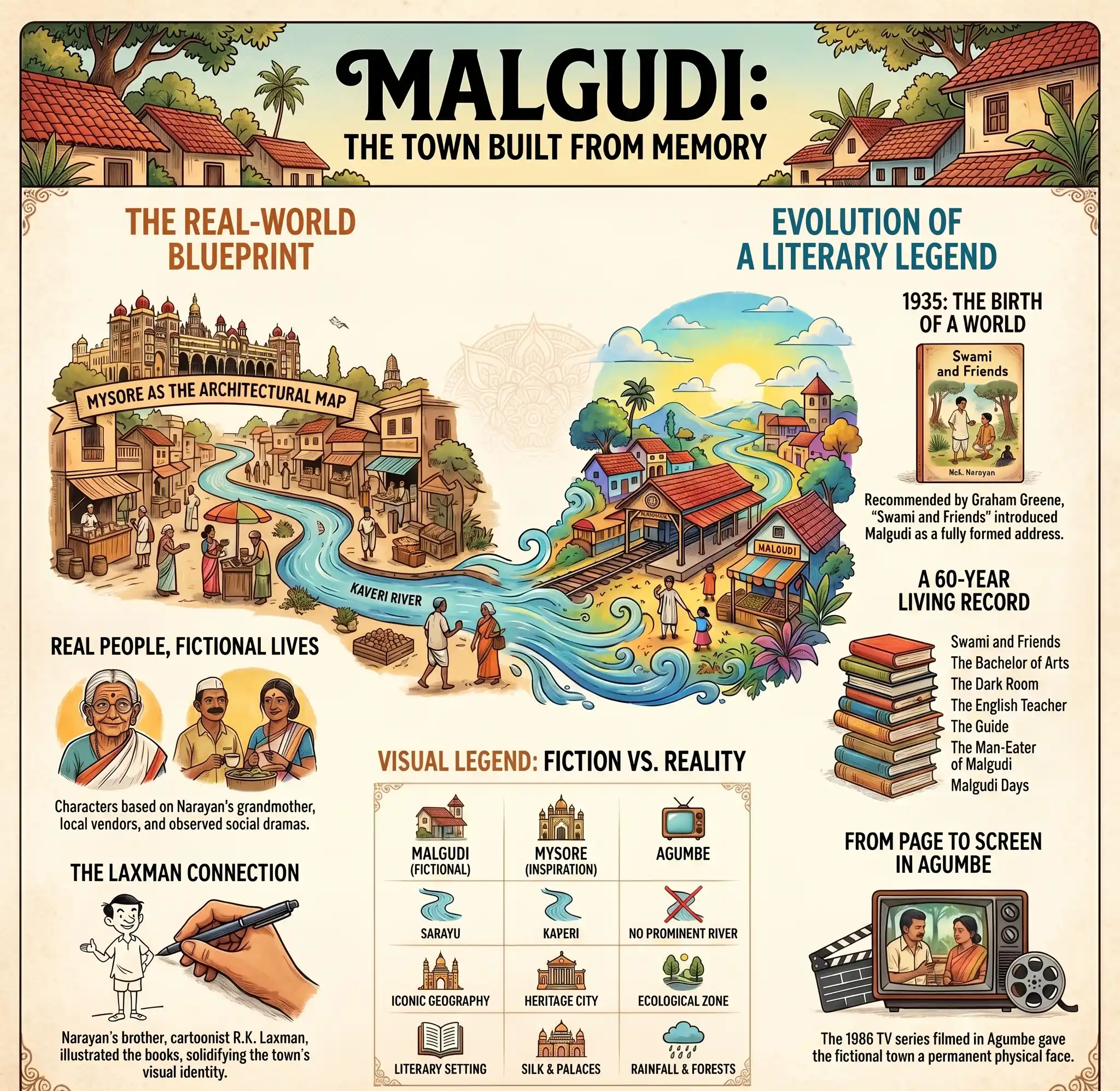
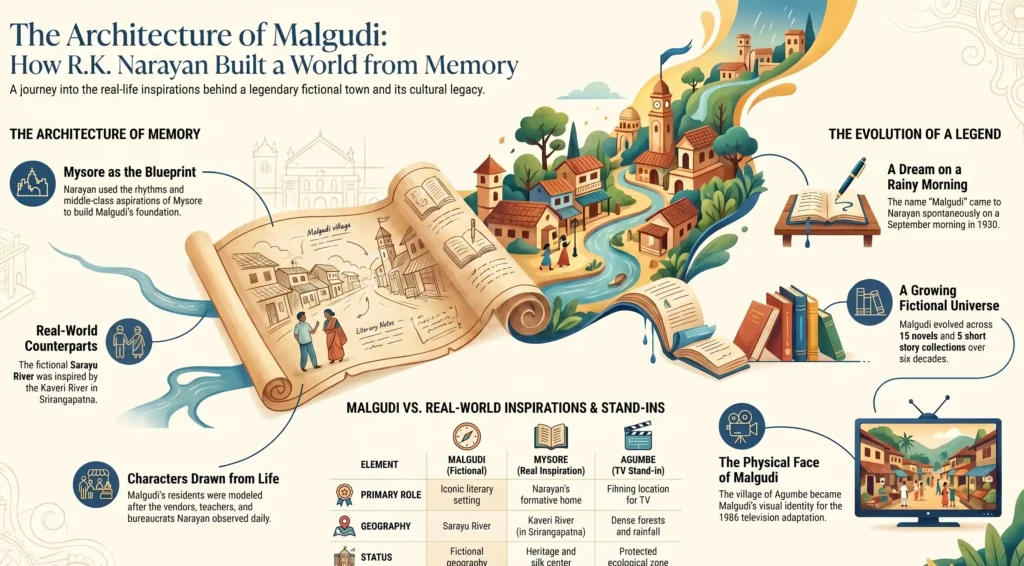
Narayan was born in Madras in 1906, but Mysore was the city that shaped him. He spent his formative years there while living with his grandmother, a woman whose storytelling and deep-rooted knowledge of South Indian life left permanent marks on everything he would later write. The streets of Mysore, its rhythms, its small-scale social dramas, and its particular brand of middle-class aspiration quietly became the architectural blueprint for Malgudi.
The Musical Revolution of Chaitanya Mahaprabhu in Medieval India
The Mysore Connection: Memory as Raw Material
Narayan himself was candid about the debt he owed to Mysore. In his memoir, “My Days,” he described how the city’s geography filtered naturally into his fiction. The Sarayu River that flows through Malgudi is understood by literary scholars and Narayan himself to have been inspired by the Kaveri, which he encountered during his years in Mysore and during visits to the town of Srirangapatna. The Albert Mission School where young Swaminathan studies in “Swami and Friends” mirrors the kind of colonial-era educational institutions that Narayan attended and observed closely.
What Narayan did was not simple imitation. He took real places and real social textures and reorganized them into a composite that felt truer than any single location could. Scholars at the Sahitya Akademi have noted that this technique of composite place-building is a hallmark of literary realism, the same method used by writers like Thomas Hardy with Wessex or William Faulkner with Yoknapatawpha County. Narayan was in distinguished company, even if Malgudi was always unmistakably, irrevocably South Indian.
You can read more about how Indian writers translated their lived environments into literary geography in the piece on The Cultural Landscape of South India and Its Influence on Indian Literature available on Curious Indian.
The People Who Became Characters
Malgudi’s streets were populated not just by places Narayan remembered but by people he had known or observed. The vendor who appears and reappears across stories, the officious small-town bureaucrat, the teacher who is both tyrant and figure of absurd comedy, the grandmother figure dispensing wisdom wrapped in mythology, all of these had real counterparts in Narayan’s daily life.
His own grandmother was a formative presence. She told him stories drawn from the Ramayana and the Mahabharata with the ease of someone reporting local news. That blending of myth and the mundane became one of Malgudi’s defining qualities. Characters in Malgudi town do not live in a secular, modernized world disconnected from the ancient. They argue about cricket and also consult astrologers. They fear examination results and also fear the displeasure of the gods. That layered reality is precisely what made Malgudi feel inhabited rather than invented.
Narayan’s older brother, the celebrated cartoonist R.K. Laxman, who created the iconic Common Man character for The Times of India, was also a creative companion and influence. The two brothers shared a way of seeing ordinary Indian life as endlessly rich with meaning, irony, and warmth. Laxman later illustrated many of Narayan’s works, and the visual and literary sensibilities of both men reinforced each other over decades.
How Bulleh Shah’s Poetry Transformed the Sufi World of Punjab
The Birth of Malgudi: A Dream on a Rainy Morning
The origin story of Malgudi itself is one of Indian literature’s most charming creative moments. Narayan described the moment of Malgudi’s birth in interviews and in his memoir with characteristic simplicity. On a September morning in 1930, sitting at a table with a sheet of paper, the name came to him. Not the plot. Not the characters. Just the name, Malgudi. And with the name came the place, sudden and complete enough in his mind that he could begin writing immediately.
He had been struggling to find a way into a story about a young boy and school life. The moment he placed that boy in Malgudi, everything unlocked. The resulting novel, “Swami and Friends,” took years to find a publisher. It was Graham Greene who read the manuscript and championed it to the British publisher Methuen, recognizing in Narayan’s prose a quality that was both rooted and universal. When the book was published in 1935, Malgudi entered the world as a fully formed address.
The UNESCO report on literary heritage sites in South Asia has highlighted how fictional geographies rooted in real cultural landscapes contribute significantly to a region’s intangible cultural heritage. Malgudi, in this sense, is not just a literary device but a cultural artifact. You can read the full UNESCO framework for intangible cultural heritage at UNESCO Intangible Cultural Heritage.
New Geographies: A Town That Grew
What is extraordinary about Malgudi is that it aged. Across fifteen novels and five collections of short stories, the town accumulated history. Readers who followed from “Swami and Friends” through to “Talkative Man” or “The World of Nagaraj” watched Malgudi absorb the pressures of post-Independence India, deal with modernity arriving at its doorstep in the form of a new dam or a television set, and continue to be itself despite everything.
The Compassionate Teachings of Sant Tukaram in Maharashtra
This longitudinal depth is what separates Malgudi from simple literary setting. Narayan was building something closer to a living record. Academic research published through the Sahitya Akademi, India’s national academy of letters, has described Narayan’s body of work as a sustained social document of twentieth-century South Indian middle-class life. The Sahitya Akademi awarded Narayan its highest honour in 1960 for “The Guide,” arguably the most complex and morally searching of all the Malgudi novels.
Curious Indian’s own deep-dive into The Real Stories Behind India’s Most Famous Literary Works explores how other Indian authors similarly drew from lived experience to build their fictional universes.
The Television Malgudi and a Nation’s Attachment
In 1986, Malgudi moved from the page to the screen. The television series “Malgudi Days,” produced and directed by Shankar Nag for Doordarshan, brought Narayan’s town to life with extraordinary fidelity. Filmed largely in Agumbe, a small village in Karnataka’s Shimoga district, the series gave Malgudi a physical face. Agumbe’s dense forests, old houses with red-tiled roofs, and unhurried pace matched the town’s literary personality so precisely that for millions of Indian viewers, Agumbe became Malgudi.
The series drew one of the largest television audiences in Doordarshan’s history and introduced entire generations to Narayan’s work. It also reinforced the feeling that Malgudi was a real place, not because of any deception, but because the imagination had already accepted it as one. The British Council, which has published extensive material on Narayan’s contribution to world literature, noted that the television adaptation made Narayan the most widely read and recognized Indian English author of the twentieth century among non-English-reading audiences within India itself. You can explore the British Council’s documentation of Indian literary figures at British Council India Literature.
Why Malgudi Still Matters
In an era when Indian English literature is increasingly urban, globally mobile, and structurally experimental, Malgudi’s smallness reads almost as an act of quiet radicalism. Narayan insisted, across six decades of writing, that the deepest truths about human life could be found in a town with one main street, a river, a school, and enough human folly to fill an encyclopedia.
The real architecture of Malgudi was never Mysore’s streets alone. It was Narayan’s conviction that ordinary people deserved the same careful, compassionate, and sometimes mercilessly comic attention that literature had historically reserved for kings, warriors, and tragic heroes. In Malgudi, the accountant matters. The schoolboy’s cricket match matters. The financial misadventures of a small-time printer matter. That democratic literary impulse is Narayan’s deepest contribution, and Malgudi is its permanent address.
For readers interested in how Indian literature has historically encoded cultural memory, the detailed exploration on How Ancient Indian Texts Preserved Oral History on Curious Indian offers essential context.
The Mithila Museum in Japan, which houses significant collections of South Asian art and cultural documentation, has cited Narayan’s Malgudi as an example of how fictional geographies can anchor cultural identity across generations. You can explore their documentation at Mithila Museum.
Additional research published through the Internet Archive’s collection of Indian literary criticism provides extensive academic analysis of how Narayan’s technique of rooted fictional world-building influenced subsequent generations of Indian writers. That resource is available at Internet Archive India Literature Collection.
Curious Indian’s article on The Enduring Legacy of South Indian Cultural Traditions in Modern India draws further connections between the cultural world Narayan depicted and the living traditions that continue in Karnataka today.
The Fearless Verses of Kabir That Challenged Orthodox Society
Quick Comparison Table
| Element | Malgudi (Fictional) | Mysore (Real Inspiration) | Agumbe (TV Stand-in) |
| Location | South India, unspecified | Karnataka, South India | Shimoga district, Karnataka |
| River | Sarayu | Kaveri (nearby) | No prominent river |
| Famous For | Literary setting | Palace, silk, heritage | Dense forests, rainfall |
| Associated Work | All Narayan novels | Narayan’s formative years | Malgudi Days TV series |
| Cultural Status | Iconic fictional geography | UNESCO World Heritage area | Protected ecological zone |
| Era of Prominence | 1935 onward | Early 20th century for Narayan | 1986 TV broadcast onward |
Curious Indian: Fast Facts
- R.K. Narayan wrote his first Malgudi novel, Swami and Friends, in 1930 but it was not published until 1935 after Graham Greene intervened on his behalf with a British publisher.
- The name Malgudi came to Narayan spontaneously on a single morning and he has described it as arriving complete, with its own geography already formed in his mind.
- Narayan never pinned Malgudi to an exact location on a map of India, which he believed would have diminished rather than enhanced its reality for readers.
- The TV series Malgudi Days was filmed in Agumbe, Karnataka, which receives some of the highest rainfall in peninsular India, giving the show its lush, timeless visual quality.
- William Walsh, a British literary critic, wrote the first full-length academic study of Narayan’s work and described Malgudi as one of the most significant acts of fictional place-making in twentieth-century world literature.
- Narayan’s brother, R.K. Laxman designed the cover art for several Malgudi novels and illustrated short story collections, making the visual and literary identity of Malgudi a true family creation.
- “The Guide,” the most celebrated of all Malgudi novels, won the Sahitya Akademi Award in 1960 and was later adapted into both a Hindi and an English film.
- Narayan was nominated for the Nobel Prize in Literature and was personally recommended by Graham Greene, who remained a champion of his work for decades.
- John Updike, the American novelist, reviewed several of Narayan’s books for The New Yorker and described reading them as the experience of entering a fully inhabited world.
- Despite spending decades as one of India’s most internationally recognized writers, Narayan continued to live a remarkably simple life in Mysore, which itself seemed to confirm that Malgudi’s values were his own.
Conclusion
Malgudi was never meant to be found on a map. That was the point. R.K. Narayan understood something essential about the relationship between memory and imagination, that the most convincing fictional places are not invented from nothing but assembled from the textures of real life, reorganized into something that captures emotional truth rather than geographical fact.
He took the streets of Mysore, the rhythms of South Indian middle-class life, the stories his grandmother told him, the faces he saw at market stalls and in schoolrooms and in the offices of small-town newspapers, and he built from all of that a town so fully realized that generations of readers have felt personally acquainted with it.
How Swami Vivekananda Brought Vedanta to the Modern World
What Malgudi ultimately represents is Narayan’s argument about what literature is for. It is not for the documentation of great events or the celebration of exceptional people alone. It is for the careful, loving, sometimes comic attention to ordinary life in all its detail, its frustration, its warmth, and its quiet dignity. That argument has not aged. If anything, in a literary world that often prizes scale and spectacle, Malgudi’s smallness feels more necessary than ever.
Narayan gave Indian English literature its first truly beloved address. And somewhere between the Sarayu River and Market Road, between Swaminathan’s schoolboy rebellions and Raju the Guide’s complicated morality, he gave readers something rarer than a great novel. He gave them a place to return to. That is the kind of writing that does not go out of print. It goes into memory, which is exactly where Malgudi began.
If you think you have remembered everything about this topic take this QUIZ
Results


#1. Which iconic fictional South Indian town did R.K. Narayan map out across 15 novels and multiple short story collections?
#2. What real-world city served as the primary physical blueprint and raw material for R.K. Narayan’s fictional creations?
#3. What is the title of the first-ever Malgudi novel published in 1935, which introduced readers to the schoolboy Swaminathan?
#4. Which world-renowned British author read the initial manuscript for Narayan’s first book and championed it to a publisher?
#5. What is the name of the fictional river that flows through Malgudi, heavily inspired by the real Kaveri River?
#6. Which celebrated cartoonist, famous for creating the “Common Man,” was R.K. Narayan’s brother and illustrated many of his works?
#7. In 1986, which small, high-rainfall village in Karnataka’s Shimoga district served as the iconic visual backdrop for the television adaptation of Malgudi Days?
#8. For which complex and morally searching Malgudi novel did R.K. Narayan receive the prestigious Sahitya Akademi Award in 1960?
How did R.K. Narayan come up with the idea for Malgudi?
Narayan described the origin of Malgudi in his memoir “My Days” as a sudden, almost involuntary moment of creative clarity. On a September morning in 1930, the name Malgudi came to him while he was sitting down to write, and with it came a complete sense of the town’s geography, character, and atmosphere. He had been trying to begin a story about a young boy and a school, and the moment he placed that story in Malgudi, the narrative began to flow. The name had no specific derivation he ever explained publicly, but the emotional and geographical blueprint came directly from his years in Mysore.
Is Malgudi based on a real place in India?
Malgudi is not based on any single real place but is a composite drawn primarily from Mysore and to a lesser extent Bangalore, both cities in Karnataka where Narayan spent significant portions of his life. He borrowed geographical features, social textures, institutional types, and cultural rhythms from these real locations and reorganized them into a fictional whole. Narayan deliberately kept Malgudi’s exact location unspecified, believing that anchoring it too precisely to a real map would undermine the sense of universality he wanted the town to carry.
Where was the TV series Malgudi Days filmed?
The 1986 Doordarshan television series Malgudi Days, directed by Shankar Nag, was filmed primarily in Agumbe, a small village in the Shimoga district of Karnataka. Agumbe was chosen for its lush forest surroundings, traditional architecture featuring red-tiled roofs, and its unhurried, timeless atmosphere, all of which matched the visual and emotional tone of Narayan’s fictional town. For millions of Indian television viewers, Agumbe effectively became the physical face of Malgudi.
What role did Graham Greene play in R.K. Narayan’s career?
Graham Greene was instrumental in launching Narayan’s international literary career. When Narayan completed “Swami and Friends,” he struggled to find a publisher willing to take on the manuscript. The novel eventually reached Graham Greene, already an established literary figure, who recognized its exceptional quality and personally recommended it to the British publisher Methuen. Greene remained a long-term supporter of Narayan’s work and their literary friendship helped establish Narayan’s reputation in Britain and internationally at a time when Indian English fiction had very limited global visibility.
Why is Malgudi considered important in the history of Indian literature?
Malgudi is considered a landmark achievement because it was the first fully realized fictional geography in Indian English literature to sustain an entire body of work across fifteen novels and five short story collections. It demonstrated that Indian English literature could be rooted in specifically Indian social and cultural realities without sacrificing universality or literary ambition. Narayan’s consistent focus on South Indian middle-class life through the lens of Malgudi created what scholars at the Sahitya Akademi have described as a sustained social document of twentieth-century India. It also established a template for later Indian writers who sought to anchor their fiction in recognizable regional identities.