Bulleh Shah was an eighteenth-century Punjabi Sufi poet and mystic whose kafis, lyrical verses composed in the vernacular language of the Punjab, became one of the most powerful expressions of Sufi philosophy in South Asian history. Operating within the Qadiri Sufi order under the guidance of his spiritual master Shah Inayat, he composed poetry that challenged religious orthodoxy, dissolved the boundaries between Hindu and Muslim devotional experience, and articulated the journey of the soul toward divine union with an emotional directness that no formal theological treatise could have matched. This piece traces the life, the spiritual crisis, the reconciliation, and the enduring legacy of the poet who sang Punjab's soul into being.| Detail | Information |
| Full Name | Abdullah Shah |
| Pen Name | Bulleh Shah |
| Born | Circa 1680, Uch Sharif, Bahawalpur, Punjab (present-day Pakistan) |
| Died | Circa 1757, Kasur, Punjab (present-day Pakistan) |
| Spiritual Order | Qadiri Sufi Order |
| Guru | Shah Inayat Qadiri |
| Language of Poetry | Punjabi |
| Literary Form | Kafi (lyrical verse), Si-Harfi (alphabetical verse) |
| Core Theme | Divine love, annihilation of ego, unity of being |
| Shrine Location | Kasur, Punjab, Pakistan |
| Estimated Works | Over 150 kafis and numerous Si-Harfis |
| Contemporary Of | Waris Shah, Shah Hussain |
The Man Who Humbled Himself Before a Gardener
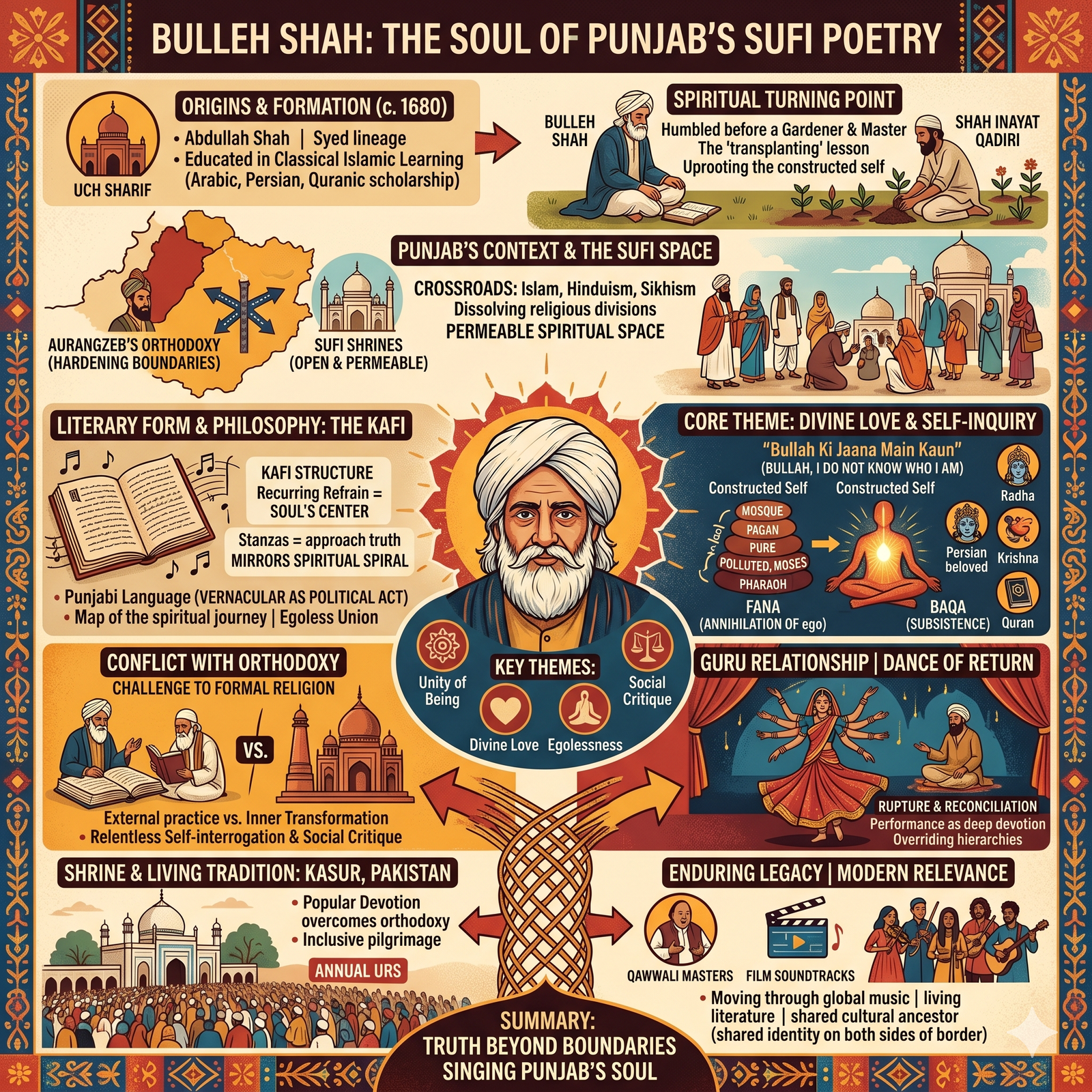
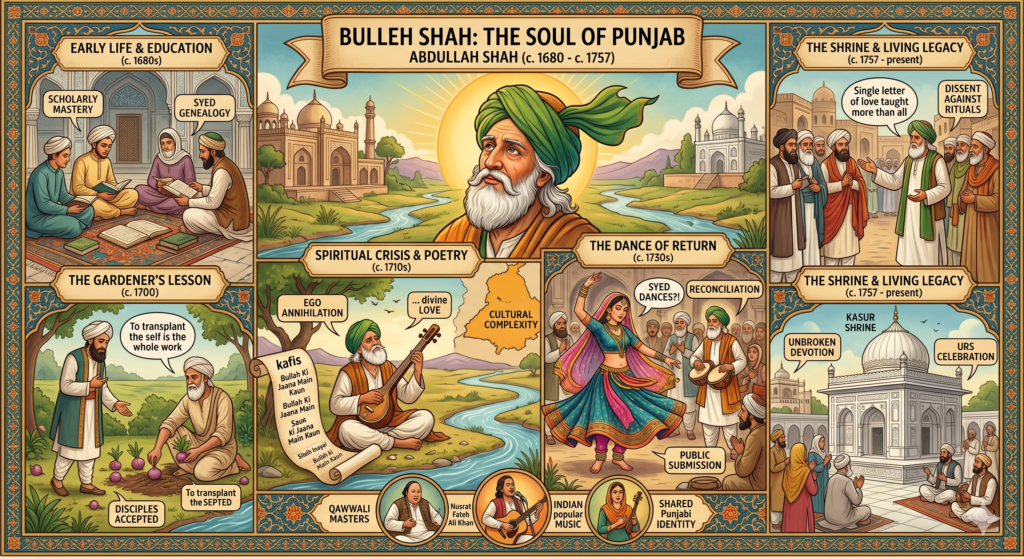
There is a moment in the life of Bulleh Shah that tells you everything you need to know about the kind of Sufi he was. He was a Syed, a man who carried the genealogical distinction of descent from the Prophet Muhammad, one of the highest social positions available to a Muslim in eighteenth-century Punjab. He was educated in classical Islamic learning, fluent in Arabic and Persian, and thoroughly grounded in the formal traditions of Quranic scholarship. He had every credential that the religious establishment of his time recognized as markers of spiritual authority.
And then he went to sit at the feet of Shah Inayat Qadiri, a man who earned his living as a gardener and market vendor of plants in Lahore, a man whose caste background placed him in a social position that made discipleship from a Syed not just unusual but, in the eyes of the orthodox establishment, scandalous.
Bulleh Shah went anyway. The accounts preserved across multiple biographical sources describe him approaching Shah Inayat, watching the master plant onion seedlings in a garden, and asking to be accepted as a disciple. Shah Inayat looked at the young scholar and said, in words that became among the most quoted in the entire Sufi literature of Punjab, that to transplant the self from one place to another, to uproot it from where it had settled and place it somewhere new, was the whole work of the spiritual path. Then he showed him how to plant an onion and told him that was the lesson.
Bulleh Shah understood. He spent the rest of his life writing about what he had understood in that garden.
The Punjab That Shaped Him
To understand Bulleh Shah’s poetry, it helps to understand the Punjab into which he was born around 1680. It was a land of extraordinary religious and cultural complexity, a crossroads where Islam, Hinduism, and Sikhism coexisted in conditions of both productive exchange and periodic violent tension. The Mughal Empire was in the advanced stages of its slow disintegration. Aurangzeb’s reign had hardened religious orthodoxy across the administration of the empire in ways that created pressure on the fluid, syncretic devotional culture that had characterized the Punjab for centuries.
Into this environment, the Sufi tradition had long provided an alternative spiritual space. The great Sufi orders that had taken root in Punjab, including the Chishti, Suhrawardi, and Qadiri orders, had historically vanished borders, maintaining a relationship with the devotional life of the region that was more permeable and inclusive than the formal boundaries of religious law suggested. Sufi shrines drew pilgrims of all faiths. Sufi music, particularly the qawwali tradition associated with the Chishti order, had developed into a form of devotional expression that could move a Hindu villager and a Muslim scholar to the same tears.
Bulleh Shah was formed by this culture and he deepened it. His poetry draws without apology from the devotional vocabulary of both the Islamic Sufi tradition and the Hindu Bhakti world that surrounded him. He uses the imagery of Radha and Krishna alongside the imagery of the lover and the beloved from Persian Sufi poetry. He references the Vedas in the same breath as the Quran, not to syncretize them into a comfortable blur but to insist that the truth they are pointing toward is singular even when the fingers pointing are many.
How R.K. Narayan Built Malgudi From Real Memories
The Kafi as a Form and a Philosophy
Bulleh Shah’s primary literary form was the kafi, a genre of Punjabi lyrical verse with deep roots in the devotional poetry of the region. The kafi is structured around a recurring refrain that anchors the poem emotionally and metrically, with stanzas that approach the central theme from different angles before returning to the refrain like a soul returning to its center.
The form itself enacts the philosophy. In Sufi thought, the spiritual journey is not a straight line from ignorance to illumination but a spiral, a repeated approach toward and partial withdrawal from the truth, with each cycle bringing the seeker closer to the center. The kafi’s structural movement, outward into the stanza and back to the refrain, mirrors this precisely. Bulleh Shah was not simply using the kafi as a container for Sufi ideas. He was choosing a form whose architecture was already a Sufi argument.
His kafis operate on multiple registers simultaneously. At their surface they are love poems, addressed to a beloved whose absence causes exquisite pain and whose presence dissolves the self. This surface is accessible to anyone who has ever loved and lost. At a deeper level they are precise maps of the spiritual journey as Sufi philosophy describes it, from the initial awakening to the stages of fana, the annihilation of the ego in the divine, and baqa, the subsistence that follows annihilation. At the deepest level they are philosophical statements about the nature of reality, the self, and the divine that engage with and often challenge the formal positions of both Islamic jurisprudence and orthodox Hindu religious thought.
Bullah Ki Jaana Main Kaun: The Most Famous Question in Punjabi Poetry
Among all the poems Bulleh Shah wrote, one stands above the rest in terms of its reach across time, geography, and cultural context. “Bullah Ki Jaana Main Kaun,” which translates approximately as “Bulleh, I do not know who I am,” is a kafi that has been sung, debated, translated, and quoted continuously since the eighteenth century and shows no signs of losing its grip on the imagination.
The poem moves through a series of declarations in which the speaker denies every identity marker that human societies use to organize themselves. I am not a believer going to the mosque. I am not a pagan bowing to idols. I am not among the pure, I am not among the polluted. I am not Moses, I am not Pharaoh. I am not from the earth, I am not from water or air or fire. Bulleh, I do not know who I am.
What the poem is doing philosophically is dismantling the architecture of the constructed self, the layers of religious identity, caste identity, social role, and theological category that accumulate around a person and are mistaken for the person themselves. It is doing this not through abstract argument but through the accumulation of a series of specific denials, each of which resonates with the reader’s own experience of those particular identity categories.
The ending does not offer a positive definition to replace what has been stripped away. It offers instead the stripping itself as the answer, the not-knowing as the most honest description available of what remains when everything constructed is removed. This is a precise expression of the Sufi concept of fana, the annihilation of the ego-self, rendered in a form that an illiterate Punjabi farmer and a contemporary philosophy student can both find entry into.
The Crisis With the Guru and the Dance of Return
The relationship between Bulleh Shah and his guru Shah Inayat was not a smooth or uncomplicated one. There came a point in Bulleh Shah’s spiritual development when something went wrong between them, and Shah Inayat withdrew from the relationship, refusing to see his disciple. The accounts differ on what caused the rupture, but its emotional consequences are documented in Bulleh Shah’s poetry with devastating clarity.
He describes in multiple kafis the experience of living without the guru’s grace as a desolation more complete than any other suffering he had known. The guru, in Sufi understanding, is not simply a teacher but the living presence through whom the divine makes itself accessible to the disciple. To lose that connection is to lose the path itself.
What Bulleh Shah did to recover the relationship has become one of the most celebrated stories in Punjabi cultural memory. He dressed as a woman, adorned himself as a dancing girl of the type associated with the entertainment districts of Lahore, and went to the gathering where Shah Inayat was present. He began to dance and sing before his guru in this disguise, pouring into the performance every ounce of his longing and devotion until Shah Inayat, recognizing him through the disguise, relented.
The story is extraordinary on several levels. A Syed, a man of the highest religious genealogy, dressing as a woman from one of the lowest social categories, performing before his master in public as an act of spiritual submission, is a gesture that inverts every hierarchy that the social world of eighteenth-century Punjab recognized as sacred. It is also a story about a poet doing the most poetic thing imaginable: using performance, disguise, and music as instruments of the most sincere possible communication.
Why Ismat Chughtai Faced a Trial for Her Fearless Storytelling
The Orthodoxy That Could Not Contain Him
Throughout his life, Bulleh Shah was in periodic conflict with the religious establishment of his time. His poetry challenged orthodox Islam not through the rejection of Islamic teaching but through the insistence that the formal, externalized practice of religion was the beginning of the spiritual path at best and a distraction from it at worst.
Some of his most direct verses address this tension with a sharpness that reads as startling even three centuries later. He wrote about scholars who had memorized religious texts without understanding them, about pilgrims who traveled to holy sites while remaining strangers to the divine that lived within themselves, about the futility of religious identity without inner transformation. He did not exempt himself from these observations. The self-interrogation in his poetry is as relentless as the social critique.
He also refused to treat the boundaries between Islam and Hinduism as spiritually significant, drawing from both traditions in the same breath and insisting that genuine devotion to the divine transcended every external marker of religious belonging. In one of his most quoted lines he declared that he had read and read until the walls of the school tired him, but a single letter of love had taught him more than all of it. The scholars of his era knew exactly who he was talking about, and they were not flattered.
The Social Architecture of His Dissent
What distinguished Bulleh Shah’s challenge to orthodoxy from simple rebellion was its structural sophistication. He was not rejecting Islamic practice out of ignorance or laziness. He had mastered its formal requirements completely before concluding that mastery was not the point. That sequence mattered. A man who has never learned the rules cannot meaningfully transcend them. A man who has mastered them and then chosen to go beyond them is doing something different and considerably more difficult to dismiss.
This is the same pattern visible in the lives of other great mystics of the Indian subcontinent. Chaitanya Mahaprabhu was a master Sanskrit scholar before he became a dancing saint in the lanes of Nabadwip. Mirabai understood every social convention of Rajput royal life before she chose to walk away from it into the open road of devotion. The mystics who changed their traditions most permanently were rarely people who had never engaged with those traditions on their own terms. They were people who had engaged so completely that they saw through to something the tradition itself was pointing toward but had stopped short of reaching.
Bulleh Shah saw through. His poetry is the record of what he found on the other side.
How Baba Farid Wove Spiritual Truths Into Early Punjabi Literature
The Language Choice as a Political Act
The decision to write in Punjabi rather than Persian or Arabic was not simply a matter of reaching a wider audience, though it did that. It was a philosophical and political statement embedded in the choice of medium itself.
Persian was the language of the Mughal court, of formal Islamic scholarship, and of the literary culture that the educated Muslim elite of the Punjab considered the only appropriate vehicle for serious thought. To write serious spiritual poetry in Punjabi was to implicitly argue that the spiritual experiences Punjabi farmers and weavers and potters had in their own language and in their own bodies were as real and as worthy of careful articulation as anything happening in the Persian literary salons of the nobility.
This argument, made through the act of writing rather than through any explicit statement, was as radical in its implications as anything in the content of the poems themselves. It said that the divine was as available in the village as in the court, as present in the spoken language of the marketplace as in the written language of the madrasa. The Punjabi language, in Bulleh Shah’s hands, became an instrument of spiritual democracy in the same way that sankirtan became an instrument of spiritual democracy in the Bengal of a century and a half earlier.
The Shrine and the Living Tradition
When Bulleh Shah died around 1757, tradition holds that the orthodox religious establishment of Kasur initially refused to allow him to be buried with full Islamic funeral rites, on the grounds that his poetry had progressed past the boundaries of acceptable religious expression. The refusal did not last. The pressure of popular devotion, the grief of the ordinary people who had found in his poetry something that the formal religious establishment had not given them, overrode the objection.
He was buried in Kasur, where his shrine stands today and where an annual urs, the death anniversary celebration observed at Sufi shrines, draws hundreds of thousands of visitors from across Pakistan, India, and the global Punjabi diaspora. The shrine has become one of the most significant centers of Sufi devotional culture in South Asia, a place where the boundaries between religious communities that Bulleh Shah dissolved in his poetry continue to be dissolved in practice every year during the urs gathering.
The Living Voice in Contemporary Music
One of the most remarkable dimensions of Bulleh Shah’s legacy is the way his poetry has moved through contemporary South Asian music with an ease that suggests it was written for every era simultaneously. The qawwali masters of Pakistan, particularly the late Nusrat Fateh Ali Khan, carried his kafis into concert halls around the world, introducing his verses to audiences in Europe, North America, and Japan who knew nothing of eighteenth-century Punjab but responded immediately to the emotional force of what they were hearing.
In Indian popular music, his verses have appeared in film soundtracks, fusion recordings, and independent musical projects with a frequency that speaks to their inexhaustible musical richness. The kafi form’s combination of rhythmic refrain and melodic flexibility makes his poems unusually amenable to musical interpretation across genres, from classical Punjabi folk music to contemporary electronic arrangements.
This musical longevity is not accidental. Bulleh Shah composed for the singing voice and the listening ear, not for the reading eye alone. The oral transmission of his kafis across three centuries of performance has kept them alive in a way that purely written poetry rarely survives. Each generation of singers has found something in them that the previous generation passed on and the next generation will carry forward. That is what living literature actually looks like.
The Fearless Verses of Kabir That Challenged Orthodox Society
What the Poetry Was Doing All Along
Looking across the full body of Bulleh Shah’s work, a single consistent project becomes visible beneath the variety of images, moods, and registers. He was trying, with the precision of someone who understood both the problem and the tool, to help his readers experience the difference between knowing about the divine and knowing the divine directly.
Every formal structure, every identity category, every religious label, every caste marker, every distinction between the sacred text of one tradition and that of another, these were, in his understanding, both useful and dangerous. Useful because they provided entry points, frameworks within which the initial impulse toward the divine could take shape. Dangerous because they had a tendency to calcify into ends in themselves, to become the destination rather than the road.
His poetry was the road. It remains one.
Quick Comparison Table
| Aspect | Bulleh Shah | Rumi | Kabir |
| Era | 17th to 18th century | 13th century | 15th to 16th century |
| Region | Punjab, South Asia | Persia, Anatolia (present-day Turkey) | Uttar Pradesh, North India |
| Language | Punjabi | Persian | Hindi, Awadhi, Braj Bhasha |
| Sufi Order | Qadiri | Mevlevi (founded by Rumi’s followers) | No formal Sufi affiliation |
| Primary Form | Kafi, Si-Harfi | Ghazal, Masnavi | Doha, Bhajan |
| Core Theme | Ego dissolution, divine love, self-inquiry | Divine love, longing, mystical union | Rejection of ritual, direct experience of god |
| Contemporary Reach | Qawwali, Punjabi folk, global fusion music | Global through translations, Mevlevi ceremony | Kabir Panth, folk music of North India |
Curious Indian: Fast Facts
- Bulleh Shah belonged to the Syed community, considered the highest genealogical rank in Muslim society, which made his choice of a lower-caste gardener as his spiritual master one of the most socially radical decisions recorded in the Sufi literature of Punjab.
- His guru Shah Inayat Qadiri was not only a Sufi master but a man who worked with his hands as a gardener, and Bulleh Shah’s poetry repeatedly uses the imagery of planting, uprooting, and cultivation as metaphors for the spiritual journey, drawing directly from this relationship.
- The kafi form that Bulleh Shah mastered had been used by earlier Punjabi Sufi poets including Shah Hussain, and Bulleh Shah’s engagement with this tradition places him within a lineage of Punjabi mystical poetry that stretches back to the fifteenth century.
- His poetry uses the names of figures from both Hindu and Islamic tradition interchangeably, referring to Krishna, Rama, the Quran, and the Prophet without marking any distinction in the authority he grants each reference.
- The city of Kasur, where Bulleh Shah lived and is buried, has been a center of Punjabi Sufi culture for centuries and his urs celebration there remains one of the largest annual Sufi gatherings in South Asia.
- Nusrat Fateh Ali Khan’s recordings of Bulleh Shah’s kafis in the 1980s and 1990s are credited by music historians with introducing the poet’s work to an international audience for the first time, reaching listeners in over forty countries.
- The Si-Harfi, another form Bulleh Shah used extensively, is an alphabetical poem in which each stanza begins with a successive letter of the Punjabi alphabet, a form requiring extraordinary technical discipline that Bulleh Shah used to contain his most systematic spiritual teachings.
- His poetry was transmitted orally for generations before being formally collected and published, which means that variant versions of many kafis exist across different regional and performance traditions, each carrying the marks of its own particular transmission history.
- Contemporary Punjabi identity, on both sides of the border created by the 1947 partition of India and Pakistan, has consistently claimed Bulleh Shah as a shared cultural ancestor, making his poetry one of the few cultural resources that the partition did not divide.
- The philosopher and poet Muhammad Iqbal, despite his very different intellectual orientation, acknowledged Bulleh Shah’s poetry as one of the finest expressions of the Punjabi spiritual imagination and cited his influence on his own understanding of the self.
Conclusion
Bulleh Shah’s poetry has survived everything that history has thrown at the Punjab over three centuries. It survived the collapse of the Mughal Empire and the chaos that followed. It survived colonialism and the particular kind of cultural amnesia that colonial education systems tend to produce. It survived the partition of 1947, which drew a political border through the middle of the cultural landscape that had produced it. It survived the various pressures of religious orthodoxy that periodically attempted to reduce the space available for the kind of spiritual complexity his work embodies.
It survived all of this because it was doing something that the forces arrayed against it could not do. It was telling the truth about what a human being actually experiences when they turn toward the divine, the longing, the confusion, the moments of apparent proximity and devastating distance, the dissolution of every category that was supposed to make the journey legible, and the strange peace that arrives not when the questions are answered but when the questioner stops needing them to be.
He chose Punjabi over Persian and Arabic because he wanted the truth to be available to everyone who could hear it. He chose the kafi form because its structure enacted the very journey it described. He chose to sit at the feet of a gardener because he understood that the credential the spiritual path actually recognizes has nothing to do with genealogy or formal learning.
The Compassionate Teachings of Sant Tukaram in Maharashtra
Three centuries later, his words are still being sung in shrines and concert halls and kitchens and car radios across South Asia and beyond. The man who did not know who he was gave everyone who heard him a slightly clearer sense of who they might be. That is the specific miracle of great mystical poetry, and Bulleh Shah performed it with a consistency and a depth that places him among the finest poets this part of the world has ever produced.
If you think you have remembered everything about this topic take this QUIZ
Results


#1. According to the provided text, around which year was Bulleh Shah born?
#2. Who was the spiritual master and gardener under whose guidance Bulleh Shah studied? A) Shah Inayat Qadiri
#3. What is the literal meaning or approximate translation of Bulleh Shah’s most famous kafi “Bullah Ki Jaana Main Kaun”?
#4. In which town or city is the shrine of Bulleh Shah located, where his annual urs is celebrated?
#5. Which poetic form used by Bulleh Shah requires extraordinary technical discipline by beginning each stanza with a successive letter of the Punjabi alphabet?
#6. To which specific community did Bulleh Shah belong by birth, carrying a genealogical distinction of descent from the Prophet Muhammad?
#7. Which legendary qawwali master is credited by music historians with introducing Bulleh Shah’s work to an international audience during the 1980s and 1990s?
#8. According to the comparison table, which language did the Persian mystic Rumi primarily use for his works?
Who was Bulleh Shah and what made his poetry unique in the Sufi tradition?
Bulleh Shah was an eighteenth-century Punjabi Sufi poet and mystic born around 1680 in Uch Sharif in the Punjab region of present-day Pakistan. What made his poetry unique within the Sufi tradition was its combination of philosophical depth with vernacular accessibility. While most formal Sufi literature of his era was composed in Persian or Arabic, Bulleh Shah wrote in Punjabi, the spoken language of the ordinary people of the region, making the most sophisticated concepts of Sufi philosophy available to audiences who had no access to classical languages. He also drew freely from both Islamic and Hindu devotional imagery without treating them as belonging to separate or competing traditions, which gave his work a cross-religious resonance unusual even within the generally inclusive Sufi tradition of South Asia.
What is the significance of Bulleh Shah’s relationship with his guru Shah Inayat?
The relationship between Bulleh Shah and Shah Inayat Qadiri is significant on several levels. It was the relationship through which Bulleh Shah received the Sufi initiation and training that made his poetry possible. It was also a relationship that challenged the social hierarchy of his time, since Bulleh Shah was a Syed of the highest genealogical rank while Shah Inayat was a gardener from a lower social background. The accounts of Bulleh Shah’s crisis with his guru, during which Shah Inayat withdrew his grace and Bulleh Shah eventually recovered the relationship by dressing as a woman and dancing before his master, are among the most celebrated stories in Punjabi Sufi tradition and illustrate the complete humility and self-surrender that Sufi discipleship demands regardless of social position.
What does the kafi form mean and why did Bulleh Shah choose it?
The kafi is a lyrical verse form rooted in the devotional poetry traditions of the Punjab, structured around a recurring refrain with stanzas that approach the central theme from multiple angles before returning to the refrain. Bulleh Shah chose it because its structure mirrored the Sufi understanding of the spiritual journey as a repeated movement toward and partial withdrawal from truth, with each cycle bringing the seeker closer to the center. The form also had deep roots in the existing Punjabi Sufi poetic tradition, connecting his work to earlier masters including Shah Hussain. The kafi’s musical adaptability, its combination of rhythmic regularity and melodic flexibility, also made it an ideal vehicle for performance in the devotional contexts of Sufi practice, where sung poetry was a primary spiritual method.
How did Bulleh Shah’s poetry challenge religious orthodoxy?
Bulleh Shah challenged religious orthodoxy not through direct theological argument but through the sustained demonstration in his poetry that formal religious practice divorced from inner transformation was spiritually ineffective. He wrote about scholars who had mastered the letter of religious texts without penetrating their spirit, about pilgrims who traveled to holy places while remaining strangers to the divine within themselves, and about the futility of religious identity as a substitute for direct spiritual experience. He also refused to treat the boundaries between Islam and Hinduism as spiritually significant, drawing from both traditions in the same breath and insisting that genuine devotion to the divine transcended every external marker of religious belonging. This brought him into periodic conflict with the orthodox religious establishment of his time, and accounts of his death indicate that the local religious authorities initially refused him full Islamic funeral rites on the grounds that his poetry had transgressed acceptable limits.
Why is Bulleh Shah’s poetry still relevant today?
Bulleh Shah’s poetry remains relevant today for reasons that operate simultaneously at the emotional, philosophical, and cultural levels. Emotionally, his kafis address experiences of longing, love, loss, and self-questioning that have no historical expiry date. Philosophically, his systematic dismantling of constructed identity in poems like “Bullah Ki Jaana Main Kaun” engages with questions about the nature of the self that contemporary philosophy, psychology, and neuroscience continue to find pressing and unresolved. Culturally, his poetry has become one of the primary shared cultural inheritances across the communities of divided Punjab, functioning as a common ground between India and Pakistan, between Hindu and Muslim Punjabis, and between the diaspora and the homeland. His continuing presence in contemporary music, from traditional qawwali to popular film soundtracks to global fusion recordings, ensures that new generations continue to encounter his work in forms accessible to them.