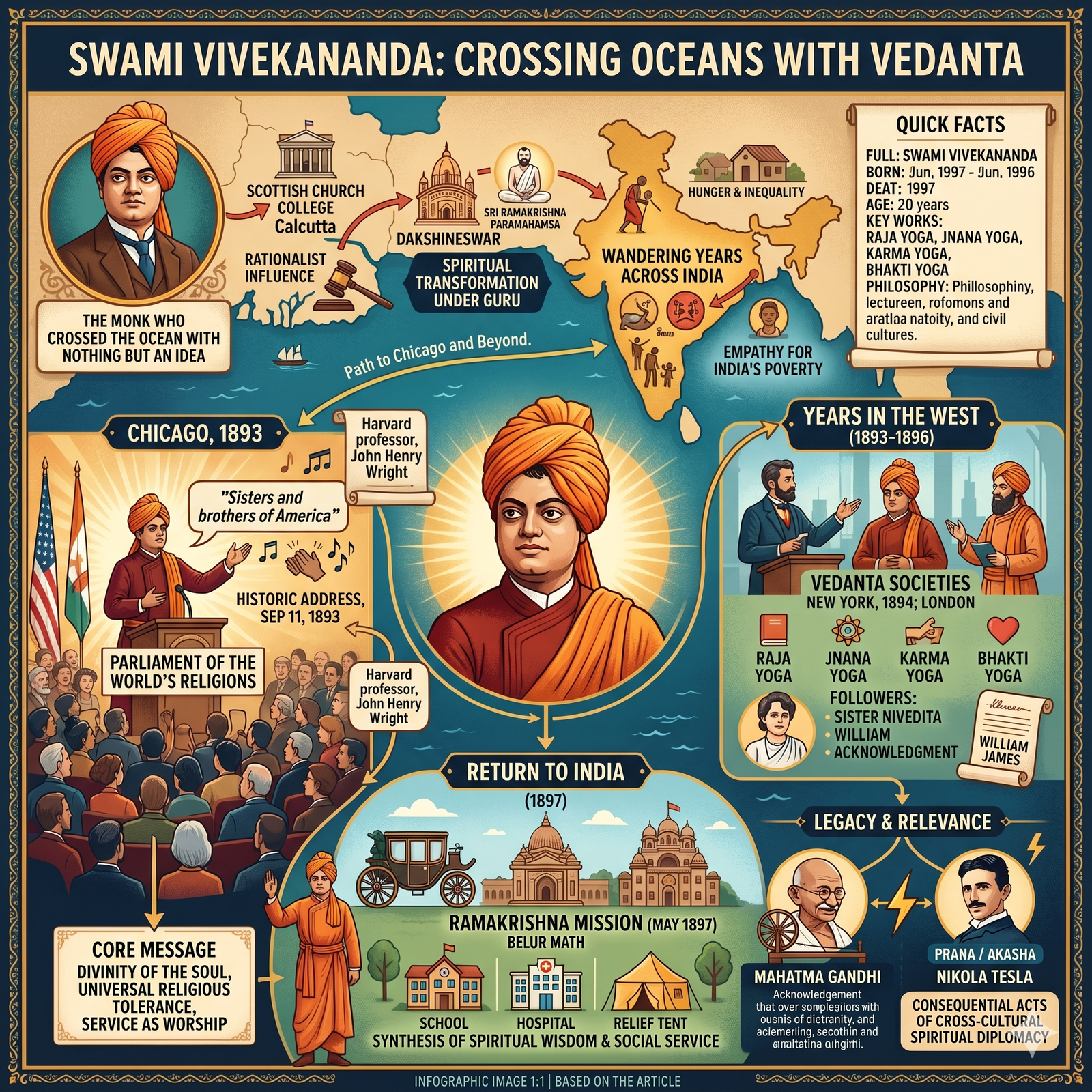
Swami Vivekananda's decision to carry the philosophy of Vedanta beyond India's borders was not an accident of circumstance but the outcome of a life shaped by intellectual hunger, spiritual transformation under Sri Ramakrishna, and a devastating encounter with India's poverty that convinced him that spiritual wisdom and human service were inseparable. His address at the Parliament of the World's Religions in Chicago in 1893 introduced Vedanta and the concept of universal religious tolerance to a Western audience that had never heard either presented with such force, clarity, and humility. This piece traces the inner journey that produced one of history's most consequential acts of cross-cultural spiritual diplomacy.| Detail | Information |
| Full Name | Narendranath Datta |
| Spiritual Name | Swami Vivekananda |
| Born | January 12, 1863, Calcutta (Kolkata), India |
| Died | July 4, 1902, Belur Math, West Bengal, India |
| Guru | Sri Ramakrishna Paramahamsa |
| Historic Speech | Parliament of the World’s Religions, Chicago, September 11, 1893 |
| Organisation Founded | Ramakrishna Mission (1897) |
| Key Works | Raja Yoga, Jnana Yoga, Karma Yoga, Bhakti Yoga |
| Core Philosophy | Vedanta, Advaita, Universal Brotherhood |
| Age at Death | 39 years |
The Monk Who Crossed the Ocean With Nothing But an Idea
There is a particular kind of courage that has nothing to do with weapons or armies. It is the courage of a person who walks into an unfamiliar room full of skeptical strangers and speaks the truth they have carried across thousands of miles, knowing that the truth itself must do the work because there is nothing else to rely on.
Swami Vivekananda had that kind of courage. In September 1893, he was thirty years old, travelling on borrowed money, dressed in a saffron robe and turban that made him look like nobody the American Midwest had ever seen, and he was about to address the most significant gathering of global religious leaders of the nineteenth century. He had no prepared text. He had no institutional endorsement from any recognized Hindu body. He had, as far as the Parliament’s organizers were concerned, arrived somewhat irregularly and been given a place on the programme partly through the intervention of a Harvard professor who had met him on a train and recognized immediately that this young Indian monk was someone the Parliament needed to hear.
What happened next did not just change Vivekananda’s life. It changed the intellectual and spiritual relationship between East and West in ways that scholars, theologians, and historians are still tracing a hundred and thirty years later.
The Fearless Verses of Kabir That Challenged Orthodox Society
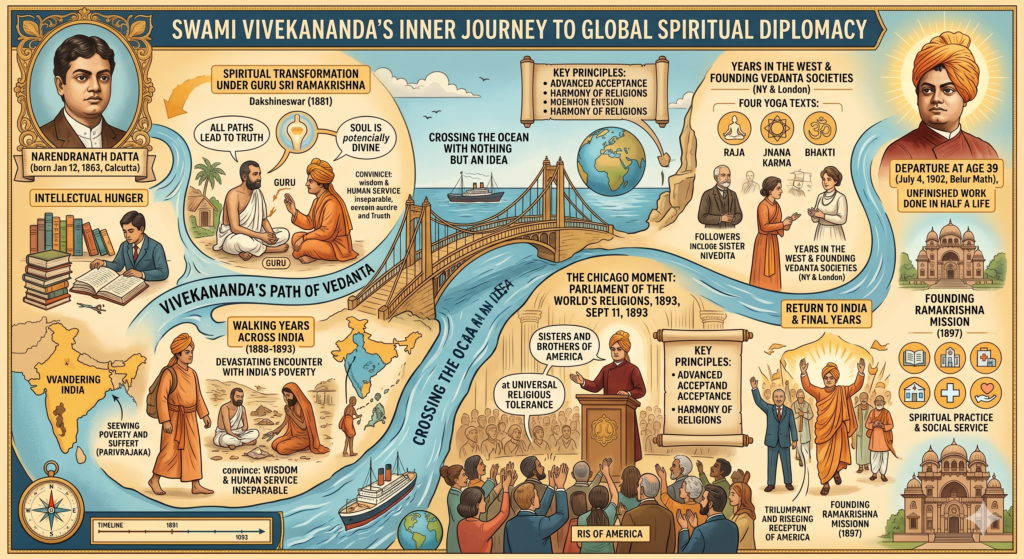
The Making of a Mind That Could Hold the World
Narendranath Datta was born on January 12, 1863, in Calcutta into a household shaped by two very different influences. His father, Vishwanath Datta, was a rationalist, a lawyer, a man of the world who read Persian poetry, spoke English fluently, and believed that a good education meant exposure to the widest possible range of human thought. His mother, Bhuvaneshwari Devi, was deeply religious, steeped in the stories of the Ramayana and the Mahabharata, and possessed of a spiritual seriousness that her son absorbed without being fully aware of it.
The combination produced a young man who was simultaneously one of the sharpest logical minds of his generation and someone who could not be satisfied by logic alone. Narendra, as he was known, tore through the Scottish Church College in Calcutta reading Western philosophy with the intensity of someone looking for something specific. He read John Stuart Mill, Herbert Spencer, David Hume, and Immanuel Kant. He found their arguments rigorous and often brilliant. He did not find in them what he was looking for, which was a direct, experiential confirmation that god was real and that human life had a meaning that transcended the merely material.
That search brought him, in 1881, to a garden house in Dakshineswar on the northern outskirts of Calcutta, where a temple priest named Ramakrishna Paramahamsa was gaining a reputation for spiritual experiences of a quality that even skeptics found difficult to dismiss. Narendra went to test him, the way a trained debater goes to dismantle an argument. He came away as a disciple.
The Transformation Under Ramakrishna
What Ramakrishna gave Narendra was not doctrine. He gave him experience. Ramakrishna was a mystic of the highest order, a man who had moved through devotional traditions as different as Islam, Christianity, and Tantra and had arrived at the conviction that all genuine spiritual paths led to the same truth. He called that truth by many names but his central insight was simple: god is real, god is present, and the human soul in its deepest nature is not separate from the divine.
For a young man who had been hunting through Western philosophy for exactly this kind of confirmation, the encounter was shattering and reorienting in equal measure. Narendra did not become Ramakrishna’s devotee in a rush of uncritical sentiment. He argued, he questioned, he resisted, he returned, and he gradually allowed himself to be taught by someone who communicated through experience rather than argument.
Ramakrishna died of throat cancer in 1886. He left behind a small group of young disciples, most of them educated young men from Calcutta’s middle class, and he left them without a formal institution, without an endowment, and without an obvious plan. What he left them was a set of ideas and a quality of inner experience that Narendra, now beginning to be called Vivekananda, would spend the rest of his short life working to understand and communicate.
Academic scholarship documented through the Ramakrishna Math and Ramakrishna Mission, the institution Vivekananda founded in 1897 and which continues as one of India’s most significant spiritual and humanitarian organizations, traces this period of formation with considerable historical detail. The Mission’s published records remain among the most authoritative sources on Vivekananda’s inner development. You can access their resources at Ramakrishna Math and Mission.
The Walking Years and the Wound That Changed Everything
Between Ramakrishna’s death and his departure for America in 1893, Vivekananda spent years wandering India as a parivrajaka, a wandering monk, traveling on foot and by the cheapest available transport through virtually every part of the subcontinent. He saw India as very few educated men of his class ever saw it, from the inside, at ground level, in its villages and its slums and its famished interiors.
What he saw broke his heart and rebuilt his purpose. He had gone out looking to deepen his own spiritual understanding. He came back knowing that spiritual understanding without attention to material suffering was not spirituality at all but a sophisticated form of escape. He saw children dying of hunger in conditions that the Vedantic philosophy he had inherited described as the manifestation of the divine. He saw untouchable communities living in conditions of degradation that mocked every claim about the sacred equality of all souls.
How Bulleh Shah’s Poetry Transformed the Sufi World of Punjab
This encounter with India’s suffering was not separate from his decision to take Vedanta to the world. It was the engine of it. He calculated, with the clarity that was one of his defining intellectual qualities, that India needed resources, education, scientific knowledge, and material development, and that the West, which possessed those things in abundance, might be persuaded to engage with India differently if it understood that India possessed something in return that the West was genuinely lacking.
That something was a philosophical framework, rooted in the Upanishads and systematized through Adi Shankaracharya’s Advaita Vedanta, that addressed the deepest questions of human existence without requiring the abandonment of reason, the acceptance of a single revealed scripture, or the condemnation of every other path to truth.
Curious Indian’s detailed exploration of How Ancient Indian Texts Preserved the Foundations of Indian Philosophy provides essential context for understanding the Vedantic tradition Vivekananda carried to Chicago.
The Chicago Moment: September 11, 1893
The Parliament of the World’s Religions opened in Chicago on September 11, 1893, as part of the World’s Columbian Exposition. It was the first formal gathering in history to bring together representatives of the world’s major religious traditions on a single platform, and its organizers, predominantly Protestant Christian clergy from the American Midwest, had designed it with the implicit assumption that it would demonstrate the spiritual superiority of Christianity while extending a generous, if somewhat patronizing, welcome to other traditions.
Vivekananda had arrived in Chicago by a route that was itself an education in providence and human kindness. He had traveled from Madras to Colombo to Japan to Vancouver to Chicago on a combination of donated funds and personal faith, having been persuaded to make the journey by a group of supporters in Madras who believed he was the right person to represent Hinduism at the Parliament. He arrived to discover that he had lost the contact information for the Parliament’s organizers and had no letter of introduction from any recognized Hindu institution.
He spent several days sleeping in a freight car in a Chicago rail yard and on the doorsteps of wealthy homes, knocking on doors and explaining his situation until a Boston socialite named Kate Sanborn connected him with Professor John Henry Wright of Harvard, who heard him speak for an afternoon and immediately wrote him a letter of introduction describing him to the Parliament’s organizing committee in terms that could not be ignored.
When Vivekananda stood to speak on September 11, he opened with seven words that the audience received as something they had been waiting years to hear. “Sisters and brothers of America,” he said, and the hall rose. Contemporary accounts record that the applause lasted between two and three minutes, an extraordinary response to an opening that had not yet contained a single substantive statement.
What followed was a short address of exceptional intellectual and emotional power. He spoke about the ancient teaching of universal acceptance, the idea that different religious paths are simply different roads to the same summit. He quoted from the Shiva Mahimna Stotram, a Sanskrit hymn that describes streams flowing from different directions into the same ocean, as a metaphor for the relationship between religions. He spoke without condescension and without defensiveness, as someone sharing a treasure rather than defending a territory.
The UNESCO documentation on the Parliament of the World’s Religions and its historical significance in the development of interfaith dialogue provides important global context for understanding the event’s place in history. That framework is available at UNESCO Culture and Dialogue.
For readers interested in how this moment fits within India’s broader tradition of philosophical exchange, the Curious Indian piece on The Ancient Indian Tradition of Debate and Intellectual Exchange offers valuable historical perspective.
How Baba Farid Wove Spiritual Truths Into Early Punjabi Literature
The Years in the West and the Founding of Vedanta Societies
Vivekananda did not return to India after Chicago. He spent the next three and a half years traveling through America and England, giving lectures, holding classes in private homes and public halls, and founding the first Vedanta Societies in New York and London. These organizations, which continue to function today, were the institutional legacy of his Western mission and the first formal structures through which Vedanta philosophy was taught to non-Indian audiences on a sustained basis.
His lectures during this period were collected and published as the four yoga texts that remain his most widely read works: Raja Yoga, Jnana Yoga, Karma Yoga, and Bhakti Yoga. Each addresses a different human temperament and a different path to spiritual realization. Together they represent the most systematic and accessible presentation of Vedantic philosophy for a general audience that had been produced up to that point.
He attracted followers of remarkable intellectual and social distinction. The sister Nivedita, born Margaret Noble in Ireland, became one of his most devoted disciples and went on to play a significant role in India’s educational and nationalist movements. The American author and music critic William James, whose work on religious experience remains foundational to the academic study of religion, attended Vivekananda’s lectures and acknowledged his influence.
The Vedanta Society of New York, founded in 1894, continues as one of the oldest continuously operating Hindu religious organizations in the United States and maintains an extensive archive of Vivekananda’s correspondence and lecture notes. You can explore their resources at Vedanta Society of New York.
The Return to India and the Final Years
Vivekananda returned to India in January 1897 to a reception that was unlike anything an Indian spiritual figure had received in the modern era. He was welcomed in Colombo and carried through the streets of Madras in a carriage drawn by enthusiastic crowds. He gave a series of lectures that, collected as “Lectures from Colombo to Almora,” represent some of the most direct and challenging things ever said to Indians about their own society by one of their own.
He told Indians simultaneously that they possessed the greatest spiritual inheritance in human history and that they had betrayed it by neglecting the physical and material welfare of their own people. He called for a synthesis of the spiritual wisdom of the East with the scientific and organizational capabilities of the West. He described this synthesis not as a compromise but as the natural next stage of human civilization.
He founded the Ramakrishna Mission in May 1897 at Belur Math on the banks of the Hooghly River near Calcutta. The Mission’s founding charter made explicit the connection between spiritual practice and social service that had been the central conviction of Vivekananda’s adult life. It established schools, hospitals, and relief organizations alongside its temples and meditation centres, an institutional embodiment of his belief that serving the poor was the highest form of worship.
The Indira Gandhi National Centre for the Arts has published extensive documentation of Vivekananda’s influence on Indian cultural and intellectual life in the decades following his death. That resource is available at Indira Gandhi National Centre for the Arts.
Curious Indian’s piece on How the Ramakrishna Mission Transformed Indian Social Service traces the institutional legacy of what Vivekananda built in his final years.
He died on July 4, 1902, at Belur Math, at the age of thirty-nine, having predicted his own early death with the same matter-of-fact directness that characterized everything else he said. He had accomplished in nineteen years of active public life what most institutions do not accomplish in a century.
The Fearless Verses of Kabir That Challenged Orthodox Society
The Idea That Was Bigger Than One Man
The message Vivekananda took to the world was not complicated at its core. Every human soul is potentially divine. Every genuine path toward that divinity deserves respect. The purpose of religion is not to build fences between people but to help them realize the unity that already exists beneath every apparent difference. Serving human beings in their suffering is the same act as worshipping god in the temple.
These ideas were not new. They were as old as the Upanishads, as present in Ramakrishna’s life as in the ancient texts. What Vivekananda brought to them was the ability to express them in a language and with a force that the modern world, shaped by science, democracy, and a deep hunger for meaning that neither science nor politics had satisfied, was ready to receive.
That readiness, and his recognition of it, is what made him not merely a saint but a world historical figure. India had many saints. It had very few people with the intellectual equipment, the personal courage, and the historical timing to carry a saint’s message to a global stage and make it land.
Quick Comparison Table
| Aspect | Swami Vivekananda | Adi Shankaracharya | Sri Ramakrishna |
| Era | 19th to 20th century | 8th century | 19th century |
| Core Method | Public lectures, institutional building | Philosophical debate, pilgrimage | Direct mystical experience, teaching |
| Primary Audience | Global, Western and Indian | Indian scholarly and monastic tradition | Immediate disciples, Bengali society |
| Key Contribution | Vedanta to the modern West | Advaita Vedanta systematized | Living demonstration of Vedantic unity |
| Institutional Legacy | Ramakrishna Mission, Vedanta Societies | Dashanami monastic order, four Mathas | Ramakrishna Order |
| Language of Outreach | English, Bengali | Sanskrit, regional languages | Bengali, symbolic communication |
| Geographic Reach | India, USA, UK, Europe | Across the Indian subcontinent | Bengal, primarily Dakshineswar |
| Age at Death | 39 years | Approximately 32 years | 50 years |
Curious Indian: Fast Facts
- Vivekananda’s opening words at the Parliament of the World’s Religions, “Sisters and brothers of America,” were not planned in advance. He had prepared a formal opening but abandoned it in the moment, speaking instead from instinct.
- He traveled to America in 1893 on funds raised largely by supporters in Madras and the royal families of Mysore and Khetri, having no personal financial resources of his own.
- William James, the father of American psychology, described Vivekananda as “a great man” after attending his lectures in Boston and acknowledged his influence on James’s own thinking about religious experience.
- Vivekananda predicted his own death at the age of forty and died at thirty-nine, reportedly telling disciples that he would not live to see forty.
- He gave approximately two hundred and fifty lectures across the United States during his first visit between 1893 and 1895, traveling by train across dozens of cities and towns.
- The New York Times covered his lectures in 1895 and described him as “the most popular and influential teacher in the United States,” a remarkable statement about a Hindu monk from Calcutta.
- He established the Ramakrishna Mission with a charter that explicitly prohibited it from engaging in proselytization, one of the first modern religious organizations in India to formalize this principle.
- Nikola Tesla, the inventor, reportedly attended at least one of Vivekananda’s lectures in New York and was intrigued by the Vedantic concepts of prana and akasha, which he explored in relation to his own theories of energy.
- Sister Nivedita, born Margaret Noble in Ireland, was one of his Western disciples who chose to remain in India permanently, eventually becoming a significant figure in the Indian independence movement and the country’s educational development.
- Mahatma Gandhi acknowledged Vivekananda’s influence on his own understanding of service and described reading his works as having deepened his love for India.
Conclusion
Swami Vivekananda took the message of Vedanta to the world because he had arrived, through personal experience and through the evidence of his wandering years across India, at a conviction that demanded action. The conviction was simple: truth this large cannot be kept in one room.
He was not naive about the difficulties. He knew that a saffron-robed monk from Calcutta arriving in Chicago without institutional endorsement or formal invitation was an unlikely candidate to reshape global spiritual conversation. He went anyway, because the alternative was to remain in possession of something important while millions of people, in India and elsewhere, continued to suffer from the absence of it.
That combination, intellectual clarity about what Vedanta offered, moral urgency about what the world lacked, and personal courage sufficient to bridge the gap between the two, is what made Vivekananda exceptional among exceptional people. India has produced saints of great purity, philosophers of great depth, and reformers of great conviction. It has produced very few people who were all three at once, with the additional capacity to speak across cultural and religious boundaries without losing the integrity of what they were carrying.
He died at thirty-nine. He had started his public life at twenty-five. In fourteen years he founded an institution that continues to operate hospitals, schools, and relief organizations across India and the world. He introduced Vedanta to the West in a form that has never gone out of serious intellectual circulation. He changed how India understood its own philosophical inheritance.
The work of a lifetime, done in less than half of one.
The Compassionate Teachings of Sant Tukaram in Maharashtra
If you think you have remembered everything about this topic take this QUIZ
This quiz no longer existsWhy did Swami Vivekananda go to the Parliament of the World’s Religions in Chicago?
Vivekananda went to Chicago in 1893 because he believed that the Parliament offered a platform to present Vedanta philosophy to a global audience and to represent India’s spiritual tradition at a moment when the world’s religious leaders were gathering for the first time in a single space. He had been encouraged and financially supported by followers in Madras and by the Maharaja of Mysore and the Raja of Khetri, who believed he was uniquely equipped to speak for India on this occasion. His deeper motivation, shaped by his years of traveling through impoverished India, was his conviction that India needed to enter into a genuine exchange with the West, offering its spiritual knowledge while gaining access to the material and scientific resources that could alleviate Indian poverty.
What is Vedanta and why did Vivekananda believe it was important for the modern world?
Vedanta is one of the six orthodox schools of Indian philosophy, rooted in the Upanishads and most systematically developed by Adi Shankaracharya in the eighth century through the Advaita or non-dualist tradition. Its central teaching is that the individual self and the universal consciousness are not ultimately separate, that the deepest layer of every human being is identical with the ground of all existence. Vivekananda believed this teaching was important for the modern world because it provided a framework for universal human dignity that transcended caste, religion, nationality, and social position. He saw it as the philosophical basis for both genuine religious tolerance and genuine social service, two things he considered the most urgent needs of his era.
What was the reaction to Vivekananda’s speech at the Chicago Parliament?
The reaction was immediate and extraordinary. Contemporary newspaper accounts describe the audience of seven thousand people rising to applaud when Vivekananda addressed them as “sisters and brothers of America,” with the applause continuing for several minutes before he could proceed. The Chicago Tribune described him as “an orator by divine right” and noted that he was the most popular speaker at the Parliament. Several other newspapers across the United States carried reports of his addresses, and he was subsequently invited to lecture across the country, eventually giving approximately two hundred and fifty lectures during his first American visit. The response established him as the most visible and recognized representative of Hinduism in the Western world.
How did Vivekananda’s time in the West influence his work back in India?
Vivekananda returned to India in 1897 with a clearer and more urgent vision of what he believed India needed to do. His experience in the West had confirmed his sense that India’s spiritual inheritance was genuinely valuable and recognized as such by thoughtful Western audiences, which gave him the moral authority to speak more directly to Indians about their own failures and responsibilities. He called for a synthesis of Eastern spirituality and Western scientific and organizational capability, which became the founding principle of the Ramakrishna Mission. He was also influenced by the Western model of organized social service and incorporated it into the Mission’s structure, creating what was at the time an unusually systematic approach to humanitarian work by a religious organization in India.
What is the legacy of Swami Vivekananda today?
Vivekananda’s legacy operates on several levels simultaneously. The Ramakrishna Mission, which he founded in 1897, continues to operate one of India’s largest networks of schools, hospitals, and disaster relief organizations, serving millions of people annually across the country and internationally. The Vedanta Societies he established in the United States and England continue to function as centres for the study of Indian philosophy. His writings, particularly the four yoga texts, remain among the most widely read works of Indian philosophy internationally. His January 12 birthday is observed in India as National Youth Day. His broader intellectual influence on Indian nationalism, on the development of a modern Hindu self-understanding, and on the global interfaith movement is recognized by scholars across disciplines as foundational and continuing.