How Aruna Asaf Ali Built the Underground Quit India Movement
Aruna Asaf Ali was an Indian freedom fighter, political organiser, and journalist whose hoisting of the Indian national flag at Gowalia Tank Maidan in Bombay on 9 August 1942 became one of the defining images of the Quit India Movement. Rather than surrendering to the arrest warrant immediately issued for her, she went underground and spent the next four years building and maintaining the clandestine networks through which the leaderless Quit India Movement continued to function after the mass arrest of Congress leadership. Her underground years took her across India, through a series of safe houses and disguised identities, editing illegal publications, organising resistance cells, and developing the ideological framework that would shape her post-independence political life. She surfaced in 1946, her warrant eventually dropped, and went on to become the first Mayor of Delhi and one of the most significant public figures of independent India. Her underground years remain the least documented and most consequential period of her extraordinary life.
The Morning at Gowalia Tank
The British colonial government knew what it was doing on the night of 8 to 9 August 1942. It had been watching the Congress leadership for weeks, monitoring the Quit India resolution that was coming, and preparing a coordinated arrest operation that would, it calculated, decapitate the movement before it could organise itself into a serious threat. By early morning on 9 August, Gandhi was in custody. Nehru was in custody. The Working Committee of the Indian National Congress was in custody. The colonial government believed it had, in a single night’s work, removed the movement’s capacity to function.
It had not counted on Aruna Asaf Ali.
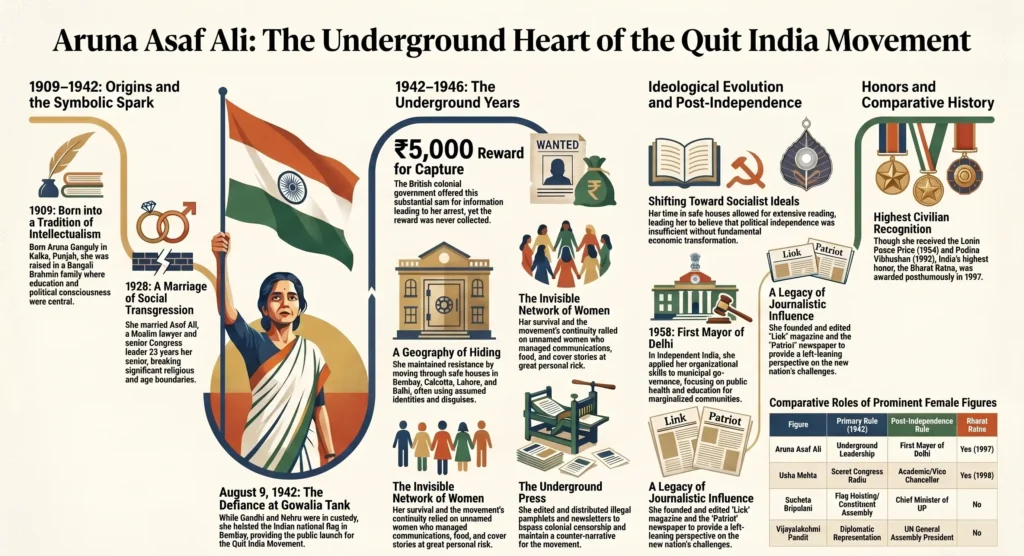
She arrived at Gowalia Tank Maidan that morning knowing what had happened overnight, knowing that the leaders were gone, knowing that a warrant for her own arrest would follow the moment she made herself visible, and she hoisted the flag anyway. The act took minutes. Its consequences lasted years, not primarily through the symbolic power of the image, though that was real and significant, but through what Aruna Asaf Ali did next.
She disappeared. Not in defeat. Not in fear. She disappeared into a network that she would spend the next four years building, extending, protecting, and using to keep a leaderless movement alive through the most sustained period of colonial repression that the Quit India campaign produced.
Savitribai Phule: School That Changed India’s History
The Woman Before the Underground
Aruna Asaf Ali was born Aruna Ganguly on 16 July 1909 in Kalka, in what is now Himachal Pradesh, into a Bengali Brahmin family of the educated professional class. Her father, Upendranath Ganguly, was a restaurant owner and her family was comfortable without being wealthy, the kind of household in which education was the primary investment in the future and political consciousness arrived through the Bengali intellectual tradition that was, in the early twentieth century, the most politically alive in India.
She was educated at Sacred Heart Convent in Lahore and later at Naini Tal, receiving the kind of English-medium mission school education that the colonial system provided to the daughters of the middle class and that produced, in a significant number of cases, women whose exposure to the rhetoric of liberty and justice in the European tradition generated a furious awareness of the gap between that rhetoric and the reality of colonial governance.
Her marriage to Asaf Ali in 1928 was the first significant act of social transgression in a life that would accumulate many. Asaf Ali was a Muslim, a senior Congress leader and lawyer from Delhi, and twenty-three years her senior. The marriage crossed both religious and age boundaries in ways that made it controversial in both families and in the broader society. Aruna Ganguly became Aruna Asaf Ali and absorbed the controversy with the same equanimity that she would later bring to considerably more dangerous forms of social transgression.
She joined the Congress movement through the Civil Disobedience campaigns of the early 1930s and distinguished herself in the Quit India preparatory period through organisational work in Delhi and her public willingness to take risks that more senior and more cautious Congress figures were reluctant to take. By 1942, she was known within the Congress as someone whose courage was not performative, a distinction that matters in political movements where genuine courage and its performance are not always the same thing.
The flag hoisting at Gowalia Tank was, in this context, not a spontaneous act of isolated bravery. It was the expression of a character and a set of commitments that had been forming for a decade and that found, on 9 August 1942, the specific moment they had been building toward.
Going Underground
The decision to go underground rather than surrender to arrest was not taken lightly and was not taken in a moment of passion. Aruna Asaf Ali understood, with the political intelligence that characterised her best decisions, that a movement that had just lost its entire leadership in a single night needed something that an imprisoned figure could not provide. It needed an organising presence outside the jail, someone with the political credibility and the organisational skill to maintain the movement’s coherence and direction during the period of maximum colonial repression.
She made herself that person. The choice was deliberate. The risks were fully understood.
The British colonial government placed a reward of five thousand rupees for information leading to her arrest, a sum that reflected both her perceived importance to the movement and the colonial government’s assessment of how difficult she would be to find. In the event, she proved considerably more difficult to find than the colonial government had anticipated, and the reward was never collected.
The network that sustained her underground years was not a single organised structure but an organic, evolving web of connections built from the Congress movement’s existing community relationships, from personal loyalties developed over years of political work, and from the specific solidarity of people who, whatever their relationship to the formal Congress organisation, understood that the colonial government’s arrest of the entire Congress leadership was an act of political violence that demanded a response.
Safe houses were provided by Congress sympathisers across the cities where she operated. The households that sheltered her ranged from the homes of senior political figures to the more modest establishments of ordinary movement workers whose commitment to the cause was expressed precisely through this kind of unglamorous but essential practical support. The women of these households were particularly important to the network’s maintenance, providing cover, managing communications, and absorbing the daily risks of harbouring a wanted person with a matter-of-factness that the historical record has largely failed to acknowledge.
Mysterious Bird Deaths In Jatinga Valley That Science Cannot Fully Explain
The Geography of Hiding
The underground years took Aruna Asaf Ali across India in a pattern that reflected both the requirements of the movement she was trying to sustain and the practical necessities of evading a colonial intelligence apparatus that was looking for her seriously and continuously.
Bombay was her first base, the city where she had hoisted the flag and where the Congress movement’s urban networks were strongest. She moved through the city’s neighbourhoods, staying in different locations, moving before patterns could be established, maintaining contact with the movement’s remaining active organisers through a system of communication that was necessarily indirect and necessarily slow.
The intelligence reports of the Bombay CID, which are preserved in the archival records of the period and have been partially examined by historians including Usha Thakkar whose research on the Quit India Movement in Bombay provides some of the most detailed documentation available, record a sustained effort to locate Aruna Asaf Ali that consistently failed because the network protecting her was too distributed and too well-disciplined to be penetrated by the informer networks on which colonial intelligence primarily depended.
She moved to Calcutta for a period, where the Bengal Congress networks and the specific culture of revolutionary organisation that Bengal had developed across decades of political activity provided both shelter and organisational resources. The Calcutta years of her underground period gave her access to the intellectual and political community of a city that was, in this period, simultaneously the most politically sophisticated and the most physically dangerous place in India for anyone the colonial government was actively seeking.
She operated in Lahore, the city of her school years, where personal connections predating her political life provided a layer of cover that purely political networks could not have supplied. She was in Delhi, the city where her husband Asaf Ali’s connections and her own organisational work had created the densest concentration of movement relationships she possessed.
The movement between cities was itself a constant exercise in the management of risk. Travelling under her own name was impossible. The railway stations and road checkpoints of wartime British India were monitored for known wanted figures, and Aruna Asaf Ali’s face was well known enough after years of public political activity that simple disguise was insufficient protection. She travelled using assumed identities, with documentation provided by the network, in conditions of physical discomfort and constant alertness that the accounts of those who assisted her during this period describe as extraordinary in their sustained demands on human endurance.
The Underground Publications
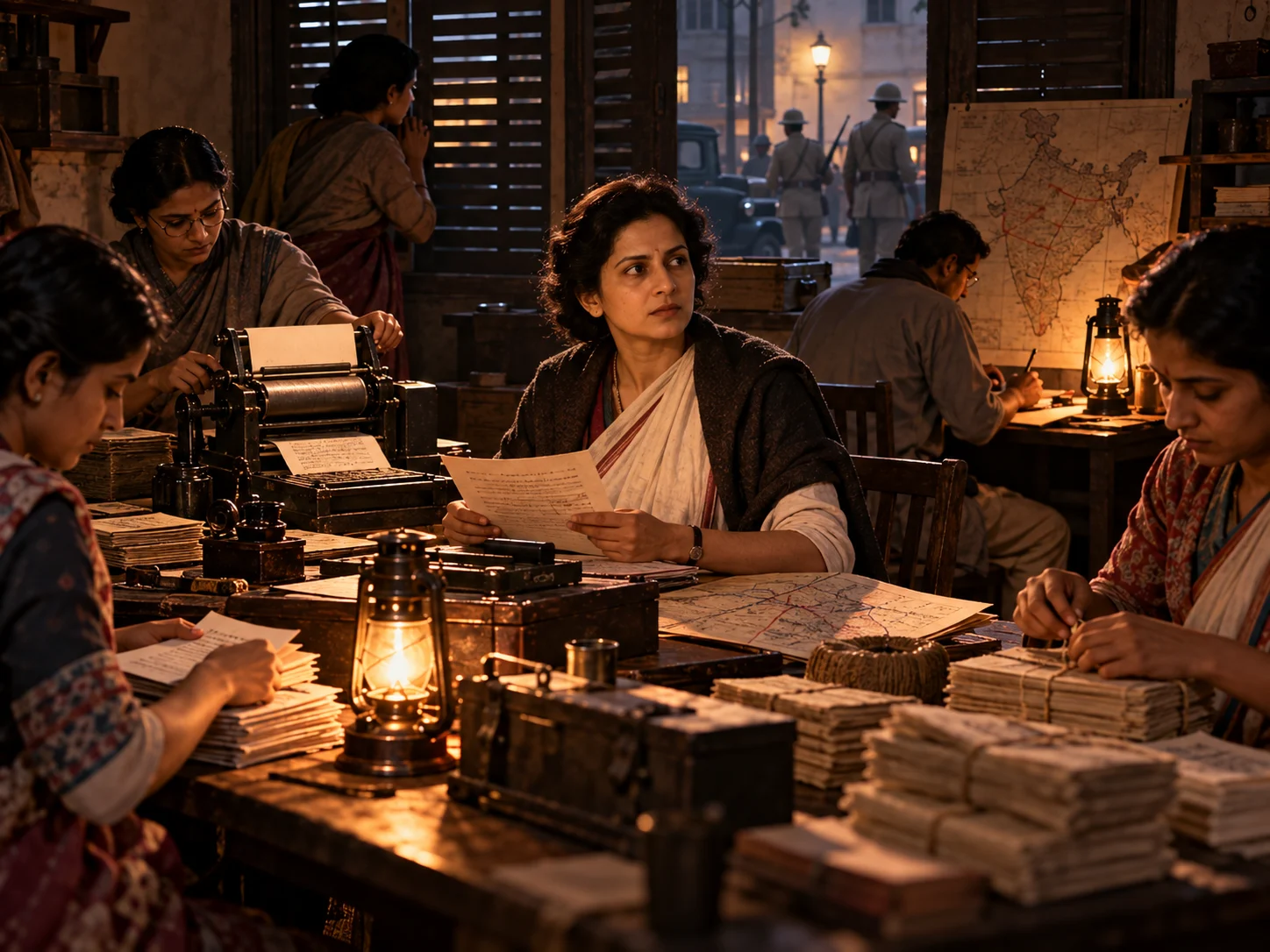
One of the most consequential dimensions of Aruna Asaf Ali’s underground years was her involvement in the production and distribution of illegal publications, the pamphlets, newsletters, and small newspapers through which the Quit India Movement attempted to maintain its communication with its supporters and its narrative about what was happening in India during the period of mass repression.
The colonial government had shut down the Congress press and imposed censorship on mainstream media coverage of the Quit India Movement. The information available to ordinary Indians about the movement’s activities, its leadership’s situation, and the colonial government’s response was therefore severely restricted, and the colonial government’s account of events, transmitted through the censored mainstream press, was unchallenged in the public sphere in ways that the movement’s leadership understood as politically dangerous.
The underground publications that Aruna Asaf Ali helped produce and distribute were the movement’s response to this information control. Printed on whatever equipment could be accessed through the network, distributed through the same channels that provided shelter and support, these publications maintained a counter-narrative that the colonial government could not fully suppress without having the distribution network to close down.
The editorial work that Aruna Asaf Ali brought to these publications reflected a journalistic and political intelligence that would later find more formal expression in her post-independence media work. The underground pamphlets were not simply propaganda. At their best, under her influence, they were sophisticated political analysis that engaged with the actual situation of the movement and the country with a seriousness that distinguished them from material produced purely for morale maintenance.
The specific publications with which she was associated during the underground years have been partially documented in the archival research of scholars working with the collections of the Nehru Memorial Museum and Library in New Delhi, which holds significant materials related to the Quit India Movement’s underground organisation and whose published finding aids provide access to the scholarly literature on this period.
Bhangarh Fort: Legends Behind India’s Most Haunted Ruins
The Ideological Evolution
The four years underground were not only years of organisational work and physical survival. They were years of intense political thinking, during which Aruna Asaf Ali’s ideological framework underwent a significant evolution that would shape her post-independence political life in ways that made her a more complex and more contested figure than the straightforward nationalist heroine of the Gowalia Tank moment.
The Quit India period in India coincided with a moment of global political crisis in which the relationship between nationalism, socialism, and communist internationalism was being worked out in different ways in different parts of the world. The Communist Party of India had taken a position on the Quit India Movement that placed it at odds with the Congress mainstream, arguing that the movement was objectively unhelpful to the Allied war effort against fascism and therefore to the cause of global working-class liberation.
Aruna Asaf Ali’s engagement with socialist and communist ideas during her underground years was therefore not a simple adoption of the CPI position but a more complex and more personally driven engagement with the questions that position raised. She was reading extensively during her underground years, using the periods of enforced stillness in safe houses to engage with the theoretical literature of the left that her active political life before 1942 had left her less time for than she would have liked.
What emerged from this reading and from the specific experience of organising a clandestine resistance movement was an increasingly sophisticated analysis of the relationship between political independence and economic liberation. She was moving, during the underground years, toward the conviction that the achievement of independence from British rule was necessary but not sufficient, that independence without a fundamental transformation of the economic structures that reproduced poverty and inequality would not deliver the India that the freedom movement had always claimed to be fighting for.
This conviction, which placed her to the left of the Congress mainstream and eventually led her to close association with the CPI in the immediate post-independence years, was the product of the underground years rather than a position she entered them holding. The experience of depending on the ordinary people of India, the households that sheltered her, the workers who printed her pamphlets, the local organisers who maintained the movement’s presence in their communities at significant personal risk, gave her a ground-level understanding of Indian economic and social reality that shaped her political thinking in permanent ways.
The ideological evolution of Aruna Asaf Ali during her underground years has been examined by historians including Aparna Basu, whose scholarly biography of Aruna Asaf Ali published by National Book Trust India provides the most comprehensive available account of her political development across the full arc of her life, with particular attention to the underground period’s formative influence on her later political positions.
The Separation and Personal Cost
One of the most personally difficult dimensions of Aruna Asaf Ali’s underground years was the effective separation from her husband Asaf Ali, who was a senior enough Congress figure to be arrested in the initial 9 August sweep and who spent the early years of her underground period in prison.
The relationship between Aruna Asaf Ali and Asaf Ali had always been conducted on terms that were unusual for the era. The marriage’s crossing of religious and generational boundaries had been a statement of personal independence from the beginning, and the political partnership that developed within it was one in which Aruna’s role was never simply supportive or derivative of her husband’s more senior position. She was a political figure in her own right, with her own organisational relationships, her own ideological development, and her own public identity that was distinct from and not subordinate to his.
The underground years deepened this independence by necessity. She could not be Asaf Ali’s wife while she was a wanted fugitive. She could not maintain any stable personal relationship with anyone whose own safety required that their connection to her be deniable. The underground years were years of necessary solitude interrupted by necessary professional collaboration, years in which the personal dimensions of her life were subordinated to the requirements of the work in ways that she would later describe as among the most personally costly aspects of the period.
Asaf Ali’s release from prison and his subsequent diplomatic appointment as India’s first Ambassador to the United States in 1947 created a new kind of distance, the distance between Delhi and Washington rather than the distance between a prison and a safe house. The relationship endured and remained significant to both of them until Asaf Ali’s death in 1953, but the specific texture of the underground years left its marks on both the relationship and on Aruna Asaf Ali’s understanding of what a political life necessarily costs those who live it completely.
The Magnetic Hill of Ladakh That Defies the Laws of Gravity
The Women Who Made It Possible
The underground network that sustained Aruna Asaf Ali for four years was built and maintained in significant part by women whose names are almost entirely absent from the historical record of the period. These were the women who managed the safe houses, who arranged food and medical care, who passed messages between network nodes, who provided cover stories when colonial intelligence came asking questions, and who absorbed the daily anxiety of harbouring a wanted fugitive without the compensation of public recognition or historical memory.
The invisibility of these women in the historical record is not accidental. It reflects the same structural inequalities of documentation that make women’s contributions to political movements consistently harder to trace than men’s. The women who sheltered Aruna Asaf Ali did not write memoirs. Their names did not appear in the underground publications. The colonial intelligence reports that tracked the movement’s activities recorded the names of the men they suspected of leadership roles more consistently than the names of the women whose household management made those leadership roles possible.
Recovering these women from the historical record requires the kind of patient, granular archival work that is being done by a small number of scholars working in regional archives across India, including the women’s history research programmes at institutions like the Centre for Women’s Development Studies in New Delhi, whose documentation of women’s participation in the Indian freedom movement provides the most systematic attempt available to make visible what the standard historical record has rendered invisible.
What can be said with confidence, based on the accounts of Aruna Asaf Ali herself in her later interviews and writings, and on the partial documentation that exists in movement archives and oral history collections, is that the underground network would not have functioned without the specific contributions of women at every level, from the most senior political figures to the most ordinary household members. The underground years of Aruna Asaf Ali were, in this sense, a collective achievement whose most significant contributors were the people history has been least willing to name.
The Colonial Hunt and Its Failure
The British colonial government’s effort to locate and arrest Aruna Asaf Ali during her four underground years was sustained, systematic, and ultimately unsuccessful. Understanding why it failed illuminates both the effectiveness of the network that protected her and the specific limits of colonial intelligence in a society where the government had alienated a significant portion of the population whose cooperation its intelligence apparatus required.
The colonial intelligence system depended heavily on informers, individuals within political and community organisations who provided information about movement activities and personnel in exchange for money or protection or both. This system had been effective against more isolated and less broadly supported revolutionary organisations. Against the Quit India Movement’s underground, it was considerably less effective because the movement’s support base was broad enough, and the community solidarity around protecting it was strong enough, that the informer networks encountered a wall of non-cooperation that they could not penetrate with any consistency.
The warrant for Aruna Asaf Ali’s arrest remained active throughout her underground period. The reward offered for information leading to her arrest remained uncollected. Multiple reported sightings led colonial intelligence to locations she had already vacated. The discipline of the network, the practice of moving before patterns became visible, of limiting the number of people who knew any individual’s current location, of maintaining communication through intermediaries rather than direct contact, held against the colonial intelligence effort with a consistency that reflected genuinely excellent operational security for an organisation that had no professional training in such practices.
The colonial government eventually dropped the warrant in 1946, not because it had decided Aruna Asaf Ali was innocent of the charges against her but because the political landscape had changed sufficiently, with the war over and independence increasingly clearly on the horizon, that the cost of continuing to seek her arrest exceeded its political utility. She surfaced publicly, the warrant dropped, and re-entered the political life of India as one of the most significant and most uncompromised figures of the independence movement.
The Mysterious 500 Year Old Mummy of Sangha Tenzin in Spiti Valley
The Post-Independence Years
When Aruna Asaf Ali emerged from the underground in 1946, she was thirty-seven years old and had spent four years living in conditions of constant physical risk, ideological ferment, and personal cost that would have broken many people of greater material resources and more protected social positions.
She was not broken. She was clarified. The underground years had stripped away whatever remained of the comfortable middle-class nationalism that had characterised her pre-1942 politics and replaced it with a harder, more specific, more demanding vision of what Indian independence was supposed to achieve and what it would require to achieve it.
Her post-independence political life reflected this clarification. She was associated with socialist and communist political currents at a time when such association was politically costly within the Congress mainstream. She founded and edited publications, including the Link magazine and the Patriot newspaper, that provided a left-leaning perspective on Indian political and economic life that challenged the Nehruvian consensus on its own terms rather than simply opposing it from outside.
She became the first Mayor of Delhi in 1958, a position she held with the same combination of ideological seriousness and practical organisational intelligence that had characterised her underground years. Her municipal work in Delhi, particularly in the areas of public health and education, reflected the ground-level understanding of ordinary people’s needs that her underground years had given her and that no amount of elite political positioning could have provided.
She received the Bharat Ratna posthumously in 1997, the year after her death at the age of eighty-seven, a recognition that came considerably later than her contribution warranted but that acknowledged, with India’s highest civilian honour, the full scope of what she had given to the country.
The Lenin Peace Prize she received in 1964 and the Jawaharlal Nehru Award she received in 1991 reflect the specific ideological positioning that her underground years had shaped and that made her, in the post-independence decades, a more politically complicated and more intellectually interesting figure than the simple nationalist heroine of the Gowalia Tank moment could contain.
What the Underground Years Actually Were
The underground years of Aruna Asaf Ali have been treated, in most historical accounts, primarily as a period of heroic endurance, the brave woman evading colonial arrest while keeping the movement alive. This framing is not wrong, but it is incomplete in ways that matter.
The underground years were also years of extraordinary intellectual and political formation. They were the period in which Aruna Asaf Ali’s political thinking reached its greatest depth, in which her understanding of India’s social and economic reality was most directly tested against the actual conditions of people’s lives, and in which the ideological commitments that would define her post-independence political life were formed.
They were years in which the specific experience of being a woman in a political underground, dependent on other women for survival, building a network in which women’s contributions were essential and invisible simultaneously, gave her a feminist political consciousness that her pre-1942 work had begun to develop but that the underground years deepened permanently.
They were years in which the relationship between individual courage and collective solidarity was lived rather than theorised, in which she experienced first-hand what it means for an individual’s survival and effectiveness to depend entirely on the willingness of hundreds of ordinary people to take personal risks on behalf of a shared cause.
The figure who emerged from the underground in 1946 was not the same person who had entered it in 1942. She was more radical in her economic analysis, more sophisticated in her understanding of political organisation, more attuned to the contributions of those whom the dominant narrative consistently overlooked, and more committed to the specific vision of India that the underground years had clarified for her.
That vision was not fully realised in the India that emerged from 1947. It has not been fully realised since. Whether it ever will be is a question that Aruna Asaf Ali spent the remaining fifty years of her life working on, with the same combination of intellectual seriousness and practical organisational commitment that the underground years had taught her was the only way serious political work gets done.
She was thirty-seven when she surfaced. She was eighty-seven when she died. Fifty years of post-independence political life, built on the foundation of what four years underground had made her.
The flag she hoisted at Gowalia Tank is the image everyone knows. The networks she built in the years that followed are the story that India still needs to hear.
Why Peer Ali Khan Chose the Gallows Over Betraying His City
If you think you have remembered everything about this topic take this QUIZ
Who was Aruna Asaf Ali and what made her underground years historically significant?
Aruna Asaf Ali was an Indian freedom fighter, political organiser, and journalist whose hoisting of the Indian national flag at Gowalia Tank Maidan in Bombay on 9 August 1942 became one of the defining acts of the Quit India Movement. Rather than surrendering to the arrest warrant immediately issued for her, she went underground for four years, building and maintaining the clandestine networks through which the leaderless Quit India Movement continued to function after the mass arrest of Congress leadership. Her underground years are historically significant both for the organisational work they produced, maintaining the movement’s coherence during the period of maximum colonial repression, and for the ideological evolution they enabled, shaping the socialist political commitments that defined her post-independence public life.
How did Aruna Asaf Ali’s underground network function and why did colonial intelligence fail to find her?
The network that sustained Aruna Asaf Ali’s underground years was a distributed, organic web of Congress movement relationships, personal loyalties, and community solidarities rather than a single structured organisation. Safe houses were provided by sympathisers across multiple cities. Communication was maintained through intermediaries rather than direct contact. Movement between locations was frequent and unpredictable, and documentation was provided through the network for travel under assumed identities. Colonial intelligence failed to locate her primarily because the network’s support base was too broad and the community solidarity around protecting it too strong to be effectively penetrated by the informer networks on which colonial intelligence primarily depended.
What ideological changes did Aruna Asaf Ali undergo during her underground years?
Aruna Asaf Ali entered the underground in 1942 as a committed nationalist whose political framework was broadly aligned with the Congress mainstream. During four years underground, extensive reading, the experience of organising a clandestine resistance movement, and direct engagement with the economic and social reality of ordinary Indians across multiple cities drove a significant leftward ideological evolution. She emerged in 1946 with an increasingly sophisticated conviction that political independence without fundamental economic transformation would not deliver the India that the freedom movement had promised, a conviction that shaped her close association with socialist and communist political currents in the post-independence decades.
What role did women play in sustaining Aruna Asaf Ali’s underground operation?
Women played an essential and almost entirely undocumented role in sustaining the underground network that protected Aruna Asaf Ali for four years. The women of the safe house households managed the daily logistics of sheltering a wanted person, arranged food and medical care, maintained cover stories when colonial intelligence came asking, and passed messages between network nodes. This work was invisible in the colonial intelligence documentation that tracked the movement and in the movement’s own subsequent historical accounts. Recovering the specific contributions of these women requires the kind of patient archival work that has only recently begun to be systematically undertaken by historians of women’s participation in the Indian freedom movement.
What was Aruna Asaf Ali’s contribution to independent India after she surfaced from the underground?
After surfacing in 1946 with her warrant dropped, Aruna Asaf Ali continued as a significant figure in Indian public life for five decades. She was closely associated with socialist and communist political currents, founded and edited publications including the Link magazine and the Patriot newspaper that provided a left-leaning perspective on Indian political and economic life, and became the first Mayor of Delhi in 1958, a role she used with particular focus on public health and education in economically marginalised communities. She received the Lenin Peace Prize in 1964, the Jawaharlal Nehru Award in 1991, the Padma Vibhushan in 1992, and the Bharat Ratna posthumously in 1997.
Sources & References
Aruna Asaf Ali background and early life — Born 16 July 1909 in Kalka, Punjab in Bengal Brahmin educated professional class family; father Upendranath Ganguly restaurant owner; educated at Sacred Heart Convent Lahore and Naini Tal receiving English-medium mission school education; married Asaf Ali 1928 crossing religious boundaries Hindu Brahmin marrying Muslim and generational boundaries twenty-three years her senior; marriage controversial in both families and broader society; joined Congress movement through Civil Disobedience campaigns 1930s; known for courage that was not performative; organisational work in Delhi distinguished her in Quit India preparatory period; willing to take risks more senior and cautious Congress figures reluctant to take; flag hoisting at Gowalia Tank on 9 August 1942 expression of character and commitments forming for decade.
Gowalia Tank flag hoisting and the moment — 9 August 1942 British colonial government arrested entire Congress leadership including Gandhi and Nehru in coordinated sweep; every senior Congress leader in custody by early morning; Aruna Asaf Ali arrived knowing leaders gone, knowing warrant would follow her visibility, hoisted flag anyway; act took minutes with consequences lasting years; not primarily through symbolic power but through what she did next; warrant for her arrest issued within hours; she disappeared not in defeat or fear but into network she would build and maintain for four years.
Underground network structure and safe houses — Network not single organised structure but organic evolving web of connections from existing Congress movement community relationships, personal loyalties from years of political work, and specific solidarity from people who understood colonial arrest of entire Congress leadership as political violence demanding response; safe houses provided by Congress sympathisers across cities from homes of senior political figures to modest establishments of ordinary movement workers; women of households particularly important providing cover, managing communications, absorbing daily risks of harbouring wanted person; British reward of five thousand rupees for information leading to arrest offered but never collected.
Geographic movement and cities — Bombay as first base where flag hoisted and Congress movement urban networks strongest; Calcutta for period accessing Bengal Congress networks and revolutionary organisation culture; Lahore city of school years with personal connections predating political life; Delhi where husband Asaf Ali’s connections and her own organisational work created densest concentration of movement relationships; movement between cities constant exercise in risk management with travelling under assumed identities, documentation provided through network, physical discomfort and constant alertness in conditions described as extraordinary in sustained demands on human endurance; Bombay CID intelligence reports preserved in archival records document sustained effort to locate her that consistently failed because network protecting her too distributed and well-disciplined to penetrate.
Underground publications and editorial work — Involvement in production and distribution of illegal publications including pamphlets newsletters small newspapers maintaining Quit India Movement communication with supporters during period of mass repression; colonial government shut down Congress press and imposed censorship on mainstream media; underground publications maintained counter-narrative that colonial government could not fully suppress without distribution network to close down; editorial work reflected journalistic and political intelligence later expressed in post-independence media work; publications were sophisticated political analysis engaging with actual situation of movement and country with seriousness distinguished from purely morale maintenance material; partially documented in archival research at Nehru Memorial Museum Library in New Delhi.
Ideological evolution during underground years — Four years of intense political thinking during which framework underwent significant evolution shaping post-independence political life; extensive reading using periods of enforced stillness in safe houses to engage with theoretical literature of left; increasingly sophisticated analysis of relationship between political independence and economic liberation; conviction that independence without fundamental transformation of economic structures reproducing poverty and inequality would not deliver promised India; experience of depending on ordinary people giving ground-level understanding of Indian economic and social reality; leftward ideological movement placing her to left of Congress mainstream eventually leading to close association with CPI in immediate post-independence years; evolution examined by historians including Aparna Basu whose National Book Trust India biography provides comprehensive account with particular attention to underground period’s formative influence.
Personal separation and the cost — Effective separation from husband Asaf Ali who arrested in initial 9 August sweep and imprisoned for early years of her underground period; marriage always conducted on unusual terms crossing religious and generational boundaries; political partnership in which Aruna’s role never simply supportive or derivative of husband’s senior position; underground years deepened independence by necessity unable to maintain stable personal relationship with anyone whose safety required their connection be deniable; years of necessary solitude interrupted by professional collaboration subordinating personal dimensions to work requirements described as among most personally costly aspects of period; Asaf Ali’s 1947 diplomatic appointment as India’s first Ambassador United States created distance between Delhi and Washington; relationship endured and remained significant until his death 1953 but specific texture of underground years left permanent marks.
Women sustaining the network — Underground network built and maintained in significant part by women almost entirely absent from historical record; women managed safe houses, arranged food and medical care, passed messages between network nodes, provided cover stories when colonial intelligence came asking, absorbed daily anxiety of harbouring wanted person without compensation of public recognition or historical memory; invisibility not accidental reflecting structural inequalities of documentation making women’s contributions to political movements harder to trace than men’s; recovering women from historical record requires patient granular archival work being done by scholars in regional archives including women’s history research programmes at Centre for Women’s Development Studies New Delhi; accounts of Aruna Asaf Ali herself in later interviews and writings and partial documentation in movement archives confirm network would not function without specific contributions of women at every level.
Post-independence career and recognition — Emerged from underground 1946 at thirty-seven after four years living in constant physical risk ideological ferment and personal cost; underground years clarified rather than broke her replacing comfortable middle-class nationalism with harder more demanding vision of what independence supposed to achieve; associated with socialist and communist political currents when politically costly within Congress mainstream; founded and edited Link magazine and Patriot newspaper providing left-leaning perspective on Indian political and economic life; first Mayor of Delhi 1958 with focus on public health and education in economically marginalised communities; received Lenin Peace Prize 1964, Jawaharlal Nehru Award 1991, Padma Vibhushan 1992, Bharat Ratna posthumously 1997; recognition at age eighty-seven representing full scope of her contribution to country; ideological positioning making her more politically complicated and intellectually interesting than simple nationalist heroine of Gowalia Tank moment.