The Phanek is the traditional wraparound lower garment worn by women of the Meitei community in Manipur, Northeast India. At first glance it appears to be a simple woven cloth in solid or striped color with a geometric border. At second glance, and with the knowledge of what the border patterns actually mean within the Meitei sacred tradition, it becomes something considerably more complex. The geometric designs woven into Phanek borders belong to a system called mayek naibi, a pattern vocabulary rooted in Sanamahism, the indigenous pre Hindu religious tradition of the Meitei people, that encodes cosmological concepts, ritual status, social identity, and spiritual protection into the geometry of daily dress. Understanding the Phanek means understanding a civilization that found a way to carry its most sacred knowledge in the most ordinary object of everyday life.| Detail | Information |
| Textile Name | Phanek (traditional wraparound lower garment of Manipuri women) |
| Origin Region | Manipur, Northeast India |
| Primary Weavers | Meitei women of the Imphal Valley, Manipur |
| Base Material | Cotton and silk, hand woven on traditional loin looms and frame looms |
| Defining Design Element | Mayek naibi, the sacred geometric border pattern system |
| Cultural Framework | Deeply connected to Sanamahism, the indigenous Meitei religious tradition |
| GI Tag Status | Manipur handloom products under GI protection framework |
| Key Weaving Centers | Imphal, Bishnupur, Nambol, Oinam village, Manipur |
Sacred Geometry Encoded in Everyday Dress
The Phanek is the traditional wraparound lower garment worn by women of the Meitei community in Manipur, Northeast India. At first glance it appears to be a simple woven cloth in solid or striped color with a geometric border. At second glance, and with the knowledge of what the border patterns actually mean within the Meitei sacred tradition, it becomes something considerably more complex. The geometric designs woven into Phanek borders belong to a system called mayek naibi, a pattern vocabulary rooted in Sanamahism, the indigenous pre-Hindu religious tradition of the Meitei people, that encodes cosmological concepts, ritual status, social identity, and spiritual protection into the geometry of daily dress. Understanding the Phanek means understanding a civilization that found a way to carry its most sacred knowledge in the most ordinary object of everyday life.
A Cloth That Begins Before History
Manipur sits in a valley ringed by hills, geographically contained and culturally distinct from the plains of mainland India in ways that have shaped its civilization into something that resists easy categorization. The Meitei people who have inhabited the Imphal Valley for millennia developed their own religious system, their own script, their own performing arts, their own martial traditions, and their own textile vocabulary entirely within this contained geography, accumulating cultural complexity without the continuous external disruptions that shaped craft traditions in more open regions.
The Phanek exists at the center of this cultural self-sufficiency. It is the garment that Meitei women have worn as their primary lower garment for as far back as oral tradition and mythological reference can reach, which in Manipur means considerably further back than documented history can confirm. The Meitei oral tradition preserved in the Puya manuscripts, sacred texts that were burned in large numbers during the forced Hinduization of Manipur in the eighteenth century and have been painstakingly reconstructed from surviving copies and memory, contains references to weaving and specific textile patterns that place the Phanek tradition within the cosmological framework of Meitei religion from its earliest recorded expressions.
This is significant. It means the Phanek did not begin as a garment that later acquired spiritual meaning. It appears to have carried spiritual meaning from the beginning, or at least from the earliest point at which Meitei civilization articulated its relationship with cloth in a form that has survived.
What Mayek Naibi Actually Means
The word mayek in Meitei refers to a pattern, a mark, or a script. The ancient Meitei script itself is called Meitei mayek, and the connection between the visual language of writing and the visual language of textile design is not coincidental in Meitei culture. Both are understood as systems for encoding meaning in geometric form.
Naibi means true, real, or authentic. Mayek naibi therefore translates approximately as true pattern or authentic mark, distinguishing the sacred geometric vocabulary of traditional Phanek design from purely decorative pattern making. The patterns within the mayek naibi system are not invented. They are inherited, each one carrying a name, a history, and a specific set of associations within the Sanamahist cosmological framework that has governed Meitei spiritual life since before the arrival of Vaishnavism in the valley in the eighteenth century.
Sanamahism, the indigenous Meitei religion, organizes the universe through a system of deities, ancestral spirits, and cosmic principles that manifest in daily life through ritual practice, including the practice of weaving. In Sanamahist understanding, the act of weaving is not simply a productive activity. It is a participation in cosmic order. The loom is understood as a model of the universe, with the warp representing the fixed vertical axis of existence and the weft representing the horizontal movement of time and experience through that fixed structure. Every pass of the shuttle is an act that mirrors the movement of life through the framework of the cosmos.
Within this understanding, the patterns woven into a Phanek border are not decorations applied to a finished cloth. They are statements made during the act of cosmic participation that weaving represents, each geometric form a deliberate invocation of a specific principle within the Sanamahist system.
The Rhythmic Buddhist Chanting of the Monks of Ladakh
The Language of the Border
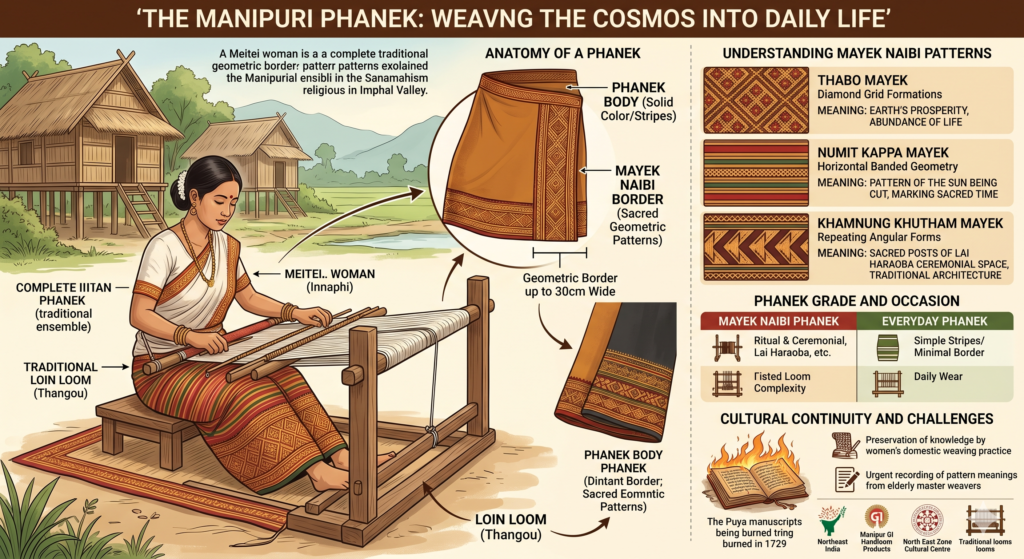
The border of a Phanek, called the mayek, is where the sacred geometry concentrates. A standard Phanek body is typically woven in solid color or simple horizontal stripes, with the visual and symbolic complexity of the garment carried entirely by the woven border running along its lower edge. This border can be narrow or wide depending on the occasion and the status of the wearer, and its geometric content follows rules that have been maintained across generations of Meitei weavers.
Several specific geometric patterns within the mayek naibi system carry documented meanings within Meitei sacred tradition. The Thabo mayek, built from a series of interlocking diamond formations, is associated with prosperity and the abundance of the earth, its diamond shapes referencing the seed forms that generate life in Sanamahist agricultural cosmology. The Numit kappa mayek, which translates as the pattern of the sun being cut, uses horizontal banded geometry to reference the movement of celestial bodies and the marking of sacred time. The Khamnung khutham mayek incorporate repeating angular forms that reference the structural elements of traditional Meitei architecture, specifically the sacred posts and beams of the Lai Haraoba ceremonial space.
These patterns are not static museum pieces. They are actively woven and actively read by Meitei women today, though the depth of literacy in the mayek naibi system varies considerably across generations, with older women typically carrying more complete knowledge of pattern meanings than younger practitioners who may have learned the geometric forms without the full cosmological context that gives those forms their significance.
According to documentation maintained by the North East Zone Cultural Centre, which operates under India’s Ministry of Culture, the recording and preservation of mayek naibi pattern knowledge from master weavers across Manipur has been identified as an urgent cultural priority, with significant portions of the pattern vocabulary existing only in the living memory of elderly artisans.
Ritual Dress and the Phanek’s Sacred Gradations
Not all Phaneks are equal in their sacred associations. The Meitei textile tradition operates on a system of gradation in which specific Phanek types are appropriate to specific occasions, and wearing the wrong type of Phanek to a ritual context is understood as a form of cosmological incorrectness rather than simply a social faux pas.
The Mayek naibi Phanek, carrying the full sacred geometric border vocabulary, is reserved for ceremonial and ritual contexts. It is worn by women participating in the Lai Haraoba festival, which is the most important annual ritual celebration in Sanamahist practice, a multi-day event that enacts the creation myth of the Meitei cosmos through dance, music, and ceremonial performance. The Phanek worn during Lai Haraoba is not simply clothing. It is ritual equipment, as functionally specific to its ceremonial purpose as any object used on an altar.
The Innaphi, a shawl worn over the upper body in combination with the Phanek, forms the complete traditional ensemble of Meitei women, and specific Innaphi designs coordinate with specific Phanek patterns in ways that follow the mayek naibi logic of sacred visual grammar. A woman dressed for a Lai Haraoba ritual is wearing a complete visual statement in the Sanamahist cosmological language, readable by those who understand the system, even if increasingly opaque to younger generations and outside observers.
The Phanek also marks life transitions. A girl’s first wearing of a full mayek naibi Phanek at the appropriate coming of age ritual marks her formal entry into the community of adult Meitei women. A woman’s Phanek at her wedding follows specific pattern requirements that distinguish the bridal context from everyday wear. Funeral rites involve specific Phanek types worn by the women of the deceased’s family. The garment moves through every significant threshold of a Meitei woman’s life, each time in a form appropriate to the specific sacred significance of the moment.
Konyak Naga Facial Tattoos: History Written on Human Skin
The Eighteenth Century Interruption
The forced conversion of the Manipuri royal court to Vaishnavism in 1729 under King Pamheiba, who adopted the name Garib Niwaz after his conversion, was one of the most disruptive events in Meitei cultural history. The king ordered the burning of the Puya manuscripts, the sacred texts of Sanamahism, and actively promoted the replacement of indigenous Meitei cultural forms with Vaishnava alternatives across the valley.
The impact on textile tradition was significant though not total. Vaishnavism brought its own aesthetic vocabulary into the Manipuri cultural landscape, including the lotus and conch motifs associated with Vishnu worship that began appearing alongside or in place of some traditional mayek naibi patterns in certain weaving contexts. The Rasleela dance tradition that developed in Manipur under Vaishnava influence, now internationally recognized as one of India’s most refined classical performing arts, generated its own distinctive costume vocabulary that drew on but also modified the existing Meitei textile tradition.
What survived of the original mayek naibi system survived largely because the knowledge was held by women in domestic weaving practice, a sphere that institutional religious suppression found harder to reach and control than public ritual or manuscript culture. Women continued weaving the patterns they had learned from their mothers, maintaining the geometric vocabulary in practice even when the full cosmological explanation of that vocabulary was becoming harder to access as the Puya texts that articulated it were destroyed or hidden.
Research documented by the Indira Gandhi National Centre for the Arts on the recovery of Meitei indigenous knowledge traditions notes that the survival of mayek naibi pattern knowledge through women’s domestic weaving practice represents one of the most significant examples of cultural preservation through textile in Northeast Indian history.
The Loom as Sacred Technology
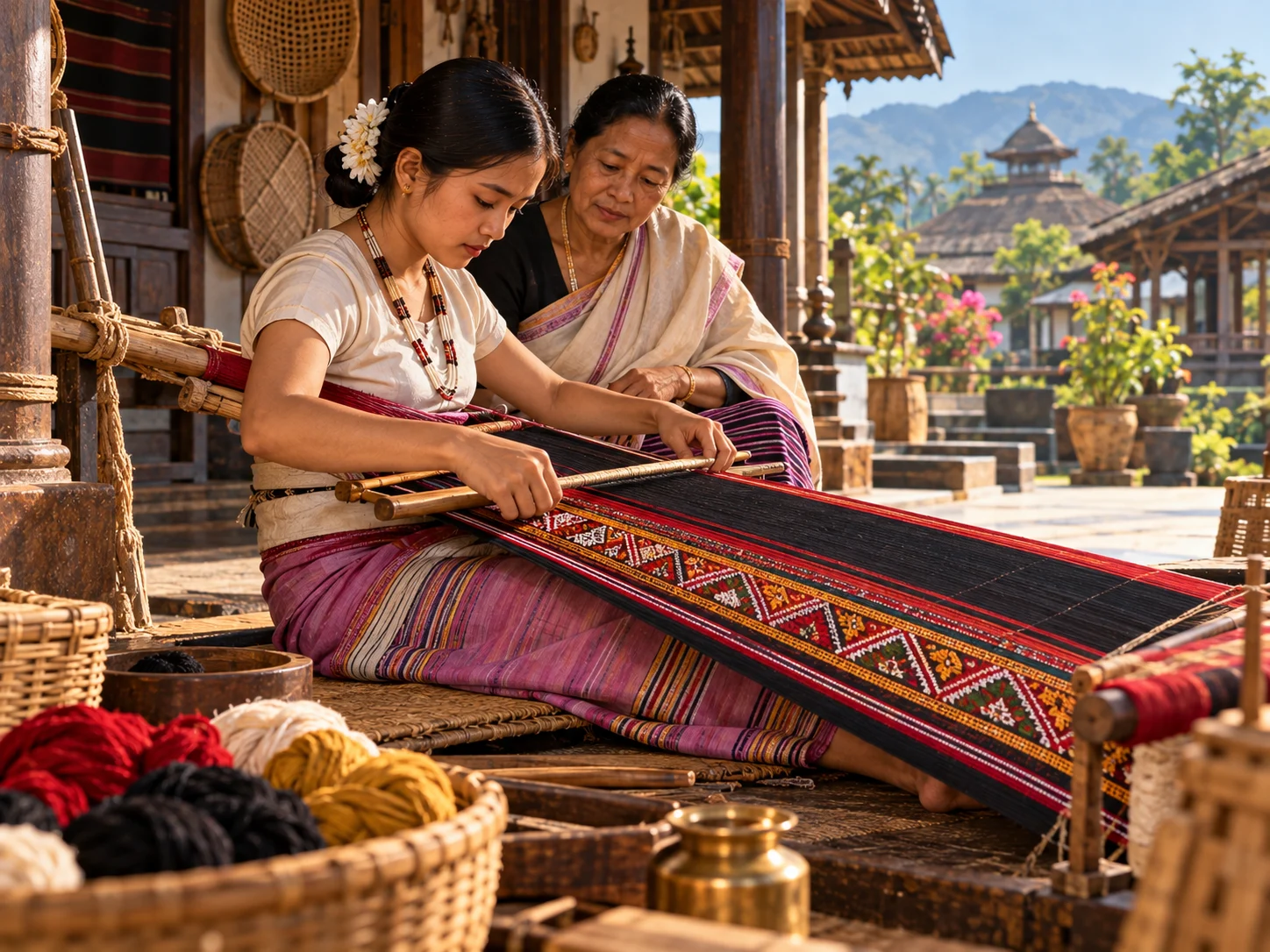
The traditional loin loom used by Meitei women for Phanek weaving, called the thangou, is itself understood within Sanamahist cosmology as a sacred instrument. The weaver sits on the ground with the loom backstrap around her body, her own physical presence forming part of the loom’s tensioning structure. She is not operating a machine. She is participating in a system in which her body, the threads, and the emerging cloth form a single integrated process.
This embodied relationship between weaver and textile is understood in Meitei tradition as one of the reasons why Phanek weaving has remained a female practice. Women’s bodies are seen in Sanamahist cosmology as inherently connected to generative processes, and weaving, understood as the creation of structured form from unstructured thread, mirrors the generative principle that Sanamahism associates with the feminine. A man operating the same loom would produce the same physical result but would be understood as operating outside his appropriate cosmic role.
The frame loom, introduced more recently and now used alongside the traditional loin loom in many Manipuri weaving households, allows for greater production speed and larger fabric dimensions. According to research compiled by the Weavers Service Centre under India’s Ministry of Textiles, the shift toward frame loom production has increased output efficiency for Manipuri handloom weavers but has in some contexts created distance from the embodied, ritually inflected practice that the loin loom represents in Sanamahist understanding of weaving as sacred activity.
Contemporary Phanek production in Manipur exists on a spectrum between these two poles, with some weavers maintaining loin loom practice specifically for ceremonial Phaneks while using frame looms for everyday production, a pragmatic adaptation that attempts to preserve the ritual integrity of the sacred context without requiring that all production conform to the most demanding traditional methods.
The Knowledge at Risk
The most sobering fact about mayek naibi pattern knowledge today is not that the patterns are difficult to learn, but that the cosmological meanings those patterns carry are fragmenting across generations. Significant portions of the mayek naibi vocabulary and their Sanamahist interpretations exist only in the living memory of elderly master weavers. Younger practitioners often learn the geometric forms without the full theological and cosmological context that makes those forms meaningful.
The North East Zone Cultural Centre has identified the documentation of this knowledge from living practitioners as an urgent cultural preservation priority. The Phanek itself survives. What the borders actually mean, the theological language that those geometric forms express, exists increasingly precariously in the minds of women whose own knowledge of that language came through demonstration and practice rather than formal instruction, and who are running out of time to pass it on.
The urgency now is different from the urgency of the eighteenth century. Then the knowledge had to survive suppression. Now it has to survive the erosion of context, the fracturing of the cosmological framework in which the patterns were always understood. Recording that meaning from the women who still hold it, in their own words and through their own understanding, is the work that determines whether the Phanek remains a living cosmological document or becomes a beautiful textile whose deepest language no one can read.
How Chhau Mask Dance of Purulia Invoke Martial Spirits
Quick Comparison Table
| Aspect | Mayek Naibi Phanek | Everyday Phanek |
| Border Pattern | Full sacred geometric mayek naibi vocabulary | Simple stripes or minimal geometric elements |
| Occasion | Ritual, ceremonial, Lai Haraoba, rites of passage | Daily wear, informal and domestic contexts |
| Loom Used | Traditional loin loom preferred | Frame loom commonly used |
| Pattern Knowledge Required | Deep familiarity with Sanamahist cosmological system | Basic weaving pattern knowledge sufficient |
| Cultural Weight | Ritual equipment with cosmological significance | Identity garment with cultural but not ritual specificity |
| Production Time | Significantly longer due to complex border work | Shorter, adapted to everyday production needs |
| Intergenerational Transmission | Increasingly at risk as cosmological knowledge fragments | More widely maintained across generations |
Curious Indian: Fast Facts
- The Meitei script, called Meitei mayek, uses the same root word mayek as the sacred textile pattern system, reflecting a deep cultural connection between written script and woven geometric language in Meitei civilization.
- The Puya manuscripts of the Meitei people, which contained references to weaving and sacred textile patterns within Sanamahist cosmology, were burned in large numbers during the forced Hinduization of Manipur under King Pamheiba in 1729.
- The Lai Haraoba festival, during which women wear specific mayek naibi Phaneks as ritual equipment, is a multi day enactment of the Meitei creation myth and is considered the most important annual event in Sanamahist religious practice.
- The North East Zone Cultural Centre has identified the preservation of mayek naibi pattern vocabulary from elderly master weavers as an urgent cultural priority, with significant portions of the system existing only in living memory.
- A Meitei woman’s first wearing of a full mayek naibi Phanek at the appropriate coming of age ritual marks her formal entry into the community of adult women in traditional Meitei social structure.
- The traditional loin loom used for Phanek weaving, called the thangou, requires the weaver’s own body to form part of the loom’s tensioning structure, making the act of weaving a physically embodied participation in cloth creation.
- Manipur’s textile tradition extends beyond the Phanek to include the Moirangphee shawl and the Wangkhei Phee fabric, both carrying distinct geometric vocabularies within the broader Meitei weaving heritage.
Double Ikat Patola of Patan and Why It Takes a Year to Weave
If you think you have remembered everything about this topic take this QUIZ
Results


#1. What is the traditional name of the system of sacred geometric border patterns woven into the Phanek?
#2. The geometric border patterns of the traditional Phanek are deeply rooted in which indigenous, pre-Hindu religious tradition of the Meitei people?
#3. What historical event in 1729 heavily disrupted Meitei cultural and textile traditions through the forced burning of the sacred Puya manuscripts?
#4. Which specific geometric pattern within the Meitei tradition is built from interlocking diamonds and associated with prosperity and agricultural cosmology?
#5. During which multi-day annual ritual celebration enacting the Meitei creation myth do women wear the Mayek naibi Phanek as essential ritual equipment?
#6. What is the traditional name for the loin loom used by Meitei women where the weaver’s own body forms part of the tensioning structure?
#7. Why did the sacred geometric border patterns of the Phanek manage to survive the intense institutional religious suppression of the eighteenth century?
#8. Which cultural organization operating under India’s Ministry of Culture has identified the preservation of mayek naibi pattern knowledge as an urgent cultural priority?
What is a Phanek and who wears it?
A Phanek is the traditional wraparound lower garment of Meitei women in Manipur, Northeast India. It is woven on handlooms from cotton or silk and worn as the primary lower garment in both everyday and ceremonial contexts. Different types of Phanek with different border patterns are appropriate for different occasions within Meitei social and ritual life.
What is the mayek naibi system in Phanek weaving?
Mayek naibi translates approximately as true pattern or authentic mark in the Meitei language. It refers to the sacred geometric border pattern vocabulary of traditional Phanek design, rooted in Sanamahism, the indigenous pre Hindu religious tradition of the Meitei people. Each pattern within the system carries a specific name and cosmological meaning, encoding spiritual concepts into the geometry of everyday cloth.
How did the forced conversion to Vaishnavism affect Phanek tradition?
The forced conversion of the Manipuri royal court to Vaishnavism in 1729 under King Pamheiba led to the burning of Puya manuscripts that contained Sanamahist cosmological knowledge, including references to sacred textile patterns. Vaishnava aesthetic elements entered the weaving vocabulary. However, women maintained the mayek naibi patterns through domestic weaving practice, preserving the geometric forms even when the theological context that explained them became harder to access.
What is the significance of the loin loom in Phanek weaving?
The traditional loin loom, called the thangou, requires the weaver’s body to form part of the loom’s tensioning structure, making weaving a physically embodied act. Within Sanamahist understanding, this embodied relationship between weaver, loom, and emerging cloth mirrors the generative principles associated with the feminine in Meitei cosmology, giving the act of weaving a ritual dimension beyond its productive function.
Why is mayek naibi knowledge considered endangered?
Significant portions of the mayek naibi pattern vocabulary and their cosmological meanings exist only in the living memory of elderly master weavers in Manipur. Younger practitioners often learn the geometric forms without the full Sanamahist context that gives those forms their sacred significance. The North East Zone Cultural Centre has identified the documentation of this knowledge from living practitioners as an urgent cultural preservation priority.