Calcutta, 1911 to 1913: the two years Meghnad Saha spent at Eden Hindu Hostel, where he could study for his exams but was not allowed to pray for them
In 1911 a grocer’s son from Seoratali, a village in the Dacca district, came to Calcutta to study mathematics at Presidency College. He was seventeen. He had just finished at Dacca College first in physics and first in mathematics, and he was given a place at Eden Hindu Hostel, the college’s boarding house across the street.
The hostel had been built in the 1880s with money raised by Ashley Eden, a former lieutenant governor of Bengal, for Hindu students from outside the city. It took Hindu boys, and in 1911 that meant it took their caste rules as well.
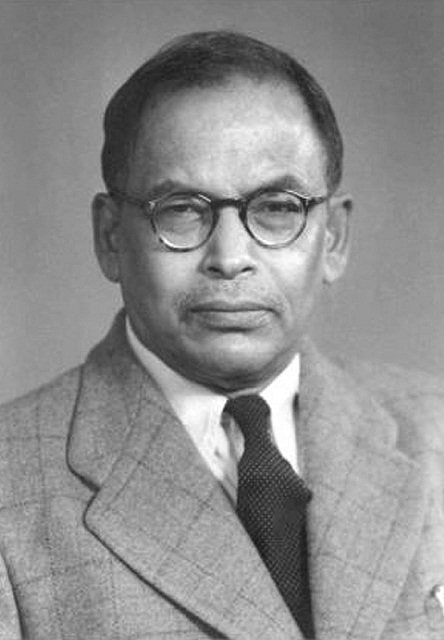
The new boy’s name was Meghnad Saha. His family were counted as shudras.
A place at the table
Some of the boarders objected to eating in the same dining hall as him.
That is almost all the record keeps. It does not say where he ate instead, or for how long, or whether any of the other boys pulled up a chair beside him. It keeps the objection and loses the rest.
The record keeps the objection and loses the rest: where he ate, and whether anyone sat with him.
In a Bengali Hindu household of the time, who you ate with was a statement of who you were, and refusing to share food with someone was the plainest way there was of telling him he was lower.
8 Defining Chapters in the Vikram Sarabhai Biography
1971 Nagarwala Case: India’s Great Bank Heist Mystery
He had paid before
It was not the first price he had paid for being in a classroom. When his elder brother failed at school, his father decided both boys should sell groceries, and it was his mother and an uncle who argued him back into school.
In 1905 he won a full scholarship to the Government Collegiate School in Dacca. That autumn Curzon partitioned Bengal, and when the lieutenant governor, Bampfylde Fuller, visited Dacca, the students boycotted him. Every boy who joined in was expelled. Saha was one of them. He lost the scholarship, and his brothers paid to keep him studying. In 1909 he came first among all the students of East Bengal in the entrance examination.
He had got to Calcutta on marks. The marks did not get him into the dining hall.
The puja
Saraswati Puja comes at the end of winter. The goddess of learning is set up in schools, colleges and hostels across Bengal, and students lay their books before her and make an offering, asking for her blessing before the examinations.
Eden Hindu Hostel held its own puja. When Saha came forward to make his offering, some of the Brahmin boarders stopped him.
He was allowed to study for his exams. He was not allowed to pray for them.
There was a particular irony in where this happened. One of his teachers at Presidency was Jagadish Chandra Bose, who had dedicated his 1902 book “to my countrymen, who will claim the intellectual heritage of their ancestors.” Across the street, some of those countrymen were deciding which of them could approach the goddess of that heritage.
Dr. A.P.J. Abdul Kalam: (1931-2015)
Eigenschaften
What the hostel would not give him, the college did. His classmates included Satyendra Nath Bose, Jnanendra Nath Mukherjee and Jnan Ghosh. His teachers included Jagadish Chandra Bose, Prafulla Chandra Ray and the mathematician Devendra Nath Mallik.
He also learned German, from a chemist who had come back to Calcutta after studying in Vienna. Nobody could have told him then why a boy from a Dacca village would need German. His classmates gave him a nickname, Eigenschaften, the German word for attributes, partly because of it. Within a few years it would let him translate Einstein into English.
1913
He left Eden Hindu Hostel in 1913 with his degree in mixed mathematics. He did not leave the dining hall or the puja behind him. For the rest of his life he wrote and spoke against caste and against the priestly authority that enforced it, and he did it the way he did physics, with arguments.
The hostel still holds its Saraswati Puja every year. It takes students of every religion now.
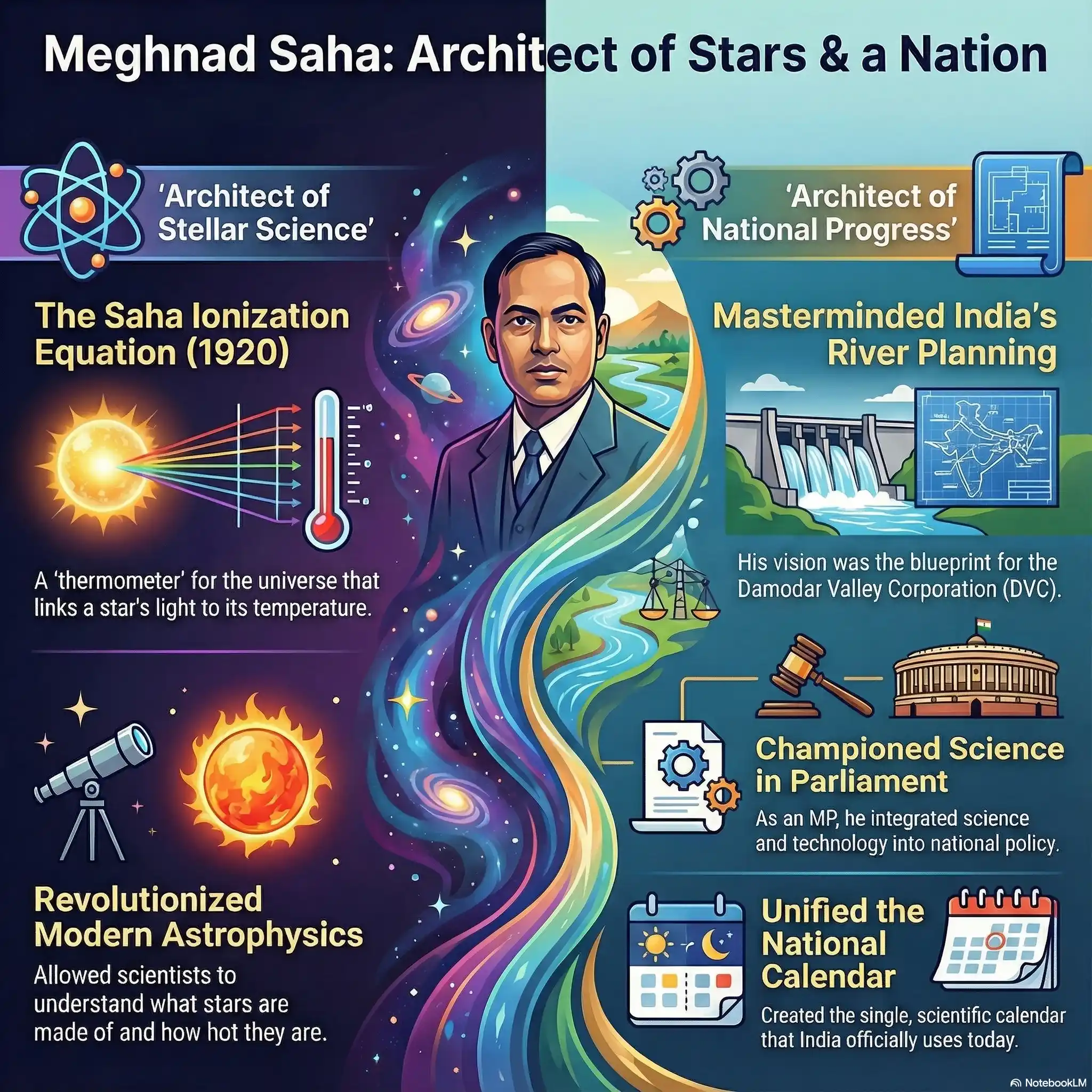
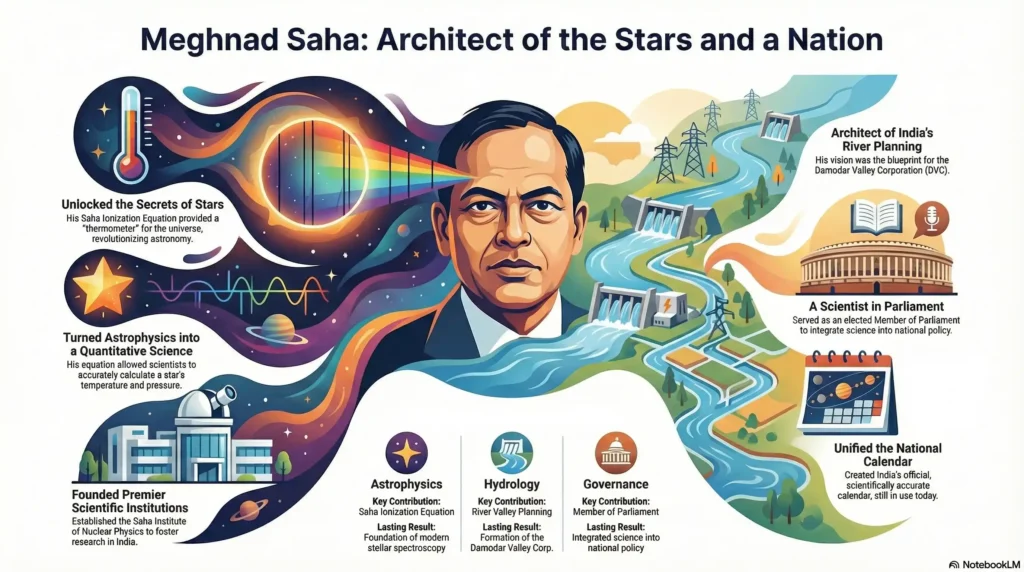
In 1920, seven years after he left it, the boy who had been kept from the offering wrote down the equation astronomers still use to read the temperature of a star from its light.


The Roopkund Skeleton Lake Mystery: Why Were Greeks Dying in the Indian Himalayas?
If you think you have remembered everything about this topic take this QUIZ
Results


#1. What fundamental insight did the Saha Ionization Equation provide about the composition of stars?
#2. Meghnad Saha’s vision for river planning in India, which led to the Damodar Valley Corporation (DVC), was directly inspired by which foreign project?
#3. In what formal capacity did Meghnad Saha participate in Indian politics after independence?
#4. What was the principal reason for Meghnad Saha’s expulsion from Dhaka Collegiate School in his youth?
#5. Which of the following best describes Meghnad Saha’s major contribution to unifying India’s system of timekeeping?
#6. At Presidency College, Meghnad Saha was a contemporary of several future scientific luminaries. Who among these was his classmate?
#7. According to the text, what was Saha’s core belief about the most effective way to address India’s poverty?
#8. Which scientific institution, now named after him, did Meghnad Saha found in Kolkata?
What exactly did Meghnad Saha discover?
He discovered the relationship between a star’s temperature and its spectrum, formalized through the Saha Ionization Equation.
Why is the Saha Equation so important?
Before this equation, astronomers didn’t know the physical state of stars. Saha’s formula allowed them to determine the temperature and pressure of celestial bodies.
How did Meghnad Saha help India’s farmers?
Through his visionary river planning in India, he designed systems to control floods and provide irrigation, most notably through the Damodar Valley project.
Was he a politician?
Yes, he was an independent Member of Parliament (MP) from 1952 until his death in 1956, advocating for scientific planning in the government.
Sources & References
Physics Today, Soma Banerjee, “Meghnad Saha: Physicist and nationalist” (August 2016) — his years at Eden Hindu Hostel, the dining hall and the puja, his family, the 1905 expulsion, his teachers and the German lessons.
Banglapedia, National Encyclopedia of Bangladesh (“Saha, Meghnad”) — his schooling in Dhaka and the 1909 entrance examination result.
The Daily Star, “Meghnad Saha, the Dhaka-born scientist who dreamed a technological future” (6 October 2025) — his lifelong writing and speaking against caste.
Author


Exploring the Soul of Bharat through History, Science, Culture, and its Diversity
Our Mission
Curious Indian is a definitive knowledge portal dedicated to chronicling the events, personalities, and cultural shifts that defined the Indian subcontinent. From the ancient Vedic Period to the complexities of 21st-century politics, our goal is to provide deep-dive analysis that inspires.
Editorial Standards & E-E-A-T
Every article published under our brand undergoes a rigorous fact-checking process. We prioritize primary historical records, academic citations, and credible archives to ensure our readers receive accurate, high-authority information.
Historical Integrity Directly sourcing from ASI archives and academic journals.Topical Authority Comprehensive clustering of Indian Science, Biographies, and Wars.Managed by Paripurna Datta and TEAM | Dedicated to the Knowledge of India.