A question children ask, an answer the best physicist in England had given, and a man who would not accept it
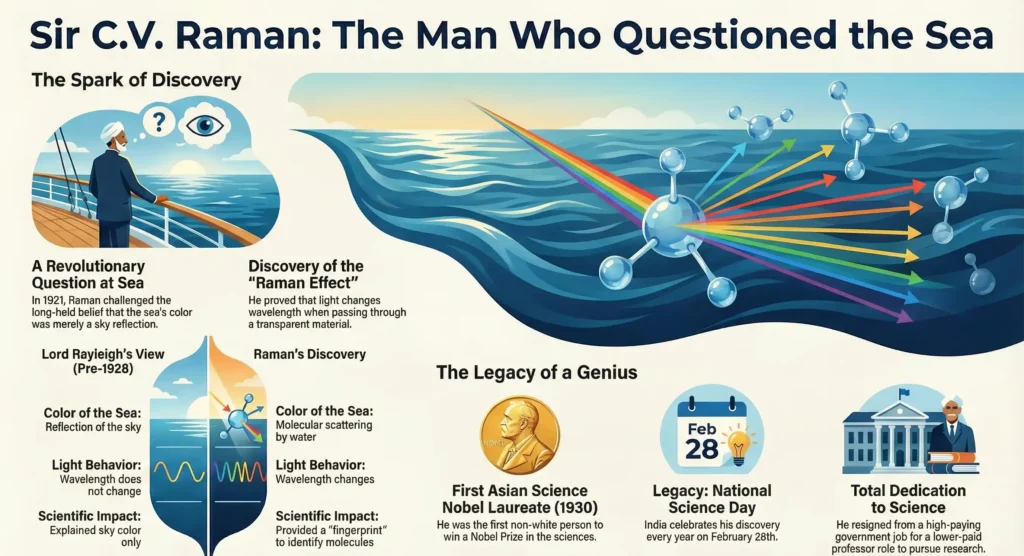
September 1921, the Mediterranean, the deck of the SS Narkunda. A thirty-three-year-old Indian professor is going home from a conference at Oxford, and he is looking at the water.
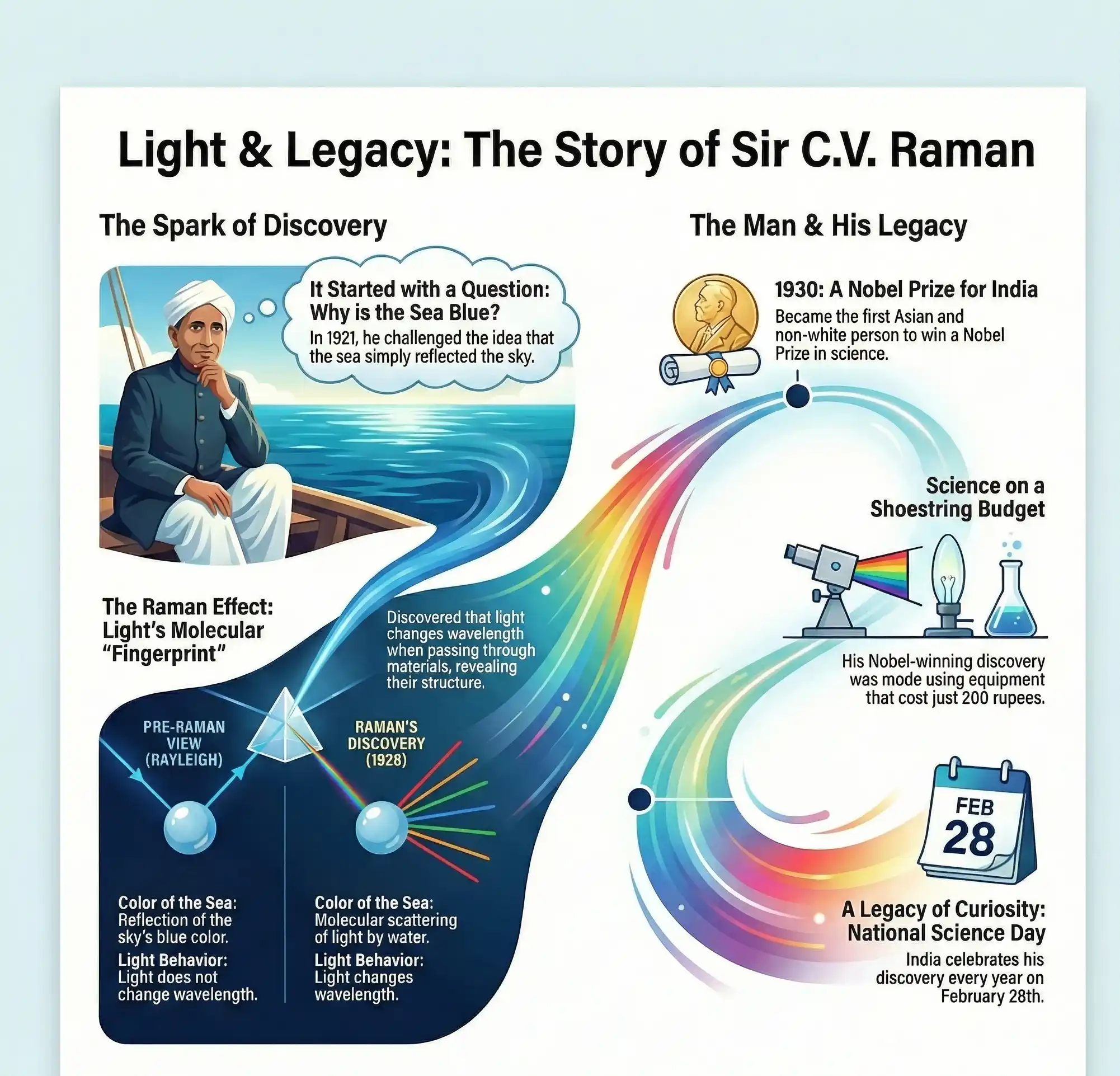
The question of why the sea is blue had been settled twenty years earlier by Lord Rayleigh, who was about as authoritative as a physicist could be. The dark blue of the deep sea, he had written, has nothing to do with the colour of water. It is simply the blue of the sky, seen by reflection.
Raman travelled the way a doctor travels, with a kit. In his pocket he had a Nicol prism, a small diffraction grating and a pocket spectroscope. He took out the prism, which can be turned to cut out light reflected off a surface, and looked at the sea through it with the reflection removed.
The blue was still there. If anything it was deeper.
The most famous physicist in England had given the answer, and a man on a ship’s rail checked it with a prism from his pocket.
The letter from the harbour
He wrote it up on board and posted it the moment the ship docked in Bombay. It appeared in Nature that November, under the title The Colour of the Sea, and it said politely that Rayleigh’s explanation could be questioned by a very simple method of observation.
What he proposed instead was that the water molecules themselves were scattering the light, the way air molecules scatter it to make the sky blue. That is a small correction to a small question. It also meant that a liquid could be interrogated by shining light into it and looking at what came back out, and that is the thread he pulled on for the next seven years.
8 Defining Chapters in the Vikram Sarabhai Biography
The laboratory he did it in
It is worth saying where. Raman had taken the Indian Finance Department examination as a young man because there was no career in physics in India to be had, came first, and became an accountant in Calcutta.
He then found a small public laboratory on Bowbazar Street run by the Indian Association for the Cultivation of Science, and worked there before the office opened and after it closed, for a decade, publishing as he went. When Calcutta University offered him a chair in 1917 he took it at a substantial cut in salary.
The equipment was never lavish. Sunlight through a telescope lens, filters, prisms, a spectrograph. The whole apparatus behind the discovery cost a few hundred rupees.
28 February 1928
Working with K.S. Krishnan, he found what he had been looking for. When light passes through a transparent substance, almost all of it comes out at the colour it went in. A very small fraction does not. That fraction comes out shifted, at a slightly different wavelength.
The shift happens because the light has traded a precise quantity of energy with the molecule it hit, and the quantity depends on how that molecule vibrates. Which means the shift is a signature. Read it and you know what the substance is.
Shine a light into an unknown material and it tells you its name. That is the whole of it, and it came out of a question about the sea.
1971 Nagarwala Case: India’s Great Bank Heist Mystery
Two years
They announced it within days and published in Nature at the end of March, jointly. The Nobel Prize followed in 1930, which is an unusually short interval, and made Raman the first Asian to win one in the sciences.
He was confident about it. He had booked his passage to Stockholm in July, months before the announcement in November, which is either insufferable or accurate depending on your temperament.
The prize went to him alone. Krishnan’s name is on the paper, and historians have argued about the credit ever since, as has everyone else who has looked at it. The two men eventually fell out badly. It is part of the record and there is no use leaving it out.
What it turned into
The effect is now a working method rather than a curiosity. Raman spectroscopy identifies a substance without touching or destroying it, from a distance, through glass or plastic if necessary.
It is in airport and customs equipment that checks for explosives and narcotics through sealed containers. It is in pharmaceutical plants, verifying that the drum contains what the label says. It is in forensic laboratories and in the hands of conservators analysing the pigments of a painting without taking a scraping.
It is also on Mars. The Perseverance rover carries Raman instruments and uses them to work out what the rocks are made of, by shining a light at them and reading the shift in what comes back.
A man wanted to know why the sea was blue. The answer is now used to identify minerals on another planet.
Dr. A.P.J. Abdul Kalam: (1931-2015)
The Roopkund Skeleton Lake Mystery: Why Were Greeks Dying in the Indian Himalayas?
If you think you have remembered everything about this topic take this QUIZ
Results


#1. What inspired C.V. Raman to investigate the color of the sea, eventually leading to his groundbreaking discovery?
#2. What is the ‘Raman Effect’ officially defined as in the field of physics?
#3. How did Raman manage to conduct scientific research while working as an Assistant Accountant General in Calcutta?
#4. Which of the following describes Raman’s level of confidence regarding his work for the 1930 Nobel Prize?
#5. What significant ‘first’ did C.V. Raman achieve in 1930?
#6. Besides light and physics, Raman had a deep interest in the acoustics of which Indian instruments?
#7. Why is National Science Day celebrated in India on February 28th?
#8. According to the comparison table, what was the primary difference between Raman’s discovery and the traditional view held by Lord Rayleigh?
What is the Raman Effect in simple terms?
The Raman Effect happens when light hits a molecule and bounces off. Most of the light bounces back with the same energy, but a tiny fraction changes its energy (and color). This change tells scientists exactly what kind of molecule they are looking at.
Why did CV Raman win the Nobel Prize?
He won the Nobel Prize in Physics in 1930 for his work on the scattering of light and the discovery of the effect named after him (The Raman Effect).
When is National Science Day celebrated in India?
It is celebrated on February 28th every year to commemorate the discovery of the Raman Effect in 1928.
Was CV Raman the first Indian to win a Nobel Prize?
He was the first Indian (and Asian) to win a Nobel Prize in Science. Rabindranath Tagore was the first Indian to win a Nobel Prize (in Literature).
Where can I visit the Raman Research Institute?
The Raman Research Institute is located in Bengaluru, Karnataka, which Raman founded to continue his research in his later years.
Sources & References
C.V. Raman, “The Colour of the Sea”, Nature (November 1921) — the shipboard observation and his objection to Rayleigh’s explanation.
C.V. Raman and K.S. Krishnan, “A New Type of Secondary Radiation”, Nature (31 March 1928) — the announcement of the effect.
The Nobel Prize, Physics 1930, including his Nobel lecture — his own account of the voyage as the starting point of the work.
G. Venkataraman, Journey into Light: Life and Science of C.V. Raman (Indian Academy of Sciences, 1988) — the years at the Indian Association for the Cultivation of Science and the aftermath of the prize.
Author


Exploring the Soul of Bharat through History, Science, Culture, and its Diversity
Our Mission
Curious Indian is a definitive knowledge portal dedicated to chronicling the events, personalities, and cultural shifts that defined the Indian subcontinent. From the ancient Vedic Period to the complexities of 21st-century politics, our goal is to provide deep-dive analysis that inspires.
Editorial Standards & E-E-A-T
Every article published under our brand undergoes a rigorous fact-checking process. We prioritize primary historical records, academic citations, and credible archives to ensure our readers receive accurate, high-authority information.
Historical Integrity Directly sourcing from ASI archives and academic journals.Topical Authority Comprehensive clustering of Indian Science, Biographies, and Wars.Managed by Paripurna Datta and TEAM | Dedicated to the Knowledge of India.