The most quoted sentence in Indian philosophy was said by a father to a son who had come home from twelve years of study with nothing but a high opinion of himself
Shvetaketu was sent away to study at twelve and came back at twenty-four, having learned the Vedas and, as the text says plainly, thinking rather a lot of himself.
His father asked him one question. Did you ask your teacher for the instruction by which what has not been heard becomes heard, what has not been thought becomes thought, what has not been known becomes known?
The boy had never heard of such a thing, and said so, and asked to be taught it. What follows is the sixth book of the Chandogya Upanishad.
Twelve years of the best education available, and the first question at the door exposed the hole in it.
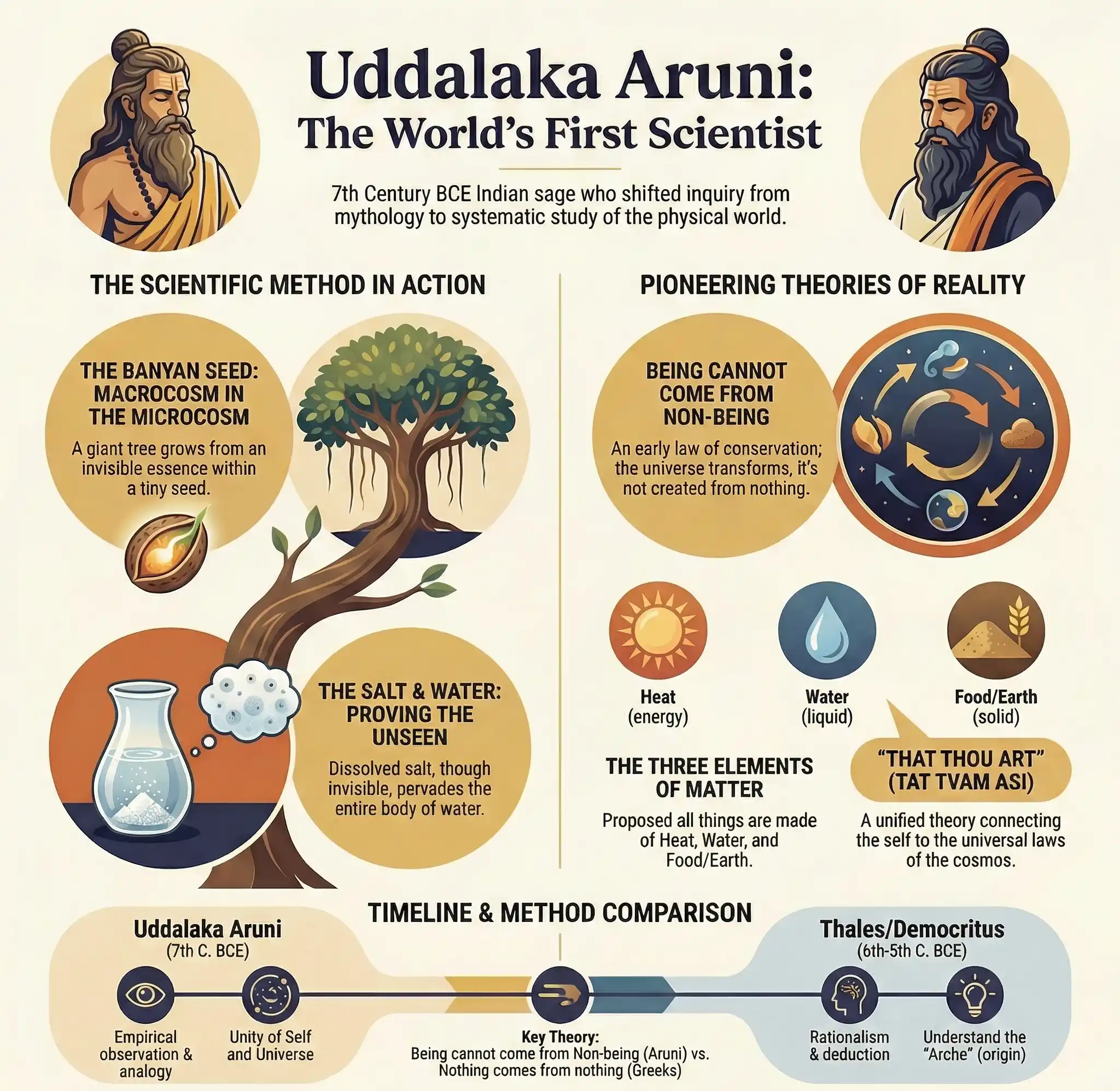
Uddalaka begins with a lump of clay. Know this one lump, he says, and you know everything made of clay. The pot, the dish, the jar are names and turns of speech. What is real in all of them is the clay.
He does it again with copper and with iron. The method is established before the content: reason from the thing in your hand to the thing you cannot see.
The seed
Then he sends the boy out for fruit from the banyan tree.
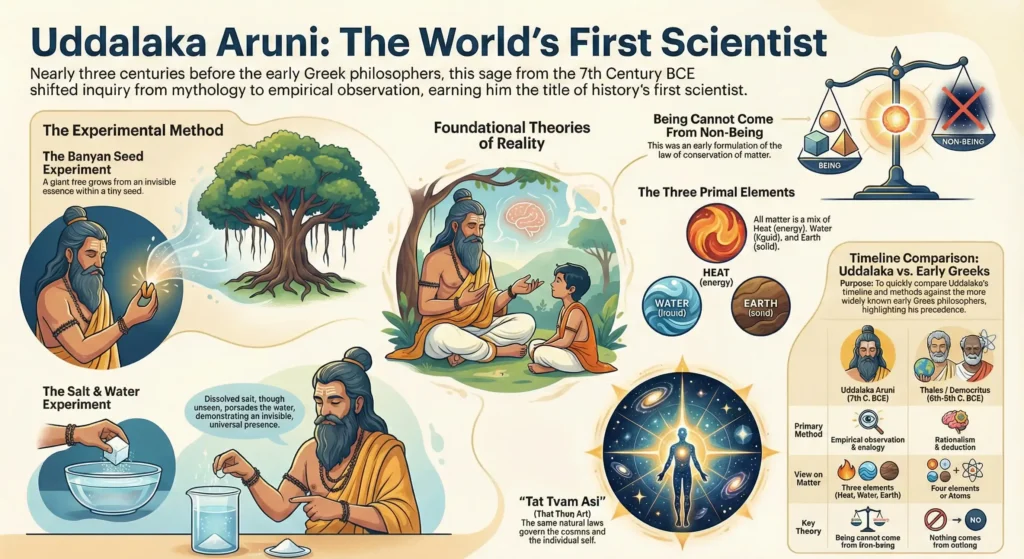
Break it open. What do you see? Seeds, tiny ones. Break one of those. What do you see now? Nothing at all, the son says. From that nothing you cannot see, his father tells him, this whole great tree has come up.
The third is the one everybody remembers. Put this lump of salt in water, he says, and come back to me in the morning.
The boy does. In the morning his father tells him to fetch the salt. He cannot. It has gone.
Taste the water at this edge. Salt. At the middle. Salt. At the far side. Salt. Throw it away and come and sit down.
A thing you cannot see is not therefore absent, and a thing you cannot locate is not therefore nowhere. That was demonstrated with a cup of water and an overnight wait.
That you are
After each demonstration comes the same sentence. The finest essence here is the self of all this, and that is the truth, and that is the self, and that you are, Shvetaketu.
Tat tvam asi. It comes nine times in the chapter, once after each lesson, which is how a good teacher does it and not how a mystic does it. The claim is not dropped from the sky. It is argued from clay and seeds and salt water, in that order, and repeated until it holds.
Indian philosophy then spent about two thousand years fighting over how to read those three words. Shankara took them as a plain statement of identity, Ramanuja as a qualified relation, Madhva as something else again, and which way a school read that sentence is very largely what made it a separate school.
The man from Gandhara
There is one more image in the chapter, and it is the least abstract thing in it. A man is taken from Gandhara blindfolded and abandoned in open country. He gets the blindfold off and then asks his way, village by village, from anyone he meets, until he comes home.
That is the whole epistemology of the chapter in a sentence. You do not arrive by being told. You arrive by asking at every stage, from wherever you happen to have been dumped.
The man himself
Uddalaka Aruni belongs to the Kuru-Panchala country, somewhere around the seventh century BC, and he turns up across the early literature, in the Brihadaranyaka Upanishad and in the Shatapatha Brahmana, as a formidable figure who travels to argue.
The same literature also records him being comprehensively beaten in debate at the court of King Janaka by Yajnavalkya, who had been his own student. That defeat was kept in the record alongside his triumphs, by people who could easily have left it out.
Was he a scientist
Some historians of Indian science have claimed him as one, and the salt, the seed and the observation that the mind fails when the body is not fed are the usual evidence. He also held that everything is made of three basic constituents in combination, which is a theory of matter of a sort.
The honest answer is that he was not testing a hypothesis he might have abandoned. He knew his conclusion before he sent the boy for the water, and the demonstrations are teaching devices for a metaphysical claim.
But the instinct underneath them is worth naming. Go and look. Come back and tell me what you found. Now reason from it to the thing you cannot look at.
A father took his clever son into the kitchen because the boy had learned everything except how to find out.
If you think you have remembered everything about this topic take this QUIZ
Results
QUIZ START
#1. Who is described in the text as the “First Scientist in History,” living nearly three centuries before the Greek philosophers?
Previous
Next
#2. What profound physical truth did Uddalaka demonstrate to his son using the “nothingness” inside a Banyan seed?
Previous
Next
#3. Which question did Uddalaka famously ask to argue against the idea that the world was created from nothing?
Previous
Next
#4. According to Uddalaka, what three essential elements constitute all physical objects?
Previous
Next
#5. What was the purpose of the experiment where Shvetaketu was asked to find dissolved salt in water?
Previous
Next
#6. What is the meaning of the famous phrase “Tat Tvam Asi” taught by Uddalaka?
Previous
Next
#7. Uddalaka proposed that the human mind is formed from which biological source?
Previous
Next
#8. Unlike the rationalism and deduction of early Greek philosophers like Thales, what was Uddalaka Aruni’s primary method?
Previous
Finish
Why is Uddalaka Aruni called the First Scientist in History?
He is called the first scientist because he moved away from mythological explanations and used observation, logic, and experiments to explain the nature of matter and existence.
It means “That Thou Art.” It is a teaching that suggests the individual self is identical to the ultimate, subtle essence of the universe.
Which Upanishad contains his teachings?
Most of his famous teachings, including the dialogue with his son Shvetaketu, are found in the Chandogya Upanishad.
Did Uddalaka Aruni believe in atoms?
While the word “atom” is Greek, Uddalaka described the “subtle essence” of matter that is invisible to the eye but forms the basis of all physical objects, which is a precursor to atomic theory.
What was his view on the mind?
He had a surprisingly physical view of the mind, teaching that it was formed from the subtle essence of the food we consume, effectively linking biology with psychology.
Sources & References
Chandogya Upanishad, book 6, translated by Patrick Olivelle (Oxford World’s Classics, 1996) — the exchange with Shvetaketu, the demonstrations and the nine repetitions.
Patrick Olivelle, The Early Upanisads: Annotated Text and Translation (Oxford University Press, 1998) — the dating of the text and Uddalaka’s appearances across the early literature.
Shatapatha Brahmana, translated by Julius Eggeling (Sacred Books of the East) — Uddalaka Aruni outside the Upanishads and his debates. Debiprasad Chattopadhyaya, History of Science and Technology in Ancient India — the case for reading his demonstrations as early natural philosophy.
Exploring the Soul of Bharat through History, Science, Culture, and its Diversity
Our Mission
Curious Indian is a definitive knowledge portal dedicated to chronicling the events, personalities, and cultural shifts that defined the Indian subcontinent. From the ancient Vedic Period to the complexities of 21st-century politics, our goal is to provide deep-dive analysis that inspires.
Editorial Standards & E-E-A-T
Every article published under our brand undergoes a rigorous fact-checking process. We prioritize primary historical records, academic citations, and credible archives to ensure our readers receive accurate, high-authority information.
Historical IntegrityDirectly sourcing from ASI archives and academic journals.
Topical AuthorityComprehensive clustering of Indian Science, Biographies, and Wars.
Managed by Paripurna Datta and TEAM | Dedicated to the Knowledge of India.