His most valuable book contains nothing he thought of himself, and saved five competing astronomies
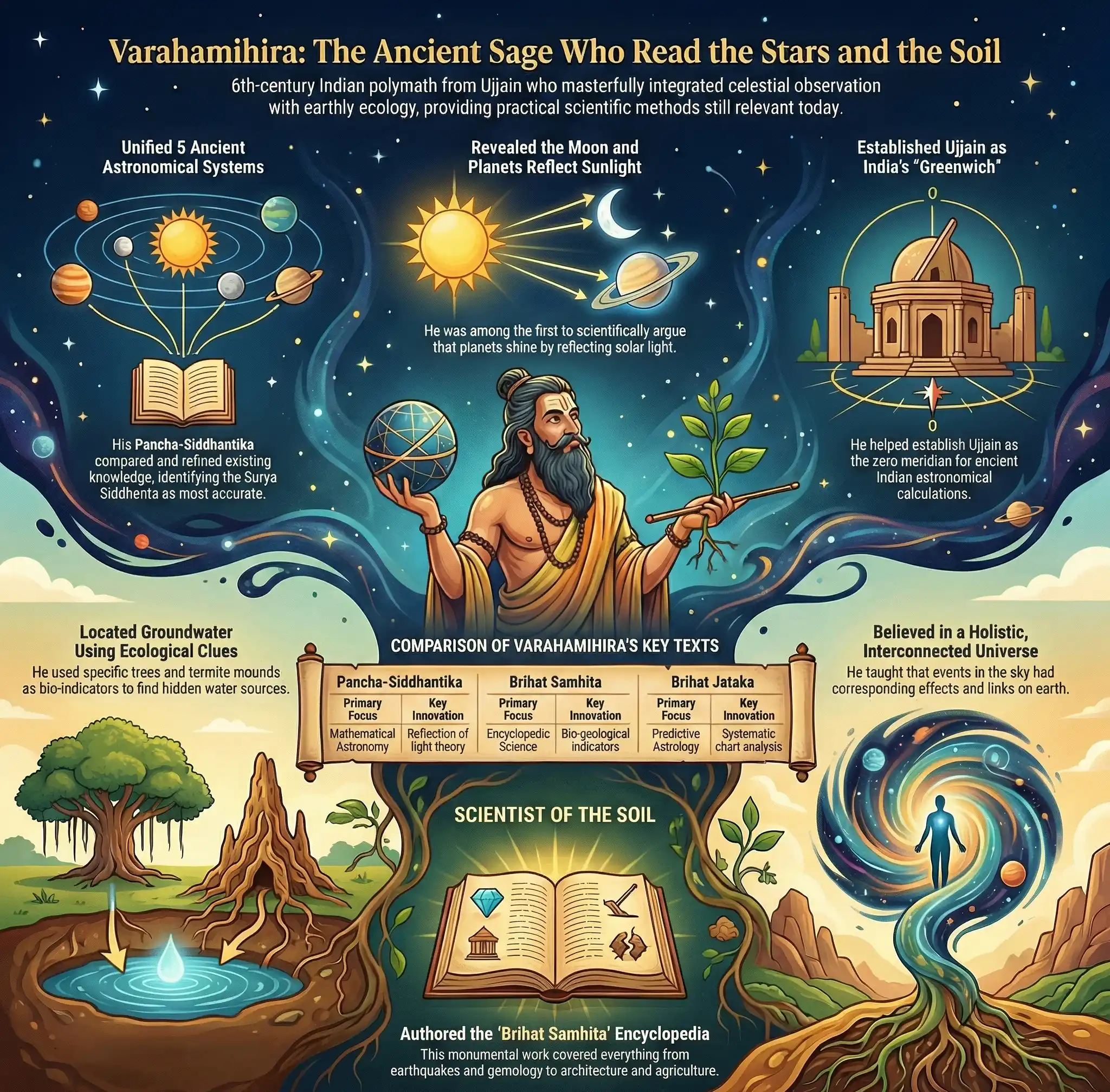
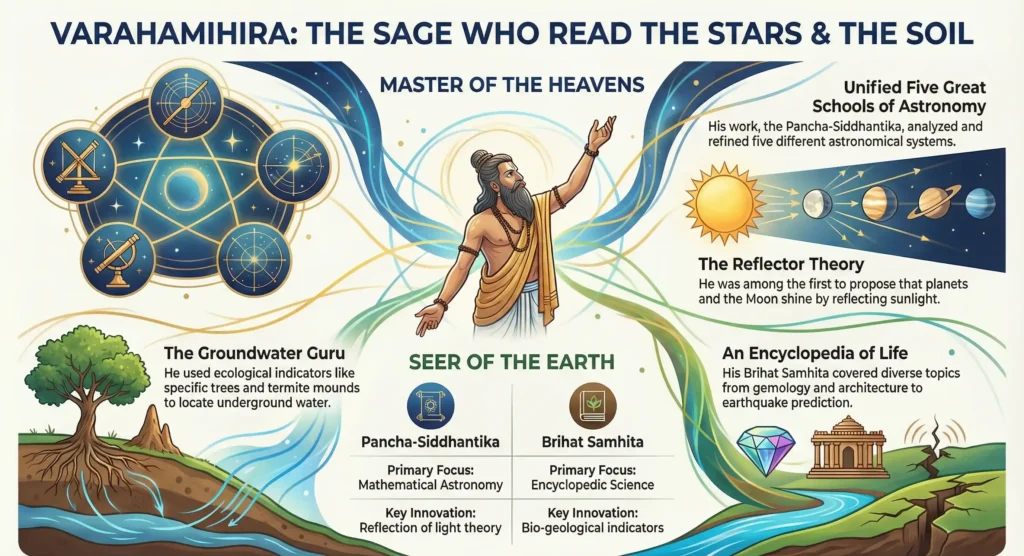
Around 575, at Ujjain, Varahamihira compiled the Pancha-siddhantika, which means the five treatises. In it he sets out, side by side, the methods of five rival systems of astronomical calculation, with their procedures, their constants and their disagreements, and his own assessment of which was the most accurate.
Three of the five have not survived in any other form. What we know of them, we know because he wrote them down while arguing with them.
A scholar’s instinct is to press his own system. He recorded everybody’s, including the ones he thought were wrong.
Rome, in Sanskrit
Two of the five carry their origins in their names. The Romaka Siddhanta is named for Rum, the Roman east. The Paulisa Siddhanta appears to draw on Alexandrian material.
The traffic shows up in the vocabulary as well. Indian astronomical Sanskrit of this period carries loan words for the hour, the degree, the minute and the signs of the zodiac that came in from Greek. Ujjain and Alexandria were connected by trade, and ideas moved along the same routes as pepper.
8 Defining Chapters in the Vikram Sarabhai Biography
The verse everyone quotes
There is a line of Varahamihira’s that circulates online as a model of intellectual generosity: that the Greeks are foreigners, but because the science is established among them they must be honoured like sages.
The verse is real and it is worth reading to the end. It says the Yavanas are mlecchas, that this science is established among them, that they are therefore revered like sages, and then it asks: how much more, then, should a brahmin who knows this science be revered?
It is an argument about the standing of astrologers at court, and the concession to foreign competence is the premise rather than the conclusion. Scholars also disagree about whether Yavana here means Greeks specifically or foreigners more loosely.
He did credit the outsiders. He was also using them to argue for his own fee, and the tidied-up version of the quotation loses both halves of that.
The book that will not be sorted
His other great work, the Brihat Samhita, is an encyclopedia and it is where a modern reader gets uncomfortable.
It covers planetary motion and eclipses. It also covers cloud formation and the prediction of rainfall, earthquakes, town planning, temple architecture, the carving of images, gemstones, the grafting of trees, agriculture, perfumery, and the reading of omens from the behaviour of animals.
There is no line in it between the parts we would call science and the parts we would call superstition, because for him no such line existed. The planets and the flight of birds were both information about what was coming.
He also rated the five systems against each other rather than deferring to seniority, and judged the Surya Siddhanta the most accurate of them, which is the judgement of a man checking the numbers rather than the lineage.
7 Untold Stories of Battle of Asal Uttar 1965 Victory
Finding water
One chapter is about locating groundwater, and it is pure fieldcraft. It tells you which plants grow above water, what a particular kind of termite mound near a particular tree indicates, how the colour and taste of the soil at depth should change, how far down to expect to strike.
It is the oldest sustained piece of hydrology in Indian writing, and it reads like a manual written by somebody who had stood over a lot of holes in the ground.
A hydrogeologist reading it today finds a body of accumulated observation that mostly works. It sits in the same volume as the omens, in the same voice, offered with the same confidence.
The mathematics
He sharpened Aryabhata’s sine table and left trigonometric identities that are still cited under his name.
In the chapter on perfume he needed to work out how many mixtures can be made from sixteen ingredients taken four at a time, and he gave a method for generating the numbers that is a version of the array Europe later called Pascal’s triangle. The earliest known four-by-four magic square is also his.
The binomial coefficients arrive in Indian mathematics in a chapter about scent.
7 Secrets of Padmanabhaswamy Temple Treasure
The man
He was born in 505 in Avanti, in what is now Madhya Pradesh, the son of Adityadasa, and was educated at a place he calls Kapitthaka. He worked at Ujjain and died in 587.
Tradition makes him one of the nine jewels of Vikramaditya’s court, which first appears in a much later source and which scholars do not accept. Four centuries after his death al-Biruni was reading him closely and quoting him, which is a better measure of his standing than the legend.
His achievement was custodial. He is the reason we still have what other people worked out.
6 Unfoldings in the Subrahmanyan Chandrasekhar Biography
If you think you have remembered everything about this topic take this QUIZ
Results


#1. In which ancient Indian city, known as the ‘zero meridian’ of its time, did Varahamihira conduct his astronomical research?
#2. What groundbreaking astronomical theory did Varahamihira propose regarding the light of the Moon and other planets?
#3. Varahamihira’s ‘ecological indicators’ for finding groundwater involved observing which of the following?
#4. In his work ‘Pancha-Siddhantika’, which system did Varahamihira identify as the most accurate among the five he analyzed?
#5. Which of Varahamihira’s works is considered a massive encyclopedia of ancient Indian science, covering subjects from gemology to temple architecture?
#6. According to the ‘Quick Comparison’ table, what was the primary focus of the ‘Brihat Jataka’?
#7. Varahamihira is traditionally associated with the court of which legendary Indian King as one of his ‘Nine Gems’ (Navaratnas)?
What is the most famous discovery of Varahamihira?
While he made many, his most famous contribution is the Brihat Samhita, where he documented how to find groundwater using ecological signs and the theory that planets reflect sunlight.
How did Varahamihira Astronomy influence the world?
His work was translated into multiple languages and formed the basis for later astronomical developments in the Islamic world and eventually the West.
Did Varahamihira believe in astrology?
Yes, but his version of astrology was deeply tied to astronomy and seasonal cycles, looking at how cosmic events physically influenced the Earth’s environment.
What is the Pancha-Siddhantika?
It is a summary of five ancient Indian astronomical systems, which Varahamihira used to determine the most accurate methods for calculating time and planetary movements.
How relevant is his water-finding technique today?
Very relevant. Modern researchers in India still study his “Vrikshayurveda” (the science of plant life) to develop low-cost, ecological methods for locating water in drought-prone regions.
Read More: https://curiousindian.in/nagarjuna-c-150-250-ce/
Sources & References
MacTutor History of Mathematics Archive, University of St Andrews (“Varahamihira”) — his dates, the five systems of the Pancha-siddhantika and his trigonometric work.
The Panchasiddhantika, edited and translated by G. Thibaut and Sudhakara Dvivedi (1889) — the text of the five systems and his comparison of their accuracy.
Brihat Samhita, translated by M. Ramakrishna Bhat (Motilal Banarsidass, 1981) — the encyclopedia’s contents, the verse on the Yavanas and the chapter on locating groundwater.
David Pingree, Jyotihsastra: Astral and Mathematical Literature — the transmission of Greek astronomical material into Sanskrit and the identity of the Paulisa and Romaka texts.
Author


Exploring the Soul of Bharat through History, Science, Culture, and its Diversity
Our Mission
Curious Indian is a definitive knowledge portal dedicated to chronicling the events, personalities, and cultural shifts that defined the Indian subcontinent. From the ancient Vedic Period to the complexities of 21st-century politics, our goal is to provide deep-dive analysis that inspires.
Editorial Standards & E-E-A-T
Every article published under our brand undergoes a rigorous fact-checking process. We prioritize primary historical records, academic citations, and credible archives to ensure our readers receive accurate, high-authority information.
Historical Integrity Directly sourcing from ASI archives and academic journals.Topical Authority Comprehensive clustering of Indian Science, Biographies, and Wars.Managed by Paripurna Datta and TEAM | Dedicated to the Knowledge of India.