Madhubala is remembered for her face and her heart. The harder fact is how little of her own life she was allowed to run
In 1957 one of the biggest film stars in India was the subject of a breach of contract suit in a Bombay court, and the case was not really about a contract.
B.R. Chopra wanted Madhubala in Bhopal for the outdoor shoot of Naya Daur. Her father, who managed her, refused to let her go. Chopra sued. The film’s leading man, Dilip Kumar, gave evidence in support of the producer, against the woman he was in a relationship with and had talked about marrying.
Three men argued in public about where she was going to be sent to work. She was the least powerful person in the room, and she was the only one whose name was on the poster.
Who ran her
Her father had run everything since she was a child, and he had reasons.
The family lost what it had and came to Bombay with nothing. She started acting at about nine, as Baby Mumtaz, and by her teens she was carrying a large household on her earnings. Ataullah Khan handled the contracts, the fees and the bookings, decided which films she took, and kept her away from what he did not like the look of.
By her twenties she was among the highest paid people in the industry and had very little access to the money. The fees went to the family, and the decisions about what she would do next were taken in a room she was not always in.
There is a version of this where he is simply the villain, and it does not hold up. She was in fact seriously ill, and travelling to a location shoot was genuinely a risk. He may well have been right. It still was not her call.
10 Remarkable Facts About Meghnad Saha Life and Achievements
The case
The proceedings were public and the industry watched all of it.
She was replaced in Naya Daur by Vyjayanthimala. The film opened in August 1957 and was a considerable hit, after which Chopra withdrew the suit, so the legal question was never really settled. What had been settled was everything else.
Her sister has said since that Madhubala asked Dilip Kumar to apologise to her father, and that he would not do it. By the accounts that have come down, he had also told the court that he loved her. Both things can be true and it did not help her.
The hole in her heart
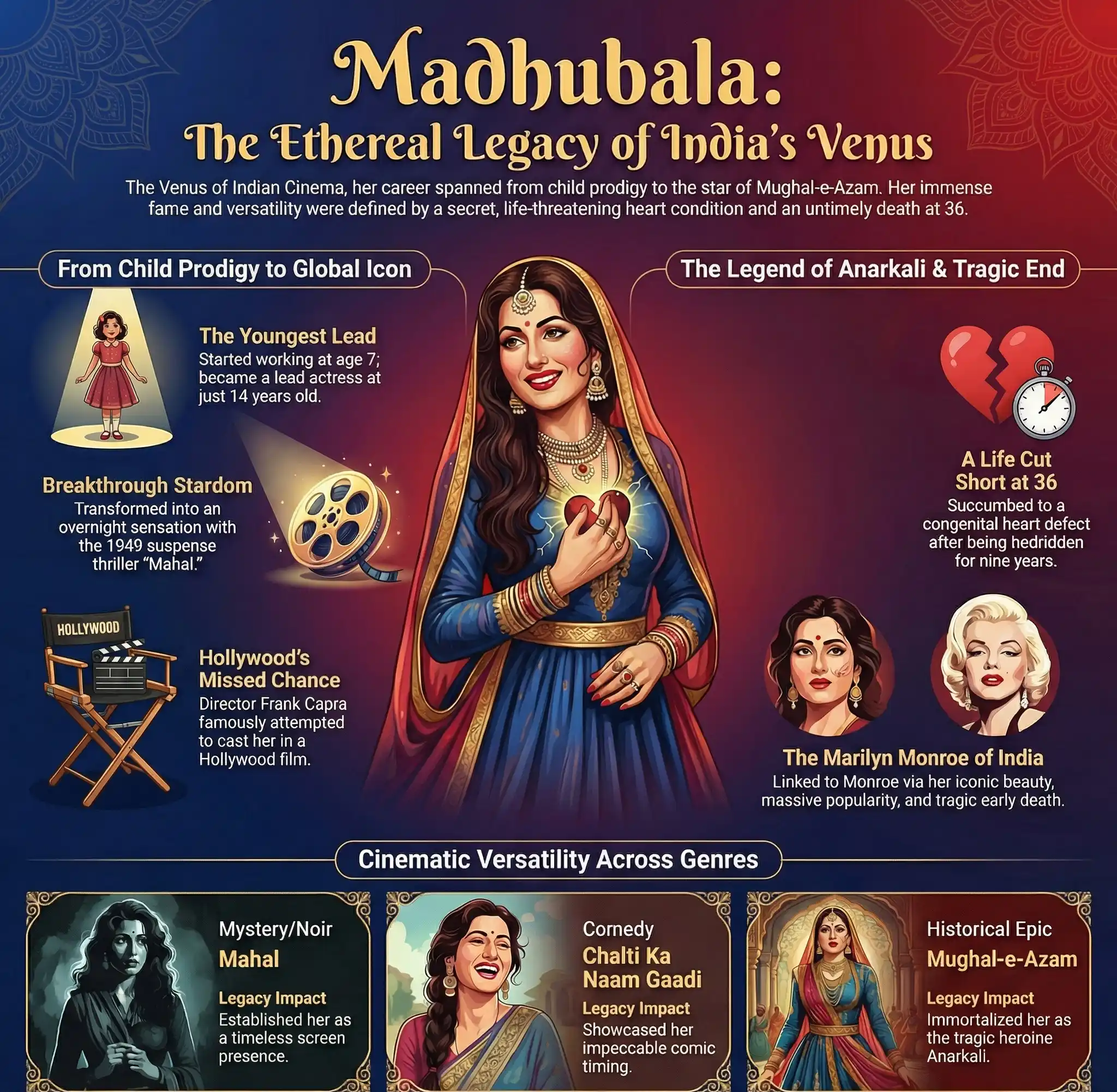
She had been diagnosed in 1954 with a ventricular septal defect, a hole between the chambers of the heart.
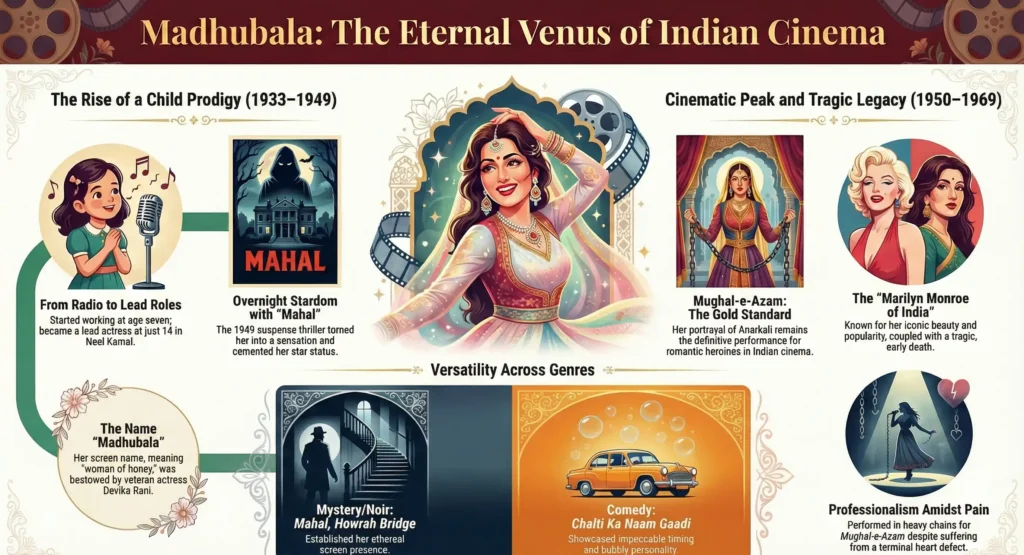
She kept working, because the household was still living on what she earned. Mughal-e-Azam took nine years to finish and she was ill for most of them. The chains in the prison sequence were real ones, and she was in them, unwell, for a film that would be released in 1960 and become the largest thing Hindi cinema had ever done.
K. Asif had begun the film before Partition and lost his financing and half his cast to it. By the time it was finished the industry had changed around it, and so had she.
She was taken to London that same year and told there was nothing to be done for her. She was twenty-seven.
6 Unfoldings in the Subrahmanyan Chandrasekhar Biography
Nine years
She married Kishore Kumar in 1960 and the marriage did not go well.
After that she was mostly at home, and increasingly in bed. She tried to direct a film of her own, which was never finished. The face that had been on every hoarding in the country was seen by almost nobody for the last stretch of her life.
Chalti Ka Naam Gaadi, Mr and Mrs 55, Howrah Bridge, Mughal-e-Azam. The comic timing in those films is the thing serious people keep rediscovering, and it was there the whole time.
23 February 1969
She died at thirty-six, in February 1969, having been out of public view for most of the decade.
The standard telling calls her a tragic figure and means her beauty and her heart, which is an oddly passive way to describe someone who worked continuously from the age of nine.
The documented tragedy is duller and worse. A father who took the decisions, a producer who went to court, a man who testified for the producer, and a body that gave out early. In a working life of nearly thirty years, almost nobody let her choose anything.
Dr. A.P.J. Abdul Kalam: (1931-2015)
If you think you have remembered everything about this topic take this QUIZ
Results


#1. What was Madhubala’s real birth name?
#2. Madhubala suffered from which congenital medical condition that led to her early death?
#3. Which veteran actress gave her the screen name “Madhubala” (meaning woman of honey)?
#4. Which 1949 suspense thriller turned Madhubala into an overnight sensation with the hit song “Aayega Aanewala”?
#5. Which famous American director reportedly wanted to cast Madhubala in a Hollywood film?
#6. Madhubala married which legendary singer in 1960?
#7. Which magnum opus film is considered Madhubala’s crowning glory, where she played the character Anarkali?
#8. Madhubala is often compared to which American icon due to her beauty, popularity, and tragic early death?
What was Madhubala’s real name?
Her birth name was Mumtaz Jehan Begum Dehlavi.
What disease did Madhubala suffer from?
She suffered from a congenital heart defect known as a Ventricular Septal Defect (a hole in the heart), which was incurable at the time.
Who was Madhubala married to?
She was married to the legendary playback singer and actor Kishore Kumar.
Which is Madhubala’s most famous film?
Her most iconic film is the historical epic Mughal-e-Azam (1960), where she played the role of Anarkali.
Did Madhubala work in Hollywood?
No, although American director Frank Capra expressed interest in casting her, her father did not allow her to pursue a career in Hollywood.
Sources & References
Khatija Akbar, Madhubala: Her Life, Her Films (1997) — the standard biography, including the Naya Daur litigation.
Mohan Deep, The Mystery and Mystique of Madhubala (1996) — her working conditions, her illness and her family’s control of her career.
Encyclopaedia Britannica (“Mughal-e-Azam”) — the nine-year production and the film’s release in 1960.
Interviews with her sister Madhur Bhushan — the family’s account of the court case and what followed it.
Author


Exploring the Soul of Bharat through History, Science, Culture, and its Diversity
Our Mission
Curious Indian is a definitive knowledge portal dedicated to chronicling the events, personalities, and cultural shifts that defined the Indian subcontinent. From the ancient Vedic Period to the complexities of 21st-century politics, our goal is to provide deep-dive analysis that inspires.
Editorial Standards & E-E-A-T
Every article published under our brand undergoes a rigorous fact-checking process. We prioritize primary historical records, academic citations, and credible archives to ensure our readers receive accurate, high-authority information.
Historical Integrity Directly sourcing from ASI archives and academic journals.Topical Authority Comprehensive clustering of Indian Science, Biographies, and Wars.Managed by Paripurna Datta and TEAM | Dedicated to the Knowledge of India.