How Mohammed Yusuf Khan of Peshawar spent seventy-eight years as Dilip Kumar of Bombay
Sometime in 1943, a shy young man from Peshawar walked into Bombay Talkies looking for work and walked out with a different name.
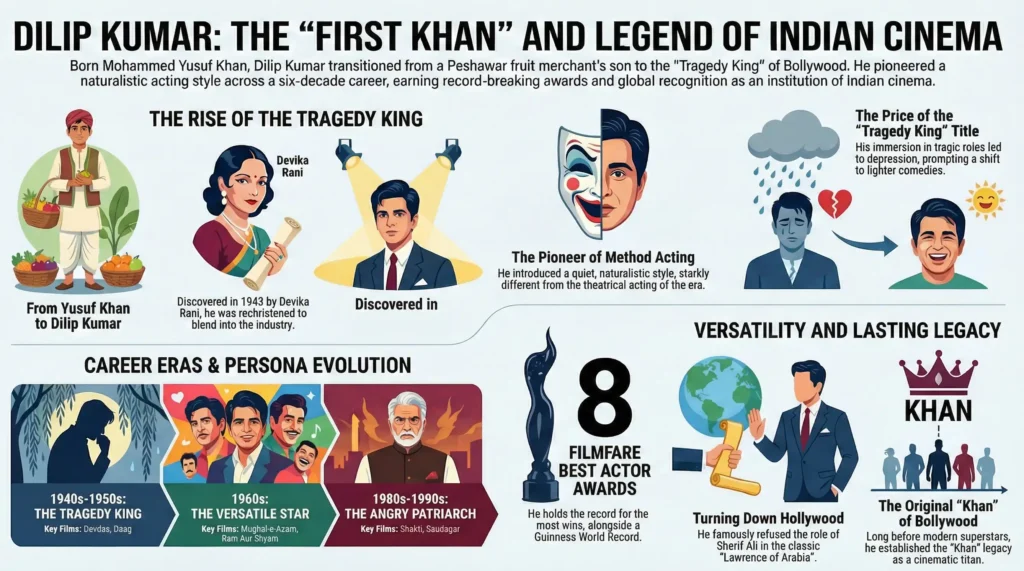
He was Mohammed Yusuf Khan, twenty years old, one of twelve children of a fruit merchant from Qissa Khwani Bazaar. Devika Rani, who ran the studio, thought he had the face and the Urdu for pictures. She also thought he needed something else to be called. He went home that day as Dilip Kumar, and he answered to it for the next seventy-eight years.
Almost everything that happened to him afterwards can be read through that exchange.
8 Defining Chapters in the Vikram Sarabhai Biography
Why the name changed
The reasons given for the new name differ depending on who is telling it.
Devika Rani is said to have found it more romantic, and better suited to an audience that would have to take him to heart. Others have written that a Muslim name was thought a liability for a leading man. He gave a quieter reason himself. His father disapproved of the film business, and a screen name kept the family out of it.
All three explanations may be true at once. What is certain is that a young man from the Frontier understood, in 1943, that he would get further under a name that was not his.
7 Secrets of Padmanabhaswamy Temple Treasure
Four years later
In 1947 the country split, and the arithmetic of that decision changed completely.
His family had already left Peshawar for Bombay in the 1930s, after his father’s business went badly. But Peshawar was now in another country. Millions of people were making the choice he had effectively made a decade earlier, and making it in far worse conditions.
He stayed in Bombay. He kept the name. And a screen name chosen for the sound of it in 1943 became, after 1947, something a man could be asked to account for.
The Tragedy King
What he did with the name was invent a way of acting.
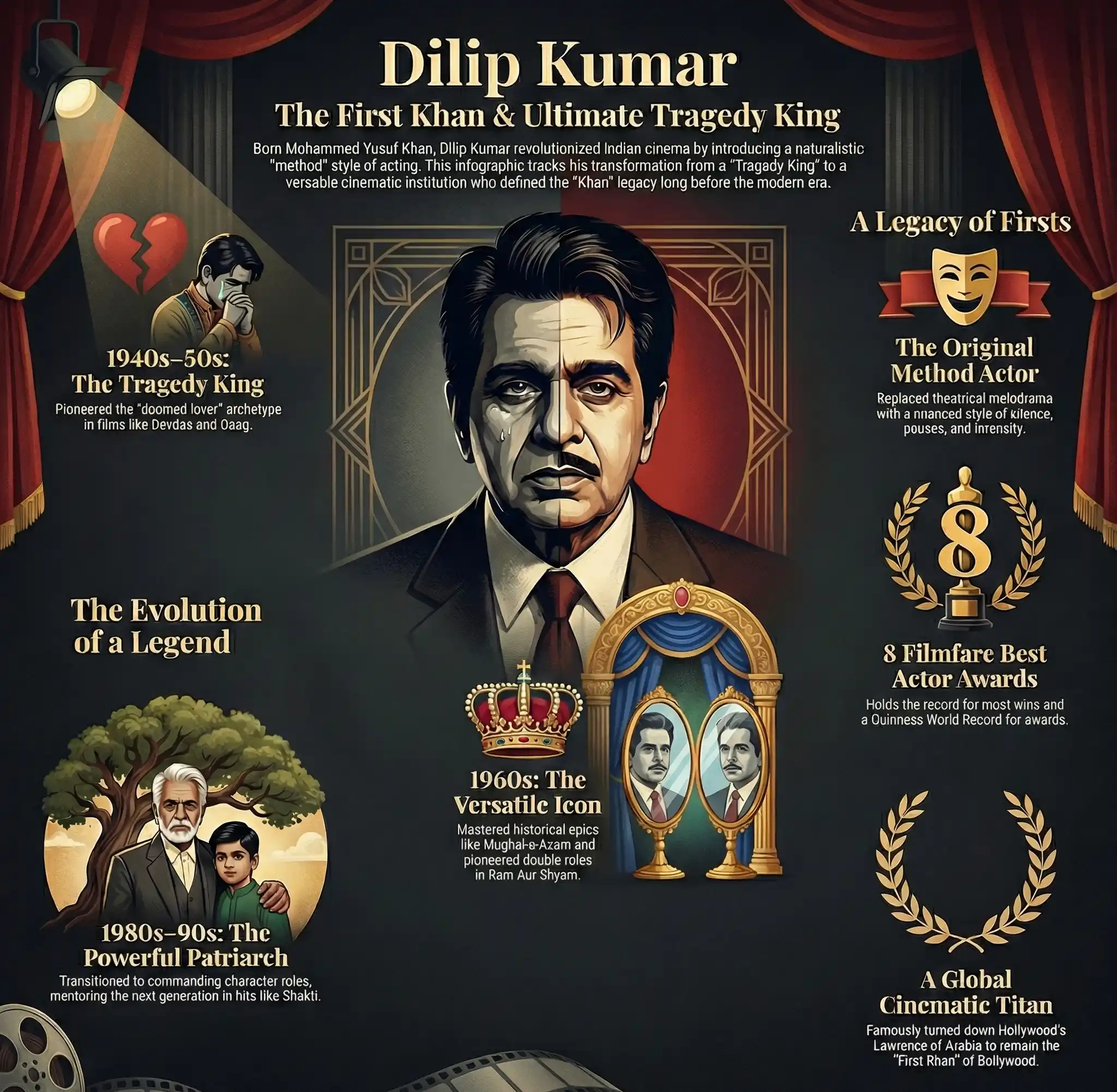
Against a Hindi cinema built on volume and gesture, he worked quietly, in pauses and half-glances, and it made him the biggest star in the country. Devdas, Deedar, Daag, Andaz. He played men who lost the thing they wanted, over and over, until India called him the Tragedy King.
Satyajit Ray called him the ultimate method actor. He won eight Filmfare awards for best actor, a record that stood for decades.
It cost him. He went so far into the sadness of those parts that he came out of them depressed, and a doctor in London eventually told him to stop and do something light. He obeyed the prescription, made Azaad and Kohinoor, and was very funny in both.
6 Unfoldings in the Subrahmanyan Chandrasekhar Biography
1998
Fifty-five years after he was renamed, Pakistan gave him the Nishan-e-Imtiaz, its highest civilian honour. He remains the only Indian actor to receive it.
The following year came Kargil. Bal Thackeray, the Shiv Sena chief and a friend of some thirty years, demanded he give the award back. Party workers gathered outside his house in Bandra. He was told, in public, that if he would not return it he should go and live in Pakistan.
He wrote to Atal Bihari Vajpayee, and said in the letter that if returning the honour served the country he would do it gladly. Vajpayee told him the decision was his alone and that his patriotism was not in question.
He kept the award. In an interview afterwards he called the demand an “abominable pronouncement,” and asked what work he had done for the poor, or for peace between the two countries, that had anything to do with a war in Kashmir.
The house in Mohalla Khudadad
He died in Bombay on 7 July 2021, aged 98, and was buried as Yusuf Khan.
The house he was born in is still standing in Peshawar, just about. Pakistan declared it national heritage in 2014 and announced it would become a museum. Ownership disputes held the work up for years. In 2021 the provincial government approved the money to buy it and began clearing the debris.
By May 2026, after heavy rain and an earthquake in April, heritage campaigners in Peshawar were warning that the building may not survive. Roofs in several rooms have come down. The walls lose a little more with each monsoon.
Two countries gave him their highest honours. Neither of them managed to keep the roof on the room he was born in.
10 Remarkable Facts About Meghnad Saha Life and Achievements
If you think you have remembered everything about this topic take this QUIZ
Results


#1. What was Dilip Kumar’s real birth name?
#2. In which city was Dilip Kumar born?
#3. Which film marked Dilip Kumar’s acting debut in 1944?
#4. Dilip Kumar is popularly known by which title in Indian cinema?
#5. Which iconic Hollywood film role did Dilip Kumar turn down, which later went to Omar Sharif?
#6. Which actress did Dilip Kumar marry in 1966?
#7. In 1998, Dilip Kumar was awarded which highest civilian honor by Pakistan?
#8. Dilip Kumar played the rebellious Prince Salim in which historical magnum opus?
What was Dilip Kumar’s real name?
His birth name was Mohammed Yusuf Khan.
Why was Dilip Kumar called the Tragedy King?
He earned this title for his realistic and heart-wrenching portrayal of tragic heroes in films like Devdas and Deedar.
Who was Dilip Kumar’s wife?
He was married to actress Saira Banu from 1966 until his death in 2021.
Did Dilip Kumar work in Hollywood?
No, he notably refused a role in the Hollywood classic Lawrence of Arabia.
How many Filmfare Awards did Dilip Kumar win?
He won 8 Filmfare Awards for Best Actor, a record he shares with Shah Rukh Khan.
Sources & References
Encyclopaedia Britannica (“Dilip Kumar”) — his birth in Peshawar, the Bombay Talkies years and the arc of his screen career.
Dilip Kumar with Udayatara Nayar, The Substance and the Shadow (2014) — the screen name, the depression, and the letter to Vajpayee.
Directorate of Archaeology and Museums, Khyber Pakhtunkhwa — the heritage status and condition of the house in Mohalla Khudadad, Peshawar.
Directorate of Film Festivals, Government of India — the Dadasaheb Phalke Award of 1994.
Author


Exploring the Soul of Bharat through History, Science, Culture, and its Diversity
Our Mission
Curious Indian is a definitive knowledge portal dedicated to chronicling the events, personalities, and cultural shifts that defined the Indian subcontinent. From the ancient Vedic Period to the complexities of 21st-century politics, our goal is to provide deep-dive analysis that inspires.
Editorial Standards & E-E-A-T
Every article published under our brand undergoes a rigorous fact-checking process. We prioritize primary historical records, academic citations, and credible archives to ensure our readers receive accurate, high-authority information.
Historical Integrity Directly sourcing from ASI archives and academic journals.Topical Authority Comprehensive clustering of Indian Science, Biographies, and Wars.Managed by Paripurna Datta and TEAM | Dedicated to the Knowledge of India.