How a smaller, quieter empire gave the world the zero, a spinning Earth, and a golden age of ideas
India’s first great empire, the Mauryas, is remembered above all for its sheer power: the biggest empire, the mightiest army, and the most organised government the land had ever seen. About five hundred years later, a second great empire arose, the Guptas, and it too is remembered as a golden age. But it was a completely different kind of gold.
The Gupta empire was smaller and looser than the Mauryan one, and it conquered a great deal less. What made it golden was not the size of its empire at all, but the sheer brilliance of its mind. This was the age when India thought most beautifully, and gave the world gifts that it is still using every single day. And chief among all those gifts was one small, world-changing idea: nothing. The number zero.
A quieter kind of empire
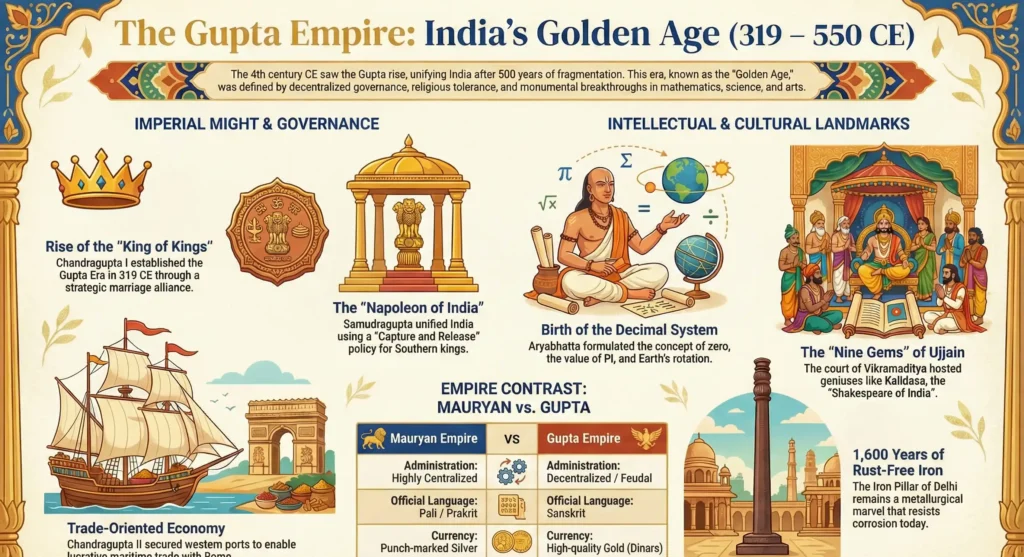
The Guptas rose to power in northern India around the year 320 CE. Their most famous warrior-king, Samudragupta, was such a triumphant conqueror that later historians nicknamed him “the Napoleon of India.”
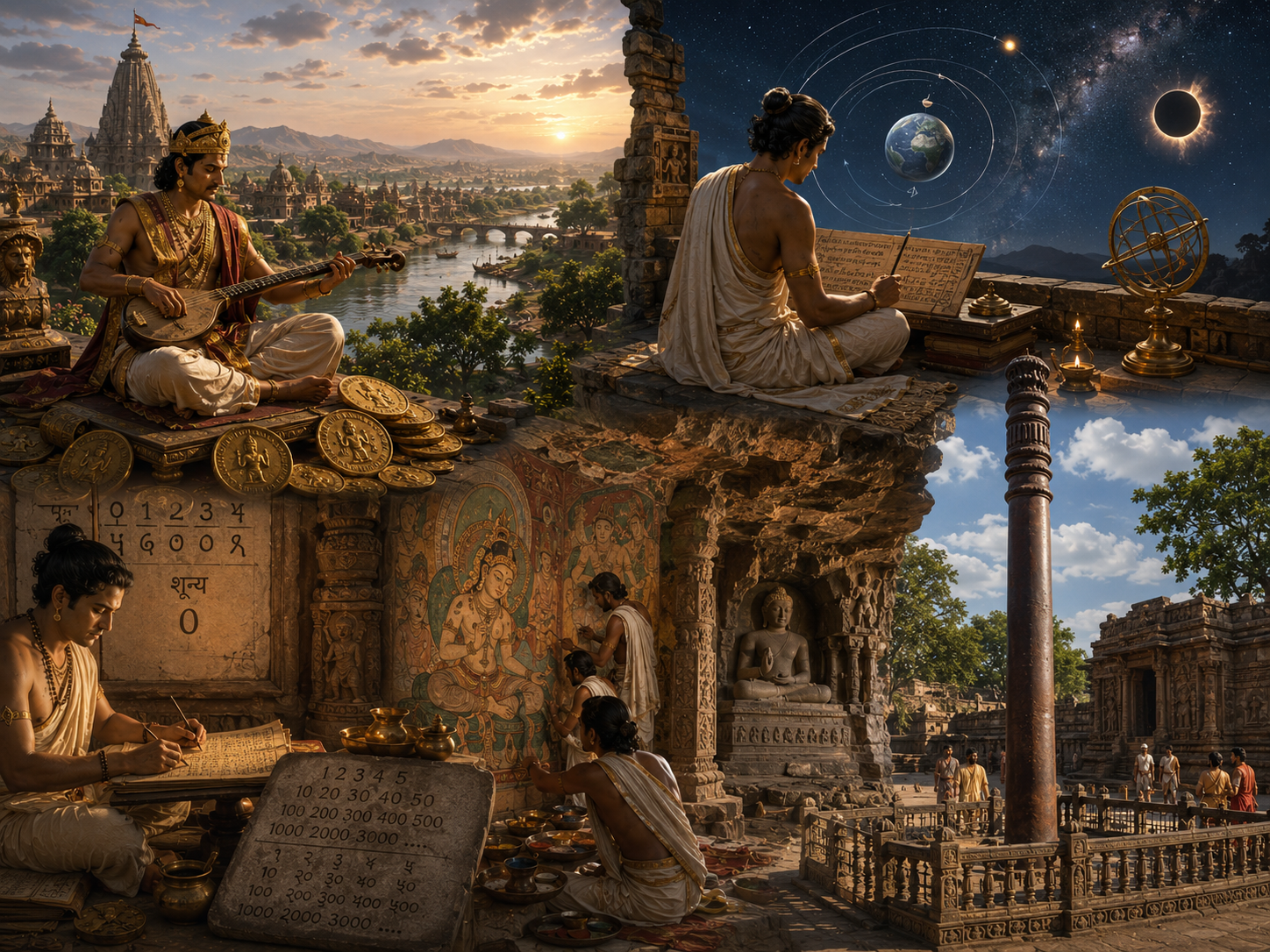
And yet there is a telling detail about him. On his own gold coins, this mighty conqueror chose to have himself shown not brandishing a sword, but sitting quietly and peacefully, playing a stringed musical instrument.
The great Gupta warrior-king was nicknamed “the Napoleon of India.” Yet on his own coins, he chose to be shown not with a sword, but playing music.
That one small choice tells you a great deal about this empire, which prized its artists every bit as much as its soldiers. Under Samudragupta’s son, Chandragupta the Second, the empire reached its shining peak. A Chinese traveller named Faxian, who journeyed right across India in those years, wrote home about what he found there: a prosperous, peaceful, well-run land, where people lived happily and were largely free to follow their own ways. It was stable and calm and rich enough for something truly wonderful to happen. It was peaceful enough for its people to sit down and think.
Reign of Harshavardhana: The Empire of Benevolence
Nothing, and everything
And here is the very greatest gift of all that thinking, a thing so completely ordinary to us today that we have quite forgotten how astonishing it really is. It was in this age that India gave the world the number zero, and, along with it, the simple and brilliant way of counting that every one of us still uses.
Stop and think about it for a moment. Before the zero, counting was clumsy and awkward, and large numbers were an absolute nightmare to write down. The Indian breakthrough was to create a symbol for “nothing” at all, and then to let the position of each digit change its value, so that just a handful of symbols could be used to build any number in the whole world, no matter how enormous.
In this age, India gave the world the number zero and the way of counting we all still use. Every calculation on every phone and every computer on earth still rests on that one ancient Indian idea.
This is the decimal system, the ones and the tens and the hundreds and the thousands, and it is so powerful and so simple that it swept clean across the entire earth. The numbers on your phone, the sums in every school, the code inside every computer that ever launched a rocket or ran the internet: all of it rests, in the end, on that ancient Indian idea of nothing. It may well be the single most useful thing that India has ever given to the world.
The man who said the Earth spins
The zero was only the beginning. In the year 476, a boy was born who would grow up to become one of the greatest scientific minds of the whole ancient world. His name was Aryabhata, and while he was still only in his twenties, he wrote a book that changed the way human beings understood the sky above them.
In an age when very nearly everyone believed that the Sun and the stars wheeled around a still and flat Earth, Aryabhata calmly worked out the actual truth of the matter.
Fifteen hundred years ago, while the world believed the sky spun around a flat Earth, Aryabhata worked out that the Earth is a ball spinning on its own axis, and that eclipses are only shadows, not demons swallowing the sun.
He understood that the Earth is a great spinning ball, turning on its own axis, and that this is the real reason the Sun appears to rise and to set each day. He explained that an eclipse is not some demon devouring the Sun, as frightened people believed, but simply a shadow, the Earth’s shadow falling upon the Moon, or the Moon’s upon the Sun. He even worked out the value of that famous number pi, and the length of the year, with an accuracy that is genuinely astonishing for his time. A young man, one and a half thousand years ago, looked up at the sky and, with nothing at all but the power of his own mind, saw it truly.
Reign of Chandragupta I: The Rise of the Gupta Empire
Poems, Paintings, and a Pillar that Would not Rust
The golden light of this age spilled far beyond mathematics and the stars. This was the time of Kalidasa, the greatest poet and playwright that the Sanskrit language ever produced, a writer so gifted that he is often called the Shakespeare of India.
It was the age when the painters deep inside the Ajanta caves created some of the most beautiful and lifelike art of the entire ancient world, and when sculptors carved images of the Buddha so calm and so perfect that they became the model for Buddhist art all across Asia. It was even, in all likelihood, the age that first gave the world the game of chess. And standing in the city of Delhi to this very day is perhaps the strangest wonder of them all: a tall pillar of iron, forged by Gupta metalworkers around sixteen hundred years ago.
Iron rusts. Leave it out in the rain and the years, and it slowly crumbles away to flakes. Yet the Delhi Iron Pillar has stood in the open air through sixteen centuries of monsoons, and has barely rusted at all.
To this day, scientists come to study that pillar in wonder, still trying to understand exactly how ancient smiths managed to make a metal that could so completely defeat time itself.
Reign of Chandragupta II Vikramaditya: The Golden Age of India
The Gold Fades
No golden age can last forever. In its later years, the Gupta empire was struck, again and again, by fierce invaders who came sweeping down out of the mountains of Central Asia.
One brave Gupta king fought them off successfully, but the endless, grinding wars drained the empire’s treasury and slowly exhausted its strength. One by one, its distant provinces began to break away and become independent kingdoms of their own. And by around 550 CE, the great Gupta empire had quietly cracked apart and fallen.
What Gold Really Is
Here, though, is the wonderful and curious thing about the Gupta golden age. Its empire is long gone now, its kings are dust, and its old borders are entirely forgotten. By the hard, cold measure of empires, how much land it held, how much power it wielded, how long it lasted, it was not even the greatest empire that India ever produced. But that was never where its true gold lay.
Its real treasure was in its ideas, and, unlike its empire, those ideas did not crumble at all. They spread out across the whole of the world, and they never stopped spreading. Every single time a child anywhere on earth learns to count, every time a scientist writes down a zero, every time a computer switches on and runs, the Gupta golden age is quietly, invisibly still alive. The Mauryas conquered more land. The Guptas gave the world more truth. And in the very long run, it turns out, an idea as simple as the number zero can outlast any empire that ever raised a sword. Perhaps that is the real lesson of India’s golden age: that the mightiest thing a civilisation can ever build is not an empire at all, but an idea good enough to be handed, gift by gift, all the way down to us.
Reign of Samudragupta: The Napoleon of India
If you think you have remembered everything about this topic take this QUIZ
Results


#1. Who was the first Gupta ruler to adopt the title “Maharajadhiraja” and established the Gupta Era in 319 CE?
#2. Who is considered the founder of the Gupta Dynasty?
#3. Which Gupta emperor is known as the “Napoleon of India” due to his extensive military conquests?
#4. Which Chinese pilgrim visited India during the reign of Chandragupta II (Vikramaditya)?
#5. Which mathematician of the Gupta period formulated the concept of Zero and wrote the Aryabhatiya?
#6. The rust-free Iron Pillar, a symbol of Gupta metallurgical skill, is located in which city?
#7. What was the official court language of the Gupta Empire?
#8. The invasions of which group in the late 5th century led to the decline of the Gupta Empire?
Why is the Gupta period called the Golden Age of India?
It is called the Golden Age due to extensive achievements in mathematics (zero, decimals), astronomy (Aryabhatta), literature (Kalidasa), sculpture, and architecture, combined with political unity and economic prosperity.
Who founded Nalanda University?
Kumaragupta I (c. 415–455 CE) founded Nalanda University, which became a global center of learning.
Who is known as the Napoleon of India?
Samudragupta is called the Napoleon of India by historian V.A. Smith because of his extensive military conquests and undefeated record.
Which Chinese traveler visited during the Gupta period?
Fa-Hien visited India during the reign of Chandragupta II.
What caused the decline of the Gupta Empire?
The primary causes were the invasions of the Hunas (White Huns) from Central Asia, economic strain from wars, and the rise of independent feudal lords.
Sources and References
- Anantam IAS (“Gupta Empire”) and India Legacy — the Gupta Empire (c. 320–550 CE) as the classical or golden age of India, the rulers from Chandragupta I through Skandagupta, the decentralised samanta system contrasted with Mauryan centralisation, and the “golden age” resting on mathematics, astronomy, literature and art rather than conquest.
- History Collection and Alan Dotchin (on the rulers) — Chandragupta I’s Lichchhavi alliance, Samudragupta as the “Napoleon of India” recorded in the Allahabad Pillar inscription and shown playing the vina on his coins, and Chandragupta II Vikramaditya presiding over the cultural zenith with the Navaratnas.
- My Study Icon and India Legacy (on science) — Aryabhata (476–550 CE) and the Aryabhatiya stating that the Earth is spherical and rotates daily, correctly explaining eclipses, giving pi as about 3.1416, and consolidating the decimal place-value system and the concept of zero.
- Standard histories of the period — Kalidasa’s Sanskrit masterpieces (Shakuntala, Meghaduta, Raghuvamsha), the Ajanta cave paintings and Gupta Buddha sculpture, the rust-resistant Iron Pillar of Delhi linked to King Chandra (Chandragupta II), Faxian’s account, and Nalanda founded by Kumaragupta.
- Curious Indian’s own overview (“Gupta Empire”) — the golden-age achievements in mathematics, astronomy, medicine, literature and metallurgy, and the decline under the Huna (Hephthalite) invasions that drained the treasury.
Author


Exploring the Soul of Bharat through History, Science, Culture, and its Diversity
Our Mission
Curious Indian is a definitive knowledge portal dedicated to chronicling the events, personalities, and cultural shifts that defined the Indian subcontinent. From the ancient Vedic Period to the complexities of 21st-century politics, our goal is to provide deep-dive analysis that inspires.
Editorial Standards & E-E-A-T
Every article published under our brand undergoes a rigorous fact-checking process. We prioritize primary historical records, academic citations, and credible archives to ensure our readers receive accurate, high-authority information.
Historical Integrity Directly sourcing from ASI archives and academic journals.Topical Authority Comprehensive clustering of Indian Science, Biographies, and Wars.Managed by Paripurna Datta and TEAM | Dedicated to the Knowledge of India.