The Vedic period, c. 1500 to 500 BCE: one hymn in the Rigveda is not a prayer at all, but a man confessing how dice ruined him. Through his eyes, the whole world he lived in comes into view
Somewhere in north-western India, perhaps three thousand years ago, a man sat down and admitted that he had ruined his life.
He did it in verse. His confession was learned by heart, recited, and passed down from teacher to student, syllable by syllable, for centuries before anyone wrote it down. It survives as hymn 34 of the tenth book of the Rigveda. Scholars call it the Akshasukta, the Gambler’s Lament. Most hymns of the Rigveda are addressed to gods. This one is addressed, more or less, to the dice.
Read closely, it is also one of the clearest pictures we have of what ordinary life in the Vedic age was like.
Most hymns of the Rigveda are addressed to gods. This one is addressed to the dice.
Nuts from a tall tree
His dice were not cubes. They were nuts from the vibhidaka tree, which grows tall on windy hillsides. In the opening verse he says they thrill him more than a draught of soma from Mount Mujavat, the sacred drink pressed for the gods.
The game was played by casting a handful of these nuts onto a board. The throws had names. The best was krita, then treta, then dvapara, and the worst was kali. Centuries later, those same four words became the names of the four ages of the world in Hindu thought, from a golden age down to our own degraded Kali Yuga. The ages of the universe were named after throws of the dice.
The poet counts fifty-three dice in play, and says their troop sports like the god Savitar. Nobody, he says, can make them bend, not even the angry and the mighty. The king himself bows down to them.
Rani Gaidinliu: Zeliangrong Uprising’s Youngest, Boldest Voice
Rise of Jainism and Buddhism 6th Century BCE
What he lost
What makes the poem remarkable is what he tells us he lost. His wife, he says, had never quarrelled with him, and had been kind to him and to his friends. Now she keeps him at a distance, and her mother hates him. Nobody will comfort him. He likens himself to a costly horse grown old and worthless.
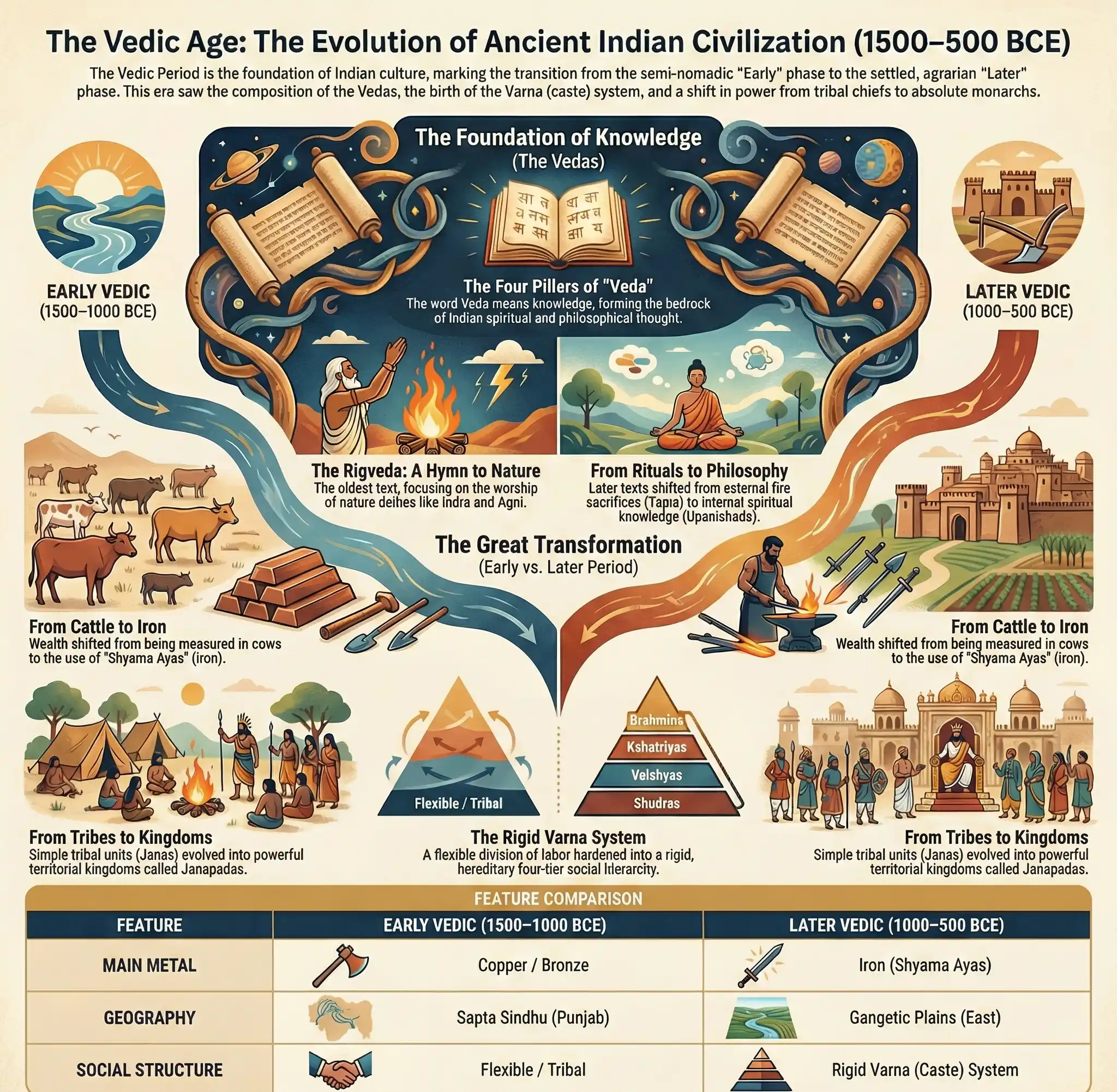
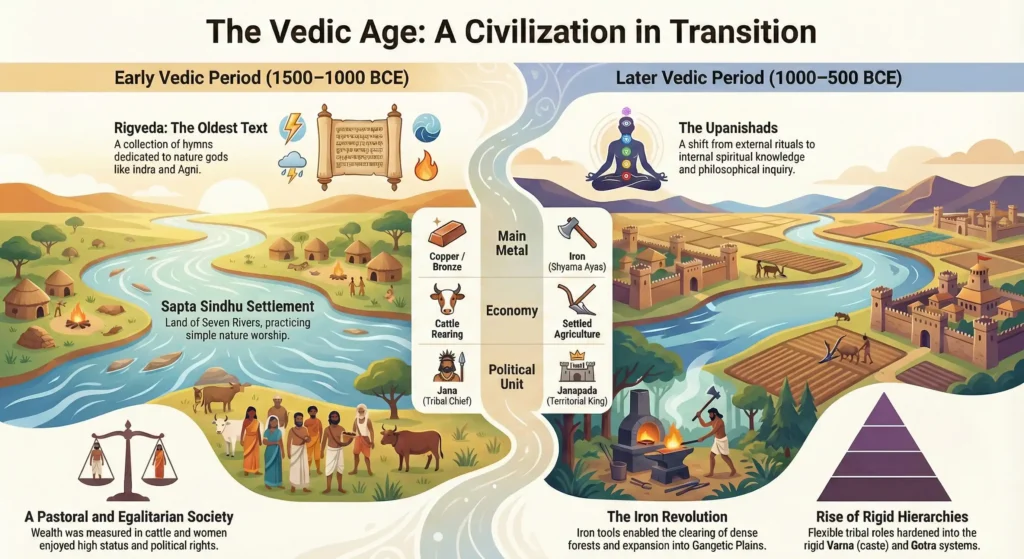
The Rigveda does not show us cities. There are no coins in it, and no great stone temples. The poet’s world was one of households and clans, of herds and fields, of fires kept burning at home. Wealth was counted in cattle; the Rigvedic word for a battle, gavishti, literally means a search for cows. Horses were precious, and pulled light chariots. The main crop was barley.
So when he describes his ruin, it is in those terms. “The gambler’s wife is left forlorn and wretched,” he says, in Ralph Griffith’s 1896 translation, and his mother mourns a son who wanders homeless. In debt and afraid, he goes out by night to other people’s houses. When he sees another man’s wife and a well-kept home, it hurts. In the morning he yokes his brown horses; by the time the home fire has gone cold, he has sunk down as an outcast.
In the morning he yokes his horses. By the time the home fire has gone cold, he is an outcast.
The assembly
The gambler had somewhere to go. Vedic people met in assemblies, the sabha and the samiti, where matters of the clan were discussed and the rajan, the chief, was advised. Later Vedic texts suggest that the sabha was also where men gathered to play dice. The gambler describes the pull of it: he swears off the game, his friends leave him, and then he hears the brown dice rattle on the board and goes back, he says, like a girl to her lover.
The rajan of this world was a leader of people more than a ruler of land. He led the clan in war and in cattle raids, protected its herds, and was expected to be generous. The gods were close and practical: Agni in the fire, Indra in the storm and in battle, Savitar the sun who set the world moving each morning. Religion meant hymns, fire and offerings, performed by priests who kept the sacred words in their memories.
Later Vedic Period c. 1000-600 BCE: The Age of Iron and Kingdoms
The advice
At the end, the poet turns to the listener and gives the advice he could not take himself. “Play not with dice: no, cultivate thy corn-land,” he says. Be content with what you earn. Your cattle are there, your wife is there. The god Savitar himself, he says, told him so.
It is advice straight out of the life of a Vedic household: the field, the herd, the family, the fire. Everything that the Rigvedic world counted as a good life is in that one verse, because it is exactly what he had thrown away.
Three thousand years
The Vedic period lasted a thousand years, and it changed. Over its later centuries people moved east into the plains of the Ganga, iron came into use, farming grew, kingdoms grew larger, and the priests’ rituals grew vast and elaborate. But the Rigveda is the voice of its beginning, and the Gambler’s Lament is one of the few places where that voice is not singing to the gods but talking about itself.
The Sanskritist Arthur Macdonell called it the most remarkable literary product of its kind, the oldest poem of its sort anywhere. Its author’s name is uncertain. The people in it have no names at all. But we know what he lost, because he told us: a kind wife, a mother’s trust, a field, a herd, and a fire at home that he let go cold.
Indus Valley Civilization: The Lost Urban Utopia
Protecting The Rare Hoolock Gibbon India
Early Vedic Period c. 1500-1000 BCE: The Age of the Rigveda
If you think you have remembered everything about this topic take this QUIZ
Results


#1. Which transition in geography characterizes the shift from the Early Vedic to the Later Vedic Period?
#2. In the Early Vedic (Rigvedic) society, how was wealth primarily measured?
#3. Which Veda is known as the ‘Book of Melodies’ and is considered the origin of Indian music?
#4. The discovery of which metal (referred to as ‘Shyama Ayas’) triggered the Second Urbanization and the rise of powerful kingdoms?
#5. How did the status of women change from the Early Vedic period to the Later Vedic period?
#6. What philosophical shift occurred in the ‘Upanishads’ at the end of the Vedic era?
#7. India’s national motto, ‘Satyameva Jayate’, is taken from which ancient Vedic text?
#8. According to the ‘Quick Comparison’ table, who were the main gods of the Early Vedic vs. Later Vedic period?
What is the time period of the Vedic Age?
It spans from approximately 1500 BCE to 500 BCE.
Which is the oldest Veda?
The Rigveda is the oldest.
What metal revolutionized the Later Vedic Period?
Iron (Shyama Ayas or Krishna Ayas).
What are the two main assemblies of the Vedic period?
The Sabha (Council of Elders) and Samiti (General Assembly).
Which region was the center of the Early Vedic civilization?
The Sapta Sindhu (Punjab and surrounding regions).
Sources & References
Ralph T.H. Griffith (tr.), The Hymns of the Rigveda (1896), Book 10, Hymn 34 — the translation quoted in the article.
Arthur Anthony Macdonell, A History of Sanskrit Literature (1900) — his assessment of the hymn and the vibhidaka dice.
Stephanie W. Jamison and Joel P. Brereton (tr.), The Rigveda: The Earliest Religious Poetry of India (Oxford University Press, 2014) — the standard modern translation, for checking the paraphrased verses.
Upinder Singh, A History of Ancient and Early Medieval India (Pearson, 2008) — Rigvedic economy, society, assemblies and the later Vedic transition; recommended for checking the descriptive passages.
Author


Exploring the Soul of Bharat through History, Science, Culture, and its Diversity
Our Mission
Curious Indian is a definitive knowledge portal dedicated to chronicling the events, personalities, and cultural shifts that defined the Indian subcontinent. From the ancient Vedic Period to the complexities of 21st-century politics, our goal is to provide deep-dive analysis that inspires.
Editorial Standards & E-E-A-T
Every article published under our brand undergoes a rigorous fact-checking process. We prioritize primary historical records, academic citations, and credible archives to ensure our readers receive accurate, high-authority information.
Historical Integrity Directly sourcing from ASI archives and academic journals.Topical Authority Comprehensive clustering of Indian Science, Biographies, and Wars.Managed by Paripurna Datta and TEAM | Dedicated to the Knowledge of India.