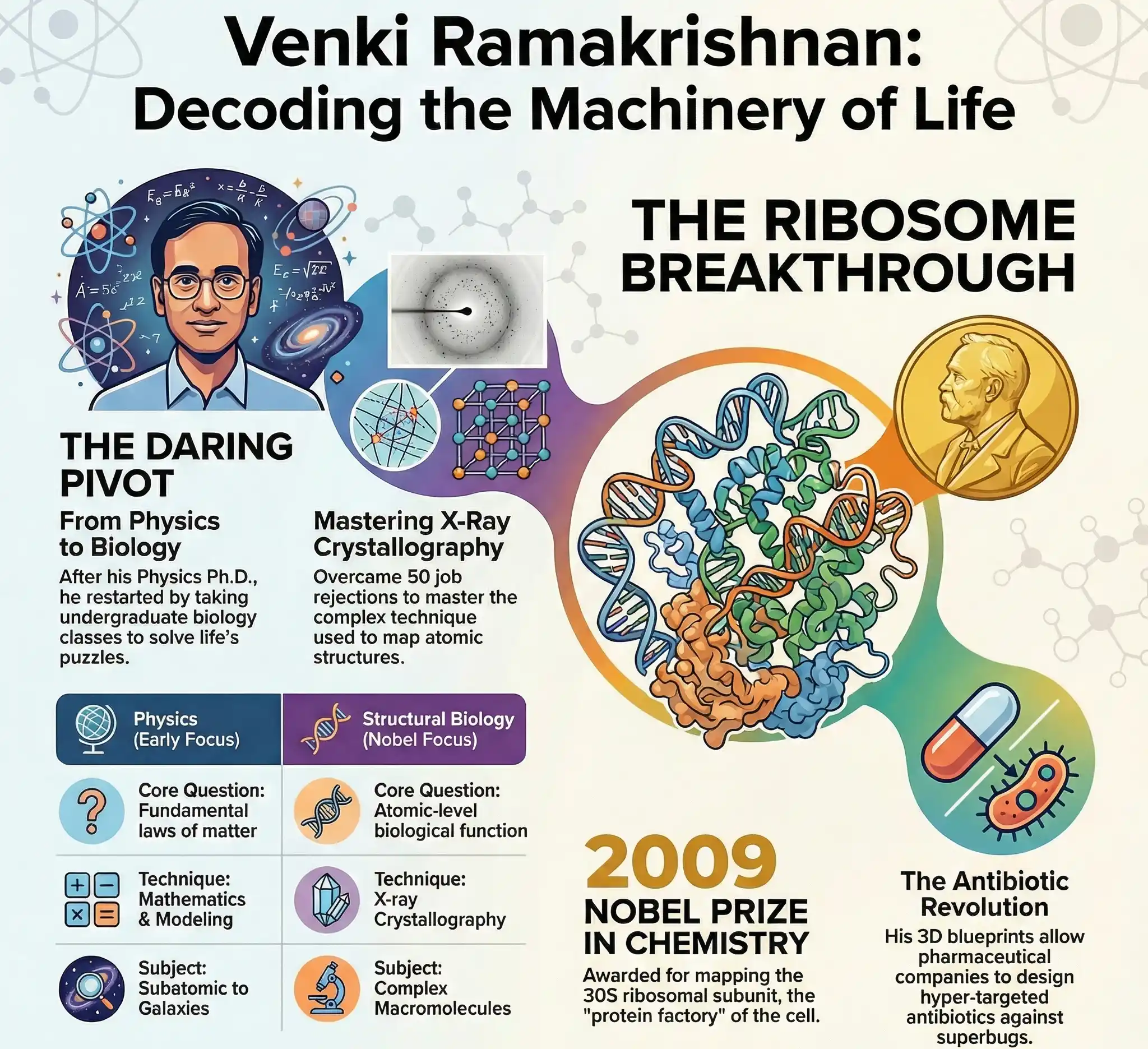
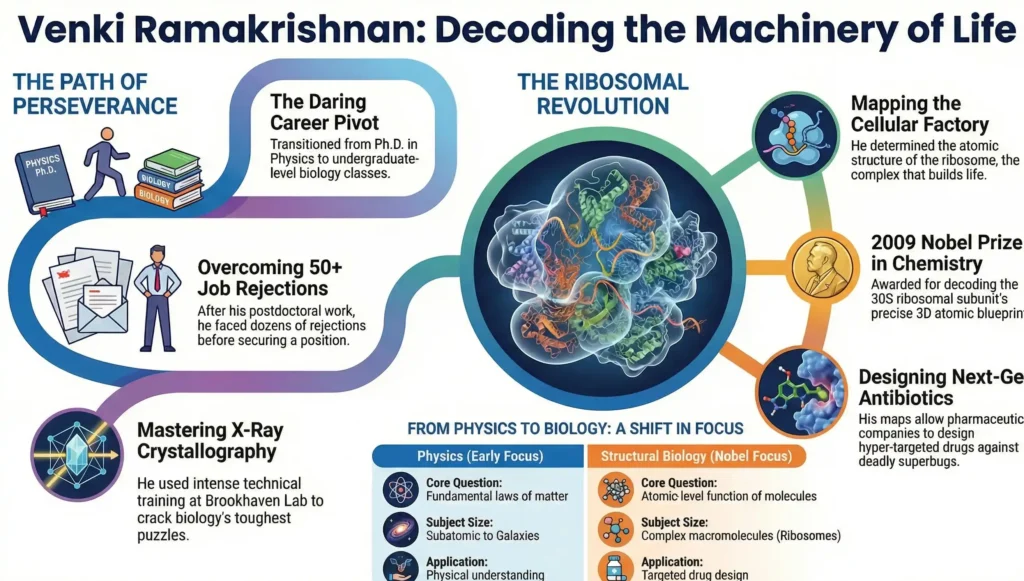
Venkatraman "Venki" Ramakrishnan (born 1952) is an Indian-born, structural biologist and Nobel laureate who achieved what was once thought impossible: mapping the exact atomic structure of the ribosome. Born in Chidambaram, Tamil Nadu, and raised in Baroda, he initially earned a Ph.D. in Physics in the US before making a daring pivot to biology. After facing severe career setbacks and dozens of job rejections, he mastered the complex technique of X-ray crystallography. Working at the MRC Laboratory of Molecular Biology in Cambridge, his team successfully mapped the 30S ribosomal subunit in 2000. This breakthrough, which earned him the 2009 Nobel Prize in Chemistry, provided the precise 3D blueprint necessary to design next-generation antibiotics. He later served as the President of the prestigious Royal Society.| Feature | Details |
| Name | Venkatraman “Venki” Ramakrishnan |
| Birth Date | 1952 |
| Birthplace | Chidambaram, Tamil Nadu, India |
| Field of Science | Structural Biology / Molecular Biology |
| Nobel Prize | Chemistry (2009) |
| Key Discovery | Atomic structure and function of the ribosome |
| Key Technique | X-ray Crystallography |
| Major Role | President of the Royal Society (2015–2020) |
| Highest Indian Award | Padma Vibhushan (2010) |
Science in the Family
Venki Ramakrishnan’s scientific curiosity was deeply rooted in his upbringing. Born in the ancient temple town of Chidambaram in Tamil Nadu, he relocated to Vadodara (Baroda) at the age of three. He grew up in a household saturated with academic rigor. His father, C.V. Ramakrishnan, was a biochemist and head of the Biochemistry Department at the Maharaja Sayajirao (M.S.) University of Baroda, while his mother was a psychologist.
Despite the biological focus of his parents, young Venki’s first academic love was the fundamental laws of matter and energy. He pursued a Bachelor of Science degree in Physics from M.S. University of Baroda, graduating in 1971, before moving to the United States to earn his Ph.D. in Physics from Ohio University in 1976.
The Daring Leap: From Physics to Biology
The path of a great scientist is rarely a straight line. After completing his Ph.D. in Physics, Ramakrishnan experienced a profound realization: the most exciting, unanswered, fundamental questions of the era were shifting from theoretical physics to molecular biology.
Driven by an impatience to make tangible, fundamental discoveries, he made the incredibly brave decision to essentially start over. He enrolled in undergraduate-level biology classes as a graduate student at the University of California, San Diego. He soon found his true calling in Structural Biology—a unique field that uses the heavy machinery of physics (like X-ray scattering) to solve the delicate puzzles of biological molecules.
Har Gobind Khorana: (1922- 2011)
The Wilderness Years and the Master Key
His path to the Nobel Prize was paved with rejection. Following his postdoctoral work at Yale University, where he first began studying the ribosome using neutron scattering, Ramakrishnan struggled to secure a permanent academic position. He reportedly applied to around 50 different universities and faced rejections from all of them.
Instead of giving up, he accepted a staff scientist position at the Brookhaven National Laboratory. This perceived “setback” became his greatest training ground. Here, he meticulously mastered X-ray crystallography—the immensely difficult technique of determining the atomic structure of a crystal by studying the patterns of X-rays bouncing off it. This was the exact tool he needed to crack biology’s toughest puzzle.
Shivkar Bapuji Talpade: (1864- 1916)
Decoding the Ribosome
The ribosome is the cellular factory that reads the genetic code (DNA/RNA) and synthesizes the proteins that build life. For decades, scientists knew what it did, but not how it did it at the atomic level. The ribosome is a massive, floppy complex of RNA and proteins, making it notoriously difficult to crystallize (a prerequisite for X-ray crystallography).
In the late 1990s, Ramakrishnan moved to the MRC Laboratory of Molecular Biology in Cambridge, England. Armed with extreme patience, he focused laser-like attention on the smaller part of the factory: the 30S ribosomal subunit of a bacterium. In 2000, his laboratory achieved the impossible, determining the complete atomic blueprint of the 30S subunit. By 2007, his team mapped the entire ribosome complex.
Daulat Singh Kothari : (1906–1993)
The Antibiotic Revolution
Ramakrishnan’s discovery was not just an academic triumph; it was a medical revolution. Because the ribosome is essential for bacterial survival, antibiotics function by binding to bacterial ribosomes and paralyzing them (while leaving human ribosomes alone). However, bacteria are constantly mutating to become drug-resistant.
By providing a precise 3D, atomic-level map of the bacterial ribosome, Ramakrishnan handed pharmaceutical companies the exact blueprint needed to design new, hyper-targeted antibiotics to fight deadly superbugs.
Manjul Bhargava: (1974- Present)
Quick Comparison Table: Interdisciplinary Science
| Feature | Physics (His Early Focus) | Structural Biology (His Nobel Focus) |
| Core Question | What are the fundamental laws of matter? | How do biological molecules function at the atomic level? |
| Subject Size | Subatomic particles to Galaxies | Massive, complex macromolecules (Ribosomes) |
| Techniques Used | Mathematics, Theoretical modeling | X-ray crystallography, Neutron scattering |
| Application | Broad physical understanding | Targeted drug design, understanding protein synthesis |
Curious Indian: Fast Facts
- The Book: Venki Ramakrishnan authored a highly acclaimed, candid memoir titled “Gene Machine: The Race to Decipher the Secrets of the Ribosome,” which details the fierce global competition and the human drama behind his Nobel-winning discovery.
- The Royal Society: In 2015, he was elected the President of the Royal Society in London, one of the world’s oldest and most prestigious scientific academies (a position once held by Isaac Newton).
- The Competition: The race to crystallize the ribosome was incredibly intense. He shared the 2009 Nobel Prize in Chemistry with two of his biggest competitors: Thomas A. Steitz and Ada E. Yonath.
Conclusion
Venkatraman Ramakrishnan’s life is a masterclass in the power of perseverance and interdisciplinary thinking. He proves that you don’t have to be a prodigy who has their entire life mapped out at age twenty. By daring to change fields, embracing failure, and patiently applying the harsh tools of physics to the messy world of biology, he unlocked one of the greatest secrets of life. His work continues to save lives today, standing as a towering inspiration for future generations of Indian scientists.
If you think you have remembered everything about this topic take this QUIZ
Results


#1. What did Venkatraman Ramakrishnan successfully map the exact atomic structure of, earning him a Nobel Prize?
#2. Before making his daring pivot to structural biology, in which field did Ramakrishnan earn his Ph.D. in 1976?
#3. Which immensely difficult technique did Ramakrishnan master to determine the atomic structure of crystals?
#4. According to the text, what is the primary function of the cellular factory known as the ribosome?
#5. Ramakrishnan’s precise 3D blueprint of the bacterial ribosome handed pharmaceutical companies the exact tool needed to design what?
#6. In 2015, Ramakrishnan was elected President of which of the world’s oldest and most prestigious scientific academies?
#7. What is the title of the highly acclaimed memoir authored by Venki Ramakrishnan detailing the human drama behind his discovery?
#8. With which two competing scientists did Venkatraman Ramakrishnan share the 2009 Nobel Prize in Chemistry?
What did Venkatraman Ramakrishnan win the Nobel Prize for?
He won the 2009 Nobel Prize in Chemistry for his studies of the structure and function of the ribosome, determining its atomic blueprint using X-ray crystallography.
What is the function of the ribosome?
The ribosome is a complex molecular machine found within all living cells that acts as a biological factory, reading genetic code and synthesizing proteins.
How did Ramakrishnan’s discovery help medicine?
By providing a precise 3D atomic map of the bacterial ribosome, his research allowed scientists to understand exactly how antibiotics bind to bacteria, paving the way for the creation of new drugs to fight antibiotic-resistant superbugs.
Did Ramakrishnan start his career as a biologist?
No, he initially earned his Bachelor’s and Ph.D. degrees in Physics before transitioning to biology as a graduate student.
Which prestigious scientific institution did he lead?
He served as the President of the Royal Society in the United Kingdom from 2015 to 2020.