Vagbhata was a revolutionary 6th-century Ayurvedic scholar who synthesized the complex teachings of his predecessors into accessible, poetic masterpieces. By merging internal medicine with surgery and emphasizing a rhythmic daily lifestyle, he created a holistic framework for health that remains the cornerstone of Ayurvedic practice today. His work, the Ashtanga Hridaya, continues to inspire millions to seek balance through nature and self-awareness.| Attribute | Details |
| Name | Vagbhata (6th Century CE) |
| Famous Works | Ashtanga Sangraha and Ashtanga Hridaya |
| Field | Ayurveda (Internal Medicine and Surgery) |
| Philosophy | The Balance of Doshas (Vata, Pitta, Kapha) |
| Legacy | The “Great Three” (Vriddha-trayi) of Ayurveda |
The Master of the Eight Limbs: A Journey Through Time
The golden era of ancient India was a time when the fragrance of herbs filled the air of university courtyards and the pursuit of longevity was considered a sacred duty. In the heart of this intellectual blooming lived a man whose words would eventually travel from the dusty plains of the Indus to the lush greenery of Kerala. His name was Vagbhata, and his contribution to Vagbhata Ayurveda remains one of the most significant bridges between ancient surgery and internal medicine. Unlike many scholars who sought to complicate the arts of healing, Vagbhata had a different mission: he wanted to make the profound secrets of health accessible, poetic, and practical for every human being.
Born as the son of Simhagupta and the grandson of a prominent physician also named Vagbhata, he was destined for greatness. He lived during a transitional period in Indian history, likely the 6th century CE, where the classical teachings of the great masters Charaka and Sushruta were becoming increasingly difficult for students to master. Vagbhata observed this gap and realized that for the wisdom of the Vedas to survive, it needed a new voice—a voice that was both concise and deeply moving.
Rakesh Roshan Biography: The Mastermind Behind the ‘K’ Phenomenon
The Mystery of the Two Vagbhatas
For centuries, historians have debated a fascinating mystery: was there one Vagbhata or two? Some believe that the author of the Ashtanga Sangraha (The Compendium of the Eight Branches) was a different individual from the one who wrote the Ashtanga Hridaya (The Heart of the Eight Branches). However, the prevailing sentiment among traditional practitioners is that of a single, brilliant mind evolving over time.
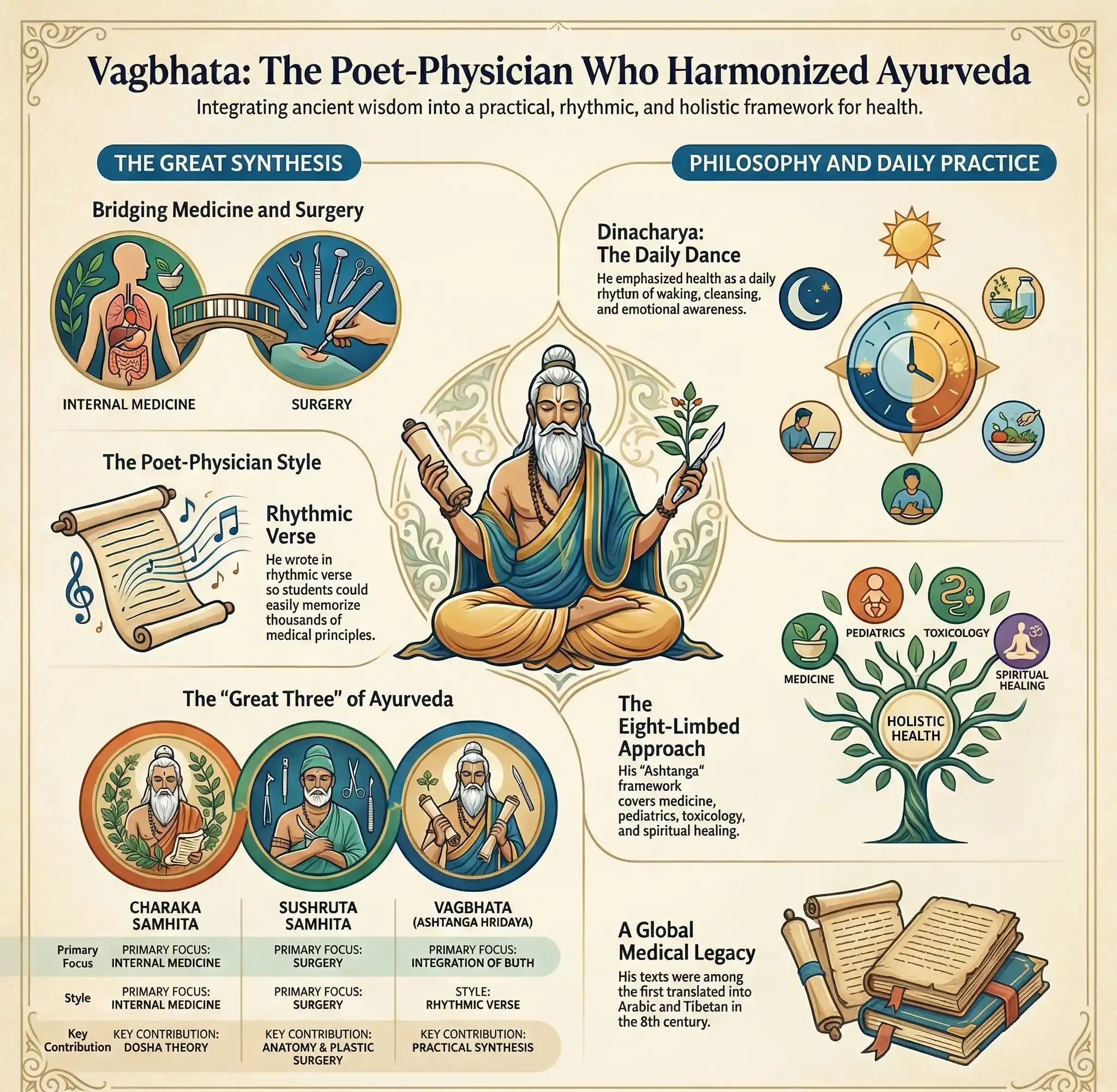
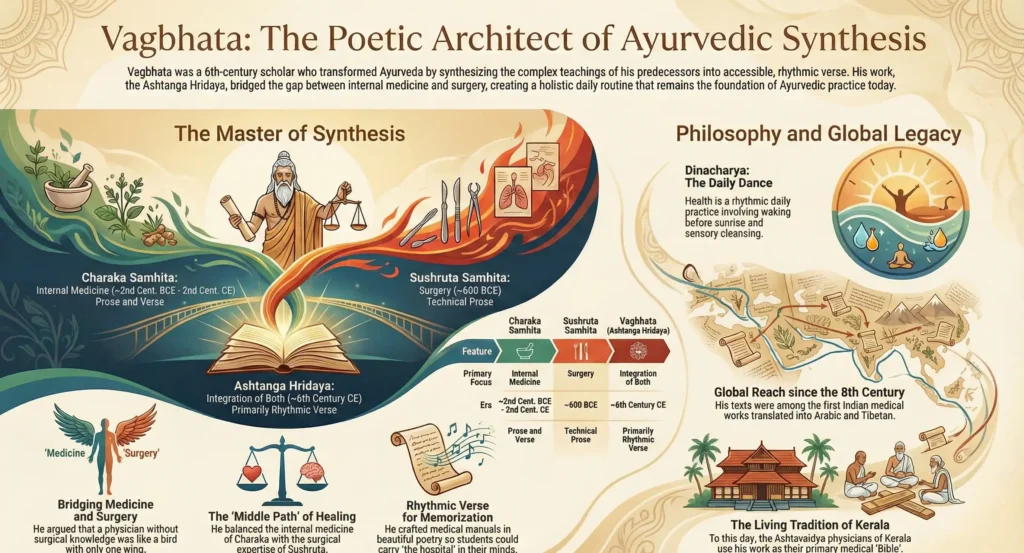
In his younger years, he likely wrote the Sangraha, a massive, detailed work that mirrored the complexity of the ancient texts. But as he aged and grew wiser, he sought to distill that knowledge. He crafted the Ashtanga Hridaya in beautiful, rhythmic verse. This wasn’t just a medical manual; it was a symphony of healing. By choosing poetry, he ensured that students could easily memorize the thousands of verses, carrying the hospital within their own minds wherever they traveled.
Bridging the Gap Between Medicine and Surgery
Before the era of Vagbhata Ayurveda, the medical world was often divided. On one side, you had the followers of Charaka, who focused heavily on internal medicine and the balance of the body’s internal fire. On the other, the followers of Sushruta were the masters of the scalpel, specializing in intricate surgeries that were centuries ahead of their time.
Vagbhata saw the human body as a unified whole. He argued that a physician who knew only medicine but not surgery was like a bird with one wing. His texts successfully merged these two disciplines, creating a comprehensive “eight-limbed” approach (Ashtanga). These limbs covered everything from general medicine and pediatrics to toxicology and even spiritual healing. This holistic integration is exactly why his work became the primary textbook for Ayurvedic students across the Indian subcontinent for over a thousand years.
The Daily Dance of Balance
One of the most relatable aspects of Vagbhata’s teachings is his focus on Dinacharya, or the daily routine. He believed that health was not something you sought only when you were ill; it was a rhythmic dance you performed every single day. He wrote extensively about the importance of waking up before the sun, the specific way one should clean their senses, and the emotional state one should maintain while eating.
He spoke of the three Doshas—Vata, Pitta, and Kapha—not as abstract concepts, but as living forces within us that respond to the seasons, the time of day, and our own thoughts. His advice was incredibly personal. He encouraged people to listen to the “whispers” of their bodies before they became “shouts” of disease. This inspirational approach to self-care is what makes his 1,400-year-old advice feel as fresh as a morning breeze in a modern world obsessed with “wellness.”
Beyond the Shadow: The Remarkable Transformation of Pran
A Legacy That Never Fades
The influence of Vagbhata traveled far beyond the borders of India. His works were translated into Tibetan, Arabic, and eventually reached the Western world, influencing the development of global medicine. In the southern state of Kerala, his Ashtanga Hridaya is still held in the highest regard, forming the foundation of the famous Ashtavaidya tradition.
The story of Vagbhata is a reminder that true brilliance lies in the ability to simplify the complex. He didn’t just record facts; he captured the essence of what it means to be a healthy, vibrant human being. His life was a testament to the idea that ancient Indian medicine was never meant to be a static relic of the past, but a living, breathing guide for the future.
Comparison of the Great Three (Vriddha-trayi)
| Feature | Charaka Samhita | Sushruta Samhita | Vagbhata (Ashtanga Hridaya) |
| Primary Focus | Internal Medicine (Kayachikitsa) | Surgery (Shalya-tantra) | Integration of Medicine & Surgery |
| Style | Prose and Verse | Descriptive and Technical | Primarily Rhythmic Verse |
| Era | ~2nd Century BCE – 2nd Century CE | ~600 BCE | ~6th Century CE |
| Key Contribution | Theory of Doshas & Diagnosis | Plastic Surgery & Anatomy | Practical Application & Synthesis |
Curious Indian: Fast Facts
- The Poet Physician: Vagbhata is unique because he wrote his medical findings in the form of poetry to make them easier to memorize.
- Global Reach: His texts were among the first Indian medical works translated into Arabic during the 8th century under the Caliphate.
- The Middle Path: He is often called the “Sage of the Middle Path” because he balanced the extreme views of previous medical schools.
- Buddhist Influence: Many historians believe Vagbhata was a Buddhist, as his works often begin with prayers to the “Unique Physician” (the Buddha).
- Kerala’s Textbook: To this day, the traditional physicians of Kerala (Ashtavaidyas) consider his text their primary “Bible” for healing.
S. P. Balasubrahmanyam Biography: 5 Decades of Musical Supremacy
Conclusion
Vagbhata’s life reminds us that the quest for health is as much about the spirit as it is about the body. By documenting the secrets of Vagbhata Ayurveda, he ensured that the wisdom of the ancients would never be lost to the shadows of history. Whether you are looking for a way to balance your daily life or seeking to understand the roots of holistic healing, the verses of this 6th-century sage offer a roadmap that is as relevant today as it was a millennium ago. He remains a beacon of light for the “Curious Indian” in all of us, urging us to find harmony within ourselves and the world around us.
If you think you have remembered everything about this topic take this QUIZ
Results


#1. What was Vagbhata’s primary motivation for writing the ‘Ashtanga Hridaya’ in rhythmic verse?
#2. Vagbhata is credited with bridging a major gap in ancient Indian medicine. Which two fields did he successfully integrate?
#3. What does the term ‘Dinacharya’ refer to in Vagbhata’s teachings?
#4. According to the ‘Comparison of the Great Three’ table, what is the primary style of the ‘Ashtanga Hridaya’?
#5. Which specific region in India holds Vagbhata’s work in such high regard that it forms the basis of the ‘Ashtavaidya’ tradition?
#6. Vagbhata is often called the ‘Sage of the Middle Path’. Why?
#7. Which historical evidence suggests a Buddhist influence on Vagbhata’s work?
#8. What is the meaning of the title ‘Ashtanga Hridaya’?
Evolution of Jyothika Saravanan as a Modern Cinematic Powerhouse
Who exactly was Vagbhata in Indian history?
Vagbhata was one of the most influential writers and scientists in the history of Ayurveda, living around the 6th century CE. He is best known for authoring the Ashtanga Hridaya, a foundational text that simplified and integrated the medical knowledge of ancient India.
What is the main difference between Vagbhata and Charaka?
While Charaka focused almost exclusively on internal medicine and herbs, Vagbhata integrated the surgical techniques of Sushruta with internal medicine, providing a more balanced and concise guide for practitioners.
Why is the Ashtanga Hridaya so important?
It is considered the most practical and best-organized text of Ayurveda. Because it was written in verse, it allowed the knowledge of healing to be passed down orally and accurately through generations.
Did Vagbhata believe in spiritual healing?
Yes, his “eight-limbed” approach included Bhuta Vidya, which addressed the psychological and spiritual aspects of health, acknowledging that the mind and soul play a critical role in physical well-being.
Is Vagbhata’s advice still applicable in the modern world?
Absolutely. His teachings on Dinacharya (daily routine) and Ritucharya (seasonal routine) are the basis for many modern wellness practices, emphasizing prevention and lifestyle over reactive treatment.