The 1971 Nagarwala Case involves Rustam Nagarwala, who defrauded the State Bank of India of ₹60 lakhs by mimicking Prime Minister Indira Gandhi’s voice to authorize a secret fund withdrawal. The chief cashier complied, handing over the cash for an alleged classified mission, but Nagarwala was arrested shortly after and later died in custody under suspicious circumstances. This incident remains one of India’s most controversial mysteries, raising lasting questions about political power and banking security during that era.| Category | Details |
| Date of Incident | May 24, 1971 |
| Location | State Bank of India, Parliament Street, New Delhi |
| Amount Involved | ₹60 Lakhs (Approx. ₹170 Crores in today’s value) |
| Key Perpetrator | Rustam Sohrab Nagarwala (Former Army Captain) |
| Key Victim/Target | Ved Prakash Malhotra (Chief Cashier, SBI) |
| The “Ruse” | Nagarwala mimicked Prime Minister Indira Gandhi’s voice on the phone, claiming the money was for a secret mission to Bangladesh. |
| The Outcome | Nagarwala was arrested within hours. In the fastest trial in Indian judicial history, he was convicted in 10 minutes and sentenced to 4 years. |
| The Mystery | Both the investigating officer (D.K. Kashyap) and Nagarwala died under suspicious circumstances shortly after the incident, leading to decades of conspiracy theories. |
The Nagarwala scandal mystery is perhaps the most bizarre financial crime in Indian history. Unlike complex cyber hacks or armed robberies, this heist required no guns, no masks, and no computers. It only required a telephone and a voice.
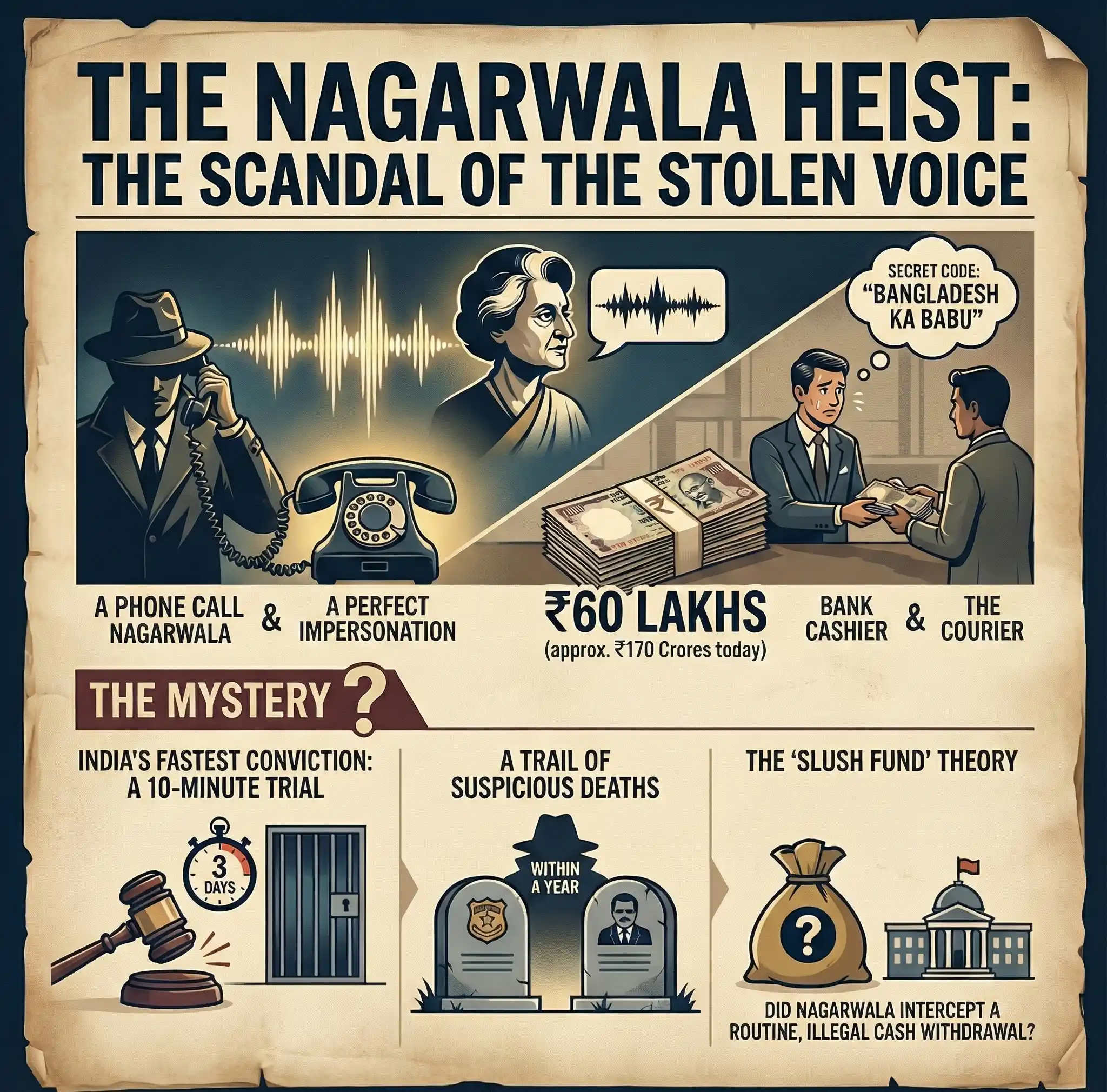
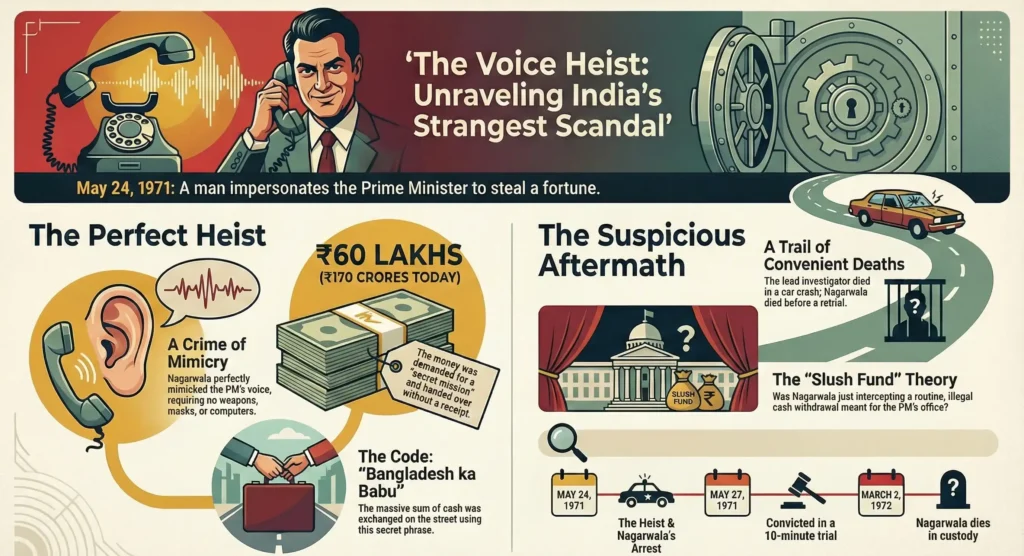
On May 24, 1971, a man called the State Bank of India (SBI) on Parliament Street, New Delhi. He mimicked the voice of Prime Minister Indira Gandhi so perfectly that the Chief Cashier not only believed him but personally delivered ₹60 Lakhs (worth approx. ₹170 Crores today) to him on the street.
The man, Rustom Sohrab Nagarwala, was caught within hours. But what followed was even stranger than the crime: a trial that lasted only 10 minutes, a mysterious death in prison, and the death of the investigating officer in a car crash.
Welcome to the seventh chapter of Unsolved India, where we open the files on the heist that shook the Prime Minister’s Office.
The Call: “Bangladesh Ka Babu”
At 11:45 AM, Ved Prakash Malhotra, the Chief Cashier of SBI, received a call. The voice on the other end claimed to be P.N. Haksar, the Principal Secretary to the Prime Minister. He told Malhotra that a “secret mission” regarding East Pakistan (now Bangladesh) required immediate funds.
Then, the line was supposedly handed over to Indira Gandhi. The voice—authoritative and breathless—told Malhotra:
“Bhai, I need Rs 60 Lakhs urgently for a secret mission. I am sending a courier. Hand over the money to him.”
Malhotra, a patriot and a loyalist, didn’t ask for a cheque. He didn’t ask for a voucher. He simply packed ₹60 Lakhs into a trunk and drove to the designated spot near a church on Parliament Street.
He met a tall, fair Parsi man (Nagarwala). They exchanged the secret codes agreed upon on the phone:
Malhotra: “Bar-at-Law?”
Nagarwala: “Bangladesh ka Babu.”
The money was handed over. Malhotra went straight to the Prime Minister’s house to get a receipt. There, he was shocked to find that neither Indira Gandhi nor P.N. Haksar had made any such call. He had been duped.
The “Instant” Justice
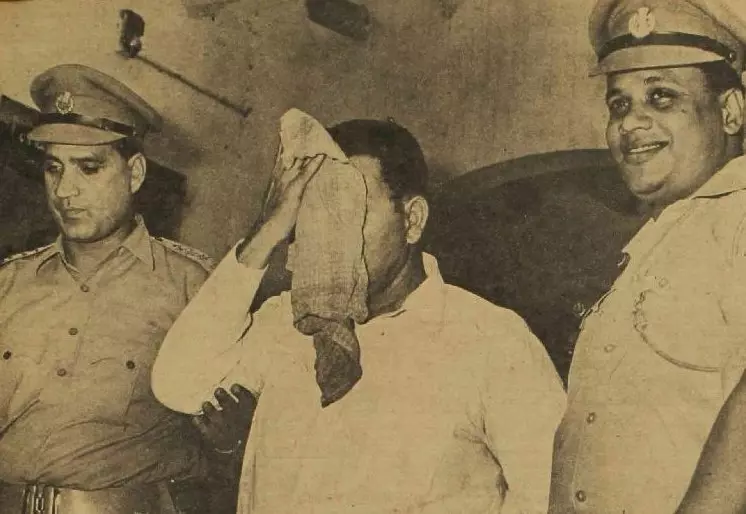
Police tracked Rustom Nagarwala to the Parsi Dharamshala in Delhi that same evening. He was arrested, and most of the money was recovered.
Here is where the Nagarwala scandal mystery deepens. In a normal judicial system, a case of this magnitude would take months or years to process.
Nagarwala was arrested on May 24.
He confessed on May 26.
He was convicted and sentenced to 4 years in prison on May 27.
The trial reportedly lasted only 10 minutes. It was the fastest conviction in Indian legal history. Why was the judicial system in such a hurry to close the case? Was someone afraid of what Nagarwala might say in an open court?
The Trail of Death
Just like in the Purulia case, the key players in this drama did not survive long.
1. The Investigating Officer’s Crash D.K. Kashyap, the brilliant police officer who cracked the case and arrested Nagarwala, died in a mysterious car accident in November 1971, just months after the heist. He was on his honeymoon.
2. The Silence of the Prisoner Nagarwala eventually tried to retract his confession, claiming he was forced to admit to the crime to save “powerful people.” He requested a retrial. But before he could speak out, he was transferred to a hospital with chest pain. On March 2, 1972—his 50th birthday—Rustom Nagarwala died in custody. The official cause was a heart attack.
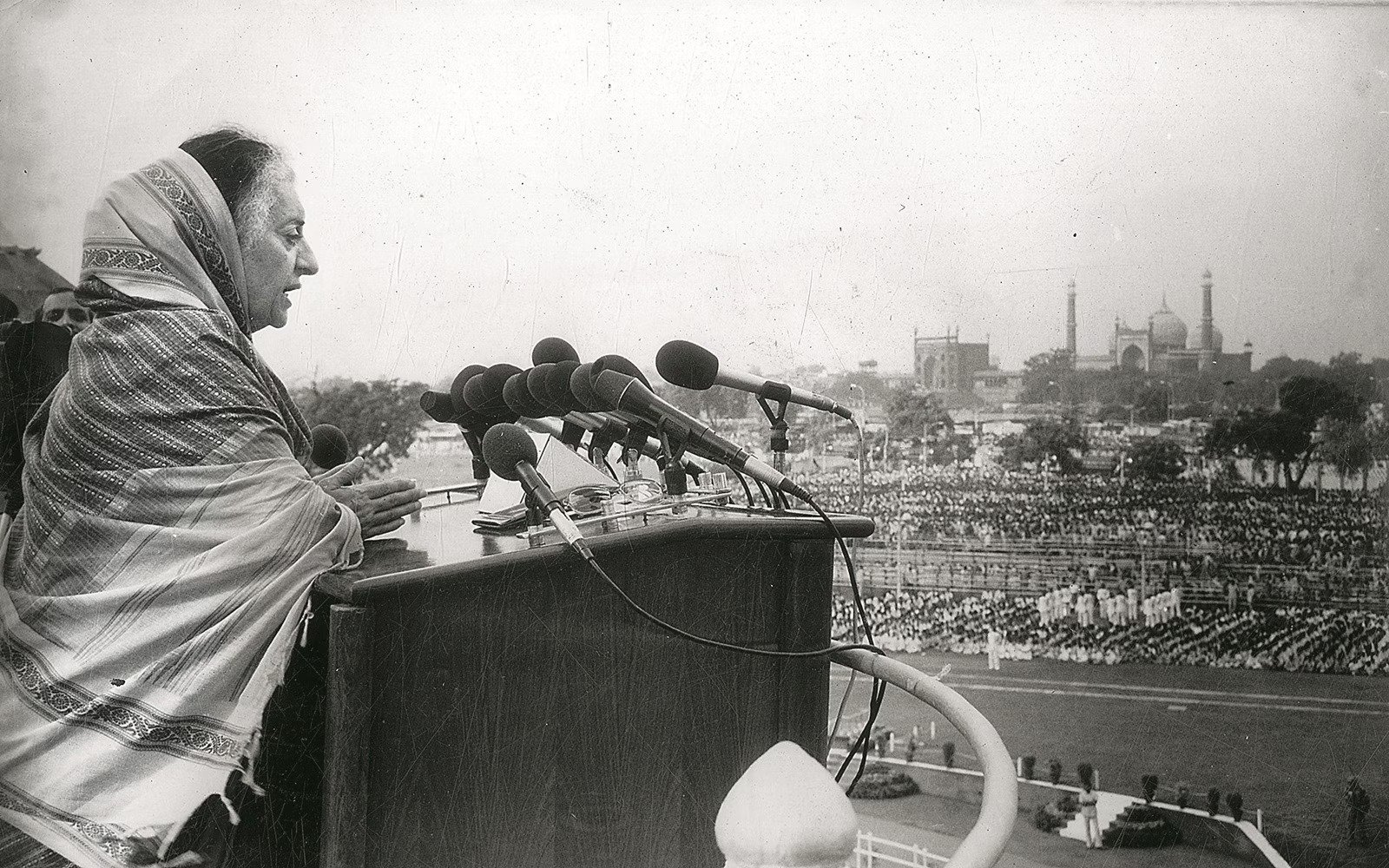
Theory: The “Slush Fund” Hypothesis
The biggest question is not how Nagarwala mimicked the voice, but why the Chief Cashier, a senior banker, handed over cash without a receipt.
Critics and historians argue that Malhotra’s behavior suggests this was not the first time such a transaction had happened.
The Theory: Was it common practice for the PMO to withdraw untraceable cash from SBI for political funding or secret operations?
The Twist: Did Nagarwala, a former Army Captain with intelligence connections, simply know the procedure and intercept a transaction that was actually “routine” for the bank, but illegal for the country?
If Malhotra was used to handing over cash on verbal orders, he wasn’t gullible; he was just following a protocol he had followed before. Nagarwala’s crime, then, was not mimicking the PM, but exposing a secret channel of money.
Conclusion: A Secret Buried
After the Emergency ended in 1977, the Jaganmohan Reddy Commission was set up to investigate the scandal. It found serious lapses in the investigation but could not conclusively prove a conspiracy due to the death of the primary witness.
To this day, we don’t know if Rustom Nagarwala was a master mimic, a fall guy for a political game, or a spy who knew too much.
Curious India: Fast Facts
The Codes: The secret codes used during the handover were “Bangladesh ka Babu” (Nagarwala) and “Bar-at-Law” (Malhotra).
The Amount: ₹60 Lakhs in 1971 is equivalent to roughly ₹170 Crores today when adjusted for inflation and gold value.
The Book: The scandal inspired the famous novel Such a Long Journey by Rohinton Mistry.
If you think you have rememberd everything about this topic take this QUIZ
Results


#1. What was the primary method Rustom Sohrab Nagarwala used to convince the Chief Cashier of the State Bank of India to hand over ₹60 Lakhs?
#2. According to the ‘Slush Fund’ hypothesis, why might Chief Cashier Ved Prakash Malhotra have complied with the request for cash so easily?
#3. What was particularly strange about the judicial process following Rustom Nagarwala’s arrest?
#4. What were the respective secret codes used by Ved Prakash Malhotra and Rustom Nagarwala during their meeting?
#5. What was the fate of D.K. Kashyap, the investigating officer who successfully arrested Nagarwala?
#6. Before Rustom Nagarwala’s death, what action did he attempt to take regarding his conviction?
Who was Rustom Sohrab Nagarwala?
He was a former Captain in the Indian Army. He reportedly had connections to intelligence circles, which fueled theories that he knew about secret bank transfers.
Did he really mimic Indira Gandhi’s voice?
That is the official police version. However, many skeptics doubt that a man could fool a senior bank manager simply by mimicking a female voice over a 1970s telephone line without prior knowledge of bank protocols.
What happened to the money?
Most of the money (₹59.9 Lakhs) was recovered from the Parsi Dharamshala where Nagarwala was staying. He had supposedly left ₹500 with a taxi driver, which helped police track him.
Why is the death of D.K. Kashyap suspicious?
D.K. Kashyap was the Assistant Superintendent of Police who arrested Nagarwala. His death in a car accident just months after the case closed led to rumors that he was silenced because he found out the “real” source of the money.
Was the money for the Bangladesh War?
The caller claimed the money was for a secret mission in East Pakistan (Bangladesh). Given that the 1971 war was looming, this was a plausible cover story that convinced the patriotic cashier to break the rules.
This article is part of our exclusive series Unsolved India. Read the previous chapter: The Purulia Arms Drop Mystery.