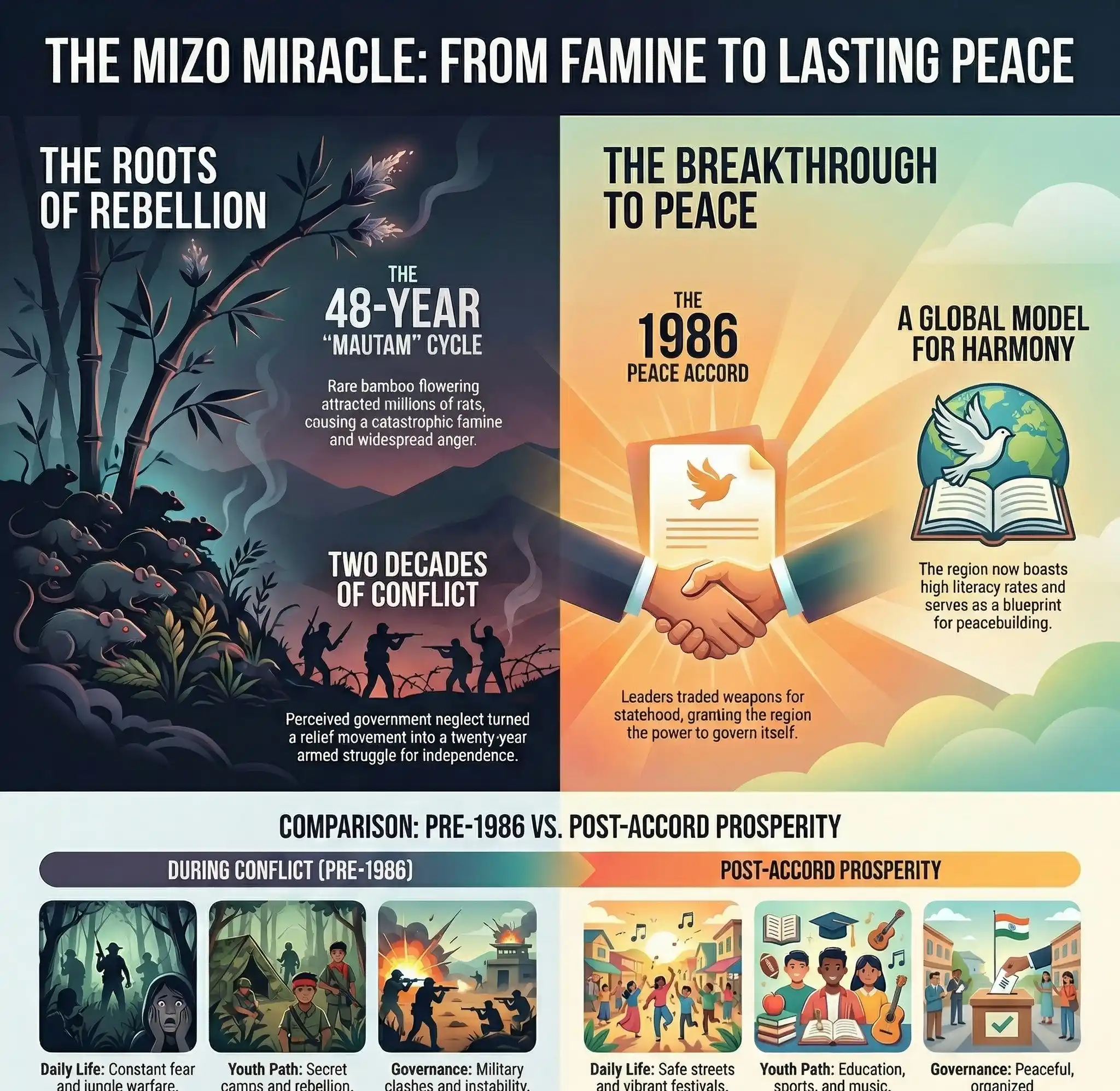
The story of this peace agreement is a beautiful reminder that even the deepest wounds can heal when people choose to listen to each other. For twenty long years, the lush green hills of Mizoram witnessed great sadness and conflict. The local people felt completely ignored during a terrible famine, which eventually led to an armed struggle against the government. Families were torn apart, and the beautiful forests became hiding places for young fighters. However, in the year 1986, leaders from both sides decided that the future of their children was much more important than fighting. They sat down, talked with open hearts, and signed an agreement that brought the fighters back home safely. Today, this agreement stands out globally as one of the most successful peace treaties ever made, turning a place of deep sorrow into one of the most peaceful and highly educated states in the entire country.
| Category | Details |
| Event Name | Signing of the historic peace agreement |
| Year Signed | 1986 |
| Key Figures | Rajiv Gandhi and Laldenga |
| Core Result | End of a twenty year conflict |
| State Formed | Mizoram became a full state in 1987 |
The morning sun rises gently over the green hills of Mizoram today, painting the wide sky in warm shades of gold and pink. Children walk safely to school laughing with their friends, and the sound of joyful church choirs fills the crisp mountain air. It is a place of deep calm and incredible natural beauty. However, the older people in the villages remember a time when the mornings were not so peaceful at all. They remember a time when the hills echoed with fear and the dark shadows held real danger. The journey from those dark days to the bright morning of today is a story of immense courage. It is the story of The Mizo Peace Accord, a magical promise that completely changed the fate of an entire generation.
The shadow of the bamboo famine
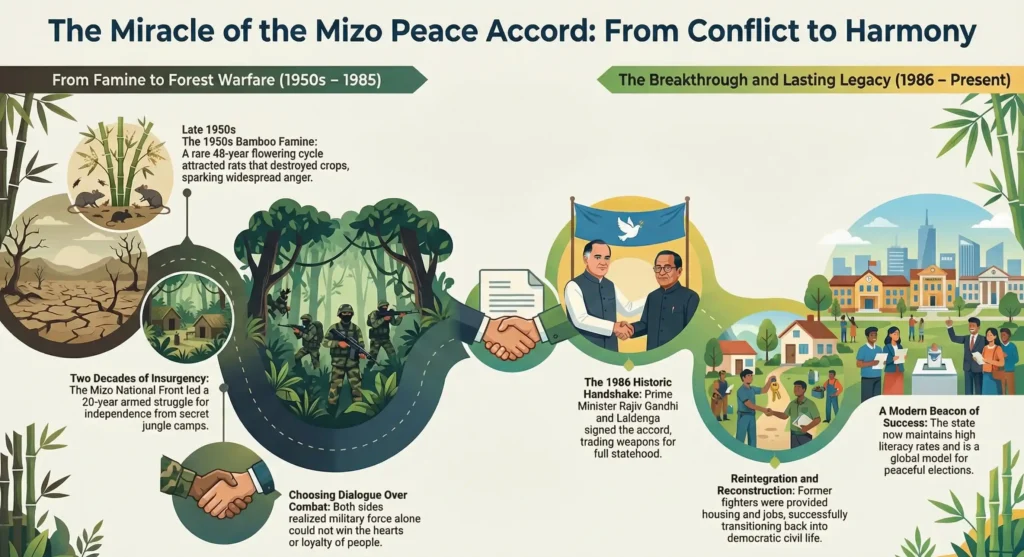
To truly understand the massive value of this peace, we must travel back in time to a very strange and difficult event. In the late 1950s, a rare natural cycle occurred in the dense forests of the region. The wild bamboo plants blossomed with beautiful flowers. While the flowers looked very pretty, they brought a terrible curse to the land. The bamboo seeds attracted millions of rats from the wild. These rats multiplied very fast and soon moved from the forests to the farms, eating all the crops in the fields. The hardworking farmers watched helplessly as their entire year of harvest disappeared in just a few days. The village granaries became completely empty, and a terrible famine swept across the land.
The local people cried out for urgent help from the government leaders located far away in the capital city. They waited anxiously for trucks full of food and medicine. But the help arrived too late and was definitely not enough to feed all the hungry families. The people felt abandoned and entirely ignored by the rest of the country. This deep feeling of neglect planted a dark seed of anger in their hearts. They felt that if no one was going to step up and protect them from starvation, they had to stand up and protect themselves.
The rise of a new movement
Out of this great sadness and growing anger, a strong local leader named Laldenga stepped forward. He formed a special group simply to provide food and relief to the starving people. He walked from village to village, trying to help families survive the disaster. As time passed, and the feeling of unfairness grew, this relief group turned into a political movement called the Mizo National Front. The anger among the youth grew much stronger, and eventually, the group decided to pick up weapons. They firmly believed they had to fight to create a separate, independent land where their people would never be ignored or left to starve again.
The difficult years in the forest
What followed was a heartbreaking period of twenty long years of conflict. The beautiful green forests transformed into scary battlegrounds. Young men left their warm homes and safe schools to live in secret camps deep in the damp jungle. The government sent many soldiers to stop the rebellion, leading to constant clashes. Entire villages had to be moved to new locations, and everyday life was completely broken.
Mothers stayed awake late into the night, praying tightly for the safe return of their sons. Children grew up only knowing the loud, scary sounds of helicopters flying above and guns firing in the distance. The pure joy of the annual harvest festivals was heavily replaced by an ongoing cloud of fear and uncertainty. It was a time when trust was totally lost, and the beautiful state was slowly breaking apart from the inside out.
Finding the courage to talk
Fighting is very easy to start, but it is incredibly difficult to stop once it begins. As the long years turned into decades, both sides slowly realized a very painful truth. The constant violence was not building a better future for anyone; it was only destroying the beautiful land they all claimed to love. The local leaders saw that their bright youth were spending their very best years hiding in the damp, muddy forests instead of getting a good education. At the same time, the national government realized that military force alone could never win the true love and loyalty of the people.
They decided to do something much braver than fighting. They decided to talk. Talking to someone you have fought for twenty years requires immense mental strength. The local leaders traveled all the way to New Delhi and sat across a large table from the government officials. The conversations were very hard and tense at first. There was a lot of old anger and deeply broken trust to repair. But slowly, step by step, they began to actually listen to each other. They began to see the shared humanity in each other’s eyes.
The historic handshake
Finally, in the warm summer of 1986, a beautiful breakthrough happened. The Prime Minister of India at that time, Rajiv Gandhi, and the local leader Laldenga agreed on a complete, fair plan for peace. They signed a historic document that promised a brand new, fresh start for everyone. This important document is what we proudly call the peace agreement today.
The terms were very clear and fair. The rebels agreed to give up their hidden weapons, leave the dark forests, and peacefully return to normal life. In return, the government promised to grant the region full statehood. This meant the local people would finally have the power to govern themselves, make their own local rules, and proudly protect their unique culture without feeling controlled from the outside.
A joyful return home
When the wonderful news of the signed agreement reached the misty hills, pure joy erupted across the entire region. People poured out of their houses into the streets, hugging their neighbors and crying tears of profound relief. Church bells rang loud and clear, echoing happily through the deep valleys to announce the final end of the dark times.
The most emotional moments happened a few days later when the young fighters finally walked out of the dense jungles. They handed over their guns and were welcomed back by their weeping mothers and proud, smiling fathers. The community did not treat them with any anger or punishment. Instead, they welcomed them back with completely open arms and complete forgiveness. The healing process had officially begun.
Why this promise lasted forever
Many times in world history, peace treaties are signed with big smiles but are sadly broken just a few years later. What makes this specific story in India so incredibly special is that the peace lasted forever. It worked perfectly because it was built on deep honesty and absolute mutual respect. The national government kept every single promise it made. The region officially became a full state the very next year.
The former rebel leader Laldenga participated in normal democratic elections and even became the Chief Minister of the new state. The young fighters joyfully traded their dangerous weapons for school books, building tools, and farming equipment. The entire community focused all their powerful energy on rebuilding their broken home rather than looking backward at the past.
The bright morning of today
Today, the state stands as a glowing, bright example of what happens when people actively choose harmony over hatred. It proudly has one of the highest literacy rates in the entire country. The youth are famous everywhere for their amazing talents in music, sports, and higher education. The local streets are incredibly safe, even at night, and the harvest festivals are celebrated again with huge smiles and colorful, traditional dances. The dark days of the bamboo famine and the long, sad conflict are now just stories told to remind the young children about the massive, priceless value of peace.
The journey of the Mizo people teaches the whole world a vital lesson. It proves beyond any doubt that no conflict is too old to be solved. It clearly shows that when leaders have the true courage to compromise and when communities have the massive heart to forgive, a beautiful new beginning is always possible. The hills that once hid frightened fighters now nurture bright students and happy families. It is a true miracle of human connection and a lasting victory for the spirit of unity.
Quick Comparison Table
| Aspect of Life | Before the Agreement | After the Agreement |
| Daily Environment | Constant fear and conflict | Total peace and safety |
| Youth Focus | Hiding in forest camps | Attending schools and colleges |
| Political Status | Ignored territory | A proud and independent state |
| Community Mood | Sorrow and separation | Joy and united families |
Curious Indian: Fast Facts
- The bamboo flowering event that caused the massive rat multiplication is a natural cycle that happens exactly every forty eight years.
- The formal signing ceremony took place safely in New Delhi on the last day of June in the year 1986.
- Upon returning from the forest camps, the former fighters were provided with special housing and jobs to help them start a normal life again.
- The state is now completely famous across the globe for its highly organized and incredibly peaceful democratic elections.
- The huge success of this agreement is constantly used as a perfect model for resolving internal conflicts peacefully.
Conclusion
The signing of The Mizo Peace Accord is not just a dry chapter in a heavy history book; it is a living, breathing proof that love and understanding can conquer decades of pain. The beautiful transformation of the region from a deeply troubled area into a shining beacon of prosperity is a massive inspiration for everyone. It reminds us gently that true strength does not come from holding a weapon or shouting the loudest, but from extending an open hand in friendship. The brave people of these green hills chose to forgive the harsh past so they could build an incredibly bright future for their children and grandchildren. Whenever the world feels divided and full of loud arguments, we can always look to this amazing story in Northeast India. It stands tall as a towering monument to the incredible power of dialogue, the pure beauty of forgiveness, and the unbreakable human desire for a safe and peaceful home.
If you think you have remembered everything about this topic take this QUIZ
What exactly was the main cause of the initial anger?
The anger started when a massive bamboo famine destroyed all the local crops, and the people felt the faraway government completely ignored their cries for urgent help.
Who were the two main leaders that signed the treaty?
The historic document was proudly signed by Rajiv Gandhi representing the national government and Laldenga representing the local movement.
Did the fighters face punishment when they returned?
No, they were welcomed back warmly by their families and the government helped them find jobs and homes so they could live a peaceful life again.
What did the local region gain from stopping the fight?
The region was granted the power to become a fully independent state within the country, allowing them to make their own local laws and protect their unique culture.
Why is this specific agreement considered so successful globally?
It is considered successful because both sides kept every single promise they made, and there has been zero return to violence since the exact day it was signed.