The mysterious passing of Lal Bahadur Shastri in Tashkent remains a significant point of contention in Indian history. Despite the official verdict of a heart attack, the physical condition of his body, the suspicious deaths of key witnesses, and the government's refusal to conduct a post-mortem or release classified files have kept the conspiracy alive. The event occurred just after the signing of the Tashkent Declaration, leading many to believe that his death was not natural but a calculated assassination intended to alter India's political and nuclear trajectory during the Cold War.| Key Detail | Information |
| Subject | Lal Bahadur Shastri |
| Date of Death | January 11, 1966 |
| Location | Tashkent, USSR (now Uzbekistan) |
| Official Cause | Myocardial Infarction (Heart Attack) |
| Key Witnesses | Jan Mohammed (Cook), Dr. R.N. Chugh |
| Primary Conflict | Indo-Pakistani War of 1965 |
The Lal Bahadur Shastri death mystery is perhaps the darkest chapter in the political history of independent India. On the night of January 10, 1966, the ancient city of Tashkent was gripped by a winter chill that seemed to seep into the very bones of history.
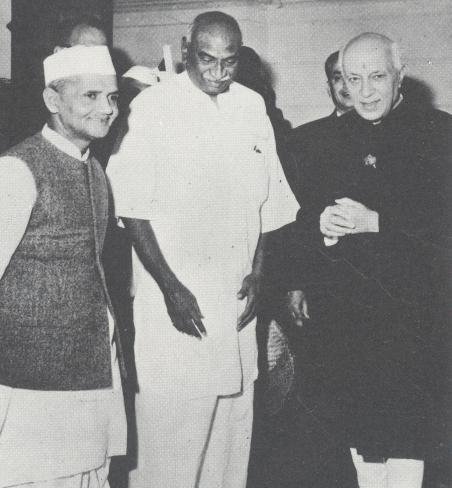
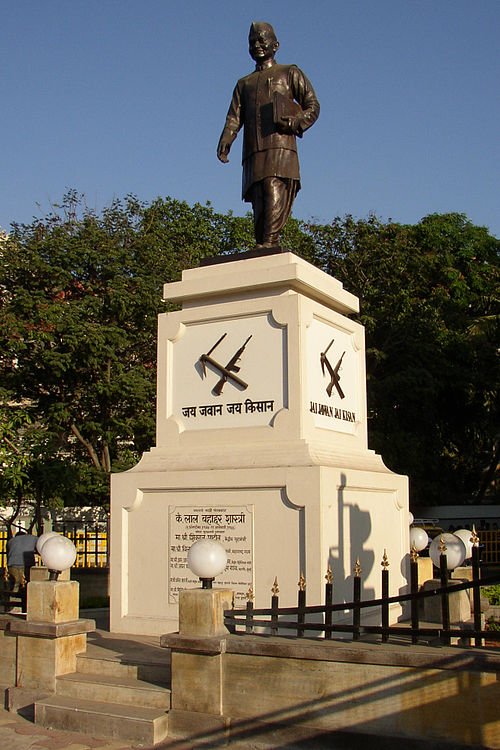
Lal Bahadur Shastri, the “Little Man” with a spine of steel, had just signed a historic peace treaty. He was the man who gave India the slogan “Jai Jawan, Jai Kisan.” He was the leader who had just led India to victory in the 1965 war. Yet, hours after the champagne toasts at Premier Alexei Kosygin’s reception, he was gone.
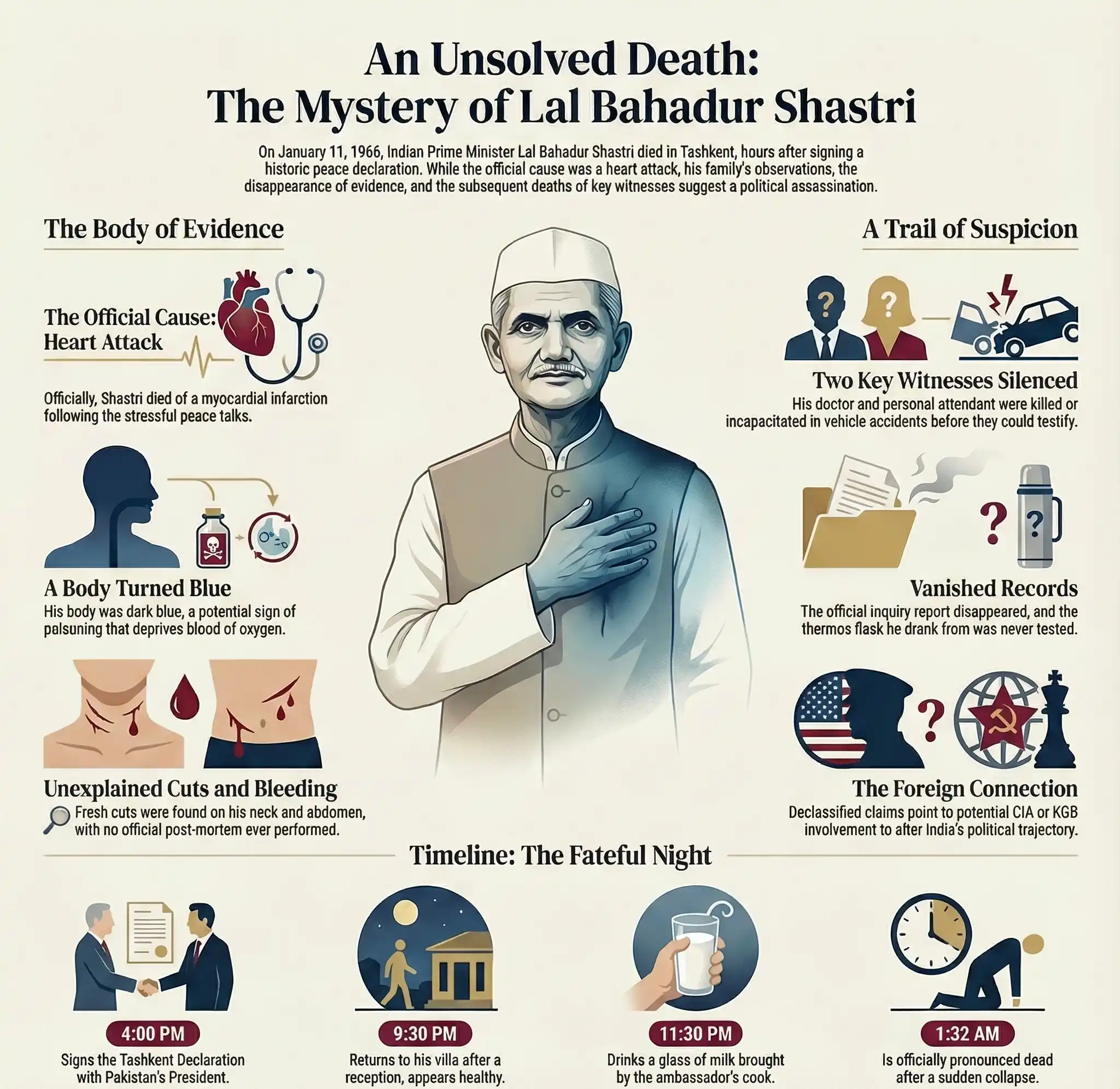
Official reports called it a massive heart attack. But as his body returned to New Delhi, dark, bloated, and bleeding from unexplained cuts, his widow screamed a question that has echoed for five decades: “If it was a heart attack, why is his body blue?”.
Welcome to the second chapter of Unsolved India, where we peel back the layers of a mystery involving vanished medical evidence, silenced witnesses, and the Cold War’s deadliest intelligence agencies.
The Roopkund Skeleton Lake Mystery: Why Were Greeks Dying in the Indian Himalayas?
The Man in Khadi: A Portrait of Integrity
To understand why this death was such a tragedy, one must understand the man who died. Lal Bahadur Shastri was an anomaly in the landscape of power. He possessed a moral authority that was adamantine.
A single anecdote defines his character. In 1964, despite being the Prime Minister, Shastri did not own a car. When his family urged him to buy one, he found that a Fiat cost ₹12,000. He had only ₹7,000 in his savings. The Prime Minister of India was ₹5,000 short.
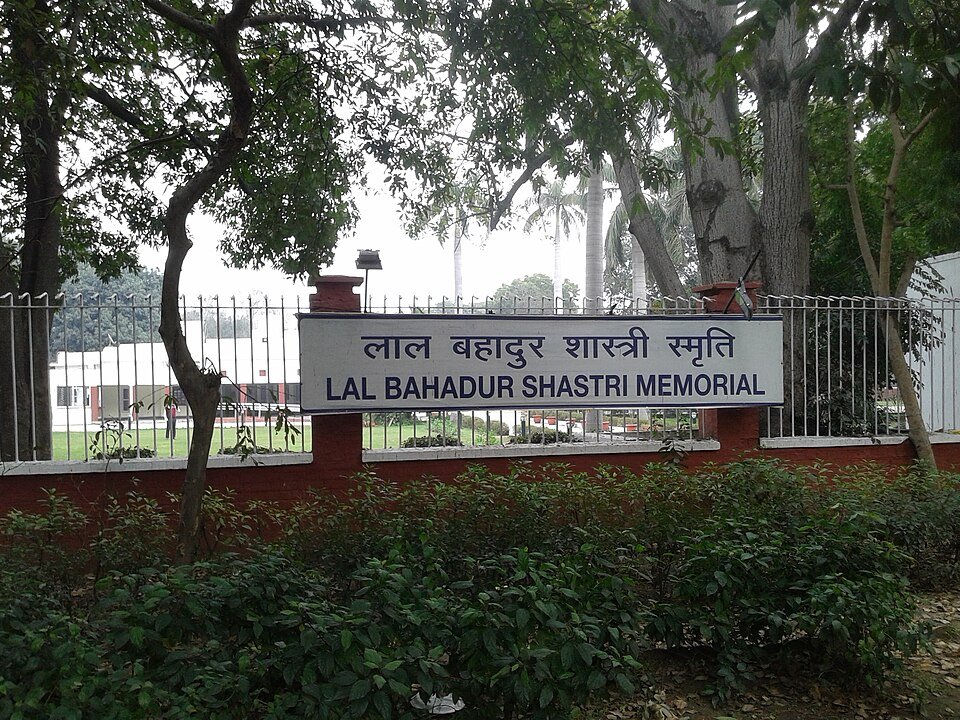
He applied for a bank loan from Punjab National Bank, which was sanctioned the same day. He would never live to repay it. After his death, his widow, Lalita Shastri, repaid that loan rupee by rupee from her pension. That cream-colored Fiat, registration number DLE 6, still stands at his memorial today—a silent witness to an era of lost innocence.
The Fateful Night: January 10, 1966
The timeline of that night is crucial to the Lal Bahadur Shastri death mystery.
At 4:00 PM, Shastri signed the Tashkent Declaration. It was a controversial move; he had agreed to return the strategic Haji Pir Pass to Pakistan to buy peace. At 8:00 PM, he attended a grand reception hosted by Soviet Premier Kosygin. He appeared healthy and in high spirits. He returned to his dacha (villa) around 9:30 PM and ate a light meal prepared by Jan Mohammad, the ambassador’s cook—not his personal cook, Ram Nath.
The Heartbreaking Phone Call
Before sleeping, Shastri made a call to his family in Delhi that would haunt his final moments. He spoke to his daughter, Kusum, asking about the reaction in India regarding the peace treaty.
Kusum was blunt: “Babuji, hamein achha nahin laga” (Father, we did not like it). She told him that his wife, Lalita, was so upset she refused to come to the phone.
This rejection from his own home shook him deeply. Witnesses reported him pacing his room, muttering, “Agar ghar walon ko achha nahin laga, to bahar wale kya kahenge?” (If my family didn’t like it, what will the outsiders say?). Skeptics argue this stress was used as a convenient excuse to explain a “heart attack,” masking a more sinister reality.
7 Secrets of Padmanabhaswamy Temple Treasure
The “Poisoned Chalice” and The Injection
At 11:30 PM, Shastri requested a glass of milk. It was brought by Jan Mohammad. This glass of milk has become the “poisoned chalice” of Indian political lore.
Around 1:20 AM, Shastri woke up in severe distress. In a baffling security lapse, his room had no functioning intercom. The Prime Minister of India had to walk to the door himself, gasping, “Doctor sahib ko bulao” (Call the doctor).
When his physician, Dr. R.N. Chugh, arrived, Shastri pointed to the thermos flask on his bedside table, indicating the water or milk was the source of his agony.
Dr. Chugh acted swiftly. He did not treat it as a simple heart attack; he fought a total systemic collapse. He administered an injection of Mepthentin Sulphate and Miccrena directly into the muscle.
Medical Insight: Mepthentin is used to treat severe hypotension (low blood pressure). Its use confirms that Shastri’s blood pressure had crashed—a symptom consistent with poisoning, not just cardiac arrest.
Despite these efforts, at 1:32 AM, Lal Bahadur Shastri was dead.
The Body That Spoke of Murder
When the body arrived in Delhi, the family was horrified.
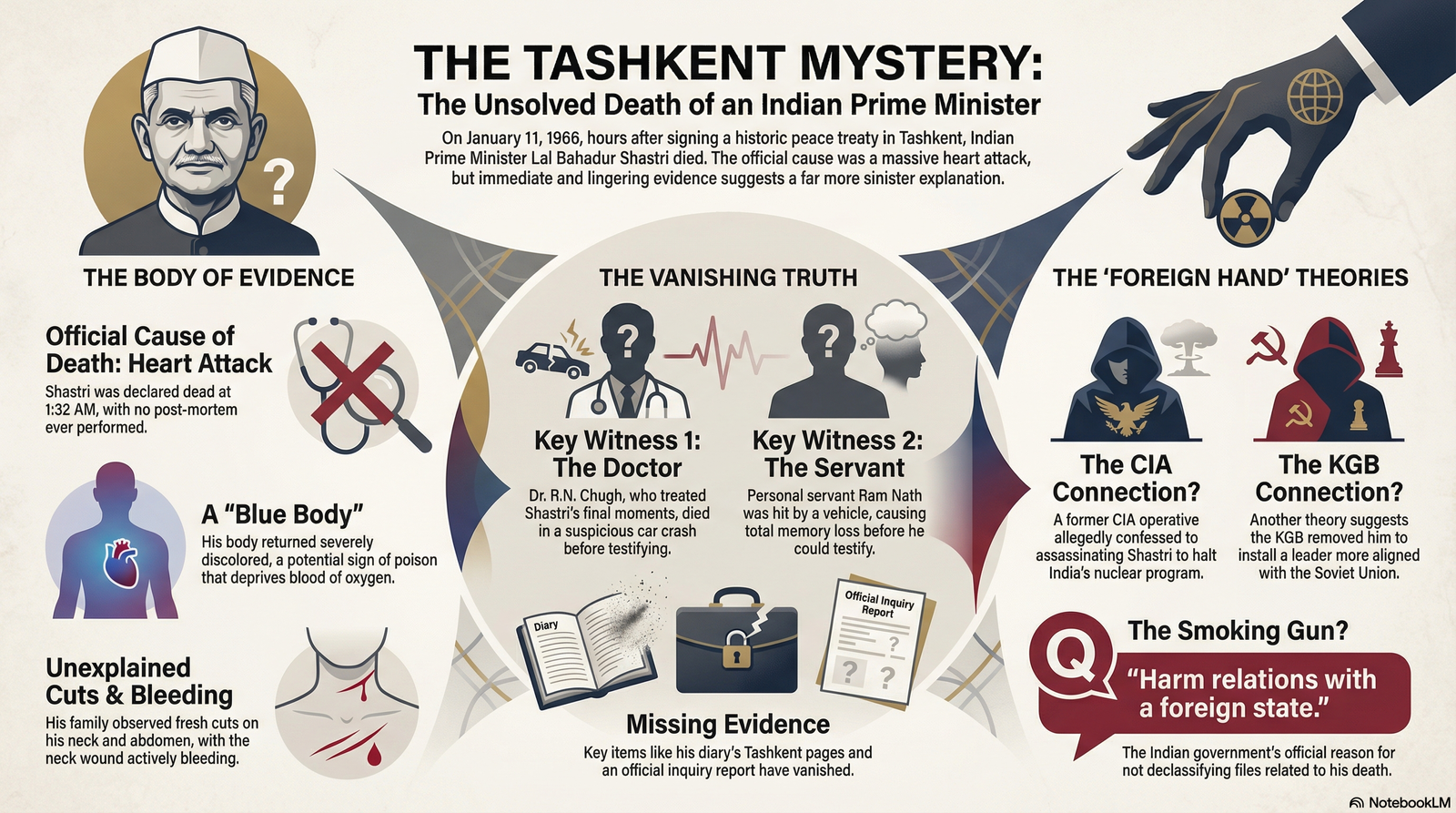
The Blue Body: The body had turned dark blue, bordering on black. While livor mortis causes some discoloration, Shastri’s face and chest were severely discolored, a sign often associated with poisons that deprive the blood of oxygen.
The Cuts: Fresh cut marks were visible on his neck and abdomen. The cut on the neck was reportedly “pouring blood,” soaking the sheets. There was also a cross-like incision on his abdomen covered with a bandage.
If the official story was a “natural heart attack” and no post-mortem was performed, who made those incisions, and why?.
The Syama Prasad Mookerjee Death Mystery: 5 Hidden Facts
The Witnesses Who Were Silenced
If the death was a mystery, the aftermath was a calculated cover-up. The two key witnesses who could have revealed the truth were systematically eliminated.
1. The Doctor: Dr. R.N. Chugh Dr. Chugh was the only man who knew the symptoms Shastri displayed in those final 10 minutes. In 1977, he was summoned to testify before the Raj Narain Committee. While driving to Delhi for the testimony, his car was rammed by a truck. Dr. Chugh, his wife, and his son were killed instantly. The primary medical witness was silenced before he could speak a word on record.
2. The Servant: Ram Nath Ram Nath, the personal servant who was in the room, was also hit by a vehicle before he could testify. He survived but suffered total memory loss. He lived the rest of his life unable to recall the events of Tashkent.
The statistical probability of both key witnesses being hit by trucks just days before testifying is virtually zero.
The Missing Files and Foreign Hands
Just like the Netaji mystery, the evidence in the Lal Bahadur Shastri death mystery has vanished.
The Missing Report: The Raj Narain Inquiry of 1977 investigated the death, but no report was ever tabled. The Parliament Library has no record of it—it has simply disappeared.
The Missing Flask: The thermos flask Shastri drank from was never returned to the family and never tested.
The CIA Connection: Was it the Cold War? In the book Conversations with the Crow, former CIA operative Robert Crowley allegedly claimed, “We nailed Shastri… and we nailed Bhabha too”. The motive? India’s nuclear program. Shastri had given the green light to nuclear tests. Just 13 days after Shastri’s death, Dr. Homi Bhabha (father of the Indian nuclear bomb) died in a mysterious plane crash. Two of India’s greatest strategic minds were removed in two weeks.
The KGB Connection: Others point to the KGB. The Mitrokhin Archive reveals that the KGB had codenamed Indira Gandhi “VANO” and viewed India as a model of infiltration. Shastri was a Gandhian, not a socialist. His removal paved the way for a leadership more aligned with the Soviet Union.
| Timeline of January 10, 1966 | Event | Context |
| 4:00 PM | The Signing | The Tashkent Declaration is signed by Shastri and Ayub Khan at the Neutral Hall. |
| 8:00 PM | The Reception | Premier Kosygin hosts a grand banquet. Shastri attends, reportedly in high spirits, interacting with guests.11 |
| 9:30 PM | Return to Villa | Shastri returns to his dacha (villa). He is accompanied by his personal staff. |
| 10:00 PM | The Last Meal | A light dinner is prepared by Jan Mohammad, the ambassador’s cook.3 |
Conclusion: The Unquiet Ghost
The official narrative asks us to believe in a series of impossibilities: that a Prime Minister died of a heart attack yet bled from cuts; that an autopsy was denied to “avoid embarrassment”; and that the files containing the truth are lost forever.
In 2018, the Prime Minister’s Office admitted it holds one classified document related to the death but refused to release it, citing that it would harm “relations with a foreign state”. This admission is the smoking gun. If he died a natural death, how could the truth harm foreign relations 50 years later?.
Lal Bahadur Shastri was the “Little Man” who cast a shadow too large for his enemies to ignore. The Fiat DLE 6 stands in Delhi, rusting slowly—a symbol of a time when leaders served the nation, and the nation failed to protect them.
The Purulia Arms Drop Mystery 1995: When the Sky Rained Guns
| Feature | Official Narrative (Natural Death) | Conspiracy Narrative (Foul Play) |
| Cause of Death | Acute Myocardial Infarction (Heart Attack) | Poisoning (Cyanide or Nerve Agent) |
| Pre-Death Condition | Healthy, cheerful at reception. Stressed by phone call. | Healthy at reception. Distress began after drinking milk. |
| Body Condition | Normal post-mortem changes. | Dark blue/black discoloration; cuts on neck and stomach. |
| Witness Fate | Dr. Chugh and Ram Nath died/injured in accidental road crashes. | Witnesses were systematically eliminated to prevent testimony. |
| Medical Evidence | History of two previous heart attacks. | Use of cardiac stimulants (Mepthentin) suggests systemic collapse; missing thermos flask. |
| State Response | No autopsy needed; death was natural. | Autopsy denied to hide evidence; files classified to protect “foreign relations.” |
| Key Beneficiary | None (Tragedy for the nation). | Indira Gandhi (Political power); USA (Stopped nuclear program); USSR (Ensured loyal ally). |
Curious India: Fast Facts
The Fiat DLE 6: Shastri ji died owing ₹5,000 to PNB for his car loan. His widow repaid it from her pension.
The Missing Diary: Shastri maintained a daily diary. After his death, it was returned to the family, but the pages documenting the Tashkent trip were torn out/missing.
The Last Words: His last words were reportedly “Amma, Babuji” (Mother, Father) before collapsing.
If you think you have rememberd everything about this topic take this QUIZ
Results

#1. What was the official cause of Lal Bahadur Shastri’s death, and what specific physical sign on his body aroused his family’s suspicions? ? Hint
Consider the contrast between the government’s explanation and what his family observed upon the return of his body.
#2. The story of Shastri’s Fiat DLE 6, for which he took out a bank loan, is used in the text to primarily illustrate what aspect of his character? ? Hint
Think about why the Prime Minister of a country would not have enough savings to buy a common family car.
#3. What was the nature of the distressing final phone call Lal Bahadur Shastri had with his daughter, Kusum? ? Hint
The conversation revolved around the political agreement he had just signed.
#4. According to the medical insight in the text, why was Dr. Chugh’s decision to administer Mepthentin Sulphate significant? ? Hint
Focus on what the specific medication treats and how that symptom relates to the different theories about his death.
#5. What suspicious fates befell the two key witnesses, Dr. R.N. Chugh and Ram Nath, before they could formally testify? ? Hint
The text highlights the statistically improbable nature of what happened to both men just before they were scheduled to speak.
#6. The source material connects the alleged CIA involvement in Shastri’s death with the death of which other prominent Indian? ? Hint
The motive for this theory was to stop India’s strategic ambitions in a particular scientific field.
#7. Besides the missing Raj Narain Inquiry report and torn diary pages, which crucial piece of physical evidence was never secured for investigation? ? Hint
This object is directly linked to the theory that he ingested a fatal substance.
#8. What is the primary reason the Indian government’s refusal to declassify a file on Shastri’s death is considered a “smoking gun” by theorists? ? Hint
Consider why the truth about a natural death would affect international relations decades later.
This article is part of our exclusive series Unsolved India. Stay tuned for more chapters where we will explore more unsolved mysteries of India.
- Read the previous chapter: The Netaji Subhas Chandra Bose Disappearance.


Was a post-mortem conducted on Lal Bahadur Shastri?
No. Despite the strange color of the body and the bleeding wounds, no post-mortem was conducted in Russia or India. The government claimed it was to avoid “international embarrassment”.
Who was Jan Mohammad?
Jan Mohammad was the cook for the Indian Ambassador to Moscow, T.N. Kaul. He prepared Shastri’s meals in Tashkent instead of Shastri’s personal cook, Ram Nath. He was later employed at the Rashtrapati Bhavan, which some critics view as a reward.
What happened to Dr. R.N. Chugh?
Dr. Chugh, Shastri’s personal physician, died in a mysterious road accident in 1977 along with his family, while he was on his way to testify before the committee investigating Shastri’s death.
Did the CIA kill Lal Bahadur Shastri?
It is a leading theory. Former CIA officer Robert Crowley allegedly confessed that the CIA eliminated Shastri and Homi Bhabha to stop India from becoming a nuclear power.
Why does the government refuse to declassify the Shastri files?
The PMO has stated under the RTI Act that declassifying the document would “harm relations with a foreign state,” implying that a foreign power (USA or USSR) was involved in the death.