In 1671, on the narrow waters of the Brahmaputra River at Saraighat in present-day Guwahati, one of the most remarkable military upsets in Indian history quietly unfolded. A small but fiercely determined Ahom Kingdom, led by the brilliant and gravely ill general Lachit Borphukan, stood its ground against a colossal Mughal armada sent by Emperor Aurangzeb under the command of Raja Ram Singh I. Using riverine tactics, psychological warfare, guerrilla intelligence, and a breathtaking display of personal courage, Lachit forced the Mughals into retreat — not just from the battlefield, but from Assam forever in spirit. The Battle of Saraighat became the last serious Mughal attempt to conquer the Northeast, and Lachit Borphukan became an immortal symbol of what one person's conviction can do against seemingly impossible odds.
| Detail | Information |
|---|---|
| Battle Name | Battle of Saraighat |
| Date | 1671 CE (March) |
| Location | Saraighat, Brahmaputra River, Guwahati, Assam |
| Ahom Commander | Lachit Borphukan |
| Mughal Commander | Raja Ram Singh I (Kachwaha) |
| Mughal Emperor | Aurangzeb |
| Type of Battle | Naval + Land (primarily riverine) |
| Outcome | Decisive Ahom Victory |
| Significance | Last major Mughal attempt to conquer Assam |
| Lachit’s Lifespan | 24 Nov 1622 – 25 April 1672 |
| Lachit Divas | Celebrated annually on 24th November in Assam |
| Memorial | Lachit Maidam, Holongapar, Jorhat |
How Lachit Borphukan Won the Battle of Saraighat
A Nation on Its Knees — and Then One Man Stood Up
Picture Assam in 1663. A proud kingdom, the Ahom dynasty — which had ruled the Brahmaputra Valley for over 400 years — had just been humiliated. The Mughal general Mir Jumla had swept through, occupied the Ahom capital, and forced a brutal peace treaty called the Treaty of Ghilajharighat. The Ahom king was made to bow to Emperor Aurangzeb. Treasure was surrendered. Territory was lost. An Ahom princess was given away as part of the deal.
The Ahom king Jayadhwaj Singha never recovered. He died in despair, but not before urging his cousin and successor Chakradhwaj Singha to “remove the spear of humiliation from the bosom of the nation.” Those words lit a fire that would burn for years — and eventually, it would blaze on the waters of the Brahmaputra.
Sukaphaa’s Crossing: How the Ahom Kingdom Was Born in Assam
The Man Chosen to Carry a Nation’s Honour
Lachit Borphukan was born on 24 November 1622 to Momai Tamuli Borbarua, a commoner who rose to become one of the most powerful officials in the Ahom kingdom. He grew up understanding both the art of war and the weight of responsibility. Before he ever became a general, he held posts like Superintendent of the Royal Horses, Commander of the strategic Simulgarh Fort, and Superintendent of the Royal Household Guards. He was trained, tested, and trusted.
When King Chakradhwaj Singha decided it was time to take Guwahati back from the Mughals, he didn’t think twice about who to call. Lachit was appointed Commander-in-Chief and given a golden-handled sword called the Hengdang — a symbol of the kingdom’s total faith in him.
What followed was a masterclass in military planning. In August 1667, Lachit established his base at Kaliabor and launched a campaign to retake Guwahati. After several battles, he successfully recaptured it in November 1667. Borthakursias academy The Mughals were pushed out. But everyone knew they would be back — bigger, angrier, and better prepared.
The Mughal War Machine Rolls In
By 1671, the patience of Emperor Aurangzeb had run out. He sent Raja Ram Singh I — a formidable Rajput commander from Amber — with one of the most powerful forces ever assembled for a campaign in the Northeast.
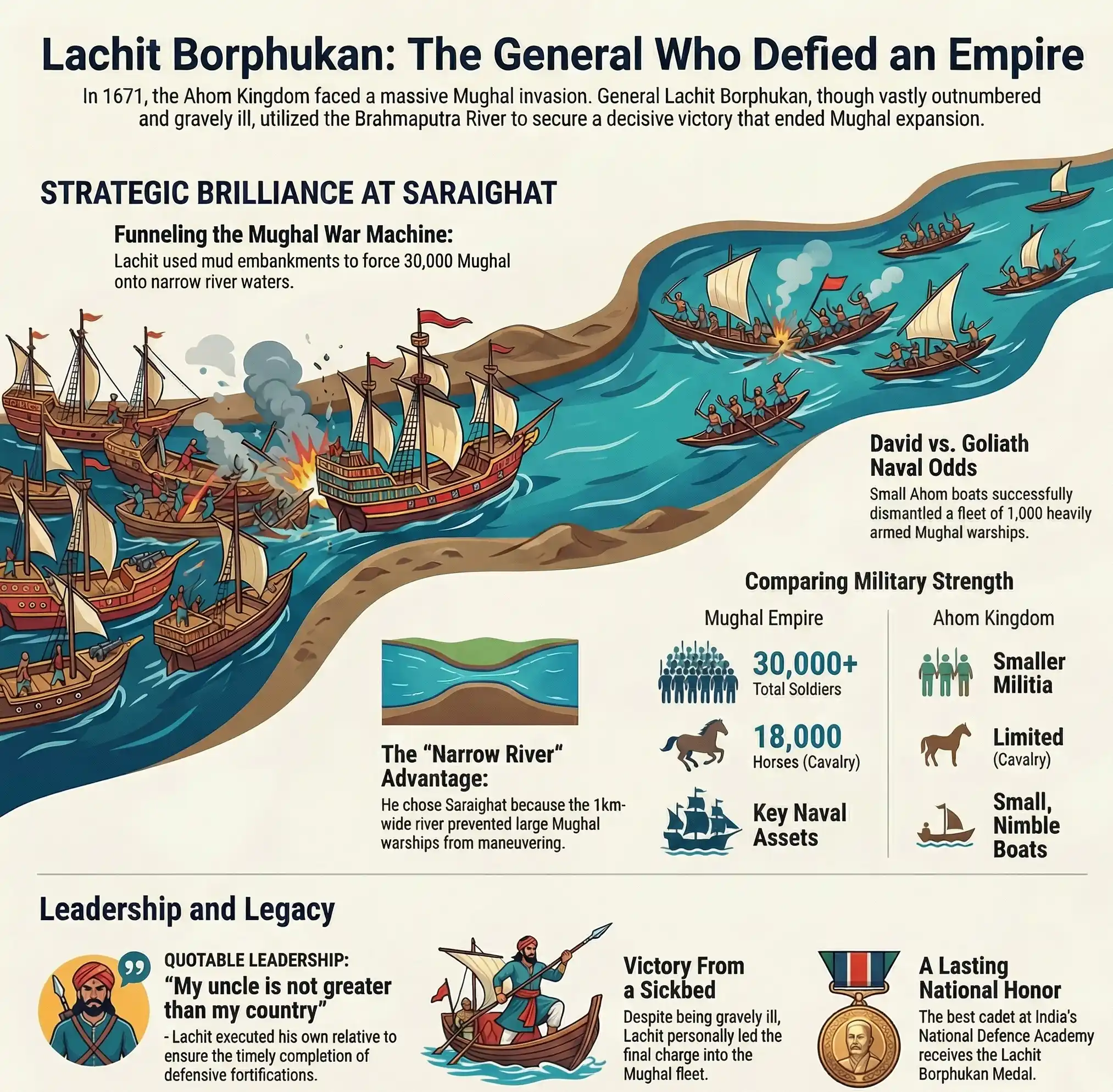
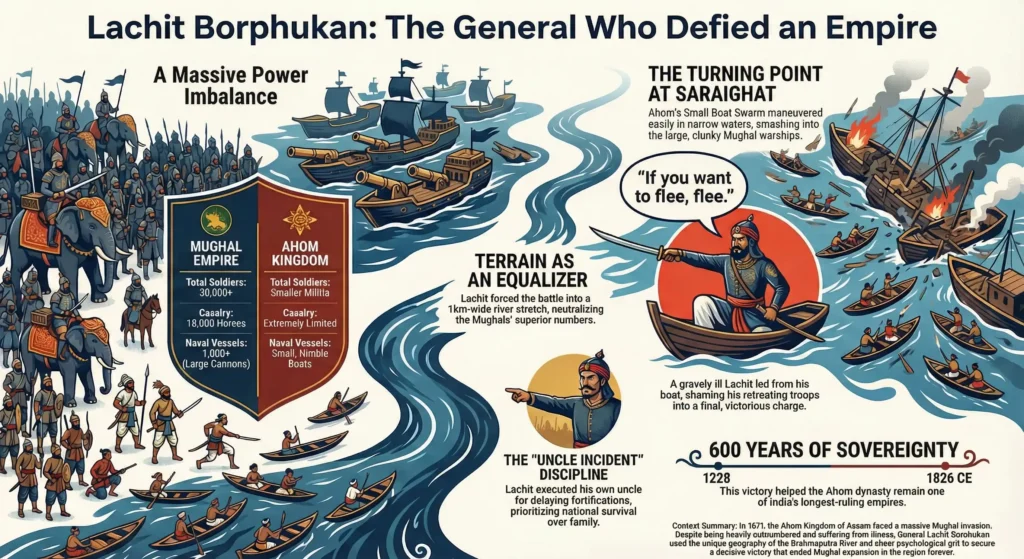
Ram Singh led a formidable army numbering over 30,000 soldiers, including 18,000 cavalry, and 1,000 warboats, aiming to annex Assam and suppress the resistance of the Ahoms. Borthakursias academy They also had large vessels equipped with up to sixteen cannons each, and skilled foreign gunners. On paper, it wasn’t even a contest.
But Lachit had a plan. And the plan was brilliant.
The Genius of Lachit’s Battlefield Strategy
Lachit understood something fundamental about warfare that many commanders miss — it’s not about where your enemy is strongest, it’s about where you can be strongest.
Aware of the Mughal military might and the weakness of the Ahom militia, especially against professional cavalry in open fields, Lachit and his commanders chose the terrain of the battlefield with great care. The choice fell on Guwahati — hilly, on the way to the heart of the Ahom kingdom, and without open fields where the Mughal cavalry would have mobility.
He then built an elaborate system of mud embankments across Guwahati, making land movement nearly impossible. If the Mughals wanted to advance east, they had only one real option — come by river.
And that was exactly where Lachit wanted them.
The Ahoms created mud embankments specifically designed to make cavalry movement difficult, forcing the Mughals to take the naval route — the very route where Ahoms knew naval defence was the Mughal’s weakest point.
Months of diplomacy, feints, and smaller skirmishes followed — including a painful loss at the Battle of Alaboi in 1669, where the Ahoms suffered greatly. But Lachit absorbed that defeat, learnt from it, and kept building toward one decisive moment.
The Day a Sick Man Saved a Kingdom
When the final clash came at Saraighat, fate had one more cruel twist in store. Lachit Borphukan was gravely ill. He could barely stand. His officers were rattled. Some boats had even begun to retreat.
This was the moment that made Lachit immortal.
Despite his illness, Lachit had himself carried to a boat and, with seven vessels alongside him, advanced headlong into the Mughal fleet. He shouted to his men: “If you want to flee, flee. The king has given me a task here and I will do it well. Let the Mughals take me away. You report to the king that his general fought well following his orders.”
Those words hit like lightning. The retreating soldiers turned around. The entire Ahom fleet surged forward.
The Ahoms entered the river with a large number of small boats very quickly and smashed them into the large Mughal warships. It took a lot of work for the Mughals to maneuver against this attack. The Ahoms created a combined front and rear attack by filling the triangle in the Brahmaputra River with men and boats — between Itakhuli, Aswakranta, and Kamakhya.
During the battle, Mughal admiral Munnawar Khan was killed by a gunshot. This decisive action pushed the Mughals back to the Manas River, the western boundary of the Ahom Kingdom.
The Mughal armada — with all its cannons, cavalry, and imperial pride — had been defeated by smaller boats, sharper minds, and one man’s refusal to give up.
The Story Doesn’t End in Victory
Here’s where the story gets bittersweet. Lachit Borphukan died in April 1672 — just about a year after his greatest victory. His last remains lie at the Lachit Maidam in Holongapar, Jorhat.
He never saw Assam fully secured. In 1682, during the reign of Swargadeo Gadadhar Singha, the Battle of Itakhuli was fought between the two forces, and the Mughals were expelled from Assam forever. But it was Lachit’s battle — the one he fought from a sickbed on the Brahmaputra — that broke the Mughal will and made that final expulsion possible.
Why the World Needs to Know This Story
Lachit Borphukan’s story isn’t just an Assamese story. It’s one of the great stories of human defiance. A man who had everything working against him — numbers, weaponry, his own failing health — and still chose to fight, still chose to lead, still chose to win.
Every year on 24th November, Assam celebrates Lachit Divas as a state holiday to commemorate the heroism of the great general and the victory at Saraighat. And in 2000, his statue was unveiled at the National Defence Academy in Pune — finally giving this extraordinary commander the national recognition he always deserved.
The Brahmaputra still flows through Guwahati. The hills of Kamakhya still stand. And somewhere in those waters, the memory of a brave general who wouldn’t let his people lose lives on — not as a lesson from a textbook, but as a reminder of what one person, one choice, one moment of courage can do.
Quick Comparison Table: Ahom vs. Mughal Forces at Saraighat (1671)
| Factor | Ahom Kingdom | Mughal Empire |
|---|---|---|
| Commander | Lachit Borphukan | Raja Ram Singh I |
| Army Size | Smaller militia | 30,000+ soldiers |
| Cavalry | Limited | 18,000 horses |
| Naval Strength | Small, nimble boats | 1,000+ warships, 16-cannon vessels |
| Key Advantage | Terrain knowledge, riverine tactics | Numerical & technological superiority |
| Psychological Edge | Lachit’s personal leadership | Failed — demoralized after admiral’s death |
| Outcome | ✅ Victory | ❌ Retreat to Manas River |
Curious Indian: Fast Facts
- The Tiger Commander: Lachit’s warrior Bagh Hazarika — whose name literally means “Tiger” — killed a tiger with his bare hands and was given his title for that feat of raw courage.
- The Uncle Incident: Lachit once beheaded his own maternal uncle for slowing down the construction of defensive embankments. His exact words: “My uncle is not greater than my country.”
- A Legend at NDA: Lachit Borphukan’s statue stands at the National Defence Academy in Pune — the only pre-modern Indian commander honored this way.
- 600-Year Dynasty: The Ahom Kingdom ruled Assam for nearly 600 years (1228–1826 CE) — longer than almost any other dynasty in Indian history.
- The Narrow River Trick: Lachit deliberately chose Saraighat because the Brahmaputra there narrows to just about 1 km — making large Mughal warships impossible to maneuver.Lachit Divas: Every 24th November, Assam observes a state holiday in his honour — and the best NDA cadet each year receives the prestigious Lachit Borphukan Gold Medal.
Conclusion
The Battle of Saraighat is more than a chapter in a history book — it’s a feeling. It’s the feeling you get when you realize that the greatest battles are rarely won by the biggest army. They are won by the clearest mind, the strongest heart, and the person willing to stand up when everyone else is sitting down.
Lachit Borphukan was that person. On a narrow stretch of river, with illness in his bones and fire in his eyes, he looked at the most powerful empire in India and said — not here, not today, not ever.
And he was right.
If you think you have remembered everything about this topic take this QUIZ
What was the Battle of Saraighat?
The Battle of Saraighat was a decisive naval battle fought in 1671 on the Brahmaputra River in present-day Guwahati, Assam. The Ahom Kingdom, led by Lachit Borphukan, defeated the Mughal Empire’s forces led by Raja Ram Singh I.
Why is the Battle of Saraighat so important in Indian history?
It was the last major attempt by the Mughal Empire to conquer Assam. The Ahom victory halted Mughal expansion into Northeast India and showcased one of the most brilliant uses of riverine warfare strategy in medieval Indian military history.
How did Lachit Borphukan use psychological warfare at Saraighat?
When Ahom boats began retreating, the gravely ill Lachit had himself carried to the front of battle on a boat and publicly declared he would fight alone if needed. This act of personal courage instantly reversed the morale of his troops and terrified the Mughals.
What happened to Lachit Borphukan after the battle?
Lachit Borphukan passed away in April 1672, just about a year after his victory at Saraighat. He is buried at the Lachit Maidam in Holongapar, Jorhat, Assam, which remains a revered memorial to this day.
How is Lachit Borphukan remembered today?
Assam celebrates Lachit Divas every year on 24th November. The best graduating cadet at India’s National Defence Academy in Pune receives the Lachit Borphukan Gold Medal. His statue also stands at the NDA campus, cementing his place as one of India’s greatest military heroes.