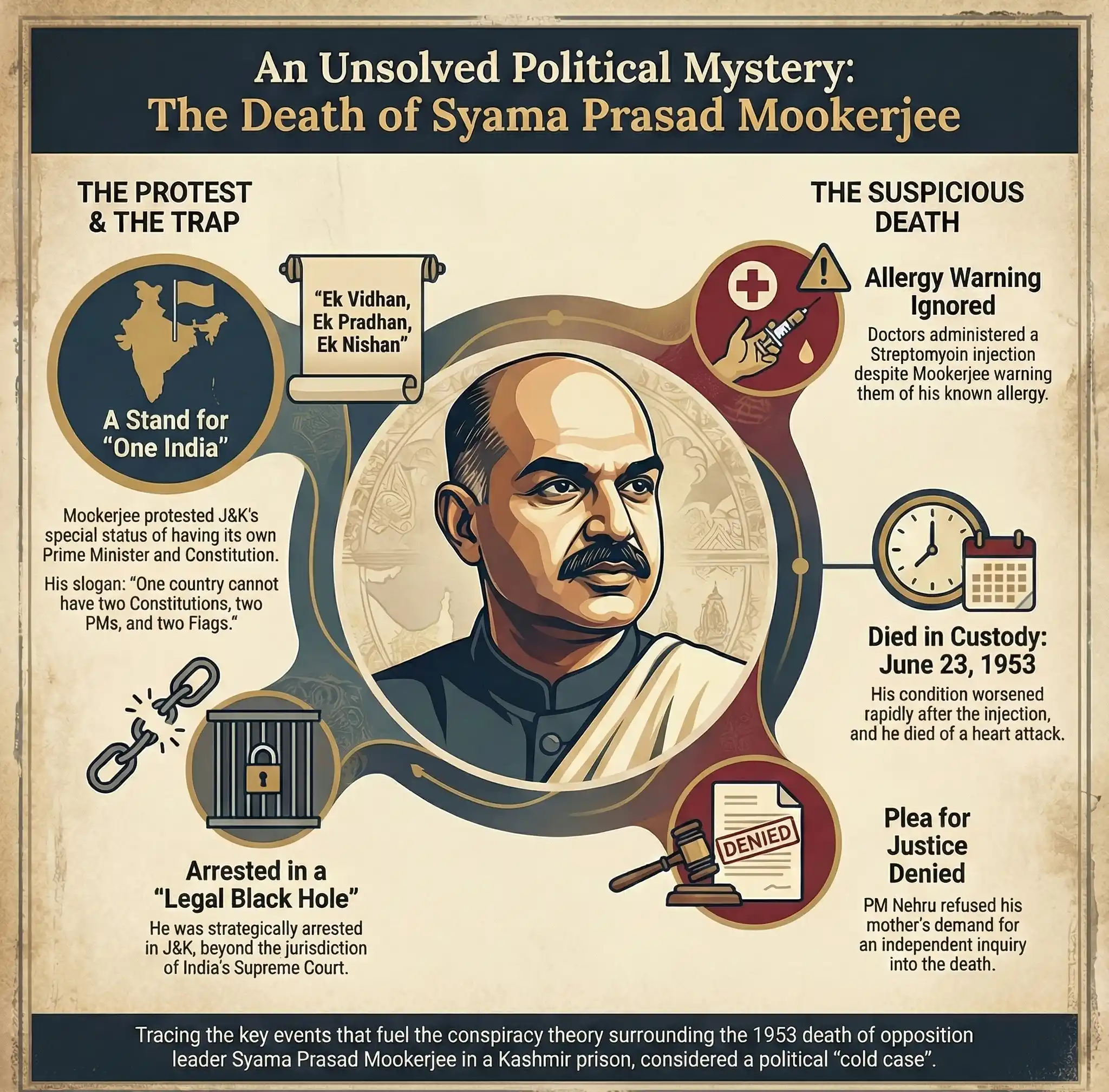
The Syama Prasad Mookerjee death mystery centers on the suspicious circumstances surrounding his detention in Srinagar in 1953. After being arrested in a location that barred intervention from the Indian Supreme Court, Mookerjee allegedly died of a heart attack. However, evidence suggests he was administered a drug he was known to be allergic to, and his personal records of the event went missing. Despite national outcry and his mother's demands, no formal inquiry was ever conducted.| Field | Details |
| Fact Card | |
| Name | Dr. Syama Prasad Mookerjee |
| Date of Death | June 23, 1953 |
| Location | Srinagar, Jammu & Kashmir |
| Primary Cause | Heart Attack / Pleurisy (Official); Medical Murder (Alleged) |
| Famous Slogan | “Ek Vidhan, Ek Pradhan, Ek Nishan” |
The Syama Prasad Mookerjee death mystery is the original political cold case of independent India. Long before Lal Bahadur Shastri died in Tashkent or Homi Bhabha’s plane crashed in the Alps, Dr. Syama Prasad Mookerjee—the Lion of Bengal—died in a prison in Kashmir.
He was 52 years old, healthy, and the most vocal critic of Prime Minister Jawaharlal Nehru. His crime? He wanted to enter Jammu & Kashmir without a permit, asserting that an Indian citizen should not need a visa to travel within their own country.
On May 11, 1953, he crossed the border to make a point. On June 23, 1953, he returned in a coffin.
Official records call it a heart attack caused by pleurisy. But for his family and millions of followers, it was a “medical murder”—a convenient elimination of a political rival who was becoming too powerful to ignore.
Welcome to the Unsolved India, where we travel to the makeshift prison in Srinagar that became a death chamber for one of India’s founding fathers.
The Context: “Ek Vidhan, Ek Pradhan, Ek Nishan”
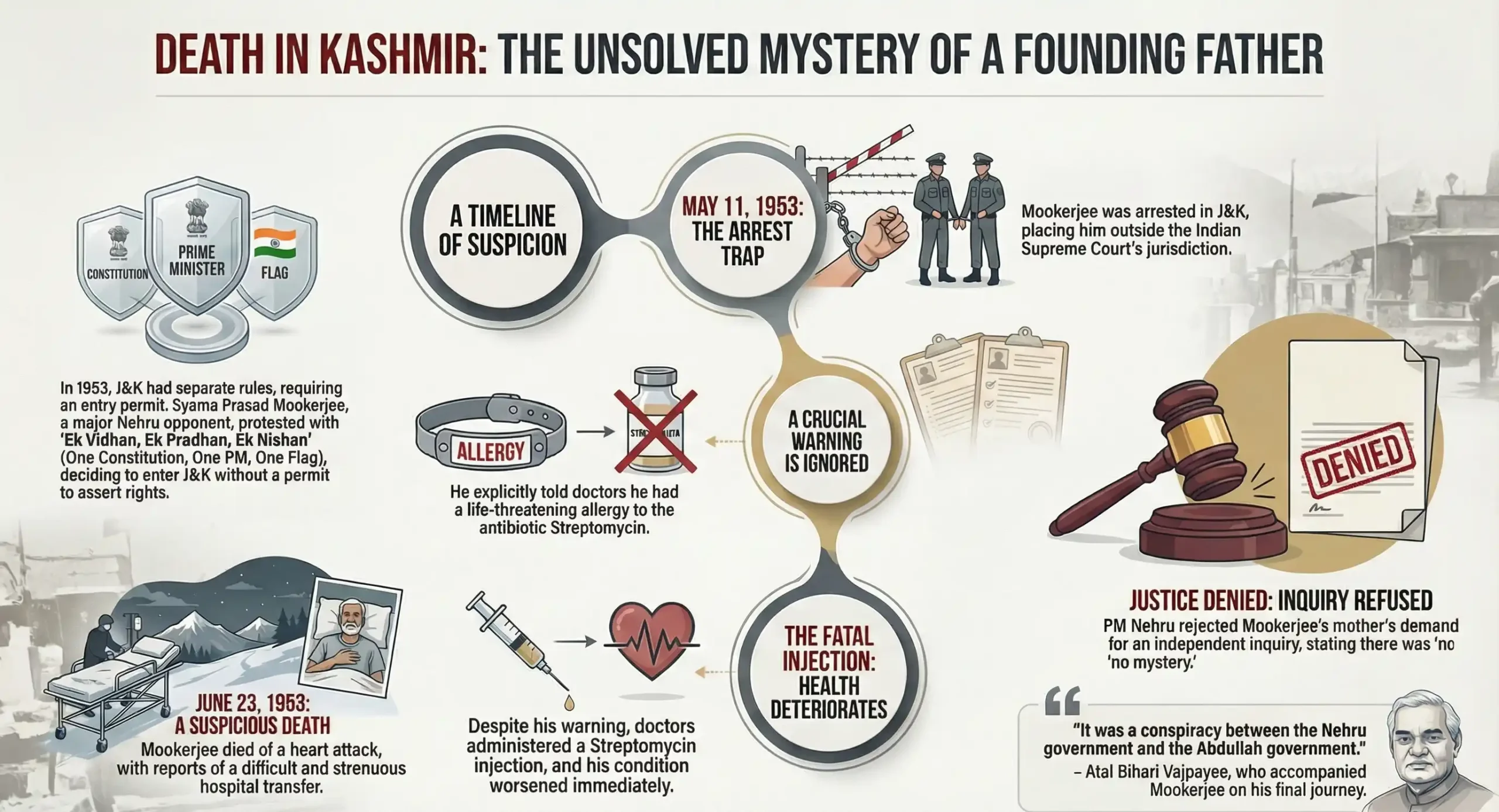
To understand the Syama Prasad Mookerjee death mystery, we must understand the Kashmir of 1953. At that time, J&K had a separate Prime Minister (Sheikh Abdullah), a separate flag, and a separate Constitution. No Indian citizen could enter without a special “entry permit.”
Mookerjee found this unacceptable. He coined the famous slogan:
“Ek desh mein do Vidhan, do Pradhan aur do Nishan nahi chalenge.” (One country cannot have two Constitutions, two Prime Ministers, and two Flags.)
He announced he would cross the border without a permit as an act of protest.

The Trap: Arrest and Detention
On May 11, 1953, Mookerjee reached the bridge at Lakhanpur on the Punjab-J&K border.
Here lies the first clue of the conspiracy. The Indian police on the Punjab side allowed him to proceed. He was not stopped until he crossed into J&K territory, where Sheikh Abdullah’s police immediately arrested him.
Why does this matter? If he had been arrested in Punjab, he would have been under the jurisdiction of the Supreme Court of India, which would have likely granted him bail. By allowing him to cross into J&K, he fell under the state’s separate laws, where the Indian Supreme Court had no jurisdiction. He was effectively moved into a legal black hole.
He was taken to Srinagar and detained in a small, remote cottage near Nishat Bagh, which was converted into a sub-jail.

The “Medical Murder”: The Wrong Injection
Inside the cottage, Mookerjee’s health began to deteriorate. He developed a pain in his leg and a fever, which was diagnosed as “Dry Pleurisy.”
What happened next forms the core of the conspiracy.
1. The Allergy Warning Ignored Dr. Mookerjee explicitly informed the doctor in charge, Dr. Ali Jan, that his family physician had warned him he was allergic to Streptomycin (an antibiotic). He kept a diary where he noted that he had told the doctors about this allergy.
2. The Fatal Injection Despite this clear warning, the doctors administered a Streptomycin injection. Mookerjee protested, but he was told it was necessary. Almost immediately, his condition worsened.
3. The Long Walk On the night of June 22, he suffered a massive heart attack. Instead of being rushed to the hospital in an ambulance, reports suggest he was made to travel in a taxi or a small car, and in some accounts, forced to walk a distance, placing immense strain on his failing heart.
He died at 3:40 AM on June 23, 1953.
The Mother’s Plea and Nehru’s Refusal
When the news reached Kolkata, Bengal erupted in grief and anger. But the most heartbreaking response came from his mother, Jogamaya Devi.
She wrote a fiery letter to Prime Minister Jawaharlal Nehru, demanding an independent inquiry. She explicitly called her son’s death a “murder” and asked for justice.
Nehru’s reply was cold and final. He wrote back stating that he had inquired with a number of persons in Kashmir and was satisfied that there was “no mystery” behind the death. He refused to set up an inquiry commission.
Jogamaya Devi replied:
“I do not ask for your sympathy… I demand justice.”
But justice never came. The “Permit System” was abolished shortly after his death, proving his protest right, but the man who fought for it was gone.
Quick Comparison: Official Version vs. Conspiracy Theory
| Feature | Official Version (1953) | Conspiracy Theory (Medical Murder) |
| Cause of Death | Natural Heart Attack | Allergic reaction to Streptomycin |
| Reason for Arrest | Violation of Permit System | Strategic move to bypass Supreme Court |
| Inquiry Status | Declared “No Mystery” by Nehru | Inquiry repeatedly refused despite evidence |
| Medical Care | Adequate hospital treatment | Intentional negligence/wrong injection |
Conclusion: A Convenient Death
Was it incompetence or assassination? The timeline is suspicious:
He was arrested only where Indian courts couldn’t reach him.
He was given the one medicine he was allergic to.
No inquiry was ever conducted despite a national outcry.
Syama Prasad Mookerjee was the biggest threat to the Congress government at the time. His death decapitated the opposition. As Atal Bihari Vajpayee, who accompanied him on that final journey as a young journalist, later said: “It was a conspiracy between the Nehru government and the Abdullah government”.
The cottage in Nishat Bagh is silent today, but the questions it holds are still loud.
Curious India: Fast Facts
- Youngest VC: At just 33, he became the youngest Vice-Chancellor of Calcutta University.
- The Missing Diary: The last pages of his detention diary, documenting his medical treatment, were never returned to his family.
- Article 370 Connection: His death eventually forced the abolition of the “Permit System,” a goal finally realized fully with the abrogation of Article 370 in 2019.
- The Taxi Ride: During his final heart attack, instead of an ambulance, he was reportedly transported in a small car/taxi, further straining his heart.
If you think you have rememberd everything about this topic take this QUIZ
Results


#1. What was the primary legal consequence of Syama Prasad Mookerjee being arrested in Jammu & Kashmir territory instead of in Punjab?
#2. The slogan ‘Ek Vidhan, Ek Pradhan, Ek Nishan’ was coined by Syama Prasad Mookerjee to protest what specific situation in Jammu & Kashmir?
#3. What is the central claim of the ‘medical murder’ theory regarding Syama Prasad Mookerjee’s death?
#4. How did Prime Minister Jawaharlal Nehru respond to the request from Mookerjee’s mother, Jogamaya Devi, for an inquiry into his death?
#5. According to the source material, where was Syama Prasad Mookerjee held in detention?
#6. What was the eventual fate of the ‘Permit System’ that Syama Prasad Mookerjee died protesting against?
#7. Who does the text quote as having said Mookerjee’s death was a ‘conspiracy between the Nehru government and the Abdullah government’?
#8. Besides the controversial injection, what other detail concerning Mookerjee’s final moments raises suspicion?
Why was Syama Prasad Mookerjee arrested?
He was arrested for entering Jammu & Kashmir without a “permit.” At that time, J&K had special autonomous status, and Indian citizens needed a permit (like a visa) to enter. Mookerjee violated this rule as an act of protest.
What drug allegedly killed him?
It is alleged that he was given Streptomycin, an antibiotic to which he was allergic. He had reportedly informed the doctors of this allergy, but it was administered anyway to treat his pleurisy.
Did the government investigate his death?
No. Despite repeated demands from his mother, Jogamaya Devi, and political leaders, Prime Minister Jawaharlal Nehru refused to order an official inquiry commission, stating he saw no mystery in the death.
What was the “Nehru-Abdullah Conspiracy” theory?
The theory, supported by leaders like Atal Bihari Vajpayee, suggests that the Indian government deliberately allowed Mookerjee to cross into J&K so he could be arrested by Sheikh Abdullah’s police, putting him out of the jurisdiction of the Indian Supreme Court and ensuring he could not be easily bailed out.
This article is part of our exclusive series Unsolved India. Read the previous chapter: The Padmanabhaswamy Temple Treasure.