Subrahmanyan Chandrasekhar was a prodigy who looked at the stars and saw mathematics where others saw mystery. His Subrahmanyan Chandrasekhar biography is a tale of early brilliance followed by a crushing betrayal. At age 19, on a ship to England, he calculated that massive stars must eventually collapse into black holes—a concept so radical that his own mentor, Sir Arthur Eddington, publicly ridiculed him. This rejection forced him to leave England for the United States, where he quietly revolutionized astrophysics for 50 years before finally receiving the Nobel Prize. His story is a testament to the quiet, unbreakable power of truth.| Attribute | Details |
| Full Name | Subrahmanyan Chandrasekhar |
| Birth Date | October 19, 1910 |
| Birth Place | Lahore, British India (now Pakistan) |
| Died | August 21, 1995 (aged 84) |
| Known As | The Man Who Calculated the Death of Stars |
| Key Discovery | Chandrasekhar Limit (1.4 Solar Mass) |
| Institutions | University of Chicago, University of Cambridge |
| Nobel Prize | Physics (1983) |
| Family | Nephew of Sir C.V. Raman (Nobel Laureate) |
The Boy on the Boat
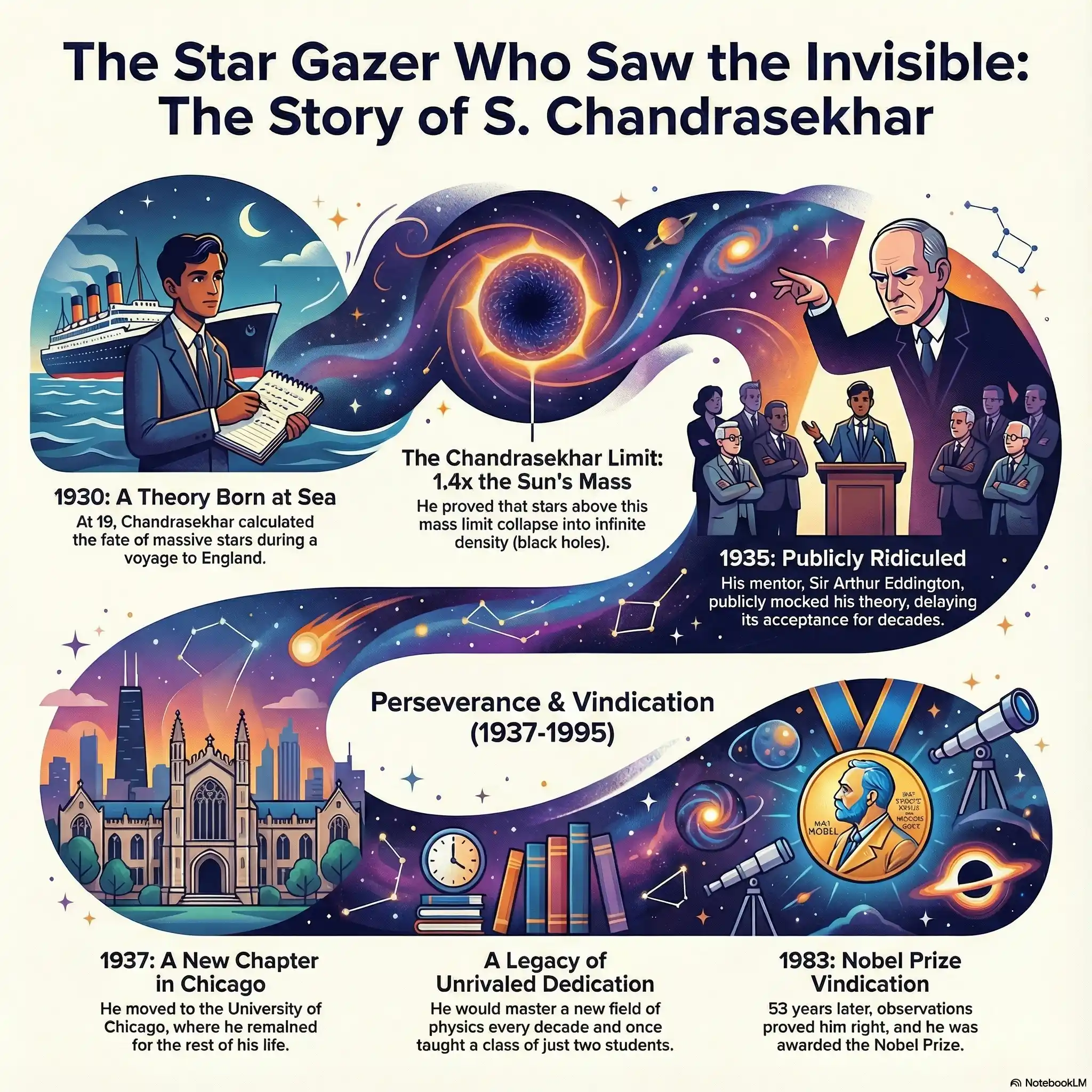
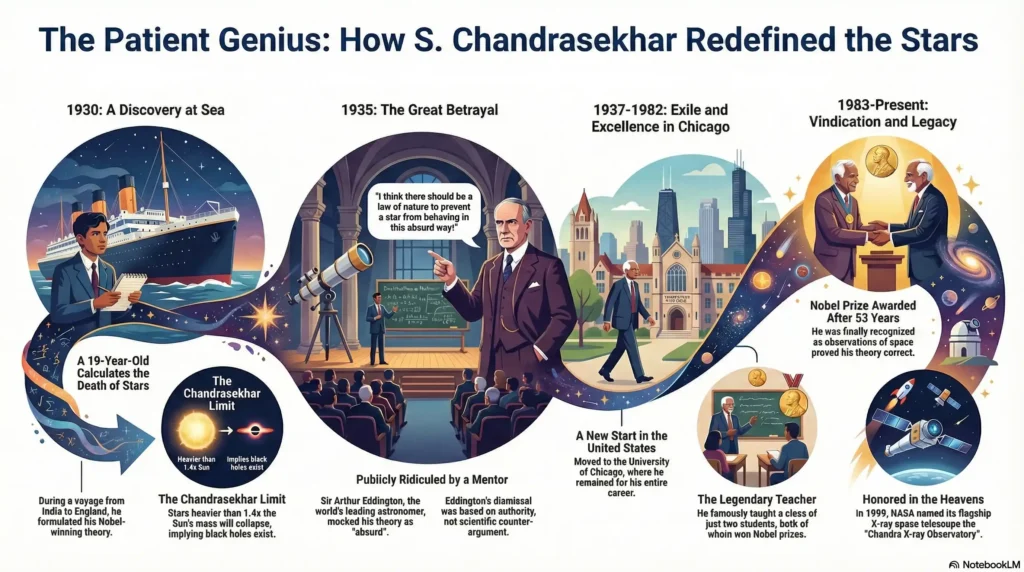
In 1930, a steamship named Pilsna was making its slow voyage from India to England. On the deck sat a quiet 19-year-old boy, scribbling equations in a notebook while the ocean churned beneath him. He was not writing poetry or a diary; he was calculating the death of stars.
This boy was Subrahmanyan Chandrasekhar, and by the time the ship docked in Southampton, he had formulated a theory that would one day win him a Nobel Prize. He had discovered that stars do not just fade away—they can collapse into nothingness, creating what we now call Black Holes. But the world was not ready for his truth. The Subrahmanyan Chandrasekhar biography is the story of a man who was right too soon.
A Legacy of Genius: Early Life
Born on October 19, 1910, in Lahore, “Chandra” (as he was affectionately known) was born into an intellectual dynasty. His father was a high-ranking railway official, and his uncle was none other than Sir C.V. Raman, who would win the Nobel Prize in Physics in 1930.
Science was the family religion. Chandra was tutored at home until age 12, after which he attended the Hindu High School in Triplicane, Madras. He was a prodigy in the truest sense. Before he even graduated from Presidency College, he had published his first scientific paper. His brilliance secured him a scholarship to Cambridge University, the Mecca of physics, where he hoped to study under the great astronomers of the day.
Dr. A.P.J. Abdul Kalam: (1931-2015)
The Chandrasekhar Limit: A 19-Year-Old’s Discovery
On that fateful voyage to Cambridge, Chandra applied Einstein’s theory of special relativity to stellar structures. At the time, scientists believed all stars would eventually cool down and become “White Dwarfs”—stable, dense balls of matter.
Chandra’s math said otherwise. He calculated that there was a limit—specifically 1.4 times the mass of the Sun. If a star was lighter than this, it would become a white dwarf. But if it was heavier? It would not stop collapsing. It would shrink further and further, crushing matter into infinite density. This threshold is known today as the Chandrasekhar Limit. It was a terrifying concept because it implied the existence of Black Holes, an idea that seemed like science fiction in the 1930s.
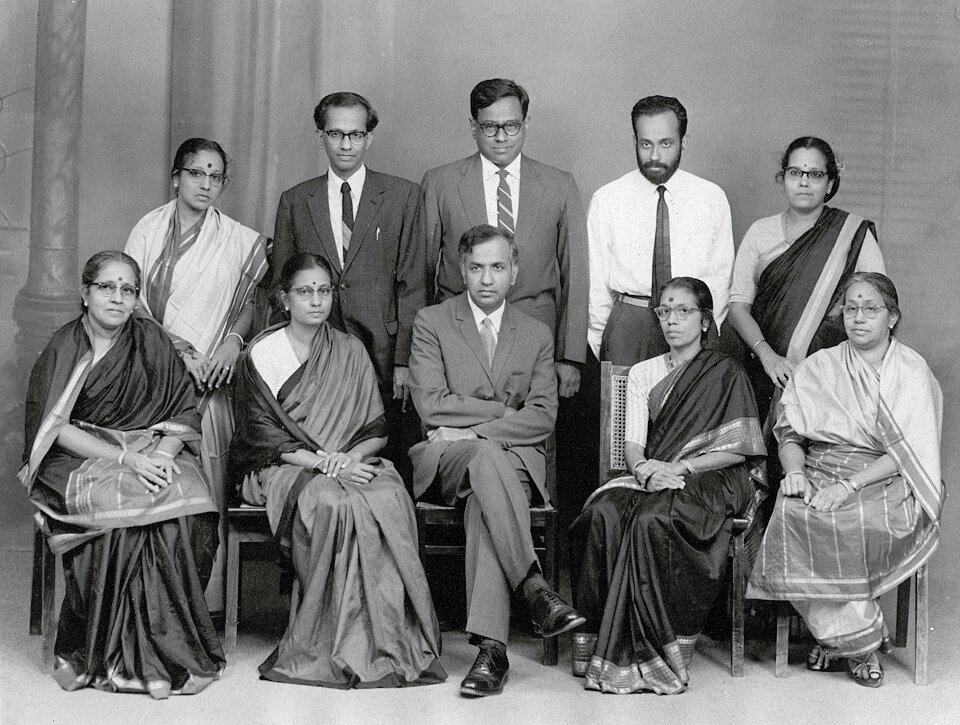
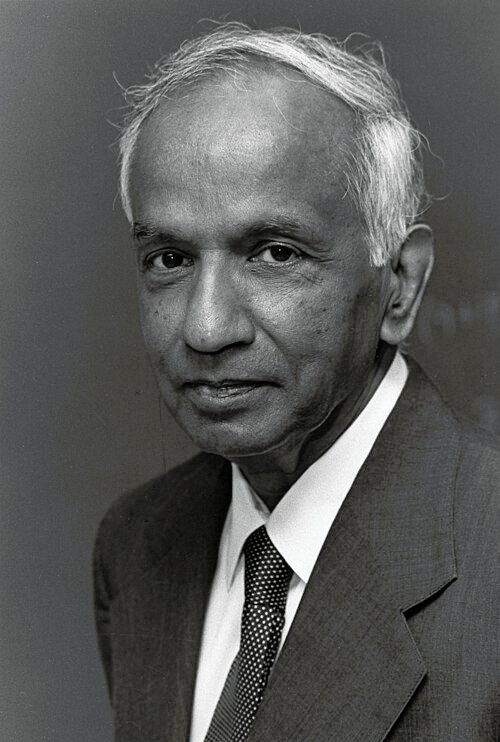
The Great Betrayal: The Eddington Controversy
The most painful chapter in the Subrahmanyan Chandrasekhar biography occurred in 1935 at the Royal Astronomical Society in London. Chandra, now 24, was invited to present his theory. He was excited because his mentor, Sir Arthur Eddington—the most famous astronomer in the world and the man who proved Einstein right—was also speaking.
Chandra presented his paper, proving that massive stars must collapse. When he sat down, Eddington stood up. Instead of supporting his student, Eddington tore him apart. He famously declared, “I think there should be a law of nature to prevent a star from behaving in this absurd way!”
The room erupted in laughter. Eddington used his immense authority to ridicule the young Indian scientist. It was not a scientific rebuttal; it was an act of bullying. Because of Eddington’s status, the scientific community sided with him, and Chandra’s theory was buried for decades.
Clash of Titans: Chandra vs. Eddington
| Feature | Subrahmanyan Chandrasekhar | Sir Arthur Eddington |
| Role | The Student / Challenger | The Mentor / Authority |
| Key Theory | Relativistic Collapse (Black Holes) | Stability of White Dwarfs |
| Tool Used | Mathematical Rigor & Relativity | Intuition & Classical Physics |
| Stance | Massive stars must collapse infinitely | “Nature prevents absurd behavior” |
| Outcome | Proven right (Nobel 1983) | Proven wrong by modern physics |
Exile and Excellence: The Chicago Years
Deeply hurt but unbroken, Chandra realized he could not build a career in the hostile environment of England. In 1937, he moved to the United States to join the University of Chicago. He would stay there for the rest of his life.
Chandra was distinct from other scientists. He did not stick to one field. He operated in “decades.” He would spend 10 years mastering a subject—like stellar structure—write the definitive book on it, and then move on to something completely different, like hydromagnetics or the theory of black holes. His lectures were legendary for their precision; he once drove from the Yerkes Observatory to Chicago every week to teach a class of just two students. Those two students were Tsung-Dao Lee and Chen-Ning Yang—both of whom won the Nobel Prize before Chandra did.
8 Defining Chapters in the Vikram Sarabhai Biography
Vindication: The Nobel Prize
Justice for Chandrasekhar was slow, but it was absolute. As technology advanced, astronomers began observing objects in deep space that behaved exactly as Chandra had predicted in 1930. The existence of Neutron Stars and Black Holes proved that Eddington was wrong and the boy on the boat was right.
In 1983—53 years after his discovery—Subrahmanyan Chandrasekhar was awarded the Nobel Prize in Physics. In his acceptance speech, he was gracious, quoting poetry and avoiding bitterness about the half-century delay. He passed away in 1995, leaving behind a legacy of elegance in mathematics and integrity in character.
Curious Indian: Fast Facts
- The NASA Tribute: In 1999, NASA launched its flagship X-ray telescope and named it the Chandra X-ray Observatory in his honor.
- The Dedicated Teacher: During the 1940s, he drove 100 miles in winter snow to teach a class of only two students. Both students (Yang and Lee) went on to win the Nobel Prize in 1957.
- Uncle-Nephew Duo: He and C.V. Raman are the only uncle-nephew pair from India to both win Nobel Prizes in Physics.
- US Citizenship: He became a US citizen in 1953, though he always maintained a deep cultural connection to his Indian roots.
- The Asteroid: An asteroid, 1958 Chandra, is named after him.
Conclusion
The Subrahmanyan Chandrasekhar biography is a reminder that truth does not need a loudspeaker; it only needs time. He faced the giant of his era, stood his ground with quiet dignity, and let the universe eventually prove him right. For every curious Indian, Chandra represents the pinnacle of intellectual integrity—the ability to see the invisible and the courage to believe in it, even when the world laughs.
If you think you have remembered everything about this topic take this QUIZ
Results


#1. What fundamental concept did Subrahmanyan Chandrasekhar apply to the study of stellar structures during his 1930 sea voyage?
#2. According to the biography, what is the fate of a star whose mass is greater than the Chandrasekhar Limit?
#3. Who was the eminent and highly respected astronomer who publicly ridiculed Chandrasekhar’s theory in 1935?
#4. What was the basis of Sir Arthur Eddington’s public criticism of Chandrasekhar’s work at the Royal Astronomical Society?
#5. Following the hostile reception in England, where did Chandrasekhar spend the majority of his professional career?
#6. What was Chandrasekhar’s distinctive approach to his research work during his ‘Chicago Years’?
#7. How long was the delay between Chandrasekhar making his discovery and receiving the Nobel Prize for it?
#8. What is the remarkable fact presented about the two students Chandrasekhar taught in the 1940s?
What is the Chandrasekhar Limit?
It is the maximum mass of a stable white dwarf star. The limit is approximately 1.4 times the mass of the Sun. Any star heavier than this cannot remain a white dwarf and will collapse into a neutron star or black hole.
Why did Arthur Eddington oppose Chandrasekhar?
Eddington found the concept of a star collapsing into a point (infinite density) philosophically “absurd.” He refused to accept the mathematical conclusion because it contradicted his intuitive understanding of nature
Is Subrahmanyan Chandrasekhar related to C.V. Raman?
Yes, Sir C.V. Raman, the first Asian to win a Nobel Prize in science, was Chandrasekhar’s paternal uncle.
Did Chandrasekhar ever return to India?
He visited often, but he lived the majority of his life in the United States, working at the University of Chicago until his death in 1995.