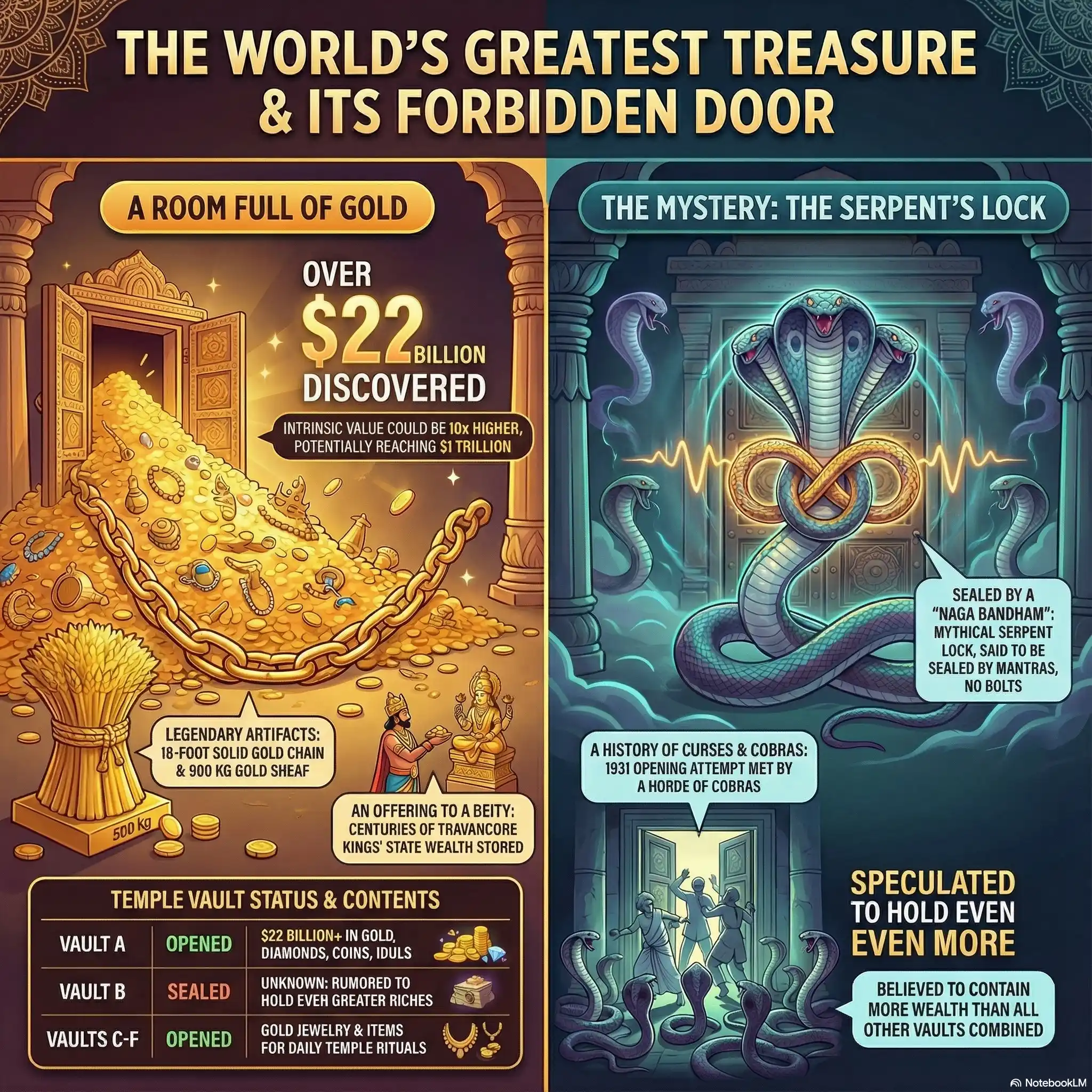
The Padmanabhaswamy Temple Treasure represents the largest discovery of hidden wealth in human history, located in Thiruvananthapuram, India. While five of the six underground vaults have been opened, revealing billions of dollars in gold and jewels, the mysterious Vault B remains sealed. Protected by legends of divine curses and ancient spells, this "richest temple in the world" continues to captivate the world with its blend of historical reality and supernatural mystery.| Feature | Details |
| Location | Thiruvananthapuram, Kerala, India |
| Primary Deity | Lord Vishnu (Anantha Shayanam posture) |
| Estimated Treasure Value | Over $22 Billion (uncounted historical value) |
| The Great Mystery | The unopened and “cursed” Vault B |
| Custodian | The Royal Family of Travancore |
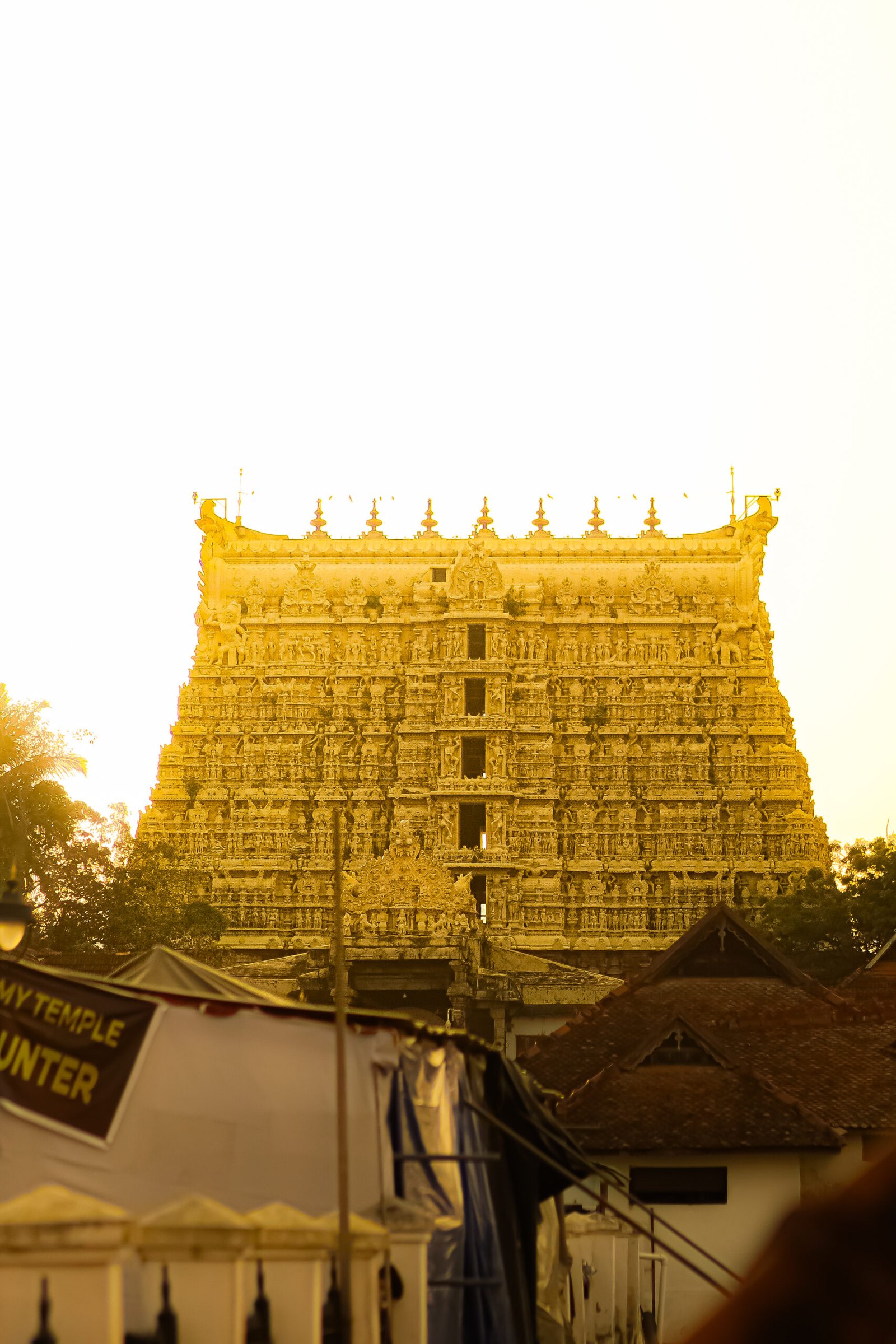
Deep in the heart of Thiruvananthapuram, Kerala, lies a shrine that has stood for centuries (Padmanabhaswamy Temple treasure) as a symbol of divine grandeur. The Sree Padmanabhaswamy Temple, with its towering gopuram and intricate Dravidian architecture, is dedicated to Lord Vishnu reclining on the serpent Anantha.
For generations, locals whispered tales of immense wealth hidden beneath the temple—gold offered by ancient kings, diamonds from lost dynasties, and secrets guarded by cobras. In 2011, the world discovered that the whispers were true.
When the Supreme Court of India ordered the opening of the temple’s underground vaults, they found what is arguably the largest discovery of wealth in recorded human history.
But one door remained shut. Vault B.
Welcome to the Unsolved India, where we stand before a door guarded by legends, curses, and a “Naga Bandham” that no man dares to break.
The Discovery: A Room Full of Gold (Vault A)
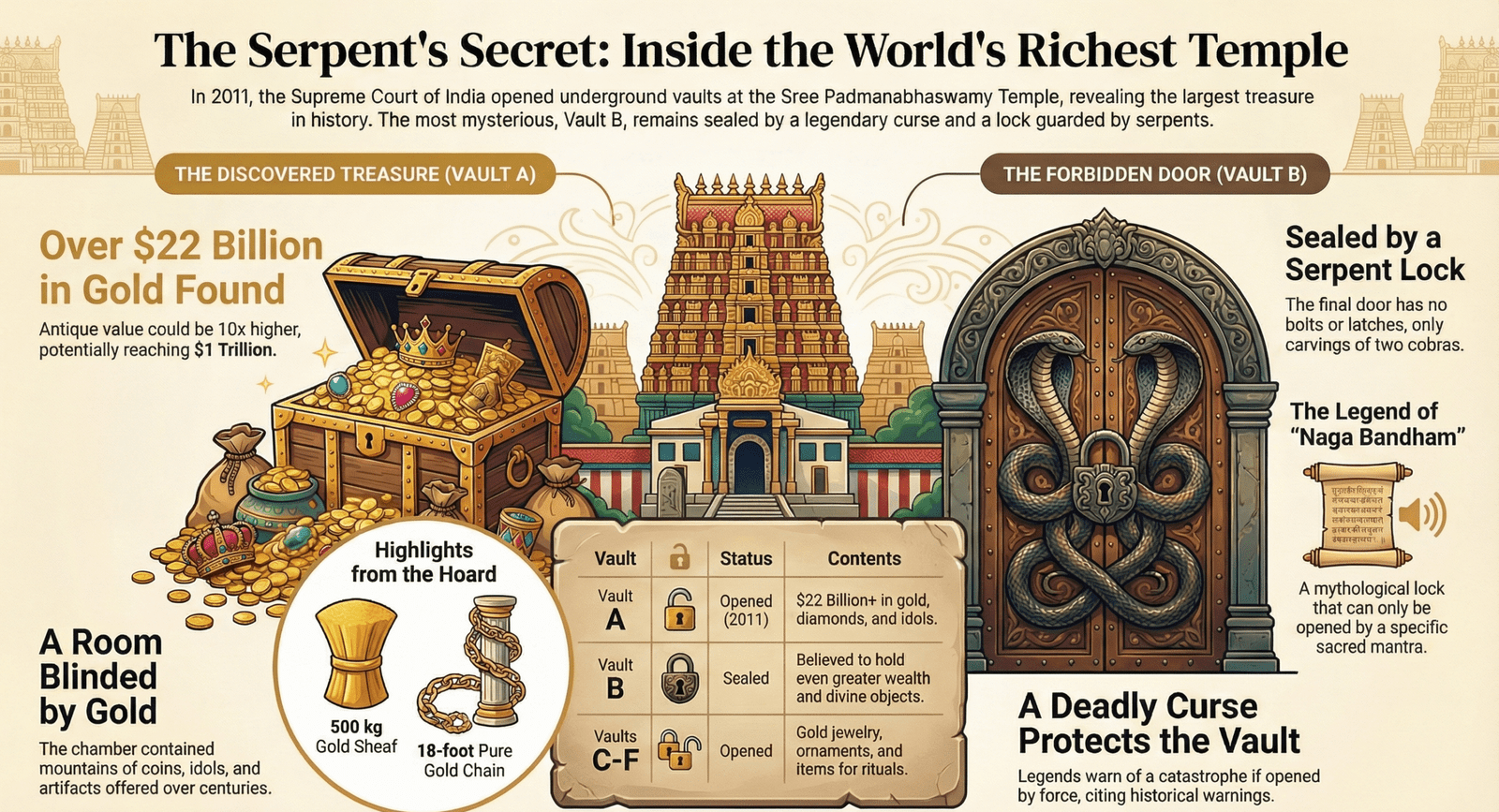
The temple has six known underground vaults, labeled A, B, C, D, E, and F. In June 2011, a seven-member committee appointed by the Supreme Court entered Vault A.
They removed a granite slab and descended a narrow flight of stairs into a pitch-black chamber. When the firemen pumped oxygen in and lit their torches, they were blinded by the reflection.
The room was filled with gold. Not just coins, but mountains of it.
Gold Sheaves: A pure gold sheaf weighing 500 kg.
The Chain: An 18-foot-long pure gold chain meant for the deity.
The Crown: A solid gold crown studded with diamonds and rubies.
Napoleonic Coins: Sacks full of gold coins from the Napoleonic era and Roman Empire.
The Throne: A golden throne meant for the 18-foot idol.
The estimated value of the treasure found in Vault A alone was over ₹1,00,000 Crore ($22 Billion). And this is just the intrinsic value of the metal; the antique value could be ten times higher, making it potentially worth $1 Trillion.
But amidst the celebration of this discovery, all eyes turned to the neighboring chamber: Vault B.
The Purulia Arms Drop Mystery 1995: When the Sky Rained Guns
The Mystery of Vault B: The Forbidden Door
While Vault A gave up its secrets, Vault B refused to yield.
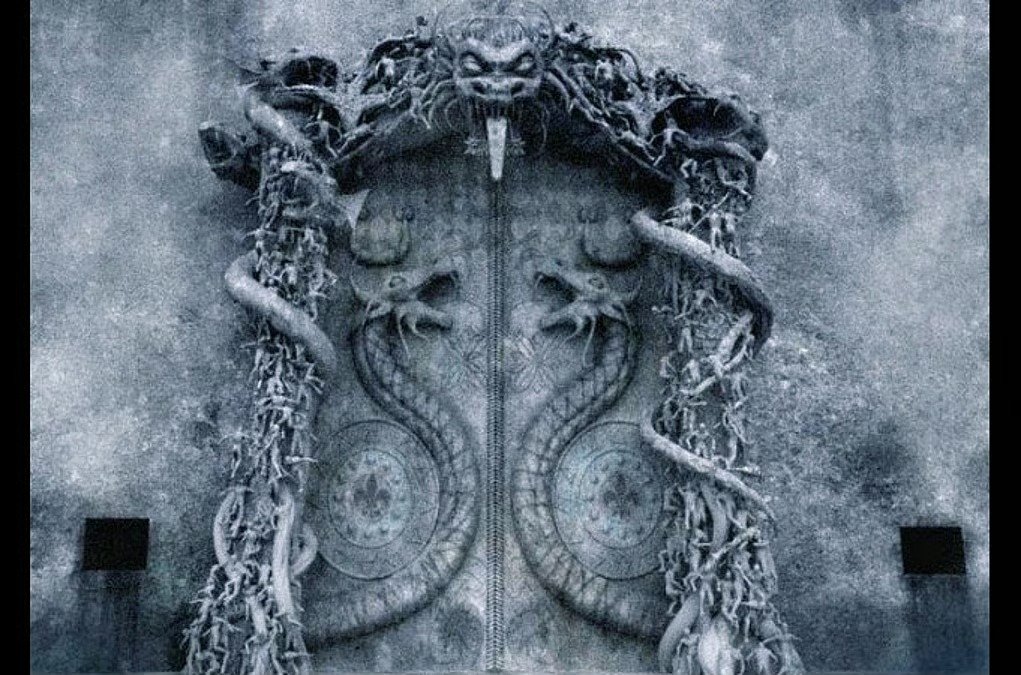
Unlike the other vaults, Vault B is protected by three doors.
The First Door: A metal grille, which the committee opened.
The Second Door: A heavy wooden door, which they also opened.
The Third Door: An ominous iron door, jammed shut.
This final door has no nuts, bolts, or latches. Instead, it is adorned with the carvings of two massive Cobras.
The Legend of Naga Bandham
According to temple legends and local belief, Vault B is sealed with a “Naga Bandham” (Serpent Lock). It is said that in the 16th century, powerful “Siddha Purushas” (saints) used “Garuda Mantras” to lock the door.
The belief is simple and terrifying:
The door can only be opened by a high priest chanting the “Garuda Mantra” in the exact reverse order.
If opened using modern technology or force, it will unleash a catastrophe—not just on the city, but on the world.
Legends say the vault is guarded by snake gods who reside inside.
In 2011, when the committee debated forcing the door open, the Travancore Royal Family intervened, citing an “Ashtamangala Devaprasnam” (astrological ritual) which warned that opening the vault would cause “divine wrath” and death to those involved.
The Roopkund Skeleton Lake Mystery: Why Were Greeks Dying in the Indian Himalayas?
The Curse of 1931: A Historical Warning
Skeptics call the curse a myth, but history offers a chilling warning.
Records from 1931 suggest that an attempt was made to open the vaults during the reign of the Travancore kings. A report from The Hindu archives mentions that when officials tried to enter, they were met with a horde of cobras and “fled for their lives”.
Even in modern times, the fear persists. The petitioner T.P. Sundararajan, whose legal battle led to the opening of the vaults, died unexpectedly in July 2011, just weeks after the treasure was discovered. While he was 70 and ill, many locals viewed his death as the first victim of the temple’s curse.
Where Did the Treasure Come From?
How did a single temple accumulate $22 billion in gold? The answer lies in the history of the Travancore Royal Family.
In 1750, the warrior king Marthanda Varma performed a ritual called “Thrippadidanam”. He surrendered his entire kingdom to Lord Padmanabhaswamy and vowed that he and his descendants would rule only as “Padmanabha Dasa” (Servant of the Lord).
For centuries, the Kingdom of Travancore was a powerhouse of the spice trade (pepper). The kings did not treat the state treasury as their personal wealth; instead, they poured the profits, taxes, and spoils of war into the temple vaults as an offering to their master, the Deity.
Unlike other Indian kingdoms that were looted by the British or Mughal invaders, Travancore managed to protect its borders and its secrets. The British Resident knew the temple was rich, but they never guessed how rich.
The Vault Inventory Breakdown
While the exact inventory is a closely guarded court secret, leaks and reports have given us a glimpse of the hierarchy of these chambers.
| Vault | Status | Contents (Verified/Speculated) |
| Vault A | OPENED (2011) | $22 Billion+ in gold, diamonds, coins, and idols. |
| Vault B | SEALED | Believed to contain even more wealth than Vault A, silver biscuits, and “divine objects”. |
| Vault C | Opened | Gold jewelry and items used for special ritual ceremonies. |
| Vault D | Opened | Ornaments for the “Garudavahana” (vehicle of the Lord). |
| Vault E | Opened | Daily puja utensils and deeparadhana plates. |
| Vault F | Opened | Idols and items for daily rituals. |
| Vault G & H | Rediscovered (2014) | Holy vaults recently identified; contents unknown. |
Conclusion: Faith vs. Curiosity
The Supreme Court of India, in a 2020 verdict, upheld the rights of the Travancore Royal Family to manage the temple, reversing an earlier decision. This was a massive victory for the believers who argued that the deity’s wealth belongs to the deity alone.
Today, Vault B remains shut. The Supreme Court has left the decision to open it to the temple’s administrative committee.
Is it a door to a trillion dollars? Is it a tunnel to the Arabian Sea? or is it a prison for ancient curses that should never be disturbed?
In a world mapped by satellites and stripped of magic, the Padmanabhaswamy Temple remains a defiant fortress of mystery. Some doors, perhaps, are meant to stay closed.
1971 Nagarwala Case: India’s Great Bank Heist Mystery
Curious India: Fast Facts
Richest Place on Earth: The treasure found in Vault A makes the Padmanabhaswamy Temple the wealthiest place of worship in the world, surpassing the Vatican and Tirupati.
The 18-Foot Idol: The main deity is made of 12,008 “Salagramas” (sacred stones) brought from Nepal.
The Secret Tunnel: Rumors persist that Vault B contains a tunnel that leads directly to the Arabian Sea, allowing the wealth to be moved in emergencies.
If you think you have rememberd everything about this topic take this QUIZ
Results


#1. What historical ritual, performed by King Marthanda Varma in 1750, is the primary reason cited for the temple’s immense wealth? ? Hint
Consider the event that fundamentally changed the relationship between the Travancore kings and the temple’s deity.
#2. According to the temple legends, what is the specific and only safe method to open the ‘Naga Bandham’ on Vault B? ? Hint
The lock is described as being mythological and based on sound, not a physical key or legal decree.
#3. Which of the following items was explicitly listed as a discovery within Vault A? ? Hint
Recall the list of treasures that contributed to the initial $22 billion valuation.
#4. What event from 1931 serves as a historical warning against trying to force entry into the temple vaults? ? Hint
The warning from this historical attempt involves the same serpent imagery found on Vault B’s door.
#5. Following the 2020 Supreme Court verdict, who has the legal right to manage the temple and its wealth? ? Hint
The verdict was seen as a victory for those who believed in the traditional system of temple administration.
#6. What is the key difference between the initial estimated value of the treasure in Vault A and its potential ultimate worth? ? Hint
Think about how we value an old coin versus a new piece of gold of the same weight.
#7. Which official body’s audit report suggested that Vault B may have been opened several times between 1990 and 2002, contradicting temple legend? ? Hint
This claim comes from a formal report by India’s supreme audit institution.
#8. What is unique about the physical construction of the final door to Vault B? ? Hint
Focus on the description of the third and most mysterious of the chamber’s three doors.
Has Vault B ever been opened?
There are conflicting reports. While temple legends say it has never been opened due to the curse, an audit report by the Comptroller and Auditor General (CAG) suggested that Vault B may have been opened seven times between 1990 and 2002. However, the Royal Family maintains that the inner sanctum with the Naga Bandham remains untouched.
What is the estimated value of the Padmanabhaswamy Temple treasure?
The treasure recovered from Vault A alone is estimated at $22 billion (₹1 lakh crore). If Vault B is opened, some estimates suggest the total value could exceed $1 Trillion, considering the antique value of the artifacts.
What is the “Naga Bandham”?
It is a mythological “Serpent Lock.” Legends state that it locks the door using sound waves (mantras) rather than a physical key. It is believed that only a priest chanting the “Garuda Mantra” correctly can open it safely.
Who owns the treasure?
The Supreme Court ruled in 2020 that the treasure belongs to the “Deity” (Lord Padmanabhaswamy). The Travancore Royal Family acts as the “Shebait” (manager/servant) of the deity, meaning they manage the wealth but do not personally own it.
Why was the treasure hidden?
The Travancore kings dedicated their kingdom to the Lord in 1750. They stored the state’s surplus wealth, taxes, and donations in the temple vaults to protect it from invaders and to serve as a reserve for the state in times of famine or crisis.
This article is part of our exclusive series Unsolved India. Read the previous chapter: The Homi Bhabha Death Mystery.