Manjul Bhargava (born 1974) is a Canadian-American mathematician of Indian descent, widely regarded as one of the greatest minds in contemporary number theory. Raised in New York in a highly academic household, his early exposure to Sanskrit poetry and classical Indian music (specifically the tabla) profoundly shaped his mathematical intuition. After studying at Harvard and completing his Ph.D. at Princeton under the legendary Andrew Wiles, Bhargava achieved global fame by generalizing Carl Friedrich Gauss's 200-year-old law for the composition of binary quadratic forms. His revolutionary work, utilizing "Bhargava cubes," earned him a full professorship at Princeton by age 28 and the prestigious Fields Medal in 2014. He is the first person of Indian origin to receive this honor.| Feature | Details |
| Name | Manjul Bhargava |
| Birth Date | August 8, 1974 |
| Birthplace | Hamilton, Ontario, Canada (Raised in NY, USA) |
| Field of Study | Mathematics (Number Theory) |
| Alma Mater | Harvard University (B.A.), Princeton University (Ph.D.) |
| Ph.D. Advisor | Andrew Wiles (Solver of Fermat’s Last Theorem) |
| Major Discovery | 14 new Gauss composition laws (Bhargava Cubes) |
| Highest Award | Fields Medal (2014) |
| Civilian Honor | Padma Bhushan (2015, India) |
| Musical Skill | Accomplished Tabla Player (Trained under Zakir Hussain) |
The Magic of a Mathematical Household
Manjul Bhargava’s genius was nurtured in an environment where logic, art, and heritage flowed seamlessly together. Born in Canada and raised in Long Island, New York, his mother, Mira Bhargava, was a mathematics professor at Hofstra University, and his father was a chemist. From a young age, mathematics was not presented to him as a rigid set of rules, but as a language of patterns and puzzles.
However, a massive intellectual influence came from his grandfather, Purushottam Lal Bhargava, a renowned scholar of Sanskrit and ancient Indian history based in Jaipur, India. Young Manjul would spend months in India, soaking in the linguistic structures of ancient texts.
Venkatraman Ramakrishnan: (1952- Present)
The Symphony of Sanskrit and the Tabla
Unlike many scientists who separate their art from their research, Bhargava’s hobbies directly fueled his mathematical breakthroughs.
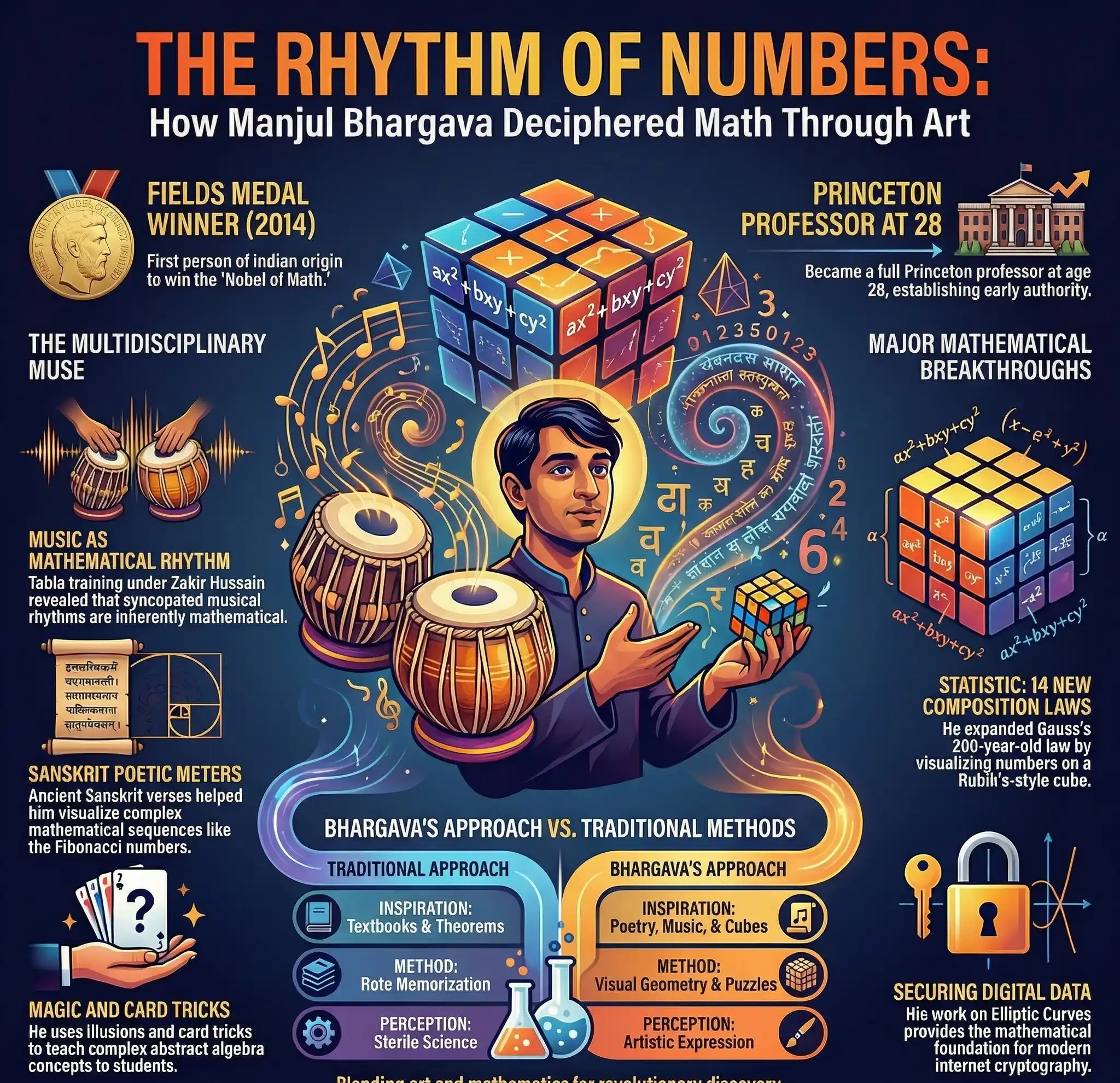
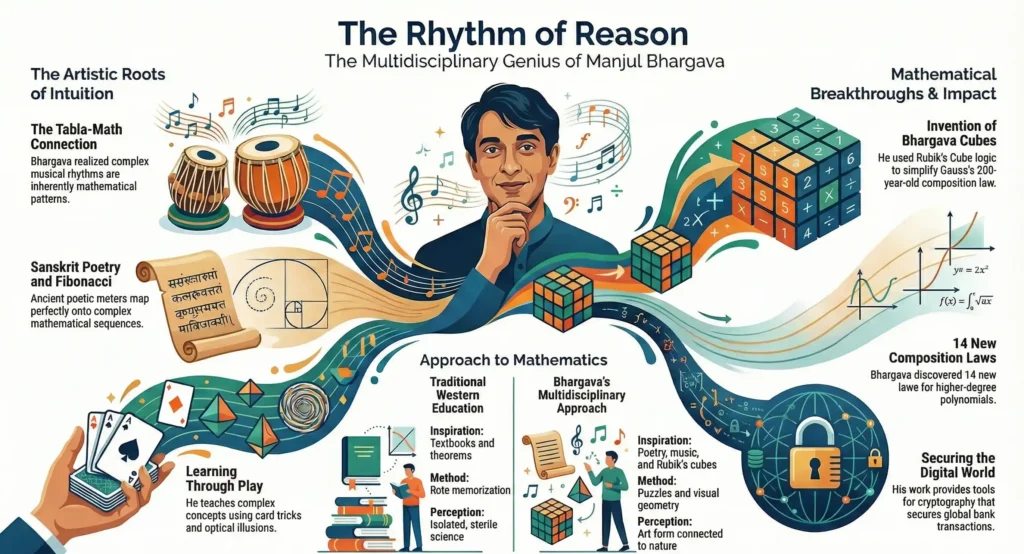
- The Tabla Connection: Bhargava is an accomplished tabla player, having studied under the legendary Ustad Zakir Hussain. He realized that the complex, syncopated rhythms of Indian classical music are inherently mathematical.
- The Sanskrit Connection: While studying ancient Sanskrit poetry (such as the works of Pingala and Hemachandra), Bhargava discovered that the rhythms and meters of the verses perfectly mapped onto complex mathematical sequences, like the Fibonacci numbers. This taught him to look for elegant, visual, and rhythmic patterns in abstract algebra.
From Harvard to a Princeton Professorship
Bhargava’s academic rise was meteoric. He enrolled at Harvard University, where his undergraduate thesis solved a problem in number theory that had baffled mathematicians for decades.
He then moved to Princeton University for his Ph.D. His doctoral advisor was none other than Andrew Wiles, the mathematical titan who famously proved Fermat’s Last Theorem. Under Wiles’s mentorship, Bhargava didn’t just solve existing problems; he invented entirely new mathematical frameworks. His brilliance was so undeniable that Princeton University offered him a full tenured professorship in 2003 when he was just 28 years old—making him the second-youngest full professor in the university’s illustrious history.
The Breakthrough: Gauss and the Bhargava Cubes
In 1801, the great German mathematician Carl Friedrich Gauss published a monumental 20-page proof explaining how to combine (or “compose”) two binary quadratic forms to create a third. It was brilliant but incredibly dense and complicated. For 200 years, mathematicians assumed this was a unique rule that couldn’t be expanded.
Bhargava revolutionized this. Legend has it that while playing with a Rubik’s Cube in his room, he visualized a way to simplify Gauss’s complex math using the corners of a three-dimensional cube.
By slicing the cube and assigning numbers to its corners, Bhargava didn’t just elegantly recreate Gauss’s 200-year-old law in a few lines—he discovered 14 entirely new composition laws for higher-degree polynomials.
This breakthrough cracked open the field of number theory. It provided crucial new tools for understanding Elliptic Curves, which are the mathematical foundation of modern digital cryptography (the math that secures your bank transactions and internet data).
Har Gobind Khorana: (1922- 2011)
Quick Comparison Table: Approaches to Mathematics
| Feature | Traditional Western Math Education | Bhargava’s Multidisciplinary Approach |
| Learning Method | Rote memorization, formulas, rigid rules | Puzzles, magic tricks, visual geometry |
| Inspiration | Previous textbooks and theorems | Sanskrit poetry, musical rhythms, Rubik’s cubes |
| Goal | Finding the correct numerical answer | Finding the most elegant and beautiful proof |
| Perception | Math is an isolated, sterile science | Math is an art form connected to nature and music |
Curious Indian: Fast Facts
- The Fields Medal: In 2014, Bhargava was awarded the Fields Medal. Unlike the Nobel Prize, which is awarded annually to people of any age, the Fields Medal is awarded only once every four years, and strictly to mathematicians under the age of 40, making it arguably harder to win.
- National Education Policy (NEP): Deeply passionate about education reform in India, Bhargava was a key member of the committee that drafted India’s monumental National Education Policy (NEP) 2020, advocating for a move away from rote learning toward holistic, multidisciplinary education.
- Math and Magic: Bhargava is famous among his students at Princeton for teaching complex mathematical concepts using card tricks and optical illusions.
- The Pingala Sequence: Bhargava often points out that the famous “Fibonacci sequence” of numbers was actually described centuries earlier by ancient Indian scholars like Pingala and Hemachandra in the context of Sanskrit poetic meters.
Conclusion
Manjul Bhargava is a modern-day Renaissance man. He shattered the stereotype of the isolated, hyper-rational mathematician by proving that the highest levels of science require deep creativity, intuition, and art. By tracing the rhythms of the tabla and the meters of Sanskrit poetry into the abstract realm of number theory, he won the ultimate prize in his field. His journey reminds us that heritage and cutting-edge science are not opposites; when combined, they create a harmony capable of changing the world.
Daulat Singh Kothari : (1906–1993)
If you think you have remembered everything about this topic take this QUIZ
Results


#1. In what year did Manjul Bhargava win the prestigious Fields Medal?
#2. Who was Manjul Bhargava’s doctoral advisor during his Ph.D. at Princeton University?
#3. Which classical Indian musical instrument did Bhargava study under Ustad Zakir Hussain?
#4. Bhargava achieved global fame by generalizing a 200-year-old law originally created by which mathematician?
#5. According to the article, what common object helped Bhargava visualize a way to simplify complex math and discover new composition laws?
#6. At what age was Manjul Bhargava offered a full tenured professorship at Princeton University?
#7. Bhargava’s breakthrough provided crucial new tools for understanding Elliptic Curves. What modern technology relies heavily on the math behind Elliptic Curves?
#8. Which famous mathematical sequence does Bhargava point out was actually described centuries earlier by ancient Indian scholars like Pingala?
What did Manjul Bhargava win the Fields Medal for?
He won the 2014 Fields Medal for developing powerful new methods in the geometry of numbers, which allowed him to generalize Gauss’s composition laws and bound the average rank of elliptic curves.
What are “Bhargava Cubes”?
It is a visual, geometric framework invented by Bhargava (inspired by a Rubik’s cube) that drastically simplified a 200-year-old mathematical law by Carl Friedrich Gauss and revealed 14 new mathematical composition laws.
Is Manjul Bhargava Indian?
He was born in Canada and raised in the United States, making him a Canadian-American. However, he is of Indian descent and maintains deep cultural and academic ties to India.
How does music relate to his mathematics?
An accomplished tabla player, Bhargava uses the rhythmic, syncopated patterns of Indian classical music to visualize and solve complex algebraic sequences in his mind.
What was his role in India’s education system?
He was an active member of the drafting committee for India’s National Education Policy (NEP) 2020, strongly advocating for a multidisciplinary approach to learning that discourages rote memorization.