The Khasi tribe are an indigenous people of the Meghalaya plateau in northeastern India, celebrated as one of the world's few remaining matrilineal societies. Their history stretches back to a time long before written records, carried forward through oral traditions, sacred groves, and living root bridges. From their possible origins in Southeast Asia to their encounter with British colonizers, the Khasi people have survived, adapted, and preserved a way of life that continues to astonish scholars, travellers, and anthropologists alike.| Detail | Information |
|---|---|
| Tribe Name | Khasi |
| Location | Meghalaya, Northeast India |
| Language | Khasi (Austroasiatic family) |
| Social Structure | Matrilineal |
| Religion | Niam Khasi (indigenous) + Christianity |
| Estimated Population | ~1.4 million (2011 Census) |
| Famous For | Living root bridges, matriliny, sacred groves |
| Historical Period | Prehistoric origins; recorded history from 16th century |
The History of the Khasi Tribe: Meghalaya’s Ancient Heart
Origins Lost in the Mist
There is something quietly extraordinary about standing on the Shillong plateau and feeling the cool mountain air roll in from the Brahmaputra valley below. This is Khasi country, a landscape of emerald forests, living bridges, and sacred stones that have witnessed a civilization older than most of us can imagine.
The history of the Khasi tribe does not begin with a king or a conquest. It begins with whispers — oral stories passed from grandmother to granddaughter across generations in a language that belongs to the Austroasiatic family, the same ancient linguistic group that connects them to the Mon-Khmer peoples of mainland Southeast Asia.
Linguistic and anthropological studies suggest that the Khasi people migrated to the hills of present-day Meghalaya thousands of years ago, possibly from Southeast Asia, making their way through the dense forests of what is now Myanmar and Assam. Their language, Khasi, bears close resemblance to Mon and Cambodian, a linguistic thread linking these cloud-dwelling hill people to distant civilizations across the Bay of Bengal.
Onam: Kerala’s Harvest Festival
A Society Unlike Any Other: The Matrilineal Structure
If you ask a Khasi child their family name, they will give you their mother’s surname, not their father’s. This is not a quirk. It is the foundation of Khasi identity.
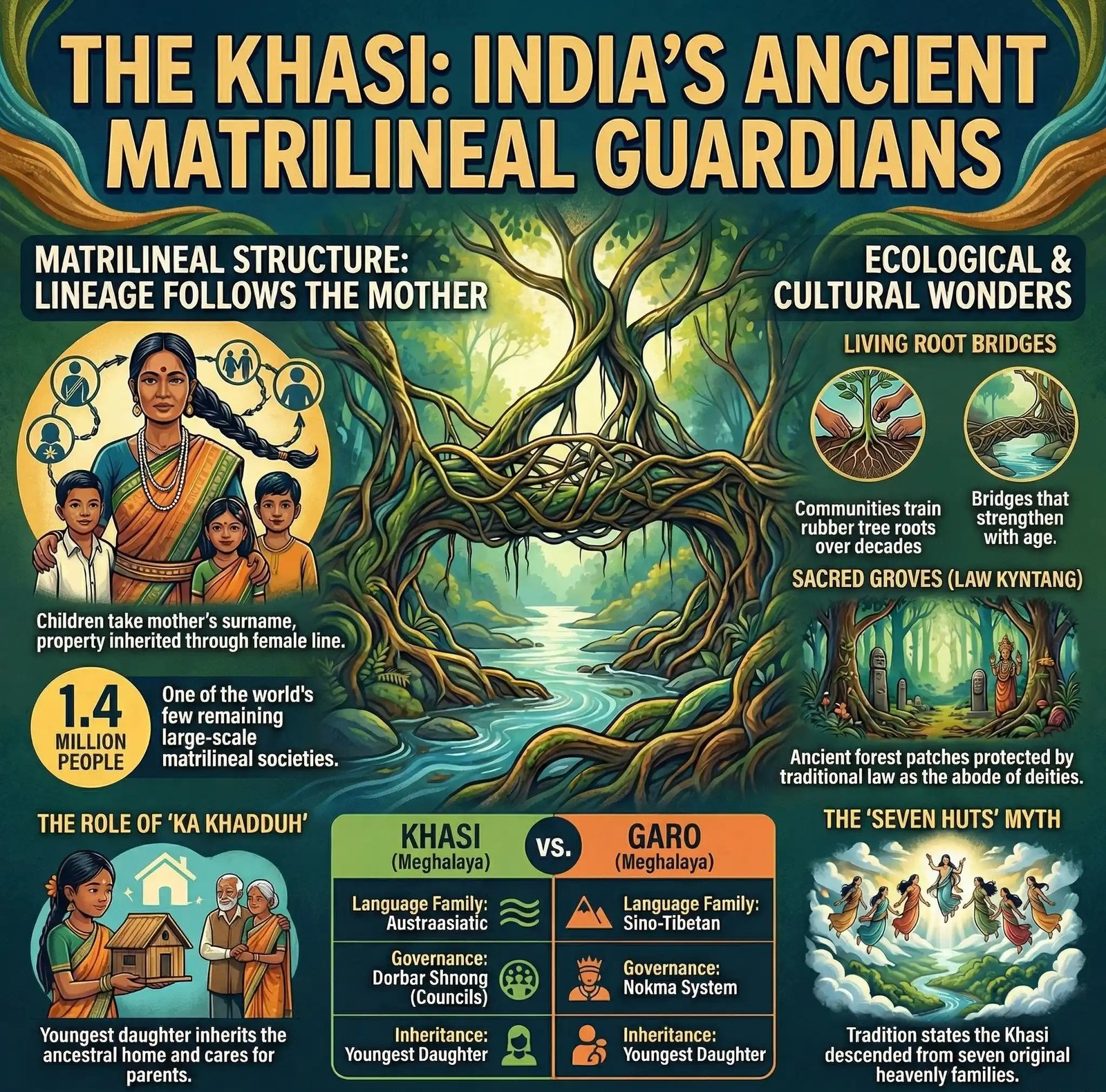
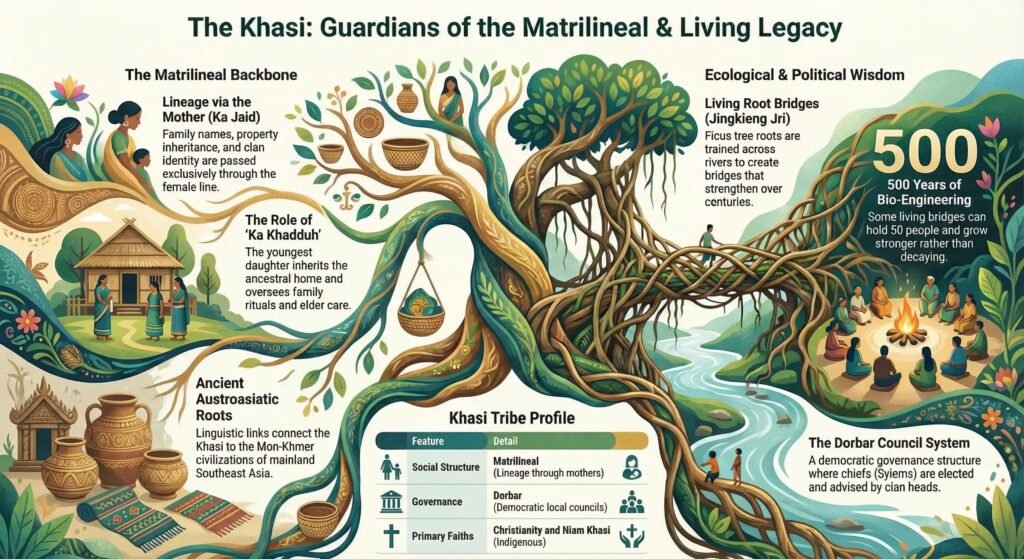
The Khasi matrilineal system — called ka jaid — is one of the oldest and most intact matrilineal traditions in the world. In Khasi society, lineage, inheritance of property, and the family home all pass through the mother’s line. The youngest daughter, known as ka khadduh, holds a position of special responsibility: she inherits the ancestral home and is tasked with maintaining family rituals and looking after aged parents.
Men in Khasi society are deeply respected and vital to community life, they hold leadership roles in councils, but they do not carry the clan name forward. A Khasi man lives in his wife’s home; his children belong to her clan. This structure has preserved Khasi women’s economic agency for millennia and continues to draw sociologists from around the world to Meghalaya.
The Seven Huts and the Sacred Myth
The Khasi people have a deeply spiritual origin story. According to their ancient oral tradition, God originally created sixteen families of human beings (Hynniew Trep), meaning “seven huts” — a poetic reference to the original Khasi clans who descended from heaven to earth. The remaining nine families chose to stay in the heavens, and the tree that connected earth and sky — the Diengiei — was eventually cut down, forever separating the earthly Khasi from their heavenly brethren.
This myth is not merely a bedtime story. It shaped everything: Khasi reverence for forests (the sacred law kyntang groves), their belief that the dead must be cremated and their bones stored in ancestral urns, and their conviction that humanity carries a divine responsibility to maintain nature.
Pre-Colonial Khasi Kingdom: The Syiems and the Hima System
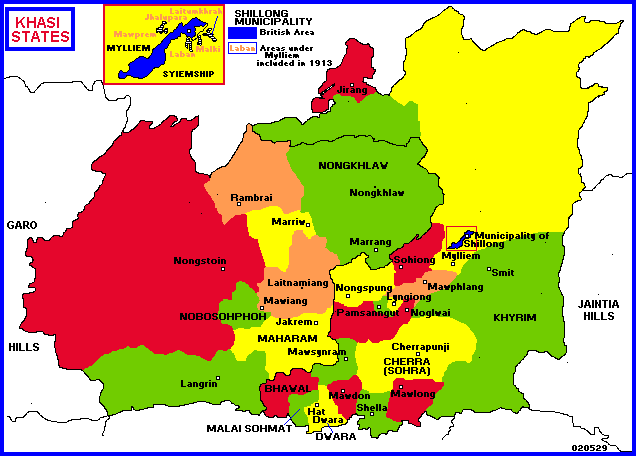
Long before the British arrived, the Khasi hills were governed by a sophisticated political system. Each Khasi region was organized as a Hima, a chieftainship or small kingdom — headed by a Syiem (king or chief), elected by clan heads. The Syiem was not an autocrat; decisions were made through a council (Dorbar), a form of democratic governance that predates modern democracy in the subcontinent.
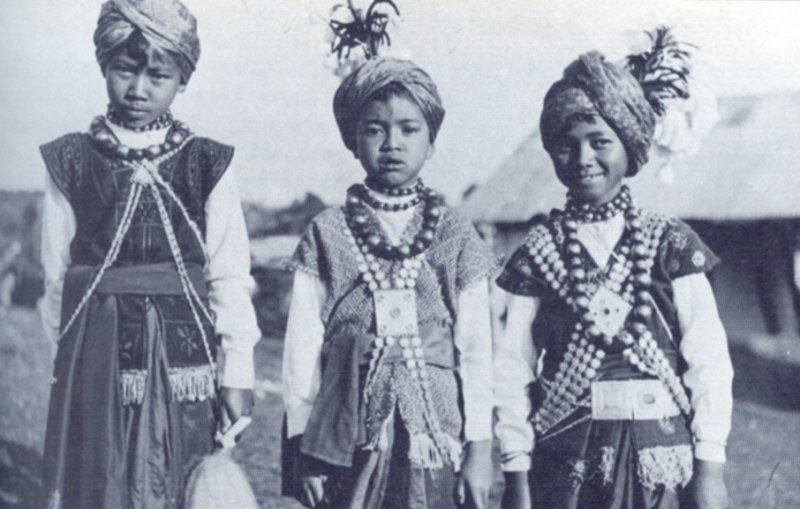
Major Khasi Himas included Nongkrem, Cherra (Sohra), Mylliem, and Nongstoin, each with its own distinct customs, dress, and dialects. These were not warring fiefdoms but largely cooperative communities connected by trade, intermarriage, and shared spiritual practice.
Trade routes connected the Khasi hills to the plains of Bengal and Assam. Khasi traders were known for their commerce in cotton, betel nut, iron, and forest produce. The Sohra (Cherrapunji) region, the rainiest place on Earth, was a bustling trade and cultural hub long before it became famous in geography textbooks.
The British Encounter and U Tirot Sing’s Resistance
The East India Company arrived in the Khasi hills in the early 19th century. What began as a treaty with the Syiem of Nongkhem in 1826 soon revealed its true nature: colonial annexation dressed in diplomatic language.
The most celebrated chapter of Khasi resistance is the story of U Tirot Sing Syiem, the chief of Nongkhlaw. When the British proposed building a road through Khasi territory in 1829 under the guise of trade, U Tirot Sing saw through the plan. He launched a guerrilla resistance that lasted four years, ambushing British troops in the dense Khasi forests. Betrayed and captured in 1833, he was exiled to Dhaka, where he died in 1835 — never returning to the hills he had fought so fiercely to protect.
U Tirot Sing remains a national hero in Meghalaya today, and his story is part of the larger, often overlooked narrative of northeastern India’s fierce resistance to colonial rule.
Christianity and Cultural Transformation
Welsh missionaries arrived in the Khasi hills in 1841, led by Reverend Thomas Jones. Within decades, Christianity spread rapidly through the Khasi community, fundamentally reshaping certain aspects of their spiritual life. Today, the majority of Khasi people are Christian — predominantly Presbyterian — while many still maintain elements of Niam Khasi, their indigenous faith.
Interestingly, the arrival of Christianity also brought literacy. Thomas Jones created the first written script for the Khasi language using the Roman alphabet, transforming an entirely oral tradition into a written one. This was a double-edged gift: it preserved Khasi knowledge while simultaneously introducing outside religious frameworks.
Colonial Architecture in India
Sacred Groves and the Living Root Bridges
Perhaps no symbol speaks more powerfully of Khasi civilization than the living root bridges (Jingkieng Jri) of Cherrapunji and Mawlynnong. For centuries, Khasi communities trained the roots of the Ficus elastica (rubber tree) to grow across rivers, creating bridges that strengthen with age rather than decay. Some of these bridges are over 500 years old and can hold the weight of fifty people.
This is not primitive technology, it is biomechanical engineering rooted in an intimate understanding of the natural world. The living root bridges are now UNESCO tentative list candidates and represent one of the most remarkable examples of indigenous ecological knowledge anywhere on Earth.
Equally astonishing are the sacred groves (Law Kyntang) — patches of ancient forest maintained by Khasi villages as the abode of deities. Cutting trees in these groves is forbidden. Modern ecologists have discovered that these sacred groves preserve extraordinary biodiversity, functioning as natural conservation zones that colonial and post-colonial forest policies often failed to protect.
Quick Comparison Table: Khasi vs. Other Matrilineal Societies in India
| Feature | Khasi (Meghalaya) | Nair (Kerala) | Garo (Meghalaya) |
|---|---|---|---|
| Lineage | Mother’s side | Mother’s side | Mother’s side |
| Inheritance | Youngest daughter | Variable | Youngest daughter |
| Language Family | Austroasiatic | Dravidian | Sino-Tibetan |
| Religion | Christian + Niam Khasi | Hindu + Christian | Christian + Songsarek |
| Political Governance | Dorbar Shnong councils | Village councils | Nokma system |
Curious Indian: Fast Facts
- The Khasi people call themselves “Hynniew Trep” — meaning “the seven huts.”
- The youngest daughter (Ka Khadduh) inherits the family home and ancestral responsibilities.
- Some living root bridges in Meghalaya are over 500 years old and grow stronger every year.
- Cherrapunji, a historic Khasi hub, holds the record for highest rainfall in a single year anywhere on Earth.
- The Nongkrem Dance Festival — held in autumn — is one of the most spectacular religious festivals in Northeast India.
- The Khasi language got its first written form only in the 1840s, thanks to Welsh missionary Thomas Jones.
- The Dorbar Shnong (village council) is one of the oldest functioning forms of democratic local governance in India.
Conclusion
The history of the Khasi tribe is not a history of monuments or empires. It is a history of forests and family, of women who carry clan names like torches through centuries of change, of men who fought colonial powers with bamboo spears, and of an entire people who taught the world to grow bridges from living trees. In every sacred grove and every root bridge, the Khasi story quietly insists that a civilization can be powerful without being loud. As Meghalaya continues to step into the modern world, the Khasi legacy, matrilineal, ecological, defiant, endures as one of India’s most profound gifts to human history.
If you think you have remembered everything about this topic take this QUIZ
Results


#1. In the Khasi matrilineal system, what is the specific term for the youngest daughter who inherits the family home and property?
#2. To which ancient linguistic group does the Khasi language belong, connecting them to peoples in Southeast Asia?
#3. What is the meaning of “Hynniew Trep,” the name the Khasi people use to refer to themselves?
#4. Who was the Khasi chief of Nongkhlaw who led a four-year guerrilla resistance against British colonial expansion in the 1820s?
#5. Which Welsh missionary is credited with creating the first written script for the Khasi language using the Roman alphabet in 1841?
#6. What is the name of the traditional Khasi village council that represents an early form of democratic local governance?
#7. What is the Khasi term for the sacred groves where cutting trees is strictly forbidden due to the belief that they are abodes of deities?
#8. The “Jingkieng Jri,” or living root bridges, are primarily made by training the roots of which specific tree?
What is the Khasi tribe known for?
The Khasi tribe is best known for being one of the world’s few remaining matrilineal societies, their ancient living root bridges in Meghalaya, and their sacred forest groves that have preserved biodiversity for centuries.
Where do the Khasi people originally come from?
Linguistic and anthropological evidence suggests the Khasi people migrated from Southeast Asia thousands of years ago, with their language linked to the Mon-Khmer group of mainland Southeast Asia.
What is the matrilineal system of the Khasi tribe?
In the Khasi matrilineal system, lineage, clan name, and property pass through the mother’s side. The youngest daughter inherits the family home, and children take their mother’s surname.
Who is U Tirot Sing and why is he important?
U Tirot Sing Syiem was a 19th-century Khasi chief who led a four-year armed resistance against British colonial expansion. He is celebrated as a freedom fighter and national hero in Meghalaya.
What religion do the Khasi people follow?
Most Khasi people today are Christian (predominantly Presbyterian), a result of Welsh missionary activity from the 1840s. However, many also practice elements of Niam Khasi, their indigenous animist faith.