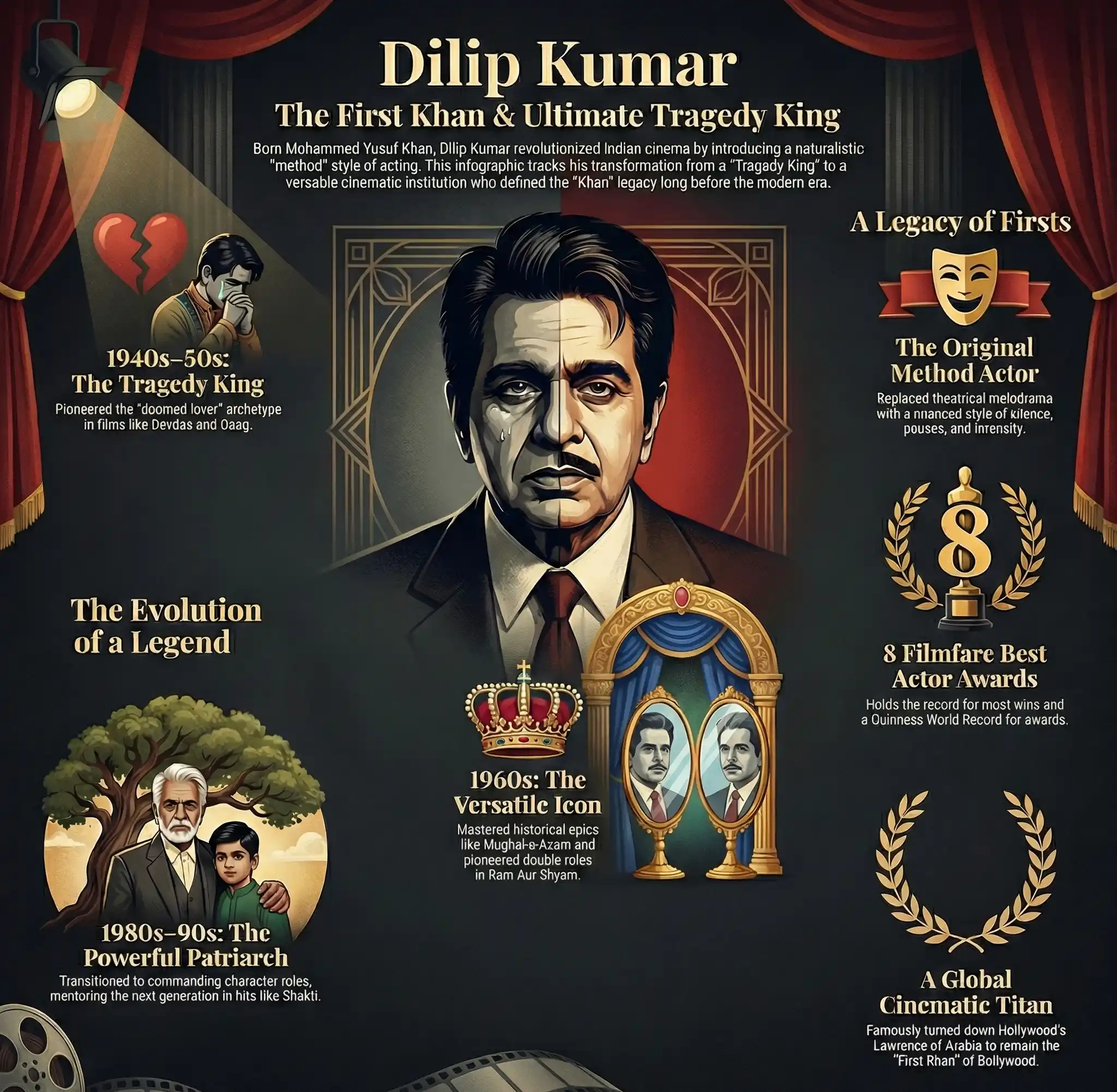
Dilip Kumar, born Mohammed Yusuf Khan in 1922, was a cinematic titan credited with pioneering method acting in Indian cinema. Moving from Peshawar to Bombay, he was discovered by Devika Rani and rechristened Dilip Kumar. He dominated the golden era of Bollywood with intense, tragic roles in films like Devdas, Daag, and Madhumati, earning him the moniker "Tragedy King." His versatility shone in the historical epic Mughal-e-Azam and the comedy Ram Aur Shyam. A recipient of the Dadasaheb Phalke Award and Pakistan's highest civilian honor, Nishan-e-Imtiaz, he holds the record for the most Filmfare Best Actor wins (8).| Attribute | Details |
| Full Name | Mohammed Yusuf Khan |
| Screen Name | Dilip Kumar |
| Date of Birth | December 11, 1922 |
| Birthplace | Peshawar, North-West Frontier Province (British India) |
| Date of Death | July 7, 2021 (Age 98) |
| Profession | Actor, Producer, Screenwriter |
| Debut Film | Jwar Bhata (1944) |
| Key Awards | Dadasaheb Phalke Award (1994), Padma Vibhushan (2015), 8 Filmfare Best Actor Awards |
| Spouse | Saira Banu (Married 1966) |
| Notable Works | Mughal-e-Azam, Devdas, Naya Daur, Madhumati, Ram Aur Shyam |
The Fruit Merchant’s Son
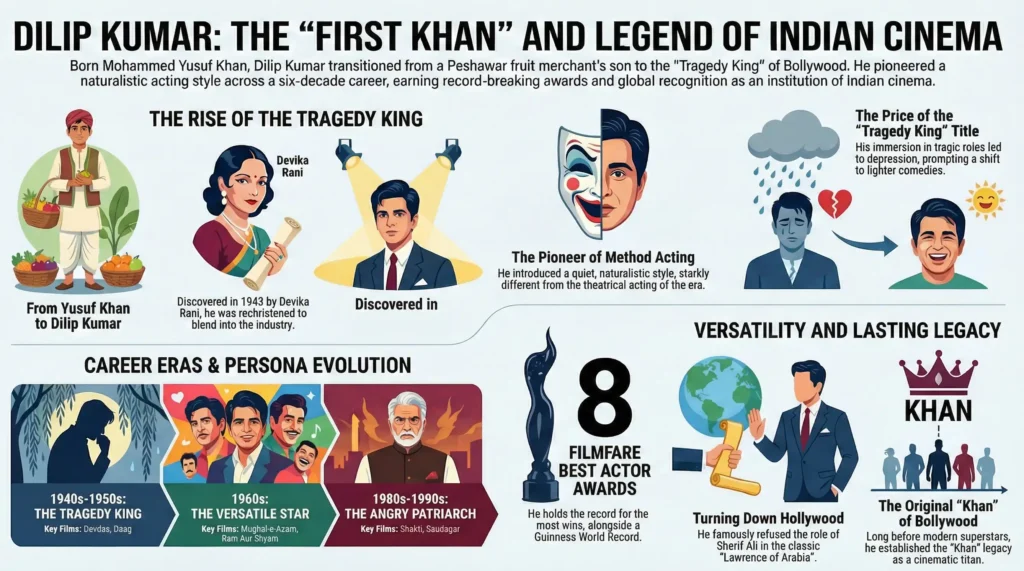
Born into a Hindko-speaking Awan family in the Qissa Khwani Bazaar of Peshawar, Yusuf Khan was one of twelve children. His father, Lala Ghulam Sarwar, was a fruit merchant who moved the family to Bombay in the 1930s. Yusuf attended the Barnes School in Deolali. A shy and introverted young man, he had no initial aspirations for cinema. A dispute with his father led him to Pune, where he worked as a canteen owner and dry fruit supplier, completely unaware that destiny had a different script for him.
8 Defining Chapters in the Vikram Sarabhai Biography
The Discovery: Enter Devika Rani
In 1943, a chance meeting with Devika Rani, the owner of Bombay Talkies, changed his life. Impressed by his Urdu diction and personality, she offered him a job as an actor and gave him the screen name Dilip Kumar to help him blend into the industry. He made his debut with Jwar Bhata (1944), which went unnoticed, but his breakthrough came with Jugnu (1947) alongside Noor Jehan.
The Tragedy King
Dilip Kumar introduced a quiet, naturalistic style of acting that was in stark contrast to the theatrical style of the era.
- The Melancholy Hero: His portrayal of doomed lovers in films like Deedar (1951), Daag (1952), and Devdas (1955) was so intense that he earned the title “Tragedy King.”
- The Price of Art: He immersed himself so deeply in these tragic roles that he suffered from depression. A psychiatrist advised him to take up lighter roles, leading to comedies like Azaad and Kohinoor.
- The Magnum Opus: His role as Prince Salim in K. Asif’s Mughal-e-Azam (1960) remains his most iconic performance. His rebellious romance with Anarkali (played by Madhubala) set the screen on fire, mirroring their real-life relationship.
6 Unfoldings in the Subrahmanyan Chandrasekhar Biography
Versatility and Later Career
He proved his range with Gunga Jumna (1961), a film he wrote and produced, which perfected the Bhojpuri dialect and inspired Deewaar. In Ram Aur Shyam (1967), he played a double role that became a template for generations. After a hiatus in the 70s, he returned as a character actor in blockbusters like Kranti (1981), Shakti (1982), and Saudagar (1991), holding his own against younger superstars.
Personal Life
Dilip Kumar’s personal life was marked by a widely publicized romance with actress Madhubala, which ended tragically due to a court case. In 1966, he married actress Saira Banu, who was 22 years his junior. Their marriage is considered one of the most enduring love stories in Bollywood.
7 Secrets of Padmanabhaswamy Temple Treasure
Quick Comparison: Eras of the Legend
| Era | Persona | Key Films | Impact |
| 1940s-50s | The Tragedy King | Devdas, Andaz, Daag | Pioneered method acting; established the “doomed lover” archetype. |
| 1960s | The Versatile Star | Mughal-e-Azam, Gunga Jumna, Ram Aur Shyam | Mastered historical epics, rustic dramas, and comedy. |
| 1980s-90s | The Angry Patriarch | Shakti, Karma, Saudagar | Transitioned to powerful character roles; mentored the new generation. |
Curious Indian Fast Facts
- The Record Holder: He holds the Guinness World Record for the maximum number of awards won by an Indian actor.
- Refused Hollywood: He turned down the role of Sherif Ali in David Lean’s classic Lawrence of Arabia (1962), a role that eventually went to Omar Sharif.
- Sheriff of Mumbai: He served as the Sheriff of Mumbai in 1980, an honorary position.
- The First Khan: Long before the era of Shah Rukh, Salman, and Aamir, Dilip Kumar (Yusuf Khan) was the original Khan of Bollywood.
- Peace Maker: He was awarded the Nishan-e-Imtiaz, Pakistan’s highest civilian award, in 1998 for his efforts to bridge the gap between India and Pakistan.
Conclusion
Dilip Kumar was not just an actor; he was an institution. He stripped acting of its melodrama and replaced it with silence, pauses, and intensity. From the rebellious Salim to the honest police officer in Shakti, his performances were textbooks on the craft. As the “First Khan” and the ultimate “Tragedy King,” his legacy is etched not just in film reels but in the very DNA of Indian acting.
10 Remarkable Facts About Meghnad Saha Life and Achievements
If you think you have remembered everything about this topic take this QUIZ
Results


#1. What was Dilip Kumar’s real birth name?
#2. In which city was Dilip Kumar born?
#3. Which film marked Dilip Kumar’s acting debut in 1944?
#4. Dilip Kumar is popularly known by which title in Indian cinema?
#5. Which iconic Hollywood film role did Dilip Kumar turn down, which later went to Omar Sharif?
#6. Which actress did Dilip Kumar marry in 1966?
#7. In 1998, Dilip Kumar was awarded which highest civilian honor by Pakistan?
#8. Dilip Kumar played the rebellious Prince Salim in which historical magnum opus?
What was Dilip Kumar’s real name?
His birth name was Mohammed Yusuf Khan.
Why was Dilip Kumar called the Tragedy King?
He earned this title for his realistic and heart-wrenching portrayal of tragic heroes in films like Devdas and Deedar.
Who was Dilip Kumar’s wife?
He was married to actress Saira Banu from 1966 until his death in 2021.
Did Dilip Kumar work in Hollywood?
No, he notably refused a role in the Hollywood classic Lawrence of Arabia.
How many Filmfare Awards did Dilip Kumar win?
He won 8 Filmfare Awards for Best Actor, a record he shares with Shah Rukh Khan.
Read more: https://curiousindian.in/narendra-modi-becomes-prime-minister-2014/