Dignaga was a 5th-century visionary who founded the school of Buddhist Logic, fundamentally changing how humanity understands perception and inference. By distinguishing between raw sensory data and mental constructs, he created a rigorous framework for truth known as the "Three Marks of a Reason." His work, primarily the Pramana-samuccaya, traveled across Asia, establishing a logical tradition that survives in Buddhist monasticism to this day.| Attribute | Details |
| Name | Dignaga (c. 480 – 540 CE) |
| Title | Founder of Buddhist Logic (Pramana) |
| Key Work | Pramana-samuccaya (Compendium of Valid Cognition) |
| Philosophy | Yogacara-Sautrantika (Epistemological Idealism) |
| Legacy | Revolutionized debate and cognition theory |
The Architect of the Mind: Dignaga’s Radical Vision
In the quiet monasteries of 5th-century India, a revolution was brewing that had nothing to do with swords or kingdoms. It was a revolution of the intellect. At the center of this storm was a monk named Dignaga, a man whose clarity of thought would eventually earn him the title of the “Father of Medieval Logic.” Through the development of Dignaga Buddhist Logic, he dismantled the traditional ways Indians debated truth and replaced them with a precision that feels remarkably modern.
Dignaga was born into a Brahmin family in Simhavaktra, near Kanchipuram. His journey began in the orthodox traditions, but his restless mind sought deeper answers. He eventually found his way to the Buddhist fold, studying under the great master Vasubandhu. However, Dignaga wasn’t content with just repeating the words of his teachers. He saw a world where debates were won by whoever shouted the loudest or cited the oldest texts. He wanted a system where truth could be proven through the mechanics of the mind itself.
8 Defining Chapters in the Vikram Sarabhai Biography
The Mystery of the Missing Perception
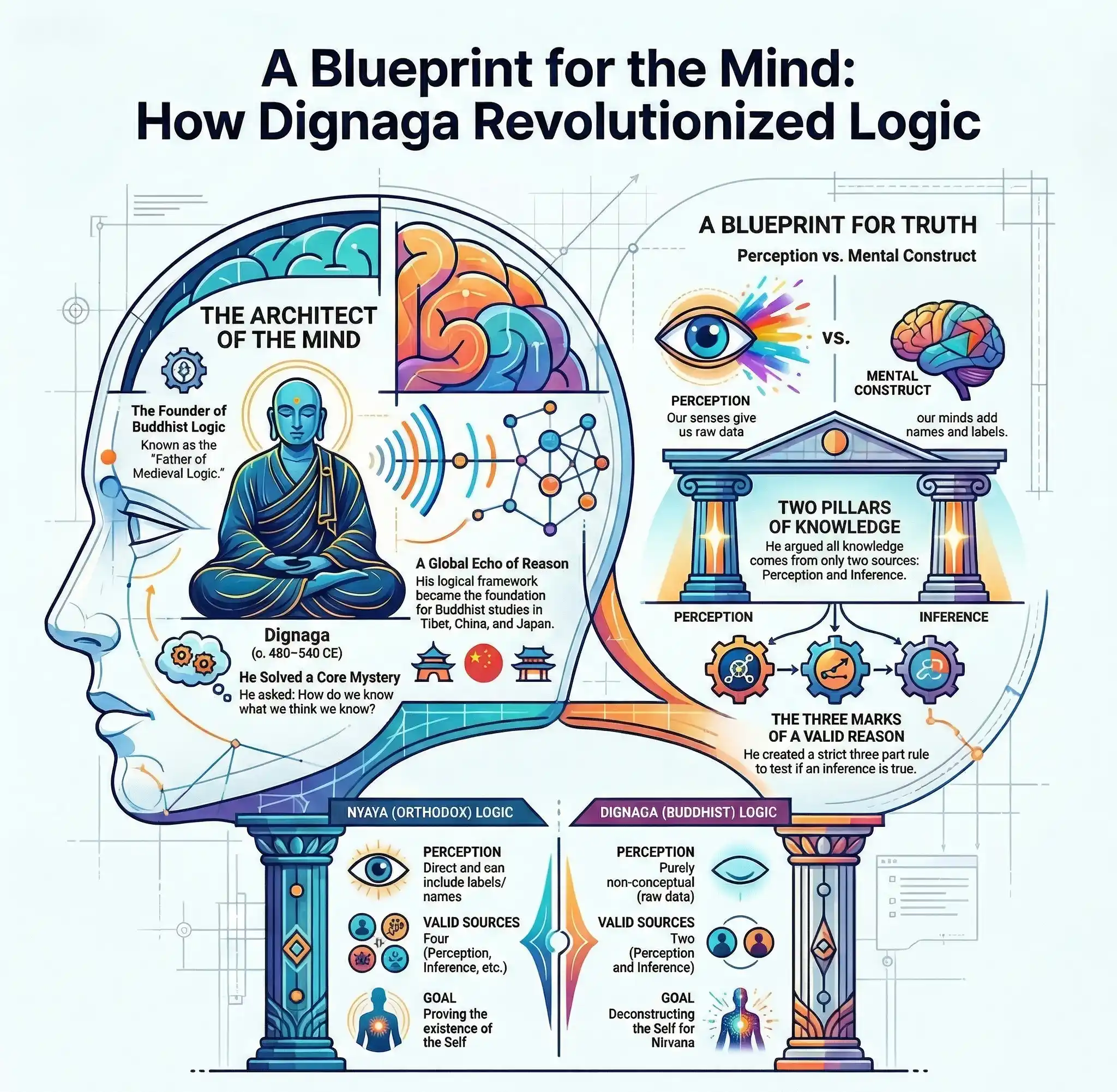
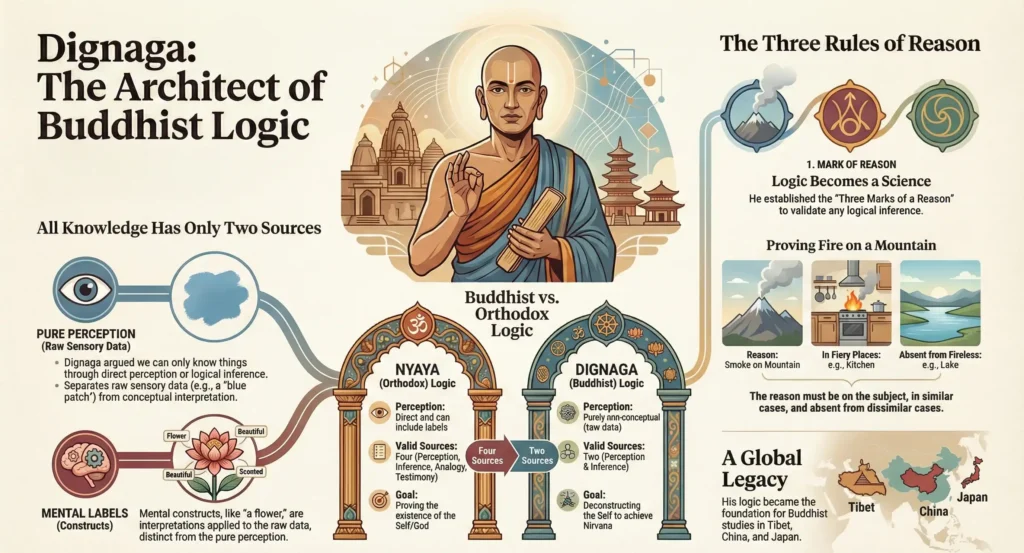
The core mystery that Dignaga sought to solve was simple yet profound: How do we actually know what we think we know? Before Dignaga Buddhist Logic, people believed that our senses provided us with a direct, unfiltered view of the world. Dignaga disagreed. He proposed a radical idea: our senses only give us raw, “point-instance” data—moments of pure sensation without names or labels.
He argued that the moment you say, “This is a blue flower,” you are no longer in the realm of pure perception. You have added a mental construct. This distinction—between the raw reality and the mental labels we slap onto it—was a breakthrough. It suggested that much of what we call “reality” is actually a construction of our own minds. This realization was not just a dry philosophical point; it was an inspirational call to look closer at the nature of our own consciousness.
The Triple Rule of the Sign
Dignaga’s most enduring contribution to the world of intellect was his formalization of the “Hetu-cakra,” or the Wheel of Reasons. He realized that for an inference to be valid, it had to follow a strict set of rules. This was the birth of formal Dignaga Buddhist Logic. He established the “Trairupya,” or the three marks of a valid reason.
To prove something—like “There is fire on the mountain because there is smoke”—Dignaga insisted that the reason (the smoke) must be present in the subject (the mountain), present in other similar cases (a kitchen), and absent in all dissimilar cases (a lake). By tightening the screws of logic in this way, he made it impossible for sloppy thinkers to win debates. He turned the act of reasoning into a science, ensuring that Indian logic would remain a dominant force in world philosophy for centuries to come.
10 Remarkable Facts About Meghnad Saha Life and Achievements
A Life of Quiet Intensity
Despite his massive intellectual shadow, Dignaga lived a life of profound simplicity. Legends say he spent much of his time in a cave in Orissa, far from the bustling centers of Nalanda University. It was in this solitude that he composed his masterpiece, the Pramana-samuccaya. When he first wrote the opening lines, it is said that the earth trembled and a great light filled the cave—a symbolic nod to the power of his realization.
His journey was one of emotional and intellectual courage. He had to challenge his own teachers and the centuries-old traditions of the Nyaya school of logic. He faced immense criticism, yet he remained focused on his goal: to provide a ladder of logic that could lead a person to ultimate wisdom. For Dignaga, logic wasn’t just about winning an argument; it was a tool for liberation. By understanding how the mind deceives us, we could finally see things as they truly are.
The Global Echo of Indian Reason
The influence of Dignaga Buddhist Logic did not stop at the borders of India. His texts traveled across the Himalayas into Tibet and eventually reached China and Japan. In these regions, his logic became the foundation for all subsequent Buddhist studies. Even today, monks in the great Tibetan monasteries spend years mastering the “Dudra” or introductory logic, which is directly descended from Dignaga’s 5th-century innovations.
His work bridged the gap between the mystical and the rational. He proved that one could be a deeply spiritual practitioner while maintaining a sharp, analytical mind. This balance is what makes his story so captivating for the “Curious Indian” today. He reminds us that our heritage is not just one of faith, but one of rigorous, world-class scientific inquiry into the nature of existence.
7 Secrets of Padmanabhaswamy Temple Treasure
Comparison of Logic Schools
| Feature | Nyaya (Orthodox) Logic | Dignaga (Buddhist) Logic |
| Nature of Perception | Direct and can include labels/names. | Purely non-conceptual (raw data). |
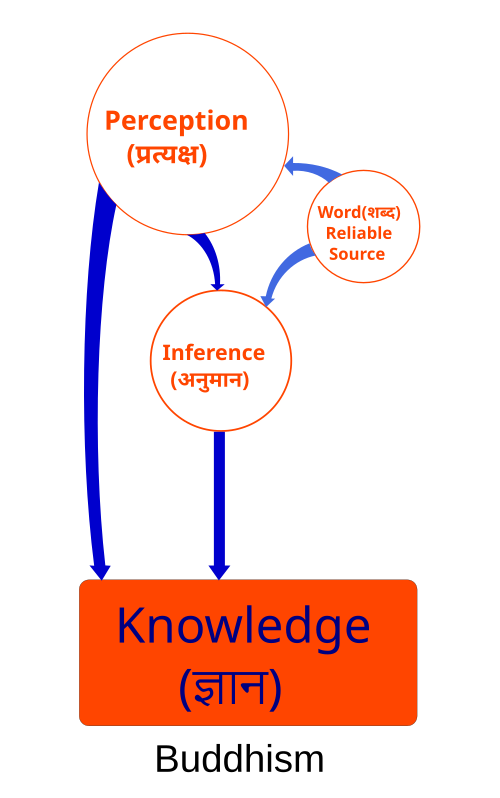
| Valid Sources | Four (Perception, Inference, Analogy, Testimony). | Two (Perception and Inference). |
| Mental Constructs | Seen as part of the real world. | Seen as “unreal” linguistic conventions. |
| Goal | Proving the existence of the Self/God. | Deconstructing the Self to achieve Nirvana. |
Curious Indian: Fast Facts
- The Father of Medieval Logic: Dignaga is widely credited with transitioning Indian philosophy from general inquiry to specific epistemology (the study of knowledge).
- The Cave Scholar: Much of his most complex work was written in a secluded cave in the hills of modern-day Odisha.
- The Two Pillars: He argued that there are only two ways to know anything: through our senses (Perception) or through our minds (Inference).
- Defeating the Critics: He famously won a debate against the Brahmin scholar Sudurjaya, which cemented his reputation as the premier logician of his era.
- Legacy in Tibet: His work is so revered in Tibet that he is considered one of the “Six Ornaments” of the Southern Continent (India).
Conclusion
The legacy of Dignaga Buddhist Logic serves as a powerful reminder of India’s golden age of reason. Dignaga did not just teach people what to think; he taught them how to think. In an age of information overload and “fake news,” his insistence on rigorous proof and the questioning of our mental labels is more relevant than ever. He was a pioneer who looked into the mirror of the mind and saw the gears turning, providing us with the tools to navigate reality with clarity and grace. As we explore our history, Dignaga stands as a beacon of intellectual honesty, challenging every “Curious Indian” to seek the truth that lies beyond mere words.
6 Unfoldings in the Subrahmanyan Chandrasekhar Biography
If you think you have remembered everything about this topic take this QUIZ
Results


#1. What radical distinction did Dignaga make regarding human perception that changed Buddhist epistemology?
#2. Dignaga is famous for establishing the ‘Trairupya’. What does this term refer to?
#3. Dignaga is famous for establishing the ‘Trairupya’. What does this term refer to?
#4. In the comparison of logic schools, how many valid sources of knowledge (Pramanas) did Dignaga recognize?
#5. What is the name of Dignaga’s masterpiece, often called the ‘Compendium of Valid Cognition’?
#6. Where is Dignaga said to have spent much of his time composing his most complex works?
#7. According to Dignaga, why are mental constructs (like names and categories) considered ‘unreal’ in a strict sense?
#8. Which great master served as Dignaga’s primary teacher during his Buddhist studies?
#9. What is the ultimate goal of using logic according to Dignaga’s Buddhist perspective?
What is the “Focus Keyword” in Dignaga’s work?
In his philosophy, the focus is on Pramana, or the “means of valid cognition.” It is the study of how we can be certain that our knowledge is accurate.
Why did Dignaga only accept two sources of knowledge?
He believed that everything we know either comes directly from the senses (Perception) or is a result of thinking about those sensations (Inference). He felt other sources like “Testimony” were just forms of inference.
Is Buddhist logic different from Western logic?
While they share many similarities, Dignaga Buddhist Logic is unique because it is deeply tied to psychology and the goal of spiritual liberation, whereas Western logic is often purely mathematical or linguistic.
What is Dignaga’s most famous book?
His most famous and influential work is the Pramana-samuccaya, a massive compendium that synthesized all his radical ideas on logic and perception.
How did he influence modern thought?
Dignaga’s distinction between “things-in-themselves” and our mental representations of them predates similar ideas by Western philosophers like Immanuel Kant by over a thousand years.
Read More: https://curiousindian.in/chanakya-300-bce/