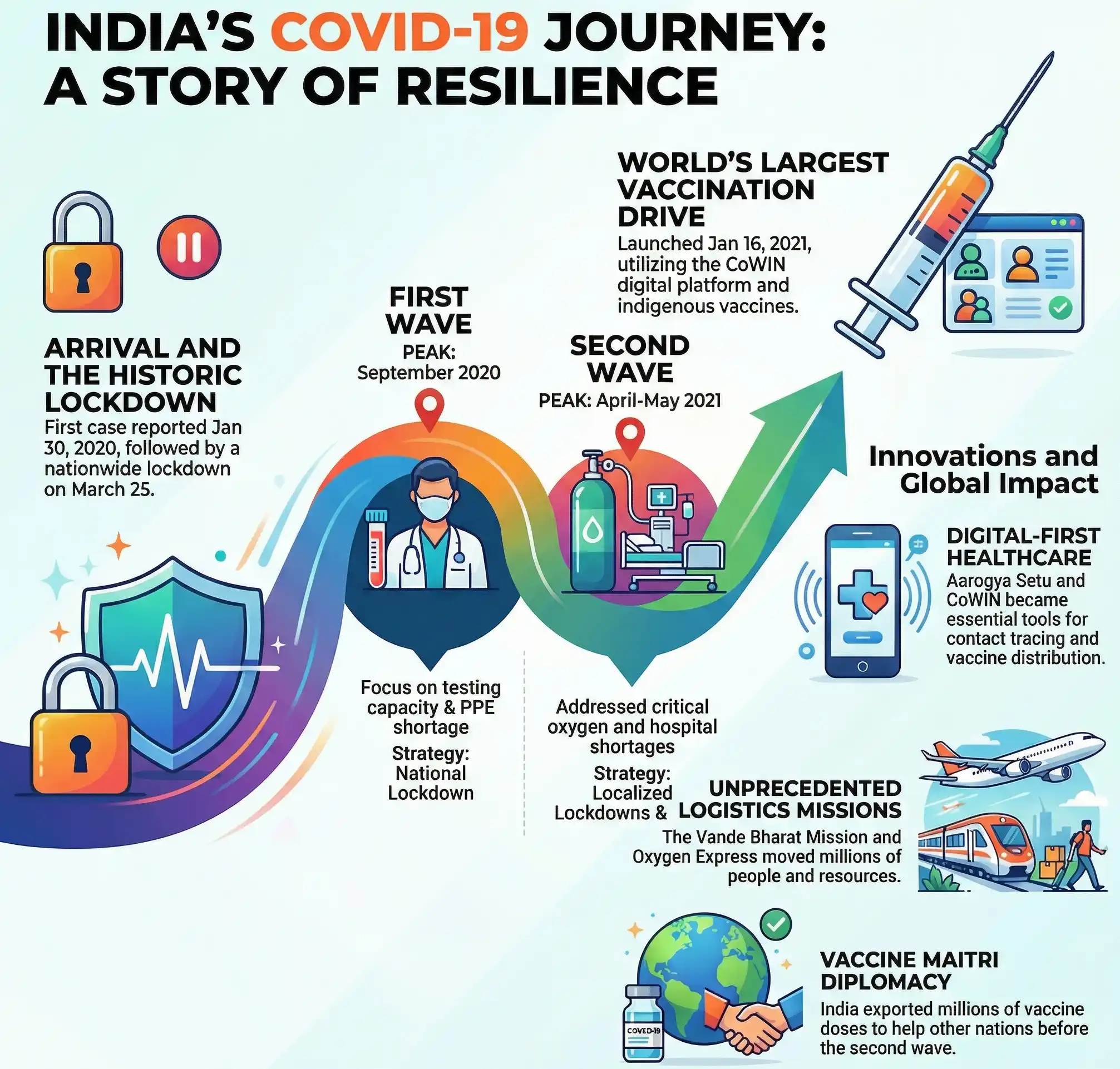
The COVID-19 pandemic in India began with the first case reported in Kerala on January 30, 2020. What followed was a series of stringent public health measures, including a nationwide lockdown starting March 25, 2020. The country witnessed multiple waves of infection, with a first peak in September 2020 and a far more severe second wave in April–May 2021 driven by new variants. In response, India launched one of the world's largest vaccination drives in January 2021, administering billions of doses. The pandemic tested India's health infrastructure, triggered a migrant crisis, and accelerated the adoption of digital health tools like Aarogya Setu and CoWIN.| Attribute | Details |
| First Case | January 30, 2020 (Kerala) |
| Key Dates | March 22, 2020 (Janata Curfew), March 25, 2020 (Lockdown Starts) |
| Vaccination Launch | January 16, 2021 |
| Primary Vaccines | Covishield, Covaxin |
| Digital Tools | Aarogya Setu, CoWIN |
| Major Initiatives | Vande Bharat Mission, PMGKAY, Vaccine Maitri |
| Key Challenges | Migrant Crisis, Oxygen Shortage (2nd Wave), Economic Contraction |
| Impact | Boosted Health Infrastructure, Digital Payments, Genomic Surveillance |
Early Timeline and Containment
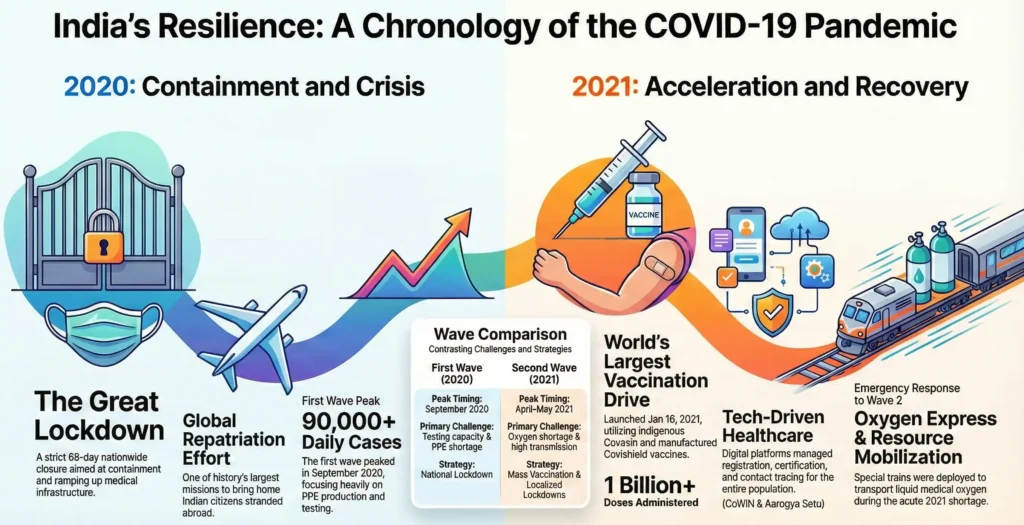
The virus arrived in India on January 30, 2020, via a student returning from Wuhan. As cases rose, the government implemented rigorous screening and the historic Janata Curfew on March 22. This was a precursor to a strict nationwide lockdown beginning March 25, which lasted until May 31. The country was divided into Red, Orange, and Green zones to manage containment, followed by phased “Unlock” processes from June onwards.
The Roopkund Skeleton Lake Mystery: Why Were Greeks Dying in the Indian Himalayas?
The Two Waves
India experienced two distinct waves:
- First Wave (2020): Peaked in September 2020 with over 90,000 daily cases. The focus was on ramping up testing (RT-PCR), PPE production, and establishing COVID-dedicated hospitals.
- Second Wave (2021): The most devastating phase began in March 2021. Driven by highly transmissible variants, it caused an acute shortage of medical oxygen, hospital beds, and essential medicines, leading to a massive mobilization of emergency resources.
The Vaccination Drive
On January 16, 2021, India kicked off the world’s largest vaccination campaign. Initially prioritizing healthcare and frontline workers, it expanded to all adults. Indigenous vaccines like Covaxin (Bharat Biotech) and manufactured ones like Covishield (Serum Institute) were pivotal. The CoWIN platform served as the digital backbone for registration and certification.
1971 Nagarwala Case: India’s Great Bank Heist Mystery
Socioeconomic Response & Governance
The pandemic triggered significant social and economic shifts:
- Migrant Crisis: The sudden lockdown led to a mass exodus of migrant workers, necessitating special Shramik Trains and relief camps.
- Economic Relief: The Atmanirbhar Bharat package aimed to stabilize the economy, offering credit to MSMEs and food security via PMGKAY.
- Digital Leap: There was a massive surge in digital payments (UPI) and telemedicine.
8 Defining Chapters in the Vikram Sarabhai Biography
Quick Comparison: Wave 1 vs. Wave 2
| Feature | First Wave (2020) | Second Wave (2021) |
| Peak Timing | September 2020 | April-May 2021 |
| Primary Challenge | Testing capacity, PPE shortage, Migrant crisis | Oxygen shortage, ICU beds, fast transmission |
| Strategy | National Lockdown, Contact Tracing | Localized Lockdowns, Mass Vaccination |
| Severity | High caseload, lower mortality rate | Extremely high caseload, higher mortality |
Curious Indian Fast Facts
- Vande Bharat Mission: One of the largest repatriation missions in history, bringing back Indians stranded abroad during the lockdown.
- Tech for Good: The Aarogya Setu app became one of the most downloaded healthcare apps globally for contact tracing.
- Vaccine Maitri: Before the second wave, India exported millions of vaccine doses to friendly nations as part of its vaccine diplomacy.
- Oxygen Express: The Indian Railways ran special trains to transport liquid medical oxygen across the country during the peak of the second wave.
- Janata Curfew: The 14-hour voluntary curfew on March 22, 2020, was observed by nearly 1.3 billion people, a unique global event.
Conclusion
The COVID-19 pandemic was a defining moment for India in the 21st century. It exposed vulnerabilities in the public health system but also demonstrated the nation’s resilience and capacity for innovation. From manufacturing its own PPE kits and vaccines to managing a digital vaccination drive of unprecedented scale, India’s response has left a lasting legacy on its healthcare infrastructure and governance models.
The Purulia Arms Drop Mystery 1995: When the Sky Rained Guns
If you think you have remembered everything about this topic take this QUIZ
Results


#1. When was the first confirmed case of COVID-19 reported in India?
#2. On which date did the nationwide lockdown officially begin in India?
#3. What was the name of the digital platform that served as the backbone for India’s vaccination registration?
#4. Which massive repatriation mission was launched to bring back Indians stranded abroad during the lockdown?
#5. India launched the world’s largest vaccination drive on which date?
#6. What was a primary challenge specifically associated with the Second Wave (2021) in the text?
#7. Under which initiative did India export millions of vaccine doses to friendly nations?
#8. The voluntary “Janata Curfew” observed by nearly 1.3 billion people took place on:
When was the first COVID-19 case reported in India?
The first case was reported on January 30, 2020, in Kerala.
What was the Janata Curfew?
It was a voluntary 14-hour public curfew observed on March 22, 2020, to prepare the nation for the subsequent lockdown.
Which vaccines were primarily used in India?
The two main vaccines used were Covishield (manufactured by Serum Institute of India) and Covaxin (developed by Bharat Biotech).
What was the Vande Bharat Mission?
It was a massive repatriation operation launched by the Indian government to bring back Indian citizens stranded abroad due to travel restrictions.
What is the CoWIN platform?
CoWIN is the digital platform used by the Indian government to manage the registration, appointment scheduling, and certification for the COVID-19 vaccination drive.