This article explores the life and enduring impact of Charaka, the legendary figure who compiled the definitive guide to Ayurvedic healing. By examining the Charaka Samhita, we reveal a medical philosophy that prioritized prevention over cure and treated the patient as a whole being rather than a collection of symptoms. From the "Tridosha" theory to his pioneering code of medical ethics, Charaka’s work remains a cornerstone of holistic science, bridging the gap between ancient spiritual insights and the modern demand for natural, balanced living.| Category | Details |
| Name | Charaka |
| Known As | The Wandering Physician |
| Era | Circa 300-200 BCE (debated) |
| Primary Work | Charaka Samhita |
| Field | Kayachikitsa (Internal Medicine) |
| Legacy | Father of Indian Medicine & Pioneer of Medical Ethics |
The Wandering Healer: Unveiling the Wisdom of Charaka
Long before the modern world developed stethoscopes or synthetic pharmaceuticals, a solitary figure walked the dusty paths of ancient India, carrying a treasure trove of botanical knowledge and spiritual insight. His name was Charaka, a title that literally translates to “the wanderer.” Unlike the settled scholars of great universities, Charaka believed that true healing could only be understood by interacting with people in their natural environments. His life’s work, known today as Charaka Samhita Medicine, became the bedrock of Ayurveda, ensuring that the health of the human race was treated not just as a physical necessity, but as a sacred art.
Dr. A.P.J. Abdul Kalam: (1931-2015)
The mystery of Charaka lies in his ability to blend empirical observation with a deep understanding of the human psyche. Living roughly between the 3rd and 2nd centuries BCE, he saw that illness was rarely the result of a single cause. Instead, he proposed that health was a delicate dance between the environment, the mind, and the body’s internal energies. This revolutionary thought transformed a collection of folk remedies into a structured, scientific discipline that we now recognize as the Father of Indian Medicine.
The Blueprint of the Charaka Samhita
At the heart of his legacy is the Charaka Samhita, an encyclopedic text that covers everything from anatomy and embryology to dietetics and treatment strategies. The Ashtadhyayi significance in grammar finds its medical parallel in the Samhita’s structural brilliance. Charaka organized his findings into eight distinct sections, known as Sthanas, which systematically guide a physician through the complexities of the human body.
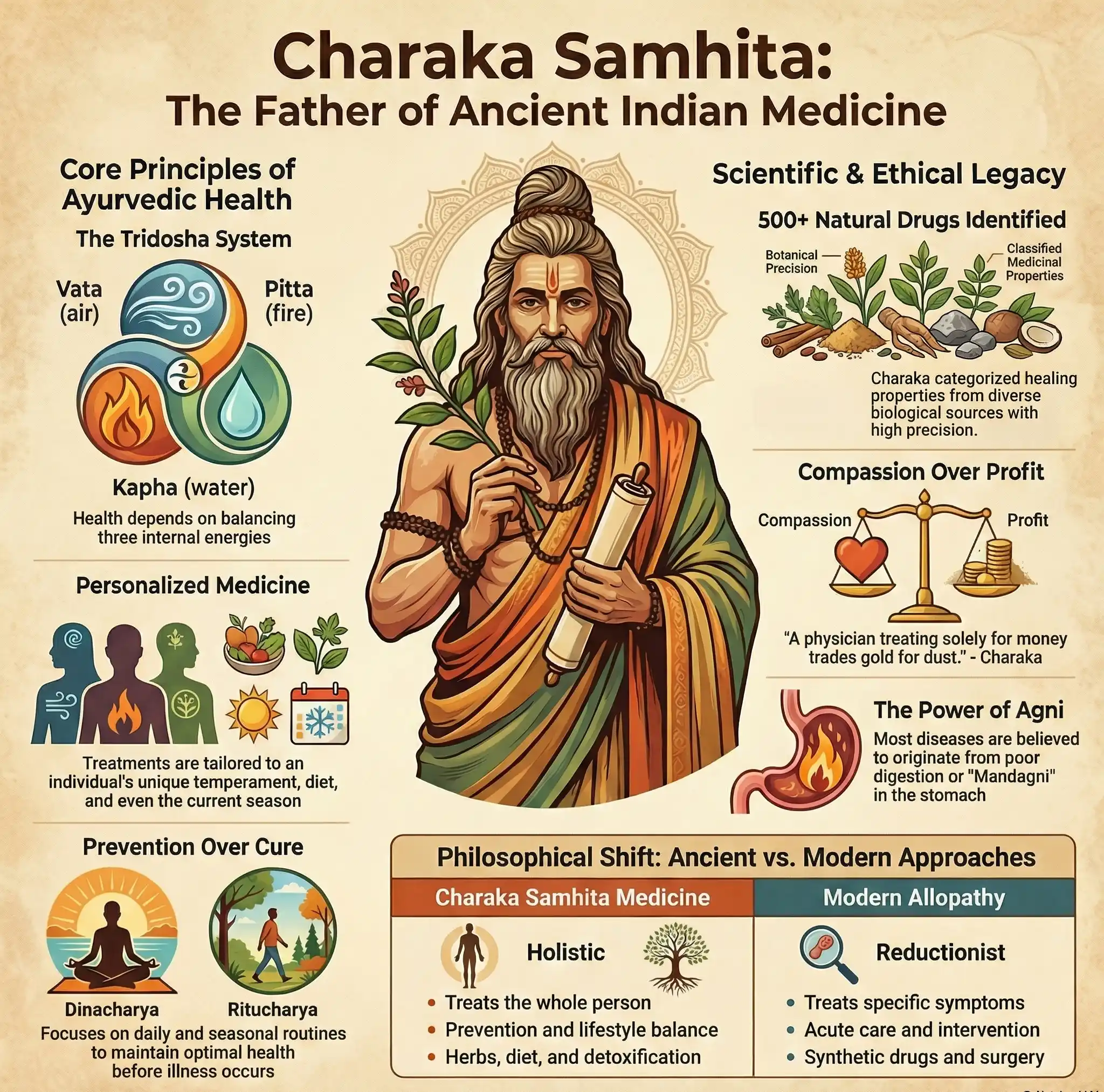
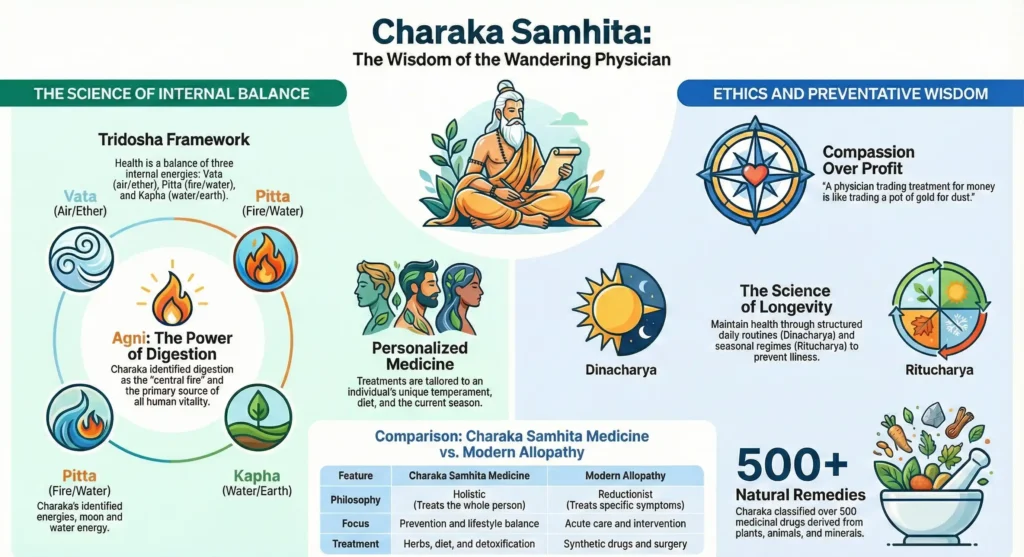
Charaka Samhita Medicine introduced the world to the concept of the Tridosha—Vata (air/ether), Pitta (fire/water), and Kapha (water/earth). According to Charaka, every individual is born with a unique combination of these three energies. Disease is simply a state of “unbalance.” This insight predated modern personalized medicine by thousands of years. Instead of a “one-size-fits-all” treatment, Charaka insisted that a physician must understand the patient’s temperament, their diet, and even the season of the year before prescribing a cure. This ancient Ayurvedic wisdom remains the primary reason why Ayurveda continues to thrive in the 21st century.
A Pioneer of Medical Ethics
Perhaps the most touching aspect of Charaka’s work is his focus on the character of the physician. Long before the Hippocratic Oath became a standard in the West, Charaka established a rigorous code of conduct for those entering the medical profession. He believed that a doctor’s primary motivation should be compassion, not profit. He famously stated that a physician who treats patients for the sake of money is like someone who trades a pot of gold for a pile of dust.
This Charaka Medical Ethics framework extended to the patient-doctor relationship, emphasizing total confidentiality and the duty of the healer to protect the life of the patient above all else. His teachings suggest that a healer must be pure in mind and body, for the energy of the doctor is as much a part of the cure as the medicine itself. This level of holistic healing science is what sets Indian heritage apart in the history of global science.
10 Remarkable Facts About Meghnad Saha Life and Achievements
The Science of Longevity
Charaka was also an early proponent of what we now call “preventative medicine.” He did not want people to wait until they were sick to seek help. Instead, the Charaka Samhita Medicine system provides detailed daily routines (Dinacharya) and seasonal regimes (Ritucharya) to maintain optimal health. He was fascinated by the power of digestion, or Agni, believing that the “fire” in our stomach was the source of all vitality.
His observations on the medicinal properties of plants were equally staggering. He classified over 500 drugs derived from plants, animals, and minerals. His ability to identify which part of a plant—the root, the leaf, or the bark—held the most potency for a specific ailment shows a level of botanical expertise that is still being validated by modern pharmacology. He viewed the entire world as a pharmacy, famously remarking that there is nothing in the universe that cannot be used as medicine if understood correctly.
A Bridge Between Eras
Today, as the world faces an epidemic of lifestyle-related diseases, the teachings of the “Wandering Physician” are more relevant than ever. The influence of Charaka reaches far beyond India’s borders. His texts were translated into Arabic and Latin in the early Middle Ages, impacting the development of medicine in the Islamic world and Europe. When we talk about “gut health” or the “mind-body connection” today, we are essentially speaking the language that Charaka perfected in the foothills of the Himalayas.
As a Father of Indian Medicine, his work reflects a unique Indian cultural value: the belief that life (Ayur) is a holistic journey toward realization. By keeping the body healthy, one ensures that the soul has a fit vehicle to pursue its higher purpose. Charaka didn’t just teach us how to live longer; he taught us how to live better.
7 Secrets of Padmanabhaswamy Temple Treasure
Quick Comparison: Ancient Ayurveda vs. Modern Medicine
| Feature | Charaka Samhita Medicine | Modern Allopathy |
| Philosophy | Holistic (Treats the whole person). | Reductionist (Treats specific symptoms). |
| Focus | Prevention and lifestyle balance. | Acute care and intervention. |
| Diagnosis | Nadi (Pulse), tongue, and temperament. | Labs, imaging, and chemical tests. |
| Treatment | Herbs, diet, and detoxification (Panchakarma). | Synthetic drugs and surgery. |
| Duration | Long-term lifestyle changes. | Often immediate symptomatic relief. |
Curious Indian: Fast Facts
- The Meaning of Charaka: The name literally means “Wanderer,” as he traveled extensively to observe the health of different communities.
- Pre-Scientific Embryology: Charaka’s descriptions of fetal development in the womb are surprisingly accurate for a time without ultrasound.
- The Power of Digestion: He believed that almost all diseases start with poor digestion (Mandagni).
- Ethics First: Charaka’s code for physicians is one of the oldest recorded medical oaths in human history.
- Universal Pharmacy: He taught that every substance on earth has medicinal value if used with the right knowledge.
Conclusion
Charaka was more than a doctor; he was a philosopher of life who understood that health is our greatest wealth. Through Charaka Samhita Medicine, he gave humanity a roadmap to live in harmony with nature rather than trying to conquer it. His legacy reminds every “Curious Indian” that our ancestors were not just dreamers, but meticulous scientists who decoded the secrets of vitality long ago. As we embrace modern technology, returning to the roots of Charaka can help us find the balance we so desperately seek in the fast-paced world of today.
6 Unfoldings in the Subrahmanyan Chandrasekhar Biography
If you think you have remembered everything about this topic take this QUIZ
Results


#1. What does the name “Charaka” literally translate to?
#2. According to Charaka Samhita Medicine, every individual is born with a unique combination of which three energies (Tridosha)?
#3. What did Charaka believe was the primary source of all vitality, often citing its malfunction as the root of disease?
#4. How did Charaka describe a physician who treats patients primarily for the sake of money?
#5. Charaka organized the Charaka Samhita into eight distinct sections known as:
#6. Which statement best reflects Charaka’s view on the medicinal properties of the natural world?
#7. Charaka is credited with providing surprisingly accurate descriptions of which biological process long before ultrasound technology?
#8. Unlike modern reductionist medicine, what was the primary focus of Charaka’s medical philosophy?
Who is considered the Father of Indian Medicine?
Charaka is widely regarded as the Father of Indian Medicine due to his compilation of the Charaka Samhita, the foundational text of internal medicine.
What is the main focus of Charaka Samhita Medicine?
Its main focus is Kayachikitsa (internal medicine), emphasizing the balance of the three Doshas—Vata, Pitta, and Kapha—to maintain health.
Did Charaka perform surgery?
While Charaka focused on internal medicine and herbs, his contemporary, Sushruta, is known as the Father of Surgery. Both are pillars of Ayurveda.
Is Charaka’s wisdom still relevant today?
Absolutely. Concepts like gut health, personalized nutrition, and the mind-body connection in modern wellness are all rooted in his ancient teachings.
Read More: https://curiousindian.in/sushruta-6th-century-bc/